
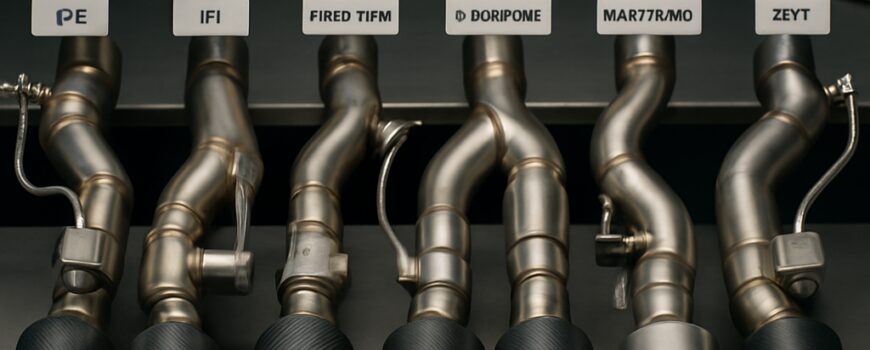
Short, loud, or surgically tuned — the right exhaust changes more than noise. Early on, IPE Exhaust made a name for bold valvetronic tones and immediate presence; this piece dissects IPE alongside FI Exhaust, Armytrix Exhaust, Akrapovic Exhaust, Valvetronic Exhaust, and Ryft Exhaust to identify measurable differences rather than marketing bravado.
IPE Exhaust and FI Exhaust: Sound Profiles and Mechanical Reality
Both IPE and FI specialize in valved systems that let drivers switch personalities. IPE leans toward a theatrical, throaty character while FI often balances on-track crispness with street civility.
From a mechanical standpoint, valve actuation, canister packing, and pipe geometry determine decibel spikes and harmonic content, not just the brand badge. Therefore, listen for rasp vs. harmonic richness instead of relying on spec sheets alone.
Sound signature and tuning nuances
Practically, IPE Exhaust offers immediate midrange punch but can exacerbate drone at cruising RPMs on some platforms. FI systems typically aim for cleaner transitions and reduced low-end resonance.
As a result, the choice should hinge on how often you drive at steady speeds versus spirited bursts; one produces theater, the other strives for control.
Armytrix Exhaust: Valve Control and Real-World Fitment
Armytrix Exhaust markets advanced valve electronics and modular installations. Their quick-response servos and app control are attractive for owners wanting frequent mode changes.
However, installation complexity and heat shielding must be scrutinized—electronics in high-temperature zones increase the risk of failure if routing or insulation is substandard.
Durability vs. Features
Armytrix scores highly on features but less consistently on longevity across diverse climates. Conversely, simpler mechanical systems often show fewer field failures.
Therefore, if you prioritize remote control and on-the-fly mode switching, Armytrix is compelling; if you prioritize long-term reliability, prioritize material quality and proven heat management.
Akrapovic Exhaust: Engineering Discipline and Material Science
Akrapovic Exhaust sits at the engineering end of the spectrum. Its titanium and Inconel offerings deliver measurable weight savings and refined acoustics thanks to precise muffler internals.
That said, premium materials come with premium price tags and often require ECU calibration to extract consistent gains. The cost-per-decibel or cost-per-kg removed becomes a useful metric for buyers.
Performance metrics and resale value
Akrapovic systems often preserve value better because of brand perception and build fidelity. Dyno-proven gains with minimal drivability trade-offs are common if installed and tuned correctly.
On the flip side, for budget-conscious buyers the incremental performance may not justify the premium compared with alternative brands offering similar sound with heavier materials.
Valvetronic Exhaust and Ryft Exhaust: Usability and Cost Efficiency
Valvetronic Exhaust emphasizes seamless valve transitions and OEM-like integration, while Ryft focuses on affordable, aggressive-sounding systems. Each targets different buyer priorities.
Valvetronic tends to favor hardware compatibility, reducing installation headaches. Ryft often prioritizes immediate acoustic impact, sometimes at the expense of refinement.
Which one matches your driving habits?
If daily drivability, warranty preservation, and low drone are critical, Valvetronic systems typically align better with those needs. Meanwhile, Ryft suits owners after a bold soundtrack and lower entry cost.
Consequently, match the exhaust to how you use the car: commute, weekend drives, track days, or show presence.
Cost, Compliance, and Real-World Testing
Price is a practical filter but should be paired with checks for emissions compliance, warranty impacts, and available dyno or road tests. Don’t buy purely on video clips or one-off owner testimonials.
Moreover, verify material specs, serviceability of valve actuators, and the availability of replacement parts. These details predict long-term ownership costs more reliably than initial MSRP.
Actionable pre-purchase checklist
Ask for measured decibel readings at standardized distances, dyno charts that show torque/horsepower across the rev range, and evidence of corrosion resistance for salt-belt climates. Also, confirm fitment to avoid custom fabrication surprises.
Finally, insist on a test drive in the configuration you plan to use most—valves open and closed—so you can assess drone, throttle response, and neighbor tolerance.
Choosing between IPE, FI, Armytrix, Akrapovic, Valvetronic, and Ryft requires clear priorities: sound theatrics, engineering precision, electronics, or budget. Use objective measures—material quality, dyno gains, valve durability, and real-world noise—to make an informed decision, and arrange a live test or professional consultation before committing to purchase.