
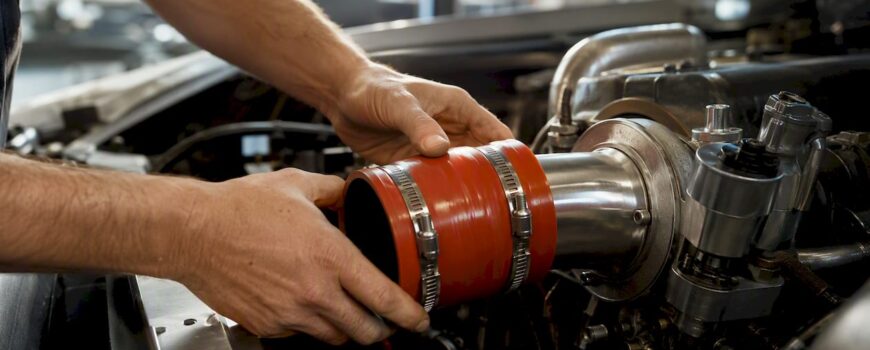
For most performance builds, reinforced multi-ply silicone turbo hoses or vehicle-specific molded silicone kits are the right call. They handle heat, resist pressure spikes, and outlast conventional rubber by a wide margin. If you’re running a diesel, sustained track use, or a high-boost setup near exhaust headers, step up to meta-aramid (Kevlar-type) reinforced hoses. For custom fabrication where routing is non-standard, universal silicone couplers give you the flexibility molded kits can’t.
The quick buy signal: match the hose’s working pressure rating to your peak boost plus a safety margin, and confirm the temperature rating clears your underhood temps. Aramid or fiberglass reinforcement over plain rubber, every time.
Key Takeaways
Reinforced multi-ply silicone is the correct material for turbo hoses on any performance build; meta-aramid reinforcement is the upgrade for diesel, track, or sustained high-heat applications.
| Point | Details |
|---|---|
| Material choice drives longevity | Multi-ply silicone (fiberglass or meta-aramid) outlasts rubber and resists heat, vibration, and pressure cycling. |
| Match specs to your boost | Working pressure rating must exceed peak boost; burst pressure should be at least 2–3x working pressure. |
| Temp range: typical silicone turbo hoses cover the common underhood temperature span. | Silicone turbo hoses with aramid reinforcement cover very wide temperature ranges suitable for most engine bays. |
| Clamp type matters | Use T-bolt clamps on charge pipes and high-pressure outlets; worm-drive clamps suit low-boost and vacuum lines only. |
| Valvecontrolexhaust | Covers the full exhaust and turbo plumbing interface for European performance platforms with fitment-documented systems. |
Table of Contents
- Which turbo hoses should you buy? A quick comparison
- Why silicone beats rubber and how reinforcement actually works
- How to size turbo hoses correctly: diameter, length, and clamps
- Installation checklist and the failure modes worth knowing
- How to choose turbo hoses: the buying checklist and red flags
- Real-world spec reference: what the datasheets actually show
- A perspective on choosing turbo hoses for real builds
- Valvecontrolexhaust for high-performance turbo system builds
- Sources
Which turbo hoses should you buy? A quick comparison
The table below covers the main options across the use cases that matter most to performance builders and mechanics.
Key callouts:
- Street / daily driver: Gates Corporation molded kits or McMaster-Carr stocked silicone for straightforward OEM-replacement fitment.
- Track / sustained high-boost: TurboHoses Inc motorsports lines or Flexfab’s meta-aramid reinforced series for heat and ozone resistance.
- Diesel / high-heat: Meta-aramid reinforced hose; confirm burst pressure against your peak boost with margin.
- Custom fabrication: McMaster-Carr universal stock or TurboHoses Inc custom pieces where routing demands non-standard geometry.
- Luxury performance with valved exhaust integration: Valve Control Exhaust, which provides fitment documentation covering the full system interface.
Why silicone beats rubber and how reinforcement actually works
Reinforced silicone is the standard for turbo hose applications because it resists heat, vibration, and pressure cycling better than conventional rubber. A rubber hose softens and swells near exhaust-side heat sources; silicone holds its shape and wall thickness across a far wider temperature range. According to Fenner, silicone outperforms conventional materials in vibration dampening and heat resistance, which directly reduces stress at connection points and prevents the micro-cracking that leads to boost leaks over time.
Reinforcement is what separates a hose that holds boost from one that collapses or blows off:
- Fiberglass-coated plies (3-ply standard): The most common construction for street and performance builds. Cost-effective, flexible, and durable enough for most boost levels. Flexfab’s 7701 series is a representative example.
- Heavy-duty fiberglass (4-ply to 6-ply): Higher working and burst pressures for aggressive builds. Flexfab’s 7703 heavy-duty series documents higher operating and burst pressure ratings specifically for extreme or diesel applications.
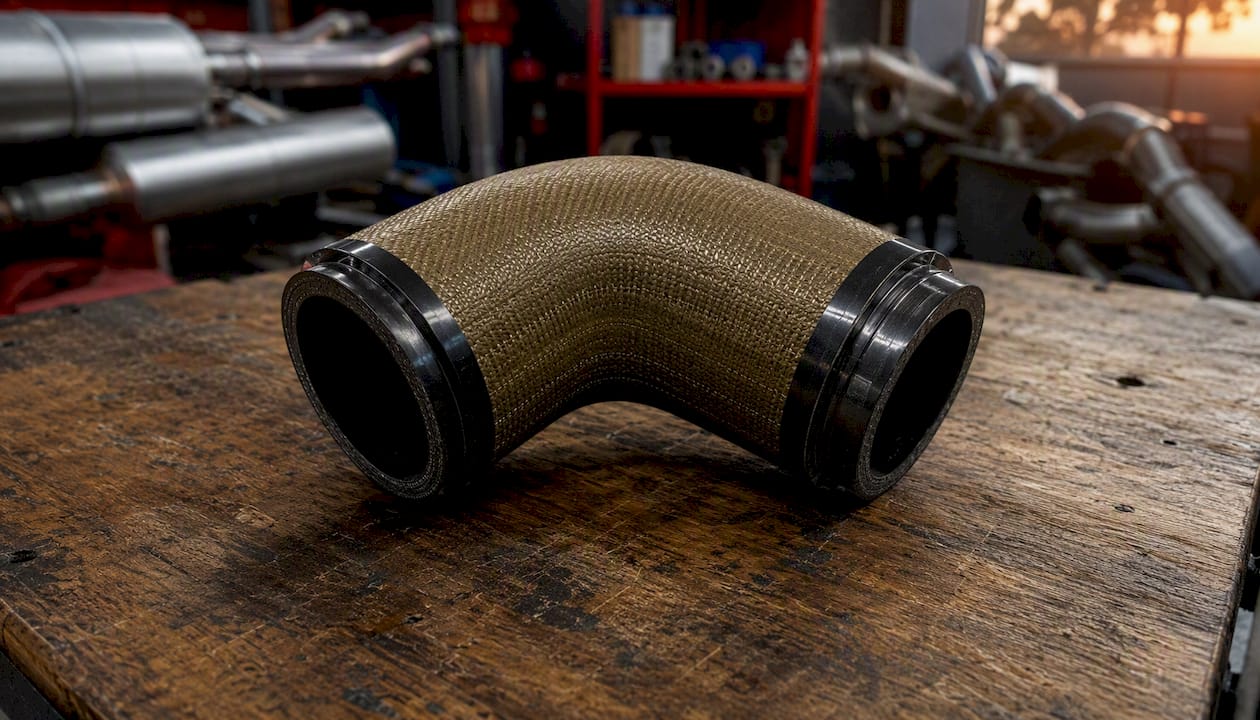
- Meta-aramid (Kevlar-type) fabric: The choice for sustained high-heat environments. Improved resistance to heat, ozone, and aging compared to fiberglass-reinforced silicone. Flexfab’s 7851 series uses this construction.
- Fluorocarbon liner (optional): Silicone resists minor oil splash well, but for hoses routed near oil return lines or in petrochemical-heavy environments, an optional fluorocarbon liner adds meaningful protection.
Spec callout: McMaster-Carr’s reinforced silicone turbo hose stock is rated from −65°F to +500°F with aramid fabric reinforcement. That range covers virtually every underhood application short of direct exhaust contact.
The practical takeaway: 3-ply fiberglass silicone handles most street and performance builds at a reasonable price. Move to meta-aramid when you’re running sustained boost near exhaust headers, diesel conversions, or repeated track sessions where underhood temps stay elevated. Understanding how exhaust design affects thermal conditions helps you pick the right reinforcement tier before you buy.
How to size turbo hoses correctly: diameter, length, and clamps
Sizing wrong is the most common reason a new hose leaks or blows off. Here’s the process that actually works:
- Measure inside diameter at the flange face. Use calipers, not a tape measure. For silicone couplers, allow roughly 0.06–0.10 in. of slip fit over the pipe OD so the hose seats without stretching.
- Identify every connection point. Turbo compressor outlet, charge pipe, intercooler inlet and outlet, throttle body coupler, and any vacuum or boost control lines that branch off the charge circuit.
- Check bend geometry. A molded kit has a fixed bend radius; a universal straight hose needs enough length to route around obstructions without kinking. Measure the actual path, not the straight-line distance.
- Confirm coupler overlap. Most suppliers recommend a minimum of 1.5 in. of hose over each pipe end. Less than that and clamp load concentrates at the edge, which is where blow-offs start.
- Select clamp type by pressure:
- Worm-drive (screw) clamps: adequate for low-boost and vacuum lines, easy to source, but can loosen under thermal cycling.
- T-bolt clamps: the right choice for charge pipes and high-pressure turbo outlets. They distribute clamping force evenly around the full circumference. McMaster-Carr’s product tables note clamp compatibility alongside wall thickness and overlap specs.
- Verify wall thickness. Thicker walls resist collapse under vacuum at spool-down but add stiffness. Match wall thickness to the hose’s listed working pressure, not just the ID.
Installation checklist and the failure modes worth knowing
A correct install comes down to three things: the right hose type, the right clamp torqued properly, and a routing path that avoids heat sources and sharp bends. Get those right and most failures never happen.
Installation checklist:
- Clean and deburr pipe ends before sliding the hose on.
- Confirm coupler overlap of at least 1.5 in. on each side.
- Use T-bolt clamps on charge pipes; position the clamp 0.25–0.5 in. from the hose end, not at the very edge.
- Torque clamps evenly. Over-tightening a worm-drive clamp cuts into silicone; under-tightening a T-bolt leaves gaps under pressure.
- Route hoses away from exhaust manifolds, headers, and sharp chassis edges. Use heat sleeve or ceramic wrap where clearance is tight.
- Support long unsupported spans with a hose bracket to prevent vibration fatigue at the clamp ends.
Common failure modes:
- Blow-off at the clamp: Usually under-torqued T-bolt or a coupler seated too shallow. Fix: re-seat with correct overlap and re-torque.
- Hose collapse under vacuum: Happens at spool-down on hoses with insufficient wall thickness or no internal reinforcement. Fix: upgrade to a heavier-ply hose or add a spiral wire insert.
- Heat degradation near headers: Silicone softens and eventually cracks when sustained temps exceed its rating. Fix: add heat shielding or switch to meta-aramid reinforced hose in that section.
- Abrasion failure: Contact with a chassis edge or bracket wears through the outer ply. Fix: reroute or add a protective sleeve at the contact point.
Pro Tip: Install clamps before sliding the hose onto the pipe, not after. Trying to thread a T-bolt clamp into position on an already-seated hose in a tight engine bay is how you strip threads and scratch paint. Slide the clamp onto the hose first, seat the hose, then torque. Saves 20 minutes and a lot of frustration.
For a broader look at common turbo exhaust setup errors that affect the full boost circuit, that guide covers the system-level mistakes that hose selection alone won’t fix.
How to choose turbo hoses: the buying checklist and red flags
Prioritize material, pressure rating, and fitment before price. A $15 hose that fails at 20 psi costs far more than a $60 one that holds 80 psi for five years.
Buying checklist:
- Confirmed ID and OD dimensions matching your pipe ends
- Working pressure and burst pressure specs listed by the manufacturer
- Temperature rating that clears your underhood peak (not just ambient)
- Documented reinforcement type: fiberglass ply count or aramid fabric
- Form factor: molded vehicle-specific kit vs. universal sleeve
- Warranty or manufacturer spec sheet available
- Fitment cross-reference for vehicle-specific kits
Questions worth asking the seller:
- What is the max continuous operating temperature (not just peak)?
- What is the burst pressure at my working ID?
- How many reinforcement plies, and what material?
- Is there a fluorocarbon or chemical-resistant liner for oil-exposed locations?
Red flags:
- No pressure or temperature specs listed anywhere on the product page
- Described only as “rubber” with no reinforcement detail
- Lifetime warranty claims with no supporting datasheet
- Vehicle-specific kit with no OEM part cross-reference or fitment list
Datasheet-driven selection, matching working and burst pressures to your peak boost with a safety margin, prevents premature failure more reliably than choosing by brand name alone.
Real-world spec reference: what the datasheets actually show
Use supplier datasheets as the authoritative spec source. The values below are representative examples drawn from major supplier documentation.
| Hose Series | Reinforcement Type | Typical Working Pressure | Burst Pressure | Temp Range | Best For |
|---|---|---|---|---|---|
| Flexfab 7701 | Fiberglass, 3-ply | Moderate boost (street/performance) | Higher than working by rated margin | Standard silicone range | Street, light track |
| Flexfab 7703 | Fiberglass, heavy-duty (higher ply) | Higher than 7701 | Significantly higher | Standard silicone range | Diesel, high-boost builds |
| Flexfab 7851 | Meta-aramid fabric | Comparable to 7703 | High | Extended high-heat range | Sustained track, diesel, extreme heat |
| McMaster-Carr aramid stock | Aramid fabric reinforcement | Rated by ID (see product table) | Listed by ID | −65°F to +500°F | Fabrication, custom sizing |
Pressure calculation example: If your turbo peaks at 22 psi boost, your charge pipe sees roughly that working pressure. A hose rated to 30 psi working pressure gives you a reasonable margin. Always pull the actual datasheet for the specific ID you’re buying, since pressure ratings drop as inside diameter increases.
A perspective on choosing turbo hoses for real builds
The spec sheet matters more than the brand logo, and that’s a point most enthusiasts learn the hard way. A hose that looks right and fits the pipe can still fail at 25 psi if it’s a 2-ply rubber sleeve dressed up in silicone colors. The reinforcement type and ply count are the numbers to read first.
For street builds on European platforms like BMW or Audi, a 3-ply fiberglass silicone kit from a documented supplier handles daily boost levels without drama. For anything running sustained high boost, near exhaust headers, or in a diesel application, meta-aramid reinforcement is worth the price premium. The heat resistance difference is real, and the failure mode for an under-spec hose in that environment is a sudden boost leak at the worst possible moment.
One thing that gets overlooked: hose selection doesn’t happen in isolation on a high-performance build. If you’re upgrading turbo plumbing on a vehicle that also has a valved exhaust system, the thermal and pressure environment around the charge circuit changes depending on how the exhaust is configured. Exhaust design affects turbo spool and underhood temperatures in ways that should inform which hose spec you choose, not just what fits the pipe.
Valvecontrolexhaust for high-performance turbo system builds

If you’re building or upgrading a turbocharged European performance car, Valvecontrolexhaust covers the exhaust side of the equation with the same specificity this guide applies to hose selection. The catalog includes valved exhaust systems, downpipes, and performance parts with documented compatibility for Audi, BMW, Porsche, Ferrari, Lamborghini, and Mercedes-AMG platforms. Every component comes with fitment documentation, so you’re not guessing whether a part works with your existing turbo plumbing layout.
The difference from sourcing individual hoses and exhaust parts separately: Valvecontrolexhaust’s systems are designed to work together, with remote electronic valve control for adjustable sound and performance built in. For enthusiasts who want the full system dialed in rather than pieced together, that integration matters. Browse the high-end aftermarket system comparison to see how the options stack up, or go directly to the product pages to confirm fitment for your vehicle.
Sources
- Silicone Organic | Turbo Hose