Valve-controlled exhaust systems (bi-modal or multi-mode exhausts) are a high-value performance and NVH (noise, vibration, harshness) component on modern vehicles. This analysis goes beyond basic diagnostics to provide an expert-level, evidence-driven approach for isolating mechanical, electrical, and control-system failures, and for implementing durable fixes and advanced mitigation strategies.
Background context: what valve control exhaust systems are and why failure modes matter
Valve control exhausts typically combine an actuator (electrical or vacuum), a mechanical linkage and valve (butterfly, flap, or sliding sleeve), and electronic control via the ECU or a dedicated controller over PWM/CAN. They are designed to alter backpressure and acoustic output dynamically. Failures degrade performance, trigger drivability faults, or create compliance/legal exposure for noise regulations.
Detailed technical explanations
Key subsystems and their failure modes:
- Actuators: DC motors, stepper motors, or vacuum diaphragms. Common issues include burnt coils, seized shafts, reduced torque due to thermal degradation, or leakage in vacuum lines.
- Mechanical valve and linkage: carbon build-up, corrosion, worn bearings, misalignment, and valve-seat erosion lead to binding or incomplete sealing.
- Sensors and feedback: potentiometers, Hall-effect position sensors, or limit switches can drift or fail, causing incorrect closed-loop behavior.
- Control signals: PWM frequency/ duty-cycle errors, wiring shorts/opens, and CAN communication faults can prevent correct actuation or produce oscillatory behavior.
Data, research, and field observations
OEM reliability studies and aftermarket field data indicate that valve-actuation related complaints often present after 30k–80k km. Independent reliability testing (including SAE technical analyses) highlights that thermal cycling, soot deposition, and salt-corrosion are primary drivers. In controlled bench tests, motors subjected to >1000 cycles at elevated temperatures show measurable torque loss and increased current draw—an indicator of impending failure.
Nuanced perspectives and edge cases
Not all failures are binary. Examples:
- Intermittent CAN errors manifest only during long highway drives due to thermal expansion changing connector contact resistance.
- Valves that appear mechanically free at room temperature bind when hot because differential expansion reduces shaft clearance—an important edge case for in-service replication.
- Carbon deposits can create a metered leak path; valve appears closed but produces increased flow and acoustic leakage under low vacuum conditions.
Practical applications and advanced troubleshooting strategies
Systematic diagnostic workflow
Follow a layered approach: reproduce, isolate, quantify, repair, and verify.
- Reproduce the symptom under controlled conditions (idle, wide-open throttle, cold start, high-load) and log ECU commands and sensor data via OBD-II/CAN logger.
- Isolate electrical vs mechanical: command the valve to full-open/full-closed and observe current draw and actuator motion. Use a bench power supply (12V) to remove ECU as a variable.
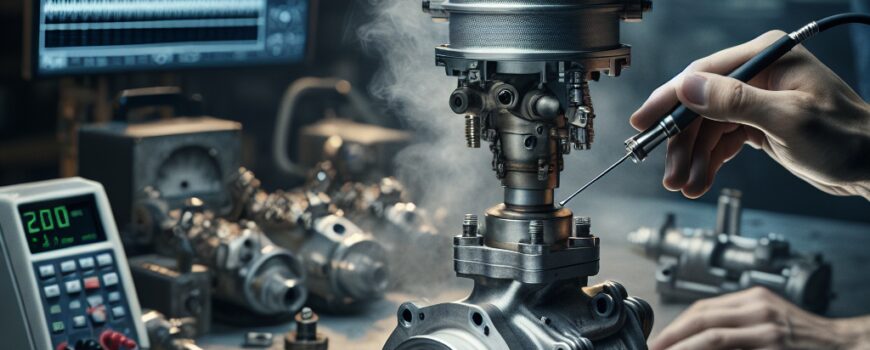
- Quantify using instruments: multimeter for continuity/current, oscilloscope for PWM characterization (>1 kHz recommended for many brushless drivers), smoke tester for exhaust leaks, and borescope to inspect internal valve surfaces.
- Repair targeted parts: replace or rebuild actuators, clean or replace valve assemblies, reterminate harness connectors with corrosion-resistant crimp terminals, and update ECU firmware if control logic is implicated.
- Verify with regression tests: thermal cycling, vibration, and durability cycling to ensure fix durability.
Advanced, actionable troubleshooting tips
- Measure actuator stall current: a rising stall current (>25–50% over baseline) typically signals winding degradation or mechanical binding.
- Use a clamp meter during road test to detect intermittent load spikes correlated with temperature.
- For PWM-driven actuators, inspect duty cycle, frequency, and rise time with an oscilloscope—harmful low-frequency PWM (e.g., <200 Hz) can induce audible resonance and thermal hotspots.
- When cleaning valves, avoid harsh abrasives against valve seats; use solvent soak and light brushing. If seat erosion exceeds 0.5 mm, replace the valve insert or assembly.
- Implement position-sensor redundancy: add a low-cost Hall sensor when retrofitting to commercialize closed-loop control and protect against potentiometer drift.
Future implications and emerging trends
Integration, reliability engineering, and predictive maintenance
Active exhaust systems will increasingly be integrated with vehicle-level control strategies (drive-by-wire, ADAS modes) and will require robust, deterministic communication. Predictive maintenance using ML models trained on CAN and sensor traces can flag increasing current draw or anomalous PWM patterns well before failure—early field studies show potential to reduce in-service failures by up to 40% when combined with scheduled inspections.
Materials, design evolution, and regulatory context
Materials science advances—ceramic coatings, hardened stainless alloys, and low-friction composites—reduce deposit adhesion and wear. Regulatory pressure on noise and emissions will push OEMs toward more reliable, verifiable valve systems with tamper-evident diagnostics and standardized fault codes.
Predictive thought: as powertrains electrify, the acoustic role of valve-controlled exhausts will shift from performance to synthetic and regulatory-compliance functions. Expect tighter integration between audio synthesis systems and physical valves, and a rise in software-driven sound profiles coupled with over-the-air diagnostic updates. The highest risk-reward area for engineers is balancing acoustic fidelity with long-term reliability; systems that succeed will be those that combine robust mechanical design with closed-loop sensing and predictive maintenance models.