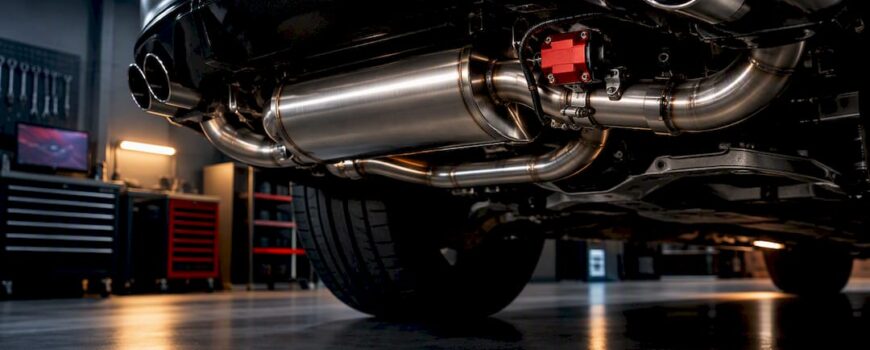
For most AMG C63 owners, a valved cat-back exhaust, paired with a catted downpipe and a proper ECU calibration, gives you the best balance of sound, drivability, and legal compliance. The trade-offs come down to how loud you want to be, how much airflow you actually need, and whether your local inspection rules can live with what you install. The sections below walk through upgrade types, the mechanics behind the sound and power gains, and what to check before you buy.
TL;DR:
- Upgrading to a valved cat-back exhaust with a catted downpipe and proper ECU tune offers the best balance of sound, power, and legal compliance for daily driving.
- Catted downpipes improve flow and turbo response while remaining street legal, whereas catless pipes provide maximum flow but pose high legal risks for street use.
- Proper installation involves confirming fitment, relocating sensors correctly, and linking a calibrated tune to unlock power gains and avoid check engine lights.
- Emissions laws require parts to have documentation, such as CARB Executive Orders, to avoid violations, especially when removing catalysts from street-driven vehicles.
- For most owners, starting with a valved exhaust and adding a catted downpipe with tuning offers reliable performance without risking warranty, inspections, or legal issues.
Table of Contents
- Cat-back, axle-back, and downpipes: which upgrade fits your goals
- How exhaust upgrades change sound and turbo response
- Staying legal: what US emissions rules actually require
- Planning the install: costs, order of operations, and pitfalls
- Why a valved exhaust solves most of the trade-offs
- Keeping your exhaust system reliable over time
- Comparing popular aftermarket exhaust options for the C63
- What an exhaust swap means for your warranty and insurance
- Matching your exhaust choice to how and where you drive
- From order to install: what to expect timeline-wise
- What owners actually say about common exhaust upgrades
- What most C63 owners should actually do
- How Valve Control Exhaust can help you get there
- Sources
- FAQ
Cat-back, axle-back, and downpipes: which upgrade fits your goals
Every C63 exhaust upgrade falls into one of a few categories, and each one changes a different part of the car’s behavior.
A cat-back exhaust replaces everything from the catalytic converters rearward, including the mid-pipe, mufflers, and tips. It’s the most common upgrade because it changes sound and appearance without touching the emissions hardware upstream. An axle-back only swaps the mufflers and tips behind the rear axle, so it’s a lighter touch: less sound change, less cost, and almost no risk of driveability issues. A downpipe replaces the factory pipe that runs from the turbo to the rest of the exhaust, and this is where things get more serious. Catted downpipes keep catalytic converters in place but use less restrictive cores, improving flow while staying closer to street-legal. Catless downpipes remove the catalysts entirely, which unlocks the most flow and the loudest, rawest tone, but it also carries the highest legal exposure for street-driven cars.
Match the upgrade to your actual goal:
- Daily driver, sound-first: axle-back or a valved cat-back gives you a louder note on demand without sacrificing comfort or inspection compliance.
- Track day car with occasional street use: valved cat-back plus a catted downpipe, so you get real flow gains and can still dial back the volume for the drive home.
- Dedicated track or show car never driven on public roads: catless downpipes make sense here, since emissions rules for street use don’t apply.
Catless downpipes on a car you register and drive daily are the biggest red flag in this whole guide. That single choice is what turns a performance upgrade into a compliance problem.
How exhaust upgrades change sound and turbo response
Reducing exhaust restriction changes how the engine breathes, and the effect depends heavily on which C63 you own.
The M177 in the W205 and later cars is turbocharged, so airflow downstream of the turbo affects backpressure, which in turn affects how quickly the turbo spools and how hard it can push at higher RPM. Freeing up that flow, especially with a catted or catless downpipe, tends to sharpen throttle response and raise the ceiling on boost, but only if the ECU is told how to use it. The older M156, found in earlier C63 generations, is naturally aspirated. There’s no turbo to interact with, so exhaust changes there are almost entirely about sound and marginal flow, not meaningful power.
Valved exhausts work differently than either scenario. They don’t change how much backpressure exists during a WOT pull. Instead, they open or close a valve to redirect sound through a straighter or more muffled path, which is why a factory switchable AMG Performance Exhaust can go from a quiet idle to a loud snarl in Sport or Race mode without removing any emissions equipment.
- Confirm whether your downpipe change is catted or catless before you touch the ECU.
- Have a calibrator flash a tune matched to the new flow characteristics, not a generic map.
- Log pre- and post-installation data to confirm the check engine light stays off and the gains are real.
Pro Tip: If you’re only after a louder sound, skip the downpipe and start with a valved cat-back. It’s the flow change, not the noise, that forces a tune.
Staying legal: what US emissions rules actually require
Emissions compliance is where a lot of otherwise smart exhaust builds go wrong.
The Clean Air Act’s aftermarket guidance prohibits installing parts whose main effect is to bypass or defeat emissions controls, and removing catalytic converters from a street-driven vehicle is generally unlawful under that rule. This is why catless downpipes are fine for a track-only build but risky for a car you register and drive on public roads.
Nearly every enforcement action the EPA describes in its tampering policy hinges on whether a seller or installer can show a documented “reasonable basis” that the part doesn’t increase emissions, such as a CARB Executive Order listing, emissions test results, or a manufacturer warranty statement.
Before buying, ask any vendor or shop:
- Is there a CARB Executive Order number for this part, and can you show it to me?
- Does the part come with documentation or test data supporting emissions compliance?
- What’s the warranty policy if the part causes a check engine light or fails inspection?
Keep receipts, EO listings, and any tune logs. Our exhaust legal checklist walks through what paperwork to hold onto if your car is ever inspected.
Planning the install: costs, order of operations, and pitfalls
Budgeting for a C63 exhaust upgrade depends heavily on which path you choose. A basic axle-back with mufflers and tips is the cheapest entry point. A valved cat-back adds cost for the valve hardware and controller. A full downpipe swap plus ECU calibration is the most expensive route, since it typically requires a dyno session and a calibrator’s time on top of parts and labor. Location, shop labor rates, and whether you need custom fabrication for fitment all move the number up or down.
The order of operations matters more than most owners expect:
- Confirm fitment first. Model year and chassis (W204, W205, or later) change flange design, sensor placement, and hanger points.
- Retain or relocate O2 sensors correctly. Moving a sensor too far from its factory position throws false readings and can trigger a check engine light.
- Calibrate before you celebrate. Any flow change beyond a simple axle-back should get a matched ECU tune, per the W205 Stage 2 tuning breakdown, which notes that skipping this step often leaves gains unrealized and triggers codes.
- Log and verify. A quick data log after installation confirms the car is running clean before you put real miles on it.
Installing a downpipe without a tune is the single most common mistake in this process. The part fits fine, the car starts fine, and the check engine light shows up a week later.
Why a valved exhaust solves most of the trade-offs
Adjustable valves give you both sides of the argument, quiet commuting and an aggressive note on demand, without swapping hardware every time your mood changes. Valve Control Exhaust documents this approach across its catted downpipe options, which are built to help owners retain inspection compliance while still improving flow over restrictive factory pipes.
A few things to know before buying:
- Valved systems change perceived loudness through actuator position, not by removing catalysts, so they don’t inherently solve emissions compliance on their own.
- Catted downpipe fitments are documented per model, which helps avoid the fitment errors that cause sensor and clearance problems.
- Valve actuators, wiring, and controllers are mechanical parts that need occasional inspection, since they’re the components most likely to wear over years of use.
A valved system still needs a calibrated tune if it’s paired with a downpipe change, and it still needs emissions paperwork if your region asks for it.
Keeping your exhaust system reliable over time
Exhaust components take a beating from heat cycling, road salt, and vibration, and aftermarket parts are not immune just because they’re newer than the factory pipes.
Stainless steel cat-backs and downpipes generally resist corrosion better than mild steel, but welds, flanges, and hangers are still worth a visual check during routine service. Valved systems add another layer: the electronic actuator and its wiring harness are exposed to engine bay heat and road spray, and a failed actuator can leave the valve stuck open or closed. Catalytic converters, whether factory or aftermarket catted units, degrade over time and can trigger efficiency codes well before they physically fail. O2 sensors near a downpipe swap are especially prone to false readings if heat shields or sensor bosses were changed during installation.

A simple annual check, looking at hangers, clamps, and actuator wiring, catches most problems before they become expensive. Rattles at idle usually mean a loose heat shield or worn hanger rather than a failing muffler, and they’re cheap to fix if caught early.
Comparing popular aftermarket exhaust options for the C63
Aftermarket exhaust brands for the C63 generally split into two camps: fixed-flow systems built for maximum sound and flow, and valved systems built for adjustable sound. Fixed systems tend to be simpler mechanically, since there’s no actuator to fail, but you’re locked into one volume level unless you swap resonators or tips. Valved systems, including options from brands like Fi Exhaust and Armytrix, let you toggle between a quiet setting for daily driving and an open setting for weekends, controlled by a remote or through drive mode integration.
Sound profiles vary by design more than by brand name. Systems with straight-through mufflers and larger diameter piping tend to produce a deeper, louder tone with less back pressure. Systems that retain resonators or use chambered mufflers keep more of the factory refinement while still opening up the note under load. Pricing depends on the specific fitment, material (stainless versus titanium), and whether the system includes a downpipe.
If you’re comparing specific models side by side, our performance exhaust buyer’s guide covers brands like IPE, Fi, Armytrix, Akrapovic, Valvetronic, and Ryft in more detail, and our exhaust system face-off breaks down how those same brands compare on sound character and construction.

What an exhaust swap means for your warranty and insurance
Modifying your exhaust can affect both your factory warranty and your insurance coverage, and the rules aren’t always intuitive.
Under federal law, a dealer can’t void your entire warranty just because you installed an aftermarket exhaust. They can, however, deny warranty coverage for a specific failure if they can show the modification caused it, so a cracked downpipe flange that damages a turbo seal could become your problem to pay for. Keeping documentation of professional installation and calibration helps if you ever need to make that case.
Insurance is a separate conversation. Many standard policies cover the car as originally equipped, and a modified exhaust, especially one paired with a downpipe and tune that raises power output, may need to be disclosed to your insurer. Failing to disclose a modification that affects performance can complicate a claim after an accident, even if the exhaust had nothing to do with the incident. A quick call to your insurance provider before installation is cheaper than finding out the hard way after a claim.
Matching your exhaust choice to how and where you drive
The right exhaust depends less on what sounds best in a video and more on how you actually use the car.
If you commute daily and live somewhere with strict noise ordinances or emissions inspections, a valved cat-back that stays quiet at idle and opens up on demand is the safest bet. If you split time between street and track, a catted downpipe paired with a valved cat-back and a matched tune gives you real flow gains while keeping catalysts in place for inspection. If your car is track-only and never touches public roads, a catless downpipe and a fixed, loud exhaust make sense since street emissions rules don’t apply.
Regional restrictions matter as much as personal preference. Some states and municipalities enforce decibel limits at idle or during acceleration, and others require emissions testing that a catless downpipe will fail outright. Before buying anything, check your state’s vehicle inspection requirements and any local noise ordinances, since a system that’s perfectly legal one county over can get you cited at home.
From order to install: what to expect timeline-wise
Most C63 owners can expect a few weeks between placing an order and driving away with the finished install, though the exact timeline depends on the parts and the shop’s schedule.
Cat-back and axle-back systems are usually in stock or ship within a few days, and installation itself often takes half a day to a full day at a competent shop. Downpipe installs take longer to schedule since they usually need a dedicated ECU calibration session afterward, and calibrators booked for dyno time can add a week or more to the process. Custom fitment issues, especially on older chassis or cars with prior modifications, can add unexpected delays if a shop needs to source brackets or sensors.
Ordering parts before booking a shop slot is the most common way owners shorten the wait, since many delays come from scheduling rather than the parts themselves.
What owners actually say about common exhaust upgrades
Owner feedback on C63 exhaust upgrades tends to cluster around a few recurring themes rather than brand loyalty alone.
Valved systems get consistent praise for solving the “loud on weekends, quiet at 6 a.m.” problem, though owners occasionally report actuator or wiring issues after a few years of use, which lines up with the mechanical wear points worth inspecting during routine service. Catted downpipes paired with a proper tune tend to draw fewer complaints about check engine lights than catless setups installed without calibration, reinforcing that the tuning step matters as much as the part itself. Axle-back upgrades are the most consistently praised for reliability, likely because there’s less to go wrong when you’re only swapping mufflers and tips.
The recurring complaint across nearly every upgrade path isn’t about sound or power. It’s about skipped steps, an install without a matched tune, a valve controller wired incorrectly, or a downpipe installed without confirming fitment for the exact model year.
What most C63 owners should actually do
If you want the honest, low-drama answer: start with a valved cat-back, add a catted downpipe if you want real turbo response, and get it tuned properly. That combination covers daily driving, weekend fun, and most inspection requirements without gambling on enforcement.
The exception is a car that never sees public roads. Track-only builds and off-road export vehicles can justify catless downpipes and fixed loud exhausts, since the compliance concerns simply don’t apply there.
— Info
How Valve Control Exhaust can help you get there
Valve Control Exhaust sells the parts that make this recommended approach practical: browse Exhaust Parts for valved cat-back options, Down Pipe for catted and catless choices, and Accessories for controllers and actuator hardware.
Before you buy, confirm the CARB EO status on any catted part, choose the catted route if the car sees street use, and line up your calibrator before the parts arrive.
Sources
- FACT SHEET: Clean Air Act – Vehicle Aftermarket Defeat Devices and Tampering (EPA)
- EPA enforcement policy on tampering and aftermarket defeat devices
- W205 C63 & C63 S downpipes explained – Stage 2 & ECU tuning (BenzUnited Parts)
FAQ
Is a catless downpipe legal on a street-driven C63?
Generally, no. The Clean Air Act’s aftermarket guidance treats removing catalytic converters from a street-driven vehicle as unlawful tampering, so catless downpipes are best reserved for track-only cars.
Do I need a tune after installing a downpipe?
Yes, in nearly every case. The Stage 2 tuning workflow for the W205 shows that skipping calibration after a downpipe swap often triggers check engine lights and leaves potential gains unrealized.
Will an aftermarket exhaust void my C63 warranty?
Not automatically. A dealer can only deny warranty coverage for a specific failure it can prove was caused by the modification, not the entire warranty outright, so keeping installation and tuning documentation helps protect your position.
What’s the difference between a valved and a fixed exhaust?
A valved exhaust uses an actuator to open or close a passage, letting you switch between quiet and loud without changing parts, similar to the factory AMG Performance Exhaust. A fixed exhaust has one permanent sound and flow characteristic set by its design.
How do I know if a downpipe is street legal in my state?
Check whether the part carries a CARB Executive Order and ask your vendor for documentation showing a reasonable basis for emissions compliance, as outlined in EPA’s tampering policy. Rules vary by state, so confirm local inspection requirements before you buy.