
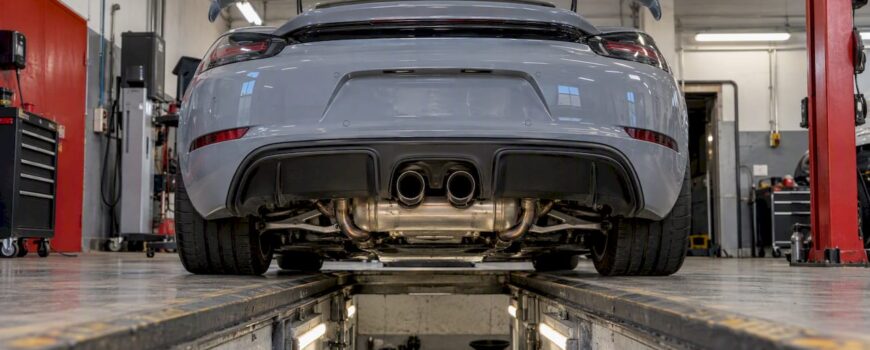
The 718 Cayman GT4 already has one of the better-sounding factory exhausts in its class, so the right upgrade depends on what you want to change: volume, tone, weight, or control over when the car is loud. Most owners end up choosing among three paths: a valved rear section or sound kit, a full cat-back, or a header and catalytic converter change. Each carries different fitment traps and different legal exposure in the US. This guide walks through all three, starting with what Porsche built.
TL;DR
- The factory GT4 system is a valved sport exhaust with a saddle-shaped rear muffler that also makes room for the rear diffuser, so any replacement has to respect that design.
- Fitment is not about the model name alone. Particulate-filter configuration, build date and transmission can decide which parts bolt on, so confirm by VIN before you order.
- Federal law prohibits selling or installing parts that defeat emissions controls, and many states add their own rules. Parts with a CARB Executive Order for your car are the safest route.
- Valved systems give the best of both worlds: quiet on the commute, loud on a back road, switchable from the cabin.
Table of Contents
- What the factory GT4 exhaust does
- Three upgrade paths
- Fitment: what actually decides what bolts on
- Valve control: the feature that changes how you live with the car
- Is a GT4 exhaust street legal in the US?
- How to choose: a simple decision path
- Installation and ownership considerations
- What to verify when comparing prices
- Our perspective
- Browse GT4 and 718 parts
- FAQ
- Sources
What the factory GT4 exhaust does
Porsche fits the 718 Cayman GT4 with a sport exhaust that has a single-chamber, saddle-shaped rear muffler. That shape is deliberate: it clears space for a functional rear diffuser, which Porsche says accounts for about 30% of the car’s rear-axle downforce. The same press kit describes a valve controller that varies the boxer sound according to engine temperature and load requirements.
Two things follow for anyone shopping:
- The muffler is part of the aerodynamic package, not just a silencer. A replacement rear section should keep the diffuser area clear and the tips aligned with the bumper opening.
- The factory valve is already doing work. An aftermarket system that ignores it or deletes it changes how the car sounds at part throttle and cruise, which is where most daily driving happens.
The factory sound is not shy. One 2020 test of the GT4 is a good reference for the hardware, and reviewers at launch praised the dual-note character without any speaker enhancement. Many owners still want more volume at the top end, a harder edge, or simply the option to quiet the car down on a long highway day. That is where valved aftermarket parts come in.
The particulate filter question on US cars
U.S.-spec GT4s carry particulate-filter housings, but according to MotorTrend’s technical rundown, they do not contain the actual particulate-trap matrices required for European emissions. On American cars these units work as secondary mufflers. That detail matters because plenty of exhaust listings are written for European cars with real filters, and the parts are not interchangeable in every case. A US owner needs to read the fitment note, not just the model line.
Three upgrade paths
Before you compare brands or finishes, decide which part of the system you actually want to change. Moving from the tailpipe forward, the options look like this.
| Path | What changes | Typical result | Main thing to verify |
|---|---|---|---|
| Sound kit or valved rear section | Rear muffler area, valve behavior | Louder and deeper when open, factory-like when closed | Fit with your car’s filter housing and diffuser |
| Cat-back system | Everything behind the catalytic converters | Bigger tone change, weight savings depend on materials | Pipe routing and tip alignment |
| Header or catalytic converter change | Front of the system, closest to the engine | Largest change in sound and flow | Emissions legality and engine tuning |
The exhaust system anatomy guide explains each of these sections in more detail if you want the full picture of how headers, converters, resonators and mufflers relate.
Sound kits and rear sections
This is the gentlest step. A sound kit reworks the rear of the system so the GT4 gets a more aggressive note when the valve is open, without touching emissions hardware. For a car that spends time on public roads, this is often the most sensible first move. We carry a sound kit built for the 2020+ Cayman GT4 for owners who want that kind of change.
Because it sits behind the catalytic converters, it generally avoids the legal complications that come with front-of-system work. Always confirm that the specific part is intended for your configuration.
Cat-back systems
A cat-back replaces everything behind the catalytic converters. It changes the sound more than a sound kit because the mid-pipes and rear section are all different, and it can shed weight if built from lighter materials. The compromise is that a full system must be matched to your car’s filter-housing setup. If you cannot tell whether your car takes a particulate-filter-back or a true cat-back design, stop and check by VIN.
Headers and catalytic converters
This is where the big changes happen, and where the rules get serious. An equal-length catless header for the 718 GT4 and Spyder with the particulate-filter setup changes the character of the engine at every rpm. Catless parts are generally for off-road or track use, and we cover why in the legal section below.
One published example gives a sense of the trade-offs. A March 2021 piece in Excellence magazine reported that removing the factory gas particulate filters can improve sound and give a small horsepower gain, without triggering a check engine light in some configurations. The same article noted that high-flow sport catalytic converters from one German maker provide 85 to 90% of a straight pipe’s flow while still meeting emissions standards. That is the middle ground many street-driven owners are looking for: most of the flow, without the legal exposure.

Fitment: what actually decides what bolts on
The GT4 is a narrow target, but “fits a 718” is a broad claim. These are the variables to pin down.
Generation and platform
The 718 GT4 (type 982) arrived for 2020 with its 4.0-liter flat-six. Parts for the earlier 987 Cayman or 981 Cayman generations will not fit it. We list older cars separately, such as a valved bypass system for the 2005-2008 987 Cayman, precisely because those platforms need different hardware.
Related 718 models
The GT4 shares its engine family and much of its exhaust architecture with the 718 Spyder, and many listings cover both cars together. The GTS 4.0 is often grouped in as well. The GT4 RS is a different animal: it has its own exhaust and rear end, so rear-section parts for the standard GT4 do not carry over. If a listing mentions the GT4 RS, read it as a separate car, as with this rear carbon fiber diffuser made for the 2022+ GT4 RS.
Filter configuration and build date
This is the trap we see most. Some cars have the particulate-filter housings, some earlier or market-specific cars do not, and parts are made for one or the other. Our own VIN-checked 718 Cayman fitment guide exists because ordering the wrong flange or the wrong filter-back section is the most common and most expensive mistake in this category. Have your VIN, build date and transmission ready before you order.
Practical fitment checklist
- Confirm model: GT4, Spyder, GTS 4.0, or GT4 RS.
- Confirm whether your car has the particulate-filter housings, and what the listing assumes.
- Check the transmission if the listing separates PDK from manual.
- Confirm the part’s emissions status for your state.
- Ask whether the valve controller is included, and whether it works with your cabin setup.
Valve control: the feature that changes how you live with the car
A valved exhaust uses electronically actuated flaps in the pipework. Open, the exhaust takes the freer path and gets louder. Closed, it routes through the quieter path. A remote or app-controlled unit lets you change that without leaving your seat.
For a GT4, that has three practical benefits:
- Neighborhood and cold-start manners. Close the valves early in the morning and the car stays civil.
- Highway drone. A properly tuned closed mode helps on long cruises, where an always-open system gets tiring.
- Track and canyon days. Open the valves when it is appropriate, and the full voice is there.
The factory car already uses a valve, so the idea is familiar. The aftermarket advantage is control: you choose the mode instead of letting the engine map decide. Our piece on why customizable exhaust appeals to enthusiasts goes deeper on that point.
Is a GT4 exhaust street legal in the US?
This is the question that separates a good purchase from a headache. The short version: it depends on what you replace and where you live.
The federal baseline is clear. The Clean Air Act prohibits manufacturing, selling, offering for sale or installing a part intended to bypass, defeat or render inoperative an emissions-control device. Catalytic converters and particulate-filter components are emissions-control devices, so removing or gutting them on a road car is a problem.
The same EPA document says the agency generally takes no enforcement action when there is a reasonable basis to conclude a part will not adversely affect emissions. Examples it gives include identical design and function to the original, qualifying emissions testing, or a CARB Executive Order for the same vehicle. In practice, that is why parts with an Executive Order for your exact car are the safest choice, especially in California and other states that follow its rules.
State rules sit on top. EPA notes that many states have additional regulations that may prohibit operating a tampered vehicle or restrict the registration of vehicles found to be non-compliant. Noise limits and inspection requirements vary by state and sometimes by city, so check yours.
A workable way to think about it:
- Behind the catalytic converters (axle-back, rear sections, sound kits): the lowest emissions risk, but check local noise limits.
- Sport catalytic converters: a common compromise when they carry the right approvals for your car.
- Catless headers, downpipes and filter deletes: treat as off-road or competition parts unless the seller documents otherwise for your vehicle.
This is not legal advice. If you are unsure about your state’s inspection or noise rules, ask your state’s emissions or motor vehicle agency, or a shop that does inspections in your area.
How to choose: a simple decision path
Start with the problem you are trying to solve.
“I want more sound on demand and no legal worries.” Look at a valved sound kit or rear section with a remote controller. This keeps emissions hardware in place.
“I want a different tone and some weight savings.” A full cat-back is the step. Make sure it matches your filter-housing configuration, and compare materials, tip size and finish.
“I track the car and want everything.” Headers and catalytic converter changes make sense here, but accept that the car may no longer be suitable for registered road use in your state, and plan for tuning.

“I just want the diffuser area to look right.” Tips and diffusers are cosmetic and aerodynamic choices that can go with any of the above. Remember the factory design ties the muffler to the diffuser.
If you want a broader look at brand types and construction methods, our performance exhaust buyer’s guide lays out what to compare, and the side-by-side exhaust evaluation covers the differences in more detail.
Installation and ownership considerations
A GT4 exhaust is not a driveway afternoon for most people. Plan for these points.
- Lift and jack points. The car is low, and the rear section sits under a diffuser. A lift makes the job safer and faster.
- Fasteners and gaskets. Replace gaskets and use fresh hardware at flanged joints to avoid leaks.
- Heat management. Check that heat shielding is reinstalled correctly near the rear bumper and diffuser.
- Tuning. Header and converter changes often call for a tune. The Excellence article noted a small gain only in specific configurations, so do not budget on a horsepower number.
- Valve wiring. A valve controller needs power and a clean routing. A pro install avoids a loose connection that fails months later.
- Warranty. Ask your Porsche dealer how aftermarket parts affect coverage on your car before modifying, especially if you are still under factory warranty.
Ownership costs rise with any modified performance car, so build the exhaust into a wider budget. A Porsche maintenance budget breakdown gives a sense of what routine care costs in the US.
What to verify when comparing prices
We do not publish a single price for a GT4 exhaust, because the range is wide and depends on the path you pick. Published examples show how wide: one 2021 GT4 sold with a 4.5-liter engine conversion, which included revised headers and exhaust pipes, cost more than $43,000 for the whole conversion, so the exhaust is only part of a much larger spend. For a normal bolt-on, compare quotes on the same terms:
- What exactly is included: tips, valve controller, gaskets, hardware.
- Whether the price covers a full system or only a section.
- Material and finish, because stainless, titanium and coated tips differ in cost and look.
- Emissions documentation for your state.
- Shipping, installation and any tune.
- Whether the product is genuine and sold through an authorized channel.
A cheap quote that leaves out the controller or the fitment check is rarely cheap in the end.
Our perspective
We sell exhaust parts for a living, and the most common mistake we see on GT4s is ordering based on the car’s name instead of its configuration. The GT4 shares so much with the Spyder and GTS that people assume everything crosses over, then discover the filter housings, flange or rear section is not what they expected. Our view is simple: pick the sound goal first, decide how much legal risk you will carry, and then match parts by VIN.
We also think valves are the right answer for most owners. A GT4 is a car you drive in town and on weekends, and being able to close the system for a quiet morning is worth as much as the loud setting on a good road. We sell only genuine parts direct from authorized manufacturers, so what arrives is what the listing says. If you are unsure which path fits your car, ask us before you order.
— Info
Browse GT4 and 718 parts
If you already know the direction, start with our exhaust parts collection, where valved systems, sound kits and rear sections for Porsche models are listed with fitment notes. For front-of-system work, see the downpipe category, and for controllers and other add-ons the accessories section. Send your VIN with any fitment question and we will help you match it.

FAQ
Will a GT4 exhaust fit the Spyder and GTS 4.0?
Often yes, because the cars share an engine family and similar exhaust layout, and many listings cover them together. Do not assume it, though. Check the part’s stated models, your filter configuration and, where listed, your transmission.
Is a catless GT4 exhaust legal on the street?
Generally no. Federal law prohibits selling or installing parts that defeat emissions controls, and many states add their own restrictions. Catless headers and downpipes are typically treated as competition parts, so check your state rules before fitting one to a road car.
Does a valved exhaust make the GT4 too loud for daily use?
Not if you can close it. In the closed position, a valved system behaves much closer to a stock exhaust, and you open it when the road and the neighborhood allow. Local noise laws still apply with the valves open.
Do I need a tune after changing the exhaust?
Rear-section changes usually do not. Header, converter or filter changes often do, and results vary by configuration. Ask the seller what they recommend for your exact setup.
Sources
- Porsche 718 Spyder and Cayman GT4 press kit (PCNA, 2020)
- 2020 Porsche 718 Cayman GT4 Technical Features (MotorTrend)
- Roaring Crocodile, Excellence magazine issue 281
- Sold: 2021 Porsche 718 Cayman GT4 DeMan 4.5L
- EPA fact sheet on aftermarket defeat devices and tampering
- EPA enforcement alert on tampering and defeat devices