A valved exhaust has two personalities. With the valves closed, exhaust gas is forced through the full muffler, and the car is calm enough for a cold start at 6 a.m. With the valves open, gas takes a freer path, and the car gets louder and sharper. How big the gap is depends on the muffler design, the engine, the rpm and how the sound is measured. Published figures run from a drop of about 10 dB at startup on one factory system to a 15 dB(A) cut of one specific boom resonance in an academic paper. There is no single number that applies to every car, and this guide explains why.
TL;DR
- Closed valves route exhaust through baffles and chambers for a quieter, more refined sound. Open valves bypass part of that path for more volume and less backpressure.
- Real measurements vary by design. One factory quiet mode cut about 10 dB, to 72 dB. A research muffler cut backpressure by about 50% when open.
- A 10 dB change is heard as roughly twice as loud, so small-looking dB differences are big in the cabin and on the street.
- Your result depends on the valve type, the engine speed, the muffler and the microphone setup, so compare dB figures only when the test method matches.
- Check your state and local exhaust noise rules before you choose a valve setting for public roads.
Table of Contents
- What the valves actually do to the sound
- What the numbers say: closed vs. open
- How exhaust sound is measured, and why readings disagree
- What decides the gap on your car
- Quiet at cruise, loud when you ask
- Our perspective
- Rules on exhaust noise in the US
- Choosing a valved setup that fits your sound goals
- Shop valved exhaust parts for your car
- FAQ
- Sources
What the valves actually do to the sound
A valved system puts a gate in the exhaust path. Closed, the gate makes exhaust pass through the baffles and chambers of the muffler. Open, it gives gas a straighter route. Researchers describe the same idea as switching between different muffler types in one exhaust line, with the valve opening at higher speeds to cut backpressure and let a more dominant sound through.
Factory examples show the pattern clearly. Underhood Service’s explanation of the Corvette bi-mode muffler says the valves stay closed up to about 3,500 rpm, forcing exhaust through the baffles, then open to give a straighter path, less backpressure and more roar. GM’s own dual-mode description says the same thing: valves closed means the normal muffled route, and valves open under acceleration means the exhaust bypasses the mufflers for greater sound levels and potentially improved performance.
Aftermarket systems use the same physics, but many add a controller or remote so you decide when the valves open instead of leaving it to a map. If you want the longer mechanical walkthrough, we cover it in how exhaust valves shape sound.
What the numbers say: closed vs. open
People search for a clean decibel difference, and the honest answer is that published data is design-specific. Here is what the checked sources report.
| What was measured | Result | Source |
|---|---|---|
| Factory quiet mode on a 2018 Mustang GT | About 10 dB lower, to 72 dB | MotorTrend |
| Muffler backpressure with the valve open | About 50% lower in one measured design | Venghaus, academic paper |
| Third-order boom component with a valve | About 15 dB(A) lower at its resonance frequency | Venghaus, academic paper |
| Valve-equipped muffler at low engine speed | Same sound levels as a standard muffler | Venghaus, academic paper |
Two lessons come out of this table. First, the quiet setting is where valves earn their keep. A 10 dB reduction at startup is the difference between a neighbor noticing and not noticing. Second, the open setting is harder to pin down, because it is limited by what the engine and the rest of the exhaust can produce, not by the valve alone. That is why a manufacturer who promises a single open-valve decibel figure should also tell you the rpm, the distance and the test method.
A professional noise-control view backs this up. William E. Hill’s 2002 paper, The pros and cons of valves in automotive exhaust systems, is framed around a deliberate tradeoff between acoustic attenuation, packaging, backpressure and performance, not a fixed decibel change.
Why 10 dB is bigger than it sounds
Decibels are logarithmic. According to Florida’s OPPAGA review of exhaust noise, a 10 dB increase means a sound ten times more intense, which the human ear perceives as about twice as loud. So a valve that adds 10 dB when it opens does not make the car slightly louder. It makes it sound about twice as loud. The reverse is also true: a 10 dB drop in quiet mode is a dramatic change at the curb and in the cabin.
How exhaust sound is measured, and why readings disagree
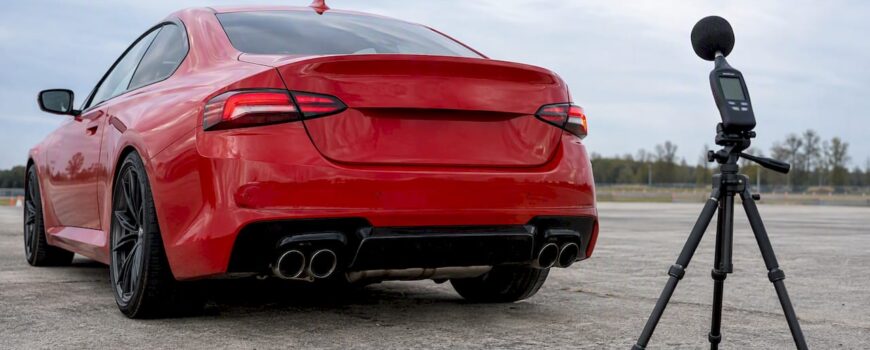
If you have seen two different dB numbers for the same car, the test conditions are usually the reason. The US engineering standard for stationary exterior exhaust sound is SAE J1492. It calls for a calibrated sound-level meter set to A-weighting and fast time-averaging. The site should be outdoors on a hard surface, with no sound-absorbing material and no large reflecting objects within 3 meters of the microphone and the vehicle. The procedure uses an engine speed sweep to find resonances and judge how the exhaust performs across the range.
The A-weighting matters. The Florida OPPAGA report explains that the dBA scale accounts for both the intensity and the frequency of sound, which is closer to how people hear. Low-frequency drone can feel worse than the dBA number suggests, so a car can read fine and still be tiring on a highway.
When you compare numbers, check these points:
- Stationary or drive-by. Stationary readings at a set rpm are not comparable to a pass-by on a road.
- Distance and angle. Moving the microphone changes the reading, sometimes by several dB.
- Surface and surroundings. Walls, garage doors and soft ground change what the meter sees.
- Rpm. A reading at idle says little about a reading near the redline.
- Valve state. Ask whether the number is for open, closed or an unspecified mix.
A phone app is fine for rough before-and-after checks on your own car, as long as you keep the position and rpm the same each time. It will not give you a figure you can compare with a standard test or with a spec sheet.
What decides the gap on your car
The difference between valve settings is not set by the valve alone. Several factors stack up.
Active or semi-active valves
Per NVH Lab’s overview of active and semi-active exhaust valves, sound character depends on whether the valve is active or semi-active, how it changes the muffler path, and operating conditions such as engine speed and exhaust flow. Active valves are driven by a speed and load map. Semi-active valves open progressively as exhaust flow rises, with no electronics deciding for you. An electronically controlled valve is the one you can override, which is why enthusiasts tend to prefer it.
Engine and muffler design
The Venghaus paper found that engine speed and muffler design both affect the sound. A big-displacement V8 and a turbo four-cylinder produce very different raw exhaust energy, so the same valve produces a different drama level. Cylinder count, firing order and header design also shape the tone. If you want the technical detail on how pitch and loudness move through the rev range, read our guide on how exhaust sound changes with rpm.
Where the valve sits
A valve in the muffler, in a mid-pipe or in the tips changes different parts of the spectrum. A valve near the muffler can tame the loudest section, but drone at cruising speed may still come from the rest of the system. The engineering tradeoffs among sound control, backpressure, packaging and performance are the kind of thing a fabrication shop weighs on a custom build, as described in this piece on auto fabrication for purpose-built performance.
Catalytic converters and downpipes
Upstream parts matter too. A high-flow cat or a catless section pushes raw, high-energy sound into the rest of the system, and a valved muffler downstream has more to tame. Emissions equipment is regulated, so check what is legal for your vehicle before you modify anything upstream.
Quiet at cruise, loud when you ask
This is the question most owners really care about: can the car stay civil for daily driving and still sound great on a back road? Yes. In the research, one valve-equipped muffler kept the same sound levels as a standard muffler at low engine speeds and allowed a sportier sound at higher speeds.
Factory systems automate this. NVH Lab notes that Jaguar’s XKR opened its valves above roughly 3,000 rpm. Quiet modes work on the other end of the range: the Mustang’s Quiet Start reduced startup volume by about 10 dB.
A practical setup for most people looks like this:
- Valves closed for cold starts, neighborhoods, parking garages and long highway stretches, where drone is the enemy.
- Valves open on open roads, at the track or at a car meet where noise is expected.
- Intermediate settings, if your controller supports them, for spirited driving that does not need full volume.
If cabin drone is your main worry, our article on how a valved exhaust changes cabin sound goes deeper. For a luxury or supercar setup, see our exhaust noise control setup guide.
Our perspective
We sell valved exhaust parts for European and performance cars, and the question we hear most is “how loud is it?” We will not give you a single decibel number, because it would be wrong for half the cars it was quoted to.
What we tell buyers is this. Judge a valved system by the range it gives you, not by its loudest setting. The point of a valve is that you control the sound: quiet when your neighbors, your passengers or your own ears need it, and open when the moment calls for it. A system that is only good when loud is a straight pipe with extra steps.

We also tell buyers to match the system to the car and the use. A turbocharged engine, a naturally aspirated V10 and a flat-six all react differently to the same valve. That is why compatibility across brands matters to us, and why we only sell genuine products from authorized manufacturers. If you cannot tell what a part does to the sound on your car, ask before you buy.
Finally, remember that the car lives in a community. Sound that is thrilling to you is a nuisance to someone else, and a controllable valve is the best tool we know of for being both a good neighbor and a happy driver.
— Info
Rules on exhaust noise in the US
There is no single national dB limit that you can point to for every car on every road. Exhaust noise is mostly handled by states, counties and cities, and the wording varies: some use a decibel limit, others require a muffler “in good working order” or ban modifications that make a vehicle louder than stock. Check your state’s vehicle code and your city’s noise ordinance before you pick a setting for daily driving.
Enforcement is increasing in places. The Florida OPPAGA review found that exhaust-related noise citations in the state rose from 857 in fiscal year 2017-18 to 3,018 in fiscal year 2021-22. The same report notes that excessive exhaust noise can come from defects, intentional modifications or the original exhaust design.
For valved systems, the practical takeaway is simple. A valve you can close gives you a quiet mode for road use and for any inspection or roadside stop. Stationary tests such as SAE J1492 are often the basis for how limits are checked, so know the dB your car makes with valves closed. If you plan track days, check the event’s own sound limit as well, since many venues set one. For a deeper look at how owners manage this on high-end cars, see our supercar exhaust decibel management guide.
Choosing a valved setup that fits your sound goals
Before you buy, work through these steps:
- Decide your quiet limit. Think about your commute, your garage and your neighbors. Your closed-valve sound is the one you will live with most.
- Decide your loud limit. Be honest about where you will use full volume.
- Pick the control type. Remote or app control gives you a choice at any moment. A map-driven or flow-driven valve decides for you.
- Check fitment. Make sure the part is made for your exact model, year and engine. Our exhaust system anatomy guide helps you understand what sits where.
- Plan upstream and downstream. A downpipe, a muffler and tips all affect the final sound, so choose them as a set. Our guide on adjustable exhaust sound compares ways to tune the result.
- Measure it. Use the same spot, same rpm and same phone each time, and note valve state.
Shop valved exhaust parts for your car
We stock customizable valved exhaust components for Audi, BMW, Porsche, Ferrari, Lamborghini, Mercedes-AMG and other European performance cars, with remote electronic valve control on systems that offer it. Start with our exhaust parts for mufflers and valved systems, look at downpipes if you are working upstream, or add controllers and accessories to get the adjustability you want.

If you are unsure which combination suits your car, our performance exhaust buyer’s guide is a good place to start.
FAQ
How much quieter is a valved exhaust with the valves closed?
It depends on the design. On the 2018 Mustang GT, MotorTrend reported that Quiet Start lowered the level by about 10 dB, to 72 dB. Aftermarket systems differ, so ask for the test method and rpm behind any figure.
How loud is a valved exhaust when the valves are open?
There is no universal number. Open valves reduce backpressure and let the exhaust bypass part of the muffler, and in one measured design backpressure fell about 50%. The final volume depends on the engine, the rpm and the rest of the system.
Will a valved exhaust drone on the highway?
It can if the valves are open at cruising rpm. With the valves closed, a well-designed system can sound like a standard muffler at low engine speeds. Keep them closed on long highway runs and open them when you want the sound.
Is a valved exhaust legal in the US?
Exhaust noise is regulated mostly at the state and local level, and the limits and wording differ. Read your state vehicle code and city noise ordinance, and know how loud your car is with the valves closed. If you are unsure, ask your state’s motor vehicle agency or a local inspection station.
Can I measure my own exhaust sound level?
Yes, for a rough comparison. Use a sound-level meter or phone app on A-weighting, in an open, hard-surfaced area, and keep the position and rpm the same. The SAE J1492 procedure uses an outdoor site with no large reflecting objects within 3 meters.
Sources
- Valves in exhaust-systems (Venghaus, DAGA)
- Tech Tip: Finding the Right Level of Exhaust Noise (Underhood Service)
- GM Dual-Mode Exhaust Tech Info (GM Authority)
- Ford Introduces Active Valve Performance exhaust system (MotorTrend)
- SAE J1492 surface vehicle recommended practice
- A Review of Exhaust System Noise (Florida OPPAGA)
- Active and Semi-Active Exhaust Valves (NVH Lab)
- The pros and cons of valves in automotive exhaust systems (INCE)