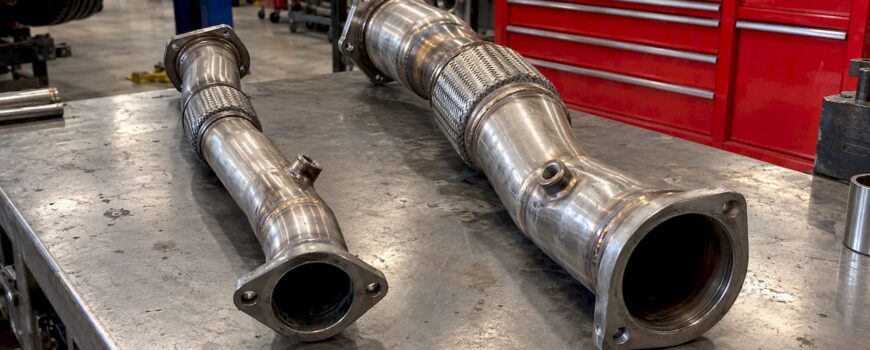
Downpipe diameter changes how easily exhaust gas leaves the turbo, and that shows up as faster spool, more top-end power and a louder, sharper note. But diameter is only one part of the flow path. The gain you get depends on the turbine outlet, the bends, the catalytic converter and the exhaust behind it. A well-matched, smooth-bent pipe beats a merely wide one, and on a car with a valved exhaust you can also tune how much of that sound reaches the cabin. Below is how the effects work, what the numbers look like, and how to choose a size for your car.
TL;DR
- A downpipe carries exhaust from the turbo outlet to the rest of the system. A larger, smoother pipe lowers backpressure, which helps spool and power.
- In one published dyno test, going from a 3-inch to a 3.5-inch exhaust on a turbo Supra added up to 66 whp and spooled the turbo 150 to 200 rpm sooner.
- Bigger is not automatically better: too much diameter slows gas velocity, and the next narrow point in the system becomes the limit.
- Larger, straighter pipes sound louder and sharper. A remote-valved system lets you dial that back for daily driving.
- On U.S. street cars, the catalytic converter question matters as much as the diameter. Check emissions rules before you buy.
Table of Contents
- What a downpipe does and why diameter matters
- What the dyno numbers show
- Why bigger is not always better
- Matching diameter to your power level
- Bends, welds and construction matter as much as inches
- Downpipe diameter and exhaust sound
- Turbo spool: what you will feel
- The U.S. rules to check before you change a downpipe
- How to choose your downpipe diameter
- Promo: a downpipe that fits your car and your sound preference
- Our perspective
- FAQ
- Sources
What a downpipe does and why diameter matters
A downpipe bolts to the turbocharger’s outlet and carries the hottest, highest-pressure exhaust gas toward the rest of the system. Everything the turbine pushes out has to pass through it. If the pipe is restrictive, gas piles up behind the turbine. That pressure is called backpressure.
The effect of backpressure is not just a little lost power at the top end. Turbo exhaust theory explains that the turbine multiplies downstream pressure through its expansion ratio. In the worked example, a 10 psig drop at the turbine discharge, at a 1.8:1 ratio, becomes a 12.6 psig drop in total engine backpressure. That is why a freer-flowing downpipe can do more than its size suggests: you are relieving pressure at the point where it is amplified.
In practical terms, lower backpressure usually means three things:
- Quicker spool. The turbine turns more easily, so boost arrives earlier.
- Cooler exhaust and cleaner cylinder filling. Less leftover exhaust stays in the cylinders.
- More power at high rpm, where airflow is greatest and a restriction costs the most.
What the dyno numbers show
The clearest public example is Motor Trend’s 3-inch versus 3.5-inch exhaust test on a turbocharged Toyota Supra. Their findings:
| Setup | Boost | 3-inch baseline | 3.5-inch result | Gain |
|---|---|---|---|---|
| Turbo Supra, full system | 19 psi | 527 whp | 567 whp | up to 66 whp peak |
| Turbo Supra, full system | 29 psi | 699 whp | 740 whp | 41 whp |
The same test found the turbo spooled 150 to 200 rpm quicker with the larger pipe, and the downpipe alone added 52 whp at 7,000 rpm. The half-inch step from 3 to 3.5 inches equals a 36 percent increase in pipe volume, which is why a seemingly small change in diameter moves so much gas.
Read this as a ceiling for a high-output car, not a promise for yours. That Supra was making more than 500 whp. A car making 300 whp will not see the same gain from the same change, because its turbo is not pushing enough gas to need the extra area.
Why bigger is not always better
The forum argument you will see in search results has a real basis. Exhaust gas moves at a certain speed for a given flow. Widen the pipe and, for the same volume of gas, the speed drops. At very low flow, a pipe that is too large can lose the pulse energy that helps pull exhaust out of the cylinders, so the gain from the larger area is partly given back.
That is why the “always” in claims like “a wider downpipe always increases flow” is too strong. A more accurate version: a wider pipe helps when the engine is actually flowing enough gas to fill it. Below that point, you gain little and may lose some low-rpm response.
The second limit is the rest of the system. Exhaust performance guidance points out that a very large downpipe feeding a small cat-back is held back by the next choke point. It also warns that bigger tubing can force sharper bends, tighter clearances, thinner mufflers or less ground clearance, which can wipe out the theoretical benefit. In other words, a 3.5-inch pipe with a tight kink is worse than a smooth 3-inch pipe.
Matching diameter to your power level
No single number fits every engine, but there are well-used rules of thumb. Turbo Exhaust Theory says 2.5-inch is fine at around 250 hp, becomes suboptimal near 300 hp, and that at 400 to 450 hp even 3-inch is on the small side.

Motor Trend notes that for modified turbo cars making 300 to 600 whp, 3-inch is the most common exhaust size. Some big-turbo builds go to 4 inches, at the cost of more noise and less ground clearance.
Here is a practical way to use that:
| Approximate power goal | Typical starting point | What to watch |
|---|---|---|
| Up to about 250 hp | 2.5-inch | Little to gain from going larger |
| About 300 hp | 3-inch | 2.5-inch starts to restrict |
| 300 to 600 whp | 3-inch (most common) | Match the rest of the system |
| 400 to 450 hp and up, large turbo | 3 to 3.5-inch | Clearance and noise rise |
| Big-turbo builds | Up to 4-inch | Ground clearance, volume |
If you are weighing the most common step on a tuned car, our breakdown of 2.5 versus 3-inch exhaust at 300 HP shows how valves shift the trade-off between flow and sound.
Start from the turbine outlet, not the catalog
The pipe’s cross-section should relate to the turbine outlet it bolts to. A pipe that steps abruptly in diameter right behind the turbine creates turbulence, even if the pipe after it is huge. The theory source recommends a gradual conical diffuser with a 7 to 12 degree included angle at the turbine discharge, and avoiding step changes in diameter.
The same source recommends keeping wastegate flow separate from the main turbine discharge for about 12 to 18 inches before it rejoins. Where the wastegate dumps in affects how cleanly the main flow leaves the turbo.
Bends, welds and construction matter as much as inches
Two downpipes with the same nominal diameter can flow very differently. What to look at:
- Mandrel bends versus crush bends. Mandrel bending keeps the tube round through the corner. Crush-bent tubing pinches in at the bend and cuts effective area right where gas is turning.
- Bend radius. Tight turns cost flow. A smooth, larger-radius path is worth more than an extra quarter inch on a kinked one.
- Transitions. Gradual changes in diameter beat abrupt steps.
- Fit. A pipe that has to be squeezed around a crossmember or heat shield can end up narrower at that spot than the stock one.
Fit is also why exact-model parts are worth the time. Matching a part to the exact chassis is the same logic behind OEM retrofit part comparisons, and it applies to downpipes on European cars, where packaging around the turbo is tight.
Downpipe diameter and exhaust sound
Will a bigger downpipe be louder? Usually, yes, and it also changes the character. SoundCy explains that a larger pipe passes a higher volume of gas with less resistance, which amplifies the sound waves, and that a straighter path gives a sharper, more pronounced tone.
Three things shape the result beyond diameter:
- Catalytic converter or not. Removing or swapping the converter changes the tone more than a quarter inch of pipe does.
- What sits downstream. Resonators, mufflers and valves decide how much of the pipe’s sound reaches the cabin and the street.
- Rpm and load. Most of the added sound shows up under boost.
This is where a valved system earns its place. With remote electronic valve control, you can open the exhaust for a fuller sound when you want it and close it down for a quieter cruise, so a free-flowing setup does not have to mean a loud one all the time. Our pages on what a downpipe changes and what it doesn’t in sound and adjusting exhaust sound from valves to speakers go deeper.
Turbo spool: what you will feel
The most noticeable effect of a better downpipe is usually response, not peak power. With less backpressure the turbine spins up sooner, so boost builds earlier and throttle feels sharper. The Supra test’s 150 to 200 rpm quicker spool is a good scale: noticeable, not dramatic.
To understand how the exhaust side drives this, see how exhaust affects turbo spool. Keep in mind that more flow can also mean the engine control unit sees different conditions. Our guide to running a downpipe without a tune covers what to expect when the software is not updated, and the dyno testing guide shows how to measure before and after so you see your own gains rather than someone else’s.
The U.S. rules to check before you change a downpipe
Diameter is the fun question. Emissions law is the one that can make a purchase unusable on the street, so check it first.
The EPA’s exhaust system repair guidelines state that catalytic converters may not be removed and replaced with converter replacement pipes by any person, including on their own vehicle, and that 45 of 50 states also prohibit tampering with pollution control equipment. A 2026 summary of federal law adds that there is no federal off-road exception for a road-certified vehicle: a car built for the street cannot be “de-certified”, and catalytic converter bypass pipes are prohibited in any situation.
California is stricter in practice. According to The Legal California, nearly all catless, high-flow and performance downpipes are illegal for street use there unless they carry a CARB Executive Order number, and legality turns on that certification rather than on whether a converter is present.

The practical takeaway for a street car: choose a catted downpipe, and where you live in California or another CARB state, check that the specific part is certified for your vehicle. We cover this in why a catted downpipe helps you pass U.S. inspections and keep power and in catted versus catless for U.S. street cars. A good catted pipe with proper bends and the right diameter keeps most of the flow benefit, because the pipe’s shape, not just the absence of a converter, drives the gain.
How to choose your downpipe diameter
- Write down your real power goal. Use the figure you will actually reach, not the one on a wish list. Use the table above as a starting range.
- Identify your turbo and its outlet. The downpipe has to bolt up cleanly and transition gradually from the turbine flange.
- Look at the whole exhaust. A larger downpipe into a small cat-back moves the choke point, it does not remove it.
- Check packaging. Ground clearance, heat shields and crossmembers decide how large a pipe can run without sharp bends.
- Decide on the converter. For a street car in the U.S., plan on a catted design and confirm the certification rules for your state.
- Plan the sound. If you want flow without constant drone, pair the pipe with a valved system.
- Measure. A before-and-after dyno pull or logged boost curve shows what the change actually did on your car.
If you drive a European or exotic car, exact-fit matters more because the engine bay leaves little room. Our Down Pipe collection lists fitments by vehicle, including models from BMW, Mercedes-AMG and McLaren.
Promo: a downpipe that fits your car and your sound preference
We supply downpipes, valved exhaust systems, controllers and related performance parts for European and luxury performance vehicles, including Audi, BMW, Porsche, Ferrari, Lamborghini and Mercedes-AMG. We sell genuine products direct from authorized manufacturers, and our systems offer remote electronic valve control so you can adjust the sound as you drive.

Browse the Down Pipe category for your model, or the Exhaust Parts range to match the rest of the system to your downpipe.
Our perspective
Diameter is the number everyone quotes, but flow is decided by the whole path: the turbine outlet, the bends, the converter and what sits behind it. That is why we think of a downpipe as one part of a system, not a stand-alone upgrade.
The sound is the other half. A freer-flowing exhaust is louder and sharper, and that is exactly what many owners want on a back road and do not want on the way home at 10 p.m. Remote electronic valve control is designed to give you both, so you choose the sound for the moment instead of living with a compromise.
Our approach is to offer broad compatibility across European and luxury performance cars and to sell genuine parts from authorized manufacturers, so the pipe you order is made for your chassis. Start from your power goal and your local emissions rules, pick the diameter and converter setup that fit them, and then tune the sound with valves.
Info
FAQ
Do bigger downpipes make a difference?
Yes, when the engine is flowing enough gas to use the extra area. On the Supra dyno test, the larger system added up to 66 whp and quicker spool. On a lower-output car, the gain from going bigger is smaller and bends and the rest of the exhaust matter more.
What is the typical downpipe diameter?
For modified turbo cars making roughly 300 to 600 whp, 3-inch is the most common size. A 2.5-inch pipe is enough at around 250 hp, and big-turbo builds sometimes use 3.5 or 4 inches.
Does exhaust pipe diameter affect sound?
Yes. A larger, straighter pipe passes more gas with less resistance, which makes the exhaust louder and sharper. The converter, resonators and mufflers behind it also shape the final sound, and a valved system lets you adjust how much of it you hear.
Is a larger or catless downpipe legal for the street?
In the U.S., federal law prohibits removing the catalytic converter and replacing it with a bypass pipe on a road vehicle, and many states also ban tampering. In California, a downpipe generally needs a CARB Executive Order number for street use. A catted downpipe is the safer path for a street car.
Sources
- 3-Inch Vs. 3.5-Inch Exhaust Test, Motor Trend
- Turbo Exhaust Theory, TercelReference
- Exhaust System Performance Guide, Exhaust Guides
- Does a Downpipe Increase Sound?, SoundCy
- Exhaust system repair guidelines, EPA
- EPA Emissions Standards and Aftermarket Part Certification, LegalClarity
- Are Downpipes Legal in California?, The Legal California