If you’re searching for valved exhaust systems for a European or luxury performance car, Valvecontrolexhaust is the standout alternative. It covers the vehicles, the valve control technology, and the U.S. compliance guidance that serious buyers actually need.
Three reasons to start here:
- Model compatibility: Audi, BMW, Porsche, Ferrari, Lamborghini, and Mercedes-AMG fitments with VIN-level verification
- Real valve control: remote electronic actuation, ECU/drive-mode integration, and autonomous RPM-based switching
- U.S. compliance support: practical guidance on EPA-adjacent noise considerations and state-level inspection rules
Table of Contents
- What do valved exhaust systems actually do for luxury performance cars?
- How do valve types and control methods work?
- How do you pick the right valved exhaust kit or vendor?
- Valve Control Exhaust: the recommended alternative for your car
- What should you expect during installation and after?
- How do you stay street-legal with a valved exhaust in the U.S.?
- What do owners actually say about valved exhaust reliability?
- What does a valved exhaust system actually cost, all in?
- Key Takeaways
- The case for getting the valve right the first time
- Get Valvecontrolexhaust on your car
What do valved exhaust systems actually do for luxury performance cars?
A valved exhaust gives your car two distinct personalities without adding a second muffler. At low RPM or in comfort mode, the valve stays closed and exhaust routes through the muffler’s baffled path, keeping cabin drone low and neighbors happy. Push past the threshold or hit Sport mode, and the valve opens a near straight-through bypass, dropping backpressure and releasing the full exhaust note.
For daily-driven European performance cars, that split matters more than it does on a dedicated track build. A fixed, always-open system sounds great at 7,000 RPM and exhausting on a two-hour highway run. Valved systems solve that trade-off by letting you customize exhaust behavior for the moment.
Key benefits for luxury and performance owners:
- Reduced cabin drone during highway cruising with valves closed
- On-demand performance sound without a permanent noise penalty
- Configurable backpressure tuning that can shift torque delivery by RPM band
- Material choices (titanium or stainless) that affect weight and tone character
Stat: According to a DAGA/DEGA technical paper on exhaust valve acoustics, valved muffler systems can reduce backpressure by roughly 50% when valves open at higher engine speeds, and can cut a specific third-order resonance by approximately 15 dB(A).
How do valve types and control methods work?
Exhaust valves fall into two broad categories: externally driven (actuated by a motor, solenoid, or vacuum source) and autonomous (self-opening based on backpressure or exhaust impulse). Understanding which you’re buying changes what you can do with the system long-term.
Externally driven valves use one of these actuation methods:
- Vacuum actuators: simple, reliable, but limited to on/off switching and dependent on engine vacuum
- Stepping motors: allow variable valve position, giving finer control over sound and flow
- Solenoids: fast-switching, commonly used in OEM sport exhausts and high-end aftermarket kits
- Electronic/remote controllers: let you open or close valves from the cabin or integrate with OEM drive modes
Autonomous valves open automatically when exhaust pressure exceeds a set threshold, typically above a specific RPM. No wiring required, but you also lose manual control. That simplicity suits some builds; it limits others.
The backpressure effect is where performance gains come from. When the valve opens, exhaust gas takes the path of least resistance, reducing restriction. That 50% backpressure reduction at high RPM translates directly into improved exhaust scavenging and, depending on the engine tune, measurable torque and power gains in the upper rev range.
According to AP Tuning, roughly 60% of older vehicle models lack compatible electronic controls for seamless ECU valve integration, making aftermarket remote controllers the practical solution for pre-2015 European cars.
Pro Tip: Cycle your valves fully open and closed at least once a week if the car sits for extended periods. Carbon buildup on valve seats is the leading cause of sticking, and regular cycling keeps the actuator mechanism free.
How do you pick the right valved exhaust kit or vendor?
Prioritize fitment accuracy first, then valve control method, materials, warranty, and legal compliance. In that order.
Decision checklist:
- Confirm model-year-specific fitment, not just “fits BMW 3 Series” — verify against your exact chassis code and engine variant
- Ask for vehicle-specific dyno data showing backpressure and power changes, not generic brand claims
- Identify the actuator type and whether it matches your control preference (remote, ECU, autonomous)
- Check controller and remote options, including whether drive-mode integration is supported on your car
- Verify emissions compliance: catalytic converter retention, OBD-II sensor compatibility, and state inspection rules
Questions to ask any vendor:
- What is the actuator warranty, and does it cover labor?
- What is the expected actuator lifespan in cycles?
- Does installation require ECU remapping or OEM harness adapters?
- Is there a return policy if fitment doesn’t work on my specific build?
- Can you show me a documented install on my exact model?
Red flags: vague fitment language (“fits most European cars”), no documented warranty on the actuator, missing controller specs, no U.S. compliance guidance, and no installation support beyond a PDF.
Valve Control Exhaust: the recommended alternative for your car
Valvecontrolexhaust is the recommended choice for U.S. owners of European and luxury performance cars because it combines model-specific fitment, multiple valve control options, and genuine post-sale support. The exhaust system anatomy guide on their site is one of the clearest technical references available for buyers new to valved systems.
What the product line covers:
- Valve actuation: remote electronic, ECU/drive-mode integration, and autonomous backpressure-driven options
- Materials: titanium and stainless steel, with weight and tone differences documented per model
- Compatibility: Audi (including RS and S models), BMW (M series, standard), Porsche (911, Cayenne, Panamera), Ferrari, Lamborghini, Mercedes-AMG, and more
- Controllers: handheld remote, smartphone app integration, and OEM drive-mode wiring harnesses where applicable
Before ordering, verify your VIN, chassis code, and model year against the compatibility list. Fitment on a 2019 BMW M3 (F80) differs from a 2022 M3 (G80) in both the pipe routing and the ECU integration path.
Warranty and installation support are documented per product. Ask specifically about actuator coverage and whether the warranty is voided by independent installation versus a certified shop.
What should you expect during installation and after?
A typical valved exhaust install runs several hours depending on model complexity, access to the underside, and whether ECU or wiring integration is required. A qualified performance shop is the right call, as detailed in the BMW F8x M3 & M4 install guide, which walks through the mechanical and electrical steps in sequence.
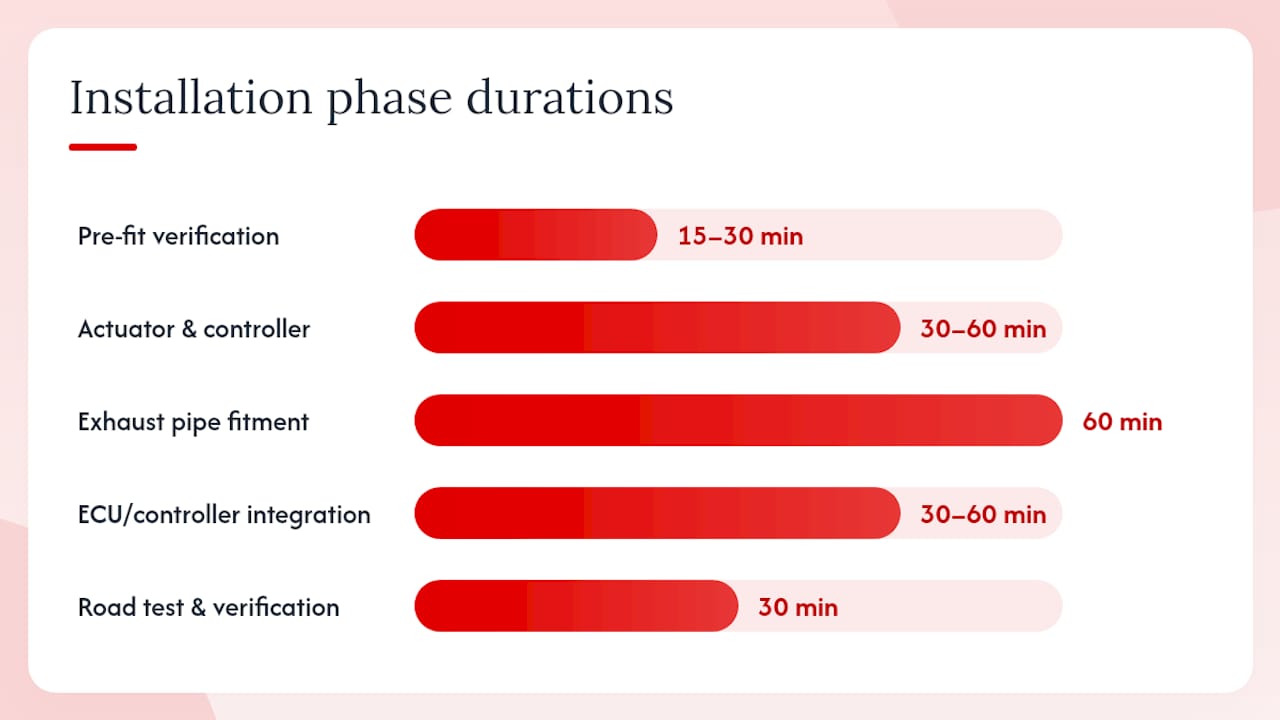
| Installation Phase | Typical Time | Notes |
|---|---|---|
| Pre-fit verification | 15–30 min | Confirm fitment against VIN and chassis code |
| Actuator and controller install | 30–60 min | Wiring harness, remote pairing |
| Exhaust pipe fitment | 60 min | Hangers, clamps, sensor reinstallation |
| ECU/controller integration | 30–60 min | Drive-mode mapping if applicable |
| Road test and verification | 30 min | Sound check, valve cycling, leak inspection |
Typical cost breakdown:
- Parts (full valved cat-back system): varies by brand and material; titanium commands a significant premium over stainless
- Labor: $300–$800 at most U.S. performance shops, higher for models requiring ECU work
- Extras: OEM harness adapters, ECU mapping sessions, and O2 sensor extensions add cost on some platforms
Maintenance checklist (see the full valve maintenance guide):
- Cycle valves fully open and closed weekly if the car sits
- Inspect actuator linkage visually every 6 months
- Check for carbon deposits on valve seats annually
- Verify controller firmware is current after any OEM software update
How do you stay street-legal with a valved exhaust in the U.S.?
Valves help you meet noise limits by providing a quieter bypass path for street use, but they don’t automatically make any system legal. State and local rules vary significantly, and California’s CARB regulations are stricter than most. The U.S. noise regulation guide from Valvecontrolexhaust covers the practical compliance steps in detail.
Legal checklist:
- Check your city and county noise ordinance for pass-by dB(A) limits (many U.S. municipalities cap at 95 dB(A) or lower)
- Verify your state’s vehicle inspection rules on aftermarket exhausts
- Confirm catalytic converter retention if your state requires emissions testing
- Check OBD-II sensor compatibility to avoid check-engine codes that fail inspection
- Keep documentation of your system’s closed-valve dB(A) rating
Pro Tip: During any state inspection, keep valves in the closed position. A compliant closed-valve configuration that passes the inspector’s ear test is the practical standard most shops use. Carry the system’s spec sheet showing OEM-comparable pass-by levels.
Stat: The supercar exhaust decibel management guide notes that many U.S. jurisdictions apply a 95 dB(A) pass-by limit, and a properly configured valved system with valves closed typically falls well within that threshold.
What do owners actually say about valved exhaust reliability?
Owner feedback on valved systems consistently clusters around three themes: sound quality, actuator reliability, and installation experience. Positive reviews cite the dramatic contrast between open and closed modes, the absence of drone on highway runs, and the responsiveness of electronic controllers. Critical reviews almost always point to one of two issues: actuator failure from carbon buildup (preventable with regular cycling) or fitment problems from kits that weren’t truly model-specific.
On European performance platforms, BMW M owners report the highest satisfaction with solenoid-actuated systems that integrate with the OEM drive-mode selector. Porsche owners note that the factory valve system sets a high bar, so aftermarket kits need to match or exceed OEM actuator quality to earn positive reviews. Ferrari and Lamborghini owners prioritize sound character over backpressure gains, and titanium systems consistently score higher in that segment for their lighter weight and sharper tone.
Valvecontrolexhaust’s customer feedback reflects the same pattern: owners who verify fitment before ordering and use a qualified shop for installation report clean results. The brand’s documented compatibility list reduces the fitment-problem category significantly compared to generic alternatives.
What does a valved exhaust system actually cost, all in?
The sticker price on a valved cat-back system is only part of the total. Hidden costs catch buyers off guard regularly.
Parts cost drivers:
- Material: titanium systems cost significantly more than stainless; the weight and tone difference is real but the price gap is substantial
- Valve control type: ECU-integrated kits with full controller ecosystems cost more than remote-only or autonomous systems
- Brand tier: model-specific engineering with documented dyno data commands a premium over generic fitment kits
Installation extras that add up:
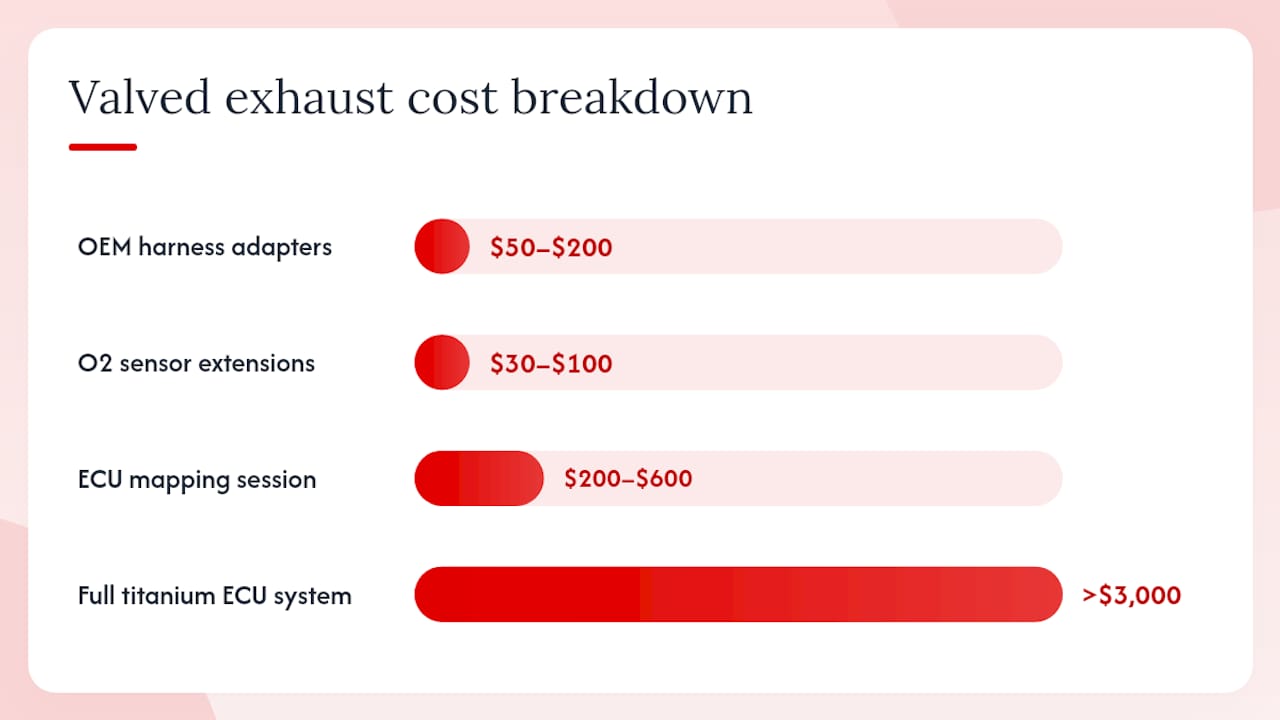
- OEM harness adapters for ECU integration: $50–$200 depending on platform
- O2 sensor extensions or relocators: $30–$100
- ECU mapping session if the tune needs adjustment: $200–$600 at a performance tuner
- Alignment and heat shield modification on tight-fitment models: shop-dependent
What to watch for:
- Vendors who quote parts only and omit controller hardware from the base price
- “Installation included” claims that cover basic fitment but exclude wiring and ECU work
- Titanium pricing that doesn’t specify grade (Grade 2 vs. Grade 5 affects both durability and cost)
The total installed cost for a quality valved system on a European performance car in the U.S. typically runs from several hundred dollars for a basic stainless remote-control setup to well over $3,000 for a full titanium ECU-integrated system on an exotic platform. Get an itemized quote that separates parts, labor, and any required extras before committing.
Key Takeaways
Valvecontrolexhaust is the strongest alternative for U.S. buyers of European and luxury performance cars, combining model-specific fitment, multiple valve control options, and documented U.S. compliance guidance.
| Point | Details |
|---|---|
| Backpressure reduction | Open valves can cut backpressure by roughly 50%, improving exhaust scavenging at high RPM. |
| Controller compatibility | Around 60% of older vehicles need aftermarket controllers; verify ECU integration before ordering. |
| Installation timeline | Expect 2–6 hours at a qualified performance shop, plus potential extras for ECU mapping. |
| Legal compliance | Keep valves closed during inspections; check local dB(A) limits and state emissions rules before fitting. |
| Valvecontrolexhaust | Recommended for U.S. European/luxury car owners; verify fitment by VIN and chassis code before purchase. |
The case for getting the valve right the first time
The conventional wisdom in the aftermarket exhaust world is that any valved system is better than none. That’s only half true. A poorly fitted valve kit on a Porsche 911 or a BMW M4 creates problems that a straight-pipe never would: actuator rattle, inconsistent valve behavior, and fitment gaps that cause exhaust leaks. The valve is a moving part in a high-heat, high-vibration environment, and the quality of the actuator hardware matters as much as the pipe material.
What buyers underestimate is how much the control method shapes the ownership experience. A remote-only system is fine if you remember to switch it before entering a noise-sensitive area. An ECU-integrated system that opens automatically in Sport mode and closes in Comfort mode is genuinely better for daily use, because it removes the human variable. On a car you drive every day, that automation is worth the extra cost and installation complexity.
The other overlooked factor is post-sale support. The exhaust market has no shortage of vendors who disappear after the order ships. For a system with moving parts, that’s a real risk. Valvecontrolexhaust’s documented support channels and maintenance guidance are part of the value, not a footnote.
Get Valvecontrolexhaust on your car
Valvecontrolexhaust delivers model-specific valved exhaust systems for European and luxury performance cars directly to U.S. buyers, with the technical support and compliance guidance to back it up. The vehicle compatibility lookup lets you confirm fitment by model and year before you spend a dollar.
To get a quote or start a fitment conversation, have your VIN, chassis code, model year, and preferred valve control method ready (remote, ECU-integrated, or autonomous). Specify your material preference (titanium or stainless) and whether you want full ECU drive-mode integration or a standalone controller. The performance exhaust comparison guide is a useful read before that conversation if you’re still deciding between configurations.
Visit valvecontrolexhaust.com to check your model, request a quote, and confirm warranty and installation support for your specific build.