Choosing a valve control exhaust is more than picking the loudest tip or the flashiest brand; it’s about matching acoustic control, flow characteristics, and control integration to your vehicle’s engine architecture and intended use. This guide drills into the technical trade-offs, measurement-driven selection criteria, and advanced tuning practices that experienced enthusiasts and professional tuners need to make an optimized purchase decision.
Introduction: What makes this analysis unique
Many buying guides focus on style, sound clips, and brand cachet. This analysis is built for technically literate readers: it synthesizes fluid dynamics considerations, actuator and ECU integration concerns, emissions/compliance constraints, and real-world dyno outcomes to create a decision framework that minimizes guesswork and post-install tuning surprises.
Background context: core concepts and technical foundation
How valve control exhausts work (detailed technical explanation)
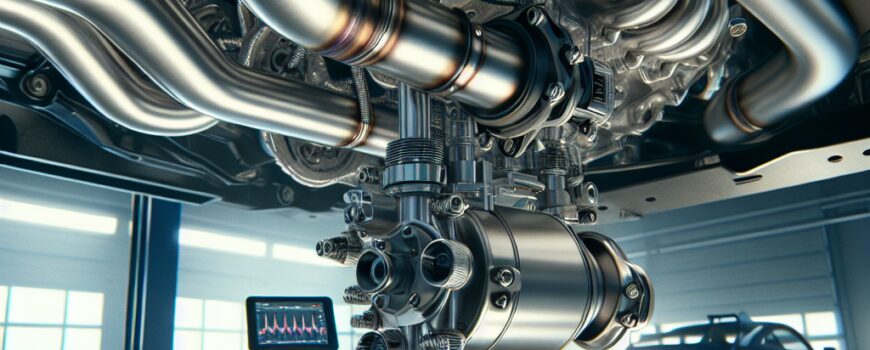
Valve control exhausts use one or more internal valves (butterfly-style, flapper, or slide) to alter the exhaust pathway and acoustic response. Valves change effective length, cross-sectional area, and the presence of resonant chambers (Helmholtz or quarter-wave). Actuation is commonly vacuum-assisted (OEM-style), electric servos, or solenoids with return springs. Electronic control ties valve position to ECU inputs: RPM, throttle position, gear, or CAN messages.
Flow dynamics and engine interaction
Valve position alters backpressure and scavenging. For naturally aspirated (NA) engines, maintaining scavenging pulses is essential—excessive free-flowing diameter at low RPM can reduce mid-range torque. For turbocharged engines, some backpressure is often beneficial upstream of the turbine to maintain spool characteristics; downstream valve strategies should avoid creating turbine flow separation. As a rule of thumb, an exhaust diameter increase of 0.5″-1.0″ may be warranted for high-flow applications, but the exact choice depends on volumetric efficiency and cam timing.
Data, research, and case study highlights
- Independent dyno tests across various platforms typically show peak gains in the 2–8% range for valve-equipped cat-back systems, with variability driven by engine tuning, header design, and whether the system reduces backpressure at mid-RPMs.
- Acoustic measurement studies indicate that well-tuned valve systems can reduce in-cabin drone by 6–12 dB in problematic RPM bands by routing exhaust through resonators when closed.
- Case study: A turbo 2.0L with factory downpipe retained showed improved transient response when the valve logic kept a partially closed state under part-throttle, preserving turbine speed—illustrating that full-open isn’t always ideal.
Nuanced perspectives and edge cases
Common edge cases include vehicles with DPFs or catalytic converters where valve strategies can trigger regeneration issues or CELs if pressures or O2 sensor readings go out of expected ranges. Older ECUs may misinterpret changes in backpressure as faults; integration with OBD-II and CAN messages can mitigate errors but often requires custom tuning or piggyback controllers. Finally, material choice (304 vs 316 stainless, titanium) impacts thermal expansion, fatigue life, and cost—316 offers better corrosion resistance in coastal climates, while titanium reduces weight but raises cost and may induce different resonant frequencies.
Practical applications and advanced selection strategies
Buying checklist: technical requirements to verify before purchase
- Fitment and flange compatibility (OEM downpipe vs aftermarket headers)
- Actuator type and control interface (0-12V, PWM, CAN, vacuum)
- Control logic flexibility: map-based, RPM/throttle, or tunable via ECU
- Materials and wall thickness: mandrel-bent tubing, TIG welds
- Emissions compliance: CARB EO number if in California
- Impact on sensors: pre/post-cat O2 placements and thermals
- Weight and heat management: heat shielding and thermal expansion allowances
Advanced tuning and installation tips (actionable)
- Log lambda and differential pressure (pre/post-muffler) before and after installation; use a wideband O2 for accurate AFR tracking.
- Map valve logic in the ECU or use an external controller: consider closed or mid-position strategies at part-throttle to reduce drone while preserving turbine energy in turbo engines.
- Dyno before/after with full runs and steady-state maps—use torque-area analysis, not just peak HP, to assess drivability changes.
- When possible, choose servo actuators with position feedback to enable proportional control and avoid binary open/close hysteresis.
- Check legal noise limits and measure dBA at standardized distances to avoid compliance issues.
Future implications and emerging trends
Valve control systems are converging with vehicle software: over-the-air updates, more granular valve maps, and machine-learning–optimized valves that adapt to driver habits are realistic near-term developments. Electrified powertrains introduce new use cases—exhaust valves could be repurposed for hybrid thermal management, or dynamically alter backpressure to aid battery and catalytic thermal strategies. Materials science advances (additive manufacturing for internal flow-optimized mufflers, ceramic coatings) promise lighter, acoustically tuned systems with improved heat resistance.
As active exhaust control becomes more software-driven and integrated with vehicle networks, the right choice will increasingly depend on the vendor’s control architecture and data transparency—select systems that expose valve telemetry and provide APIs or integration pathways for tuners. Predictive valve strategies that trade absolute peak power for drivability, emissions, and comfort will define premium systems—expect to pay more for systems that solve multiple problems (noise, emissions, torque delivery) simultaneously.
Imagine a valve system that autonomously optimizes for fuel economy on long cruises, then remaps itself for max responsiveness when it detects track use—this blend of acoustics, fluid mechanics, and advanced control logic is the frontier where aftermarket performance meets refined daily usability.