
Most people assume exhaust upgrades are just about being louder. That assumption misses almost everything that makes exhaust customization for enthusiasts genuinely worth doing. The real reason why customizable exhaust appeals to enthusiasts runs much deeper: it’s about controlling your vehicle’s sonic identity, unlocking measurable performance gains, and staying legal as noise enforcement tightens across the country. This article breaks down every dimension of that appeal, from acoustic engineering to real-world usability, so you can make a smarter decision about your next upgrade.
Table of Contents
- Key takeaways
- Why customizable exhaust appeals to enthusiasts: sound as identity
- Performance benefits beyond the sound
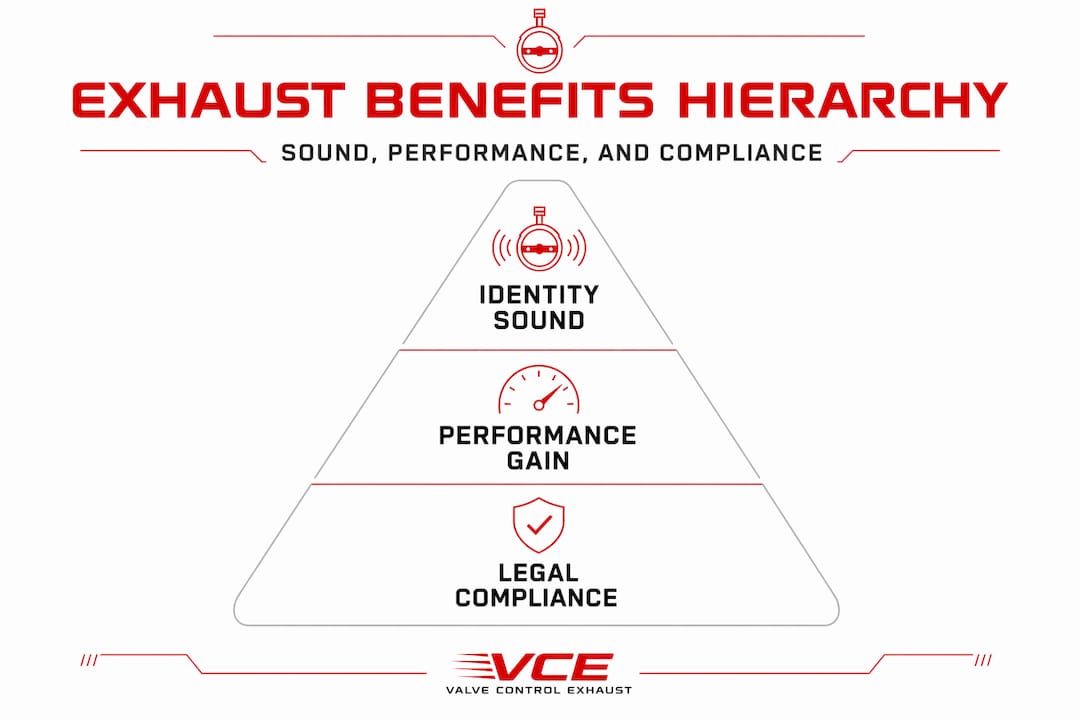
- Staying legal: how customizable exhausts help with noise compliance
- How exhaust engineering shapes sound and performance
- Practical applications in daily driving and track use
- My honest take on exhaust customization
- Upgrade with confidence through Valvecontrolexhaust
- FAQ
Key takeaways
| Point | Details |
|---|---|
| Sound control beats raw volume | Valved systems give you two distinct acoustic modes, letting you choose aggressive or refined on demand. |
| Performance gains are real | Reduced backpressure and optimized flow deliver measurable horsepower and torque increases. |
| Legal compliance matters now | Cities like Beverly Hills are issuing $1,000 fines for exhausts over 95 dB, making quiet modes a smart investment. |
| Design quality drives satisfaction | Pulse timing, X-pipes, and muffler architecture shape tone far more than pipe diameter alone. |
| Daily usability is built in | Dual-mode systems let you drive aggressively on a track and quietly through your neighborhood, same car, same day. |
Why customizable exhaust appeals to enthusiasts: sound as identity
Before anything else, let’s talk about what actually motivates enthusiasts to upgrade their exhaust. According to survey data, performance and sound equally motivate aftermarket exhaust upgrades, each cited by 59% of drivers. More telling: 64% of drivers with upgraded exhausts admit they rev their engines specifically to showcase the sound. That’s not vanity. That’s identity.
For enthusiasts, exhaust sound is a form of self-expression the same way a musician chooses their instrument’s tone. A flat-plane V8 Ferrari crackle says something different than a straight-six BMW growl. The appeal of custom exhausts is that you get to shape that voice rather than accept whatever the factory decided was safe and inoffensive.
Here’s what makes valved exhaust systems particularly compelling:
- Open mode routes exhaust gases straight through with minimal restriction, producing an aggressive, high-volume sound character that turns heads at a Cars and Coffee event.
- Closed mode redirects flow through muffler chambers, delivering a quieter and more refined tone that won’t wake up your neighbors on a Tuesday morning.
- Driver control means you decide which personality the car wears, based on road conditions, location, or mood.
Systems like K2 Industries’ builds for the Corvette C8 Z06 and Audi TTRS demonstrate exactly how this works in practice. Electronically actuated valves shift between modes in seconds, and both modes are engineered intentionally rather than being an afterthought.
Pro Tip: When evaluating a valved system, ask the manufacturer what the decibel difference is between open and closed modes. A well-engineered system should offer at least a 10 to 15 dB swing, enough to be genuinely useful in both environments.
Sound is also a social signal. The exhaust sound as automotive identity concept plays out everywhere from car meets to YouTube channels where enthusiasts compare burbles and pops. Custom exhaust aesthetics, including the tips themselves, are part of that visual and auditory package. The role of exhaust tip aesthetics in enthusiast culture reinforces that this is about the complete statement the car makes, not just noise.
Performance benefits beyond the sound
Sound customization gets most of the headlines, but the performance advantages of a well-built aftermarket system are just as real. Understanding why enthusiasts choose aftermarket exhausts for performance means understanding what the factory system is designed to prioritize: cost, emissions compliance, and broad noise regulations. None of those priorities favor outright performance.
A custom exhaust built for your specific engine can deliver genuine, measurable results. Here’s where the gains come from:
- Reduced backpressure allows exhaust gases to exit the cylinder more completely, which means the next intake charge enters with less contamination and the engine breathes more freely.
- Increased flow velocity through properly sized tubing keeps exhaust gases moving efficiently rather than creating turbulence that robs power.
- Optimized pulse timing using tuned pipe lengths lets pressure waves work in your favor, helping scavenge the cylinder and slightly boosting intake charge during overlap.
- X-pipe or H-pipe crossovers blend exhaust pulses from opposite cylinder banks, which smooths torque delivery and improves mid-range response on V-configuration engines.
The result of getting these elements right is noticeable throttle response and real horsepower gains. The actual numbers depend on engine displacement, existing restrictions, and system quality. Fluid MotorUnion’s approach captures this well: their philosophy treats sound and performance as inseparable, arguing that an exhaust tuned for good tone is usually also tuned for good flow. Those goals align more often than they conflict.
Weight reduction is another practical benefit that gets overlooked. A quality aftermarket system using titanium or high-grade stainless steel typically weighs less than the factory unit, which matters on track days where every kilogram counts. For more on how aftermarket systems translate to real engine response, improved throttle response is a documented outcome with the right setup.

Pro Tip: Bigger pipe diameter is not automatically better. Oversized tubing reduces exhaust velocity at lower RPMs, which can actually reduce low-end torque. Match pipe diameter to your engine’s displacement and intended rev range.
Staying legal: how customizable exhausts help with noise compliance
This section matters more in 2026 than it did five years ago. Noise enforcement is getting objective and expensive. Beverly Hills police are implementing instrumented decibel enforcement with $1,000 fines for vehicles exceeding 95 dB. That’s not a subjective complaint from a neighbor. That’s a measurable citation with a four-figure cost.
The shift from “someone complained” to “the meter says 96 dB” fundamentally changes the calculation for enthusiasts. A fixed loud exhaust that sounds incredible on a canyon run can become a liability the moment you pull into a parking structure or drive through a noise-monitored zone. Instrumented noise measurement is spreading beyond Beverly Hills, with similar programs appearing across urban areas and in international markets where enforcement infrastructure is catching up fast.
Customizable systems solve this problem practically. The quiet closed mode isn’t just about being polite. It’s a documented noise reduction feature that can keep you under the legal threshold when it matters. Consider what that means in practice:
- Drive in open mode on a dedicated track day or an empty mountain road.
- Switch to closed mode for the commute home, through monitored zones, and into residential areas.
- Never get cited. Never compromise the driving experience you bought the car for.
Noise regulation enforcement increasingly uses cameras and automated systems to flag loud vehicles, which means the era of getting away with a fixed loud setup in urban environments is ending. Valved personalization isn’t a compromise. It’s a strategic response to a changing regulatory environment.
Pro Tip: Before purchasing any aftermarket system, ask for documented closed-mode decibel measurements at a representative RPM range. Manufacturers who cannot provide this data are selling sound, not solutions.
How exhaust engineering shapes sound and performance
Understanding the technical side of exhaust design helps you separate genuinely good systems from expensive chrome pipes. The core of what makes dual-mode exhaust systems work is how they route gas flow differently depending on valve position.
| Design element | What it does | Why it matters |
|---|---|---|
| Valve-controlled routing | Directs flow through muffler chambers or bypasses them | Creates distinct quiet and aggressive modes in one system |
| X-pipe or H-pipe crossover | Blends pressure pulses from opposite cylinder banks | Reduces rasp and improves midrange tone and smoothness |
| Stepped tubing | Gradually increases pipe diameter toward the exit | Maintains flow velocity while accommodating volume increase |
| Perforated baffles | Absorbs specific harmonic noise frequencies inside the muffler | Reduces harmonic noise by up to 7.9 dB at targeted frequencies |
| Tuned pipe length | Sets the primary resonant frequency of the exhaust pulse | Reinforces desirable tones and suppresses drone at cruising speeds |
Acoustic research confirms that perforated muffler structures reduce specific harmonic orders measurably, with published results showing 4.6 dB reductions for third-order tones and 7.9 dB for sixth-order tones. That kind of precision shapes whether your exhaust sounds like a musical instrument or an industrial noise violation.
Pulse blending via X-pipes is particularly underappreciated. When pressure waves from opposite cylinder banks collide without blending, you get rasp and harshness in the upper RPM range. A well-placed X-pipe merges those waves constructively, which emphasizes the lower fundamental frequencies that make a performance exhaust sound deep and authoritative rather than tinny and sharp.
Pro Tip: A system that sounds great at idle and through the rev range, without droning at highway speed, is the product of deliberate acoustic engineering. If a system drones at 2,500 RPM on the freeway, the pipe length tuning was not done correctly.
Practical applications in daily driving and track use
The real-world case for exhaust customization becomes clear when you look at how enthusiasts actually use their cars. Most performance vehicles serve double duty. They’re weekend track tools and daily drivers, sometimes on the same Saturday. A fixed aggressive exhaust system forces you to choose which role you’re optimizing for. A customizable system removes that trade-off entirely.
Here’s how enthusiasts typically use dual-mode systems across different scenarios:
- Track days and canyon drives: Open the valves fully, let the engine breathe, and experience the aggressive sound character that communicates every shift and throttle input back to you as a driver.
- Weekend morning drives: Keep valves closed through residential streets out of respect for the neighborhood, then open them once you reach the open road.
- Car shows and parking lots: A quick tap of the in-cabin controller to open mode for a startup or rev that captures attention, then back to quiet for normal driving.
- Commuting and urban driving: Closed mode reduces sound to near-factory levels, which means less driver fatigue on long commutes and no citation risk in monitored zones.
- Passenger comfort: Some enthusiasts note that closed mode makes long trips genuinely more comfortable for passengers who enjoy the car but not the concert volume.
Integration with vehicle electronics has improved significantly. Many modern systems connect directly to the car’s existing steering-wheel controls or infotainment interface, making mode switching as natural as adjusting the radio. For model-specific fitment guidance, reviewing exhaust fits for popular models helps match the right system to your specific vehicle before you commit.
My honest take on exhaust customization
I’ve followed the exhaust modification space closely for a long time, and the loudness obsession still frustrates me. There’s a version of this culture where maximum decibels equal maximum credibility. That’s not sophistication. That’s missing the point.
What I’ve found consistently is that the enthusiasts who are most satisfied with their exhaust upgrades are the ones who treated the project as an engineering problem, not a volume contest. The best systems I’ve encountered manage to be genuinely exciting on demand while being genuinely livable the rest of the time. That balance is hard to achieve, and manufacturers who get it right deserve the premium they charge.
The identity aspect is real, though. There’s something deeply satisfying about a car that sounds exactly the way you want it to, whether that’s a Ferrari flat-plane shriek or a BMW straight-six howl. Valved systems reviewed in detail show that when engineering quality is high, both modes feel intentional rather than like compromises.
My advice: stop thinking about how loud you can make your car and start thinking about how expressive you want it to be. Those are different questions, and the second one leads to better decisions.
— Info
Upgrade with confidence through Valvecontrolexhaust
If you’ve made it this far, you already understand that getting the exhaust right requires more than picking the loudest option in your price range. It requires matching the system to your engine, your local regulations, and how you actually drive.

Valvecontrolexhaust specializes in exactly this. Their catalog covers leading brands including IPE, FI Exhaust, Armytrix, Akrapovic, Valvetronic, and Ryft, all systems engineered for real sound and performance control on vehicles like Audi, BMW, Ferrari, and Lamborghini. The performance exhaust buyer’s guide gives you side-by-side brand comparisons with fitment verification and expert guidance behind every recommendation. For a deeper technical comparison, the practical exhaust system audit covers real-world sound and performance data you won’t find in a spec sheet.
FAQ
What makes a customizable exhaust different from a standard aftermarket system?
A customizable exhaust uses electronically actuated valves to switch between distinct sound modes, giving you an aggressive open mode and a quieter closed mode in one system. Standard aftermarket exhausts produce a fixed sound level regardless of driving conditions.
Do valved exhaust systems actually improve performance?
Yes. By reducing backpressure and optimizing flow through tuned pipe lengths and crossover pipes, valved performance systems deliver measurable horsepower and torque gains while still allowing sound control.
Can a customizable exhaust help me avoid noise citations?
It can. Cities like Beverly Hills are enforcing fines up to $1,000 for exhausts exceeding 95 dB, and closed-mode operation on a valved system can bring your vehicle under that threshold on demand.
How do I choose the right valved exhaust for my car?
Match the system to your engine configuration, target RPM range, and local noise regulations. Reviewing how to choose the right exhaust with documented decibel measurements for both modes is the best starting point.
Are customizable exhausts worth the premium over fixed systems?
For enthusiasts who use their cars in multiple environments, yes. The ability to toggle between track-ready aggression and daily-driving refinement makes the cost difference practical rather than purely aspirational.
Recommended
- The Role of Exhaust Tips Aesthetics for Car Enthusiasts
- Technical Appraisal: Choosing Between IPE, FI, Armytrix, Akrapovic, Valvetronic and Ryft Exhausts – Valve Control Exhaust
- Tuning the Exit: Practical Evaluation of IPE, FI, Armytrix, Akrapovic, Valvetronic and Ryft Exhausts – Valve Control Exhaust