

Most car owners assume swapping exhaust tips will transform their vehicle’s sound. That belief drives a lot of purchases and a lot of disappointment. The real role of exhaust tips aesthetics is far more interesting than sound modification: tips are one of the most visible, high-impact design elements on a vehicle’s rear end, shaping how aggressive, premium, or sporty a car looks before anyone hears it move. This article breaks down exactly what exhaust tips do visually, why design choices matter more than most people realize, and how to pick tips that genuinely improve your vehicle’s appearance.
Table of Contents
- Key Takeaways
- The role of exhaust tips aesthetics vs. function
- Design elements that shape exhaust tips visual appeal
- Why enthusiasts care so much about exhaust tip design impact
- How to choose and install tips for maximum visual impact
- My take on what exhaust tips actually deliver
- Upgrade your exhaust system with Valvecontrolexhaust
- FAQ
Key Takeaways
| Point | Details |
|---|---|
| Tips are primarily visual | Standard slip-on exhaust tips have minimal effect on sound; their main job is improving vehicle appearance. |
| Design details change perception | Size, finish, angle, and number of tips directly shape whether a car reads as sporty, premium, or stock. |
| Alignment matters most | Even the best-looking tip looks cheap if it’s crooked; professional fitment is non-negotiable for quality results. |
| Aesthetics drives upgrades | Surveys show 25% of exhaust upgrades are motivated by visual appeal, not sound or performance. |
| Fake tips have real design logic | Decorative exhaust outlets solve practical problems around soot and heat while giving designers more styling freedom. |
The role of exhaust tips aesthetics vs. function
Here is the honest truth most aftermarket content skips: standard slip-on tips are cosmetic by design. They attach over existing pipes without altering the internal flow path, which means the exhaust gases travel the same route regardless of what tip you bolt on. Sound changes, if any, are subtle enough that most drivers cannot reliably detect them in a blind test.
That does not mean tips are pointless. It means their value lives in a different category entirely.
The materials used tell part of the story. Chrome, black chrome, and carbon fiber finishes all create distinct visual personalities. Material choice affects appearance far more than it affects acoustics. A thicker-walled tip will slightly damp high-frequency resonance, and a thin-walled tip reflects a sharper note, but neither change is dramatic enough to justify a purchase on sound grounds alone.
A few specialized options do push the acoustic needle slightly further:
- Resonated tips contain internal baffling that can reduce harshness and marginally deepen the exhaust note at specific RPMs
- Larger diameter openings create a fuller, more aggressive visual presence but do not increase volume without accompanying muffler or piping changes
- Straight-cut tips read as clean and modern; angled or rolled edges read as more aggressive
The distinction between real functional tips and decorative ones matters here too. Many modern production vehicles use decorative outlets that stay visually clean while the actual exhaust pipe is routed downward and hidden. The fake tip never sees exhaust gas, so it never gets sooty. The real pipe handles heat and emissions out of sight.
Pro Tip: If you want actual sound changes, invest in the muffler and mid-pipe first. Tips are the finishing touch on a system that already sounds the way you want it to. Check out this exhaust brand comparison to understand where real acoustic gains come from.
Design elements that shape exhaust tips visual appeal
This is where exhaust tip design impact gets genuinely interesting. The rear of a car is the last thing people see, and tips frame that view. Small differences in size, shape, angle, and finish create dramatically different impressions.
Size and number of tips
Going from a single 2.5-inch tip to a dual tip layout widens the visual stance of the rear end and signals performance even when nothing mechanical has changed. Quad tips push that perception further. Width creates symmetry, and symmetry reads as intentional design rather than afterthought.

Larger diameter tips create a fuller, more aggressive appearance. The psychology is straightforward: bigger openings suggest bigger power. That perception is exactly why performance-oriented vehicles use them even when the engine output does not demand it.
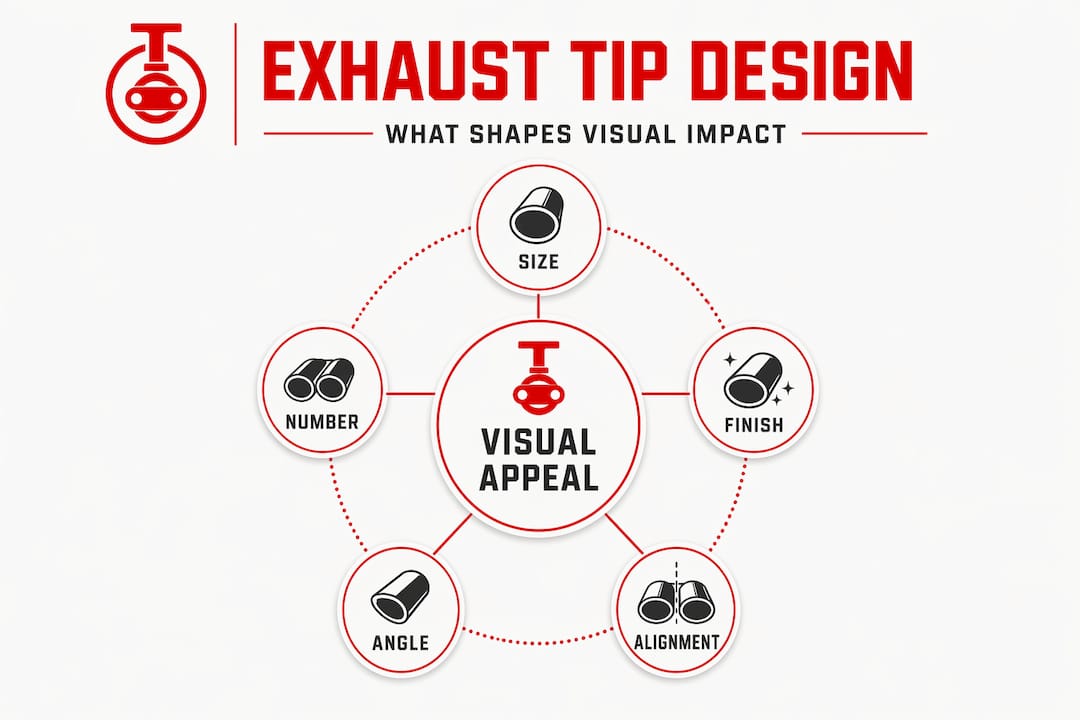
Angle, finish, and alignment
| Design Element | Visual Effect | Practical Benefit |
|---|---|---|
| Downward angle (10°–20°) | Subtle aggression, clean look | Directs soot away from bumper |
| Chrome finish | Classic, premium, high-contrast | Easy to clean, highly visible |
| Carbon fiber finish | Sporty, modern, lightweight feel | Resists heat discoloration |
| Black chrome finish | Aggressive, blacked-out aesthetic | Hides minor scratches better |
| Quad tip layout | Wide, symmetrical, performance-oriented | Maximizes rear visual impact |
An optimal downward angle between 10° and 20° balances aesthetics with practical soot management. It keeps the rear fascia cleaner and directs hot gases away from plastic trim. That slight tilt also adds a visual edge that straight-cut horizontal tips lack.
Alignment is the factor most people underestimate. Misaligned tips are immediately noticeable from normal viewing angles and destroy the perception of quality regardless of how expensive the tips themselves are. A crooked tip on a Ferrari reads worse than a straight tip on a daily driver. Craftsmanship in fitment signals quality to observers even more than the tip choice itself.
Pro Tip: Before any final welding or permanent installation, do a full mock-up with the car on level ground. Step back and check alignment from 10 feet away, from both sides, and from directly behind. What looks straight up close often reveals a visible tilt from a distance.
Why enthusiasts care so much about exhaust tip design impact
The aesthetic value of exhaust tips is not just vanity. It connects to how enthusiasts communicate identity through their vehicles, and survey data backs this up.
Aesthetics motivates 25% of exhaust upgrades, with the broader survey showing that one in ten drivers had upgraded their exhaust system. That is a meaningful portion of the market choosing tips and systems specifically for how they look. The visual upgrade is the point, not a consolation prize.
Several psychological factors explain why visual cues carry this much weight:
- Symmetry signals intent. Dual or quad tips create a balanced rear that reads as designed rather than factory-standard.
- Width creates presence. Tips that push toward the outer edges of the bumper make the car look wider and more planted.
- Finish communicates personality. Chrome says classic and refined. Matte black says aggressive and modern. Carbon fiber says track-focused.
- Visible hardware implies performance. Seeing large, real exhaust outlets creates an assumption of power, regardless of what the engine actually produces.
The fake tip trend in modern production cars is worth examining here. Manufacturers use decorative outlets to solve real problems: direct injection engines produce sooty exhaust that stains rear bumpers, real pipes get hot enough to damage plastic trim, and routing constraints sometimes make visible real tips impractical. The fake tip keeps the rear looking clean and styled without the maintenance headache.
That said, customer preference is shifting. Enthusiasts increasingly want authentic visible tips on performance models, and manufacturers are responding. The trend toward authenticity reflects a broader demand for vehicles that look as capable as they perform, not vehicles that perform well but hide the evidence.
You can see how wheel design transforms vehicle aesthetics in a similar way: both wheels and exhaust tips are functional components that carry enormous visual weight in how a car is perceived from the outside.
How to choose and install tips for maximum visual impact
Improving vehicle appearance through exhaust tips comes down to a few deliberate decisions made before you buy anything.
-
Match tip size to vehicle proportions. A compact sedan looks best with dual 2.5-inch to 3-inch tips. A full-size performance SUV or sports car can carry quad 3.5-inch to 4-inch tips without looking oversized. Tips that are too small disappear visually; tips that are too large look bolted on.
-
Choose finish based on the vehicle’s existing color palette. Chrome works on silver, white, and black cars. Black chrome suits darker vehicles or those with blacked-out trim packages. Carbon fiber tips complement cars with visible carbon fiber accents elsewhere.
-
Decide between functional and decorative tips based on your actual exhaust system. If your car routes exhaust through a visible pipe, a slip-on functional tip is the right call. If your car already uses a hidden pipe system, a decorative outlet gives you styling freedom without fighting the factory routing.
-
Plan the angle before cutting or welding anything. A 10° to 20° downward tilt keeps the rear bumper cleaner and adds a subtle aggressive look. Mark the angle on both sides and confirm they match before any permanent work.
-
Mock up and tack weld before final installation. Professional alignment requires hanging the tips, stepping back to confirm they are level and even relative to the body, and only then committing to final welds. Skipping this step is the most common reason tips look off even on expensive builds.
Pro Tip: Take a photo of the rear of your car from 15 feet back before and after installation. Your eye adjusts quickly when you are close to the work, but the photo shows you exactly what a stranger sees when they walk past your car.
My take on what exhaust tips actually deliver
I have watched a lot of enthusiasts buy tips expecting a sound transformation and walk away underwhelmed. That frustration is entirely predictable when the expectation is wrong from the start.
What I have found is that the visual return on a well-chosen, properly fitted set of tips is genuinely satisfying in a way that a minor sound tweak rarely is. The rear of a car is a canvas, and tips are one of the few elements you can change without touching the drivetrain. When the size, finish, and alignment are right, the whole rear end of the car reads differently. That is a real result.
The alignment piece is something I cannot overstate. I have seen builds where someone spent serious money on carbon fiber quad tips and the installation looked amateur because one tip sat two degrees lower than the other. From 20 feet away, that asymmetry is all you see. The tips themselves become irrelevant.
My honest advice: stop treating tips as a sound upgrade and start treating them as a styling decision. Research the finish that suits your car’s color and trim, get the size proportions right for your vehicle’s rear fascia, and pay someone who knows how to weld and align if you are not confident doing it yourself. The exhaust tips visual appeal you get from a properly executed installation is worth far more than any marginal acoustic effect you might chase.
The industry is moving toward authenticity, and I think that is the right direction. Enthusiasts want to see real hardware. If your car has a performance exhaust system, make it visible and make it look intentional.
— Info
Upgrade your exhaust system with Valvecontrolexhaust

If you have decided that tips alone are not enough and you want a system that delivers both visual presence and real acoustic control, Valvecontrolexhaust builds exactly that. Their valve control exhaust systems are designed specifically for high-performance vehicles including Audi, BMW, Ferrari, and Lamborghini, giving you real-time control over exhaust sound through adjustable valves. The tip layouts on their systems are designed to complement the rear styling of each vehicle, with dual and quad configurations that look as purposeful as they perform.
Before you buy, the performance exhaust buyer’s guide from Valvecontrolexhaust covers IPE, FI, Armytrix, Akrapovic, Valvetronic, and Ryft systems side by side, with detailed notes on both acoustic character and visual design. If you want a deeper technical breakdown, the critical performance review walks through each system’s strengths in detail. For those who want to understand the full picture of what a valve control system delivers beyond aesthetics, the benefits of valve control exhaust page is the right starting point.
FAQ
Do exhaust tips actually change how a car sounds?
Standard slip-on tips have minimal impact on exhaust tone or volume because they do not change the internal flow path. Real sound changes require modifications to the muffler or piping.
Why do some cars have fake exhaust tips?
Manufacturers use decorative exhaust outlets to keep the rear bumper clean and avoid heat damage to plastic trim, while still achieving a styled, performance-oriented appearance.
What exhaust tip size looks best on a sports car?
Larger diameter tips create a more aggressive appearance, but the right size depends on the vehicle’s rear fascia proportions. Most sports cars look best with dual or quad tips sized between 3 and 4 inches.
How important is exhaust tip alignment?
Proper alignment is critical. Even a small angular misalignment is immediately visible from normal viewing distances and significantly reduces the perceived quality of the installation.
What finish should I choose for my exhaust tips?
Chrome suits classic and premium looks, black chrome works well on aggressive or blacked-out builds, and carbon fiber complements track-focused vehicles with existing carbon accents. Match the finish to the vehicle’s existing trim and color palette.
Recommended
- Technical Appraisal: Choosing Between IPE, FI, Armytrix, Akrapovic, Valvetronic and Ryft Exhausts – Valve Control Exhaust
- Tuning the Exit: Practical Evaluation of IPE, FI, Armytrix, Akrapovic, Valvetronic and Ryft Exhausts – Valve Control Exhaust
- Practical Critique: Choosing Between IPE, FI, Armytrix, Akrapovic, Valvetronic and Ryft Exhausts – Valve Control Exhaust
- Evaluating IPE, FI, Armytrix, Akrapovic, Valvetronic and Ryft Exhausts: A Critical Comparison – Valve Control Exhaust