
Ferrari owners face a genuinely difficult choice when upgrading their exhaust. The car already sounds extraordinary from the factory, so any modification has to earn its place. The best ferrari exhaust system examples don’t just add volume. They reshape the acoustic signature, recover hidden power, and in some cases change how the car behaves aerodynamically. This article walks through the top options on the market, from Novitec’s gold-plated masterpiece to factory F1 technology, so you can make a decision grounded in real performance data rather than YouTube clips.
Table of Contents
- Key takeaways
- What to know before exploring Ferrari exhaust system examples
- 1. Novitec for the Ferrari Daytona SP3
- 2. Valvetronic Designs sport exhaust
- 3. Fabspeed valved X-Pipe system for the Ferrari F8 Tributo
- 4. AeroflowDynamics F1-style exhaust for the Ferrari 488 series
- 5. IPE Performance Exhausts
- 6. Armytrix performance exhaust
- 7. FI Exhaust
- 8. Akrapovic titanium exhaust
- 9. Ryft exhaust systems
- 10. Ferrari factory FTM exhaust system
- Comparison of top Ferrari exhaust options
- How to choose the right system for your priorities
- My honest take on Ferrari exhaust modifications
- Upgrade your Ferrari exhaust with confidence
- FAQ
Key takeaways
| Point | Details |
|---|---|
| Sound vs. regulations | Valve-controlled systems let you switch between compliant street tone and full race character. |
| Real power gains exist | Novitec’s Daytona SP3 system delivers a documented 28hp increase with premium thermal management. |
| Aerodynamics matter | Ferrari’s FTM exhaust trades 7 to 8 hp for meaningful downforce gains worth over 0.2 seconds per lap. |
| ECU compatibility is non-negotiable | Mismatched aftermarket systems can trigger overheating warnings and require professional diagnostics. |
| Valved systems offer the best flexibility | Real-time valve control gives you quiet cruising and full-throttle drama without choosing one permanently. |
What to know before exploring Ferrari exhaust system examples
Before you spend five figures on titanium pipework, you need a clear framework. Ferrari’s engineering is unusually tight, and the exhaust system sits at the intersection of acoustics, thermodynamics, and aerodynamics. Getting one variable wrong affects the others.
Here are the core criteria to evaluate any system against:
- Sound character. Ferrari exhaust character explained simply: it’s the layered combination of intake roar, mechanical valve train noise, and the exhaust note itself. The best aftermarket options preserve that layering rather than replacing it with a single loud tone.
- Performance impact. Horsepower gains from cat-back systems on modern Ferraris typically range from 8 to 20 hp. Headers and full systems can push higher, but they also affect backpressure curves that Ferrari’s ECU was calibrated around.
- Material quality. Stainless steel is the baseline. Titanium cuts weight significantly. Some Novitec systems go further with 999 fine gold plating on heat shields for thermal management at extreme temperatures.
- Valve and Valvetronic technology. Valved exhaust systems give you programmable sound modes, which is the single most practical feature for a car that doubles as a daily driver and a track weapon.
- ECU and factory calibration. Swapping exhaust components without addressing ECU mapping can cause the Ferrari ‘Slow Down’ warning, which links to catalytic converter overheating and requires professional diagnostics to resolve.
- Aerodynamic effects. On modern mid-engine Ferraris, exhaust routing affects rear downforce. This is not theoretical. It’s a measurable performance variable.
Pro Tip: Always confirm whether a system requires an ECU tune before purchasing. Some bolt-on options are truly plug-and-play. Others will throw codes within the first week of driving.
1. Novitec for the Ferrari Daytona SP3
Novitec’s system for the Daytona SP3 is the most technically ambitious aftermarket option currently available. It produces a 21kW power increase over the factory output, pushing total output to 638kW. The optional 999 fine gold plating on the heat shields is not cosmetic theater. Gold reflects radiant heat more effectively than any other coating, keeping underbody temperatures in check during sustained high-speed running.
The sound profile is operatic without being crude. It retains the naturally aspirated V12 character that makes the Daytona SP3 worth owning in the first place.
2. Valvetronic Designs sport exhaust
Valvetronic Designs builds systems specifically around valve control, which means the driver manages sound output in real time. Their Ferrari applications use electronically actuated butterfly valves that open fully under hard acceleration and restrict flow at low throttle for a quieter street mode.
The result is one of the better Ferrari exhaust sound examples on the market because the system sounds genuinely different at different throttle positions. It’s not just louder or quieter. The tone changes character, which is what Ferrari owners actually want.
3. Fabspeed valved X-Pipe system for the Ferrari F8 Tributo
Fabspeed’s approach centers on their valved X-Pipe design, which improves cross-cylinder exhaust scavenging while adding sound modulation. On the Ferrari F8 Tributo, this translates to a sharper mid-range response and a more aggressive exhaust note under boost.
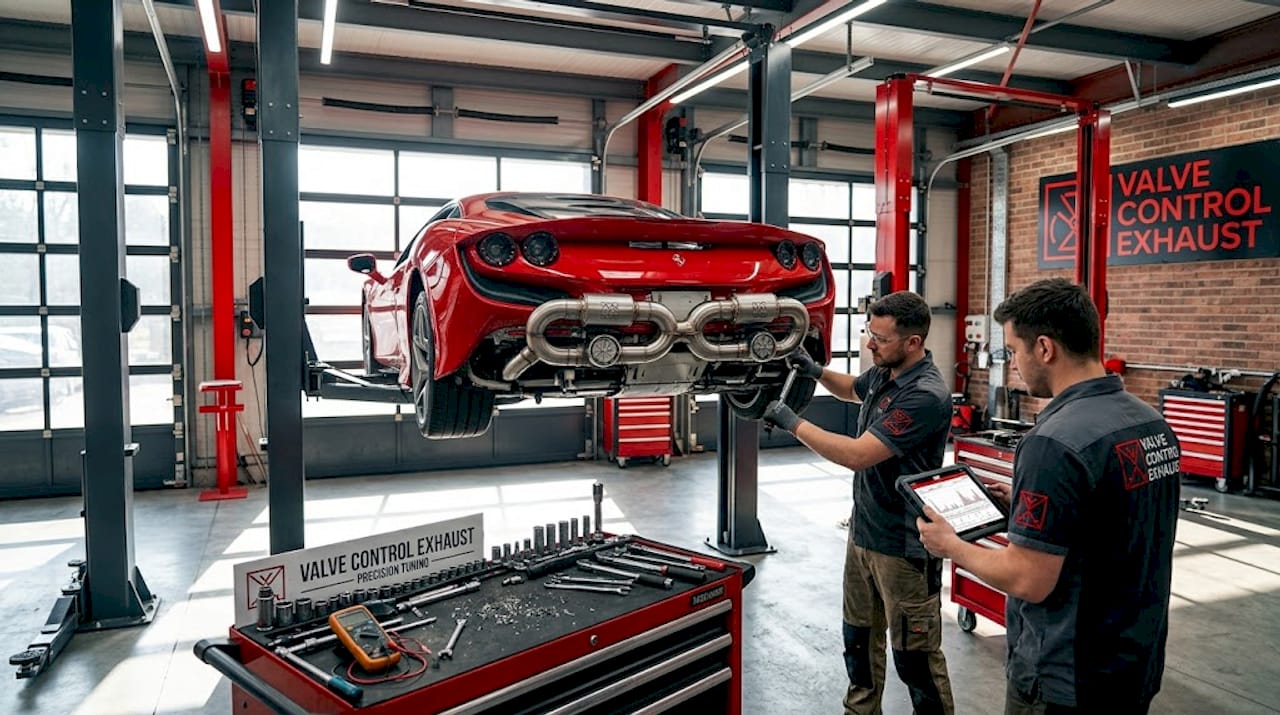
The X-Pipe configuration also tends to produce a more balanced sound between the two exhaust banks, which matters on a twin-turbocharged V8 where the firing order can create uneven tonal characteristics.
4. AeroflowDynamics F1-style exhaust for the Ferrari 488 series
AeroflowDynamics targets Ferrari 488 owners who want race-inspired sound without full race-spec complexity. Their system uses 304 stainless steel construction with a straight-through race design that removes the flow restrictions present in the factory muffler.
The sound is sharper and more aggressive than most valved street systems. It’s a strong pick for track-day regulars who don’t need quiet mode and want maximum acoustic presence at high rpm.
5. IPE Performance Exhausts
IPE builds valved systems that sit at the premium end of the Ferrari performance exhaust options market. Their Ferrari fitments combine titanium construction with electronically controlled valves and a sound profile that sits between aggressive and refined.
What separates IPE from cheaper alternatives is build consistency. The welds, fitment tolerances, and valve actuation feel like components that belong on a Ferrari rather than something grafted on. Their systems also work well alongside factory ECU calibration on most current models, reducing the risk of triggering thermal warnings.
6. Armytrix performance exhaust
Armytrix is one of the most recognized names in the valved exhaust market for luxury sports cars. Their Ferrari applications use titanium construction and wireless valve control, often integrated with a smartphone app.
The sound quality is genuinely impressive, particularly at full throttle. Some owners report that the Armytrix note is slightly more synthesized than IPE or Novitec at partial throttle, but at wide-open throttle the difference disappears. For the price point, it represents strong value among Ferrari exhaust modifications.
7. FI Exhaust
FI (Fi EXHAUST) specializes in valved systems with a focus on sound character over outright power numbers. Their Ferrari fitments are known for producing a particularly rich, layered exhaust note that complements the factory intake sound rather than competing with it.
FI systems tend to appeal to owners who have spent time with multiple exhaust options and want something that sounds correct rather than just loud. The practical selection criteria for choosing between FI and competitors comes down to whether you prioritize tonal quality or peak volume.
8. Akrapovic titanium exhaust
Akrapovic brings motorsport credibility to their Ferrari road car applications. Their titanium systems are among the lightest available, with some Ferrari fitments saving over 10 kg compared to the factory exhaust. That weight reduction has real handling implications on a mid-engine car.
The sound character leans toward the sharper, higher-pitched end of the spectrum. It’s a polarizing choice. Some owners love the race-track directness. Others find it less musical than alternatives. For track-focused builds where every kilogram matters, Akrapovic is hard to argue against.
9. Ryft exhaust systems
Ryft is a newer entrant that has built a following among Ferrari 296 and SF90 owners. Their systems focus on delivering maximum sound intensity while maintaining factory-level fitment quality. The brand positions itself as a more accessible alternative to Akrapovic and IPE without sacrificing build quality.
Early owner feedback suggests the Ryft note is particularly strong in the mid-rpm range, which is where you spend most of your time on public roads. For owners who find other systems too quiet below 4,000 rpm, Ryft is worth serious consideration.
10. Ferrari factory FTM exhaust system
The FTM (Flick Tail Mode) exhaust from Ferrari’s own F1 program deserves a place on this list because it reframes what an exhaust system is supposed to do. Rather than maximizing power output, the FTM system routes exhaust gases to increase rear downforce, sacrificing approximately 7 to 8 hp in the process.
The trade-off is worth it at the circuit level. The aerodynamic-mechanical integration delivers lap time gains exceeding 0.2 seconds per lap by improving vehicle stability and downforce balance. It’s a reminder that Ferrari exhaust design is not just about sound or horsepower. It’s about total vehicle performance.
Comparison of top Ferrari exhaust options
| Brand / System | Sound character | Performance gain | Material | Valve control | Approx. price | Compatible models |
|---|---|---|---|---|---|---|
| Novitec (Daytona SP3) | Rich, operatic V12 | +28 hp | Titanium / gold plating | No | $15,000+ | Daytona SP3 |
| Valvetronic Designs | Layered, mode-variable | Moderate | Stainless / titanium | Yes | $4,000 to $8,000 | Multiple models |
| Fabspeed (F8 Tributo) | Sharp, turbo-aggressive | Moderate | Stainless steel | Yes | $3,500 to $6,000 | F8 Tributo, others |
| AeroflowDynamics (488) | Race-loud, high-rpm | Moderate | 304 stainless | No | $2,500 to $4,500 | 488, 488 Pista |
| IPE Performance | Refined, premium tone | Moderate to high | Titanium | Yes | $5,000 to $9,000 | Multiple models |
| Armytrix | Aggressive, app-controlled | Moderate | Titanium | Yes | $4,000 to $7,000 | Multiple models |
| Akrapovic | Sharp, race-focused | Moderate + weight loss | Full titanium | Optional | $6,000 to $12,000 | Multiple models |
| FI Exhaust | Rich, tonal quality | Moderate | Stainless / titanium | Yes | $3,500 to $6,500 | Multiple models |
| Ryft | Intense mid-rpm | Moderate | Stainless / titanium | Yes | $3,000 to $5,500 | 296, SF90, others |
| Ferrari FTM | F1-inspired | Aero gain, slight hp loss | Factory spec | Factory | N/A (OEM F1) | F1 SF-26 |
How to choose the right system for your priorities
Matching a Ferrari exhaust system to your actual driving life matters more than chasing the highest-rated option on a forum.
- For maximum sound drama on the street: Valvetronic Designs or FI Exhaust give you the most control over when and how loudly the car announces itself. You get full noise when you want it and compliance when you need it.
- For track performance with real power gains: Novitec’s full system for applicable models and Akrapovic’s titanium builds deliver the best combination of power recovery and weight reduction. Pair either with a professional ECU recalibration.
- For the best value without compromising reliability: Fabspeed and AeroflowDynamics offer genuine Ferrari exhaust modifications at price points that don’t require a second mortgage. Both fit correctly and sound excellent.
- For daily driving versatility: Any valved system from IPE, Armytrix, or Ryft lets you manage sound output based on context. Quiet enough for early morning garage exits. Loud enough to remind everyone what’s under the engine cover at full throttle.
Pro Tip: Before committing to any system, confirm whether your specific model year requires an oxygen sensor spacer or ECU update. Ferrari made mid-cycle changes to several platforms that affect aftermarket exhaust compatibility.
Choosing Ferrari aftermarket exhausts requires understanding trade-offs between sound enhancement, power gains, and factory ECU compatibility. When in doubt, consult a specialist who has installed the specific system on your specific model. Generic advice from a brand’s website is not a substitute for hands-on experience with your car.
My honest take on Ferrari exhaust modifications
I’ve spent years around Ferrari exhaust modifications, and the pattern I keep seeing is this: owners who chase the loudest possible setup almost always end up disappointed within six months. The car stops feeling special and starts feeling like a performance at a car show.
What I’ve found actually works is matching the exhaust character to how the car is used. A 488 that sees two track days a year and 8,000 street miles benefits from a valved system that stays civil most of the time. A Daytona SP3 that lives in a collection and gets driven hard on special occasions can justify Novitec’s full treatment.
The aerodynamic dimension is something most owners completely ignore. Modern Ferrari exhaust design treats exhaust gases as part of the aerodynamic package. Swapping to a system that exits in a different location or with different flow characteristics can affect rear downforce in ways that show up in handling balance rather than a warning light.
The most important lesson I’ve taken from professional installations and client feedback is this: respect what Ferrari already built. The factory system is not lazy engineering. It’s a deliberate balance. Every modification you make is a negotiation with that balance, and the best results come from owners who understand what they’re negotiating rather than simply bolting on the loudest option available.
— Info
Upgrade your Ferrari exhaust with confidence
If you’re serious about finding the right system, Valvecontrolexhaust has done the hard evaluation work for you.

Their performance exhaust buyer’s guide covers IPE, FI, Armytrix, Akrapovic, Valvetronic, and Ryft in detail, with brand comparisons built specifically around Ferrari applications. The site also features a practical evaluation resource that helps you filter options by sound priority, performance goals, and budget. Whether you’re deciding between a valved street system and a full titanium track build, Valvecontrolexhaust gives you the depth of analysis to make that call with confidence rather than guesswork.
FAQ
What are the best Ferrari exhaust systems for sound?
Valvetronic Designs, IPE, and FI Exhaust consistently produce the most praised Ferrari exhaust sound examples, offering valve-controlled systems that deliver layered, character-rich tones across the rev range.
How much horsepower can a Ferrari exhaust upgrade add?
Gains vary by system and model, but well-engineered options like the Novitec Daytona SP3 system deliver up to 28 hp, while most cat-back systems on turbocharged Ferraris add 8 to 15 hp.
Do aftermarket Ferrari exhausts require an ECU tune?
Many cat-back systems do not require a tune, but full exhaust replacements often do. Skipping the tune can trigger thermal warnings linked to exhaust overheating issues that require professional diagnostics.
What is the Ferrari FTM exhaust system?
The FTM (Flick Tail Mode) exhaust is Ferrari’s F1-derived system that uses exhaust gases to increase rear downforce, gaining over 0.2 seconds per lap despite a small horsepower reduction.
Are valved exhaust systems worth it for Ferrari owners?
Yes. Valved systems give you the flexibility to run a quiet street tone and a full race sound without permanent compromise, making them the most practical choice for owners who drive their Ferrari in varied conditions.
Recommended
- Performance Exhaust Buyer’s Guide: IPE, FI, Armytrix, Akrapovic, Valvetronic & Ryft – Valve Control Exhaust
- Decisive Sound and Performance Audit: IPE, FI, Armytrix, Akrapovic, Valvetronic & Ryft Evaluated – Valve Control Exhaust
- Engineered Sound: A No-Nonsense Comparison of IPE, FI, Armytrix, Akrapovic, Valvetronic & Ryft – Valve Control Exhaust
- Technical Appraisal: Choosing Between IPE, FI, Armytrix, Akrapovic, Valvetronic and Ryft Exhausts – Valve Control Exhaust