Most people assume an aftermarket exhaust is about sound. You swap the muffler, it gets louder, and that’s the upgrade. But that framing misses the most significant benefit: why aftermarket exhaust improves response is a physics story, not an audio one. The real gains come from how your engine breathes, how efficiently it expels combustion gases, and how quickly it builds power under throttle. If you’ve ever felt a stock engine hesitate before it pulls, that lag is often the exhaust system working against the engine instead of with it.
Table of Contents
- Key Takeaways
- Why aftermarket exhaust improves response: the backpressure problem
- How aftermarket exhausts reduce restriction and improve flow
- What the data actually shows
- Nuances: pipe sizing, RPM windows, and tuning
- Practical advice for choosing your exhaust upgrade
- My take on what the data misses
- Get the right exhaust system for your vehicle
- FAQ
Key Takeaways
| Point | Details |
|---|---|
| Backpressure robs power | High exhaust backpressure forces the engine to work harder expelling gases, reducing torque and throttle response. |
| Flow design drives gains | Larger diameter pipes and smoother bends in aftermarket systems reduce restriction and improve combustion efficiency. |
| Location of restriction matters | Restrictions near the turbine and exhaust valves hurt response far more than tailpipe or muffler design. |
| Bigger is not always better | Oversized pipes can drop gas velocity and hurt low-end torque, so pipe sizing must match your engine’s operating range. |
| ECU tuning completes the upgrade | An aftermarket exhaust without a corresponding ECU calibration often leaves measurable performance gains unrealized. |
Why aftermarket exhaust improves response: the backpressure problem
Before you can appreciate what an aftermarket exhaust does, you need to understand what the stock system is actively doing wrong. Every time your engine fires, it needs to push spent combustion gases out of the cylinder before the next intake stroke begins. If those gases meet resistance on the way out, the engine has to do extra work just to clear the cylinder. That extra work is called a pumping loss, and it directly reduces the power available at the wheels.
Exhaust backpressure increases pumping losses by forcing the engine to push harder against the pressure in the exhaust system. Think of it like trying to exhale through a coffee straw. Your lungs work harder, you move less air, and your breathing efficiency drops. The same principle applies to your engine’s exhaust stroke.
The combustion side of this equation is equally important. Research on diesel engines found that EBP above 45 kPa significantly increased residual gases in the cylinder and reduced brake thermal efficiency. When exhaust gases linger in the combustion chamber, they dilute the fresh air-fuel charge, which delays ignition and weakens the burn. The result is a sluggish throttle response that no amount of tuning can fully compensate for while the restriction remains.
OEM exhaust systems are not designed for maximum flow. They are designed to meet noise regulations, pass emissions testing, and fit within tight packaging constraints under the car. That means narrower pipes, sharper bends, and more restrictive mufflers than a performance-focused design would use.
Pro Tip: If your car feels like it needs a moment to “wake up” after you press the throttle, especially at mid-range RPM, high exhaust backpressure is one of the first things worth investigating.
Here is what high backpressure costs you in real driving terms:
- Slower throttle response because the engine cannot clear exhaust gases quickly enough between strokes
- Reduced peak torque output, especially in the mid-RPM range where most real-world driving happens
- Higher combustion temperatures due to residual gas contamination
- Increased fuel consumption as the engine works harder to produce the same output
How aftermarket exhausts reduce restriction and improve flow
The core design philosophy of a quality aftermarket exhaust system is to get gases out of the engine faster and with less resistance. That sounds simple, but the execution involves several specific engineering choices that work together as a system.
Here is how the design changes translate to real flow improvements:
- Larger diameter piping reduces the pressure the engine pushes against. A stock mid-pipe might be 2 inches in diameter; a performance replacement might run 2.5 or even 3 inches, depending on the engine’s displacement and power output.
- Mandrel-bent tubing maintains a consistent interior diameter through bends instead of collapsing slightly the way crush-bent pipes do. That consistency keeps gas velocity high and resistance low through corners.
- High-flow catalytic converters replace the restrictive stock cats with units that allow more exhaust volume to pass while still meeting emissions requirements.
- Performance mufflers use straight-through or chambered designs instead of the baffled, restrictive internals found in OEM units.
- Optimized header design improves scavenging, which is the process by which exhaust pulses from one cylinder help pull gases out of adjacent cylinders, improving volumetric efficiency.
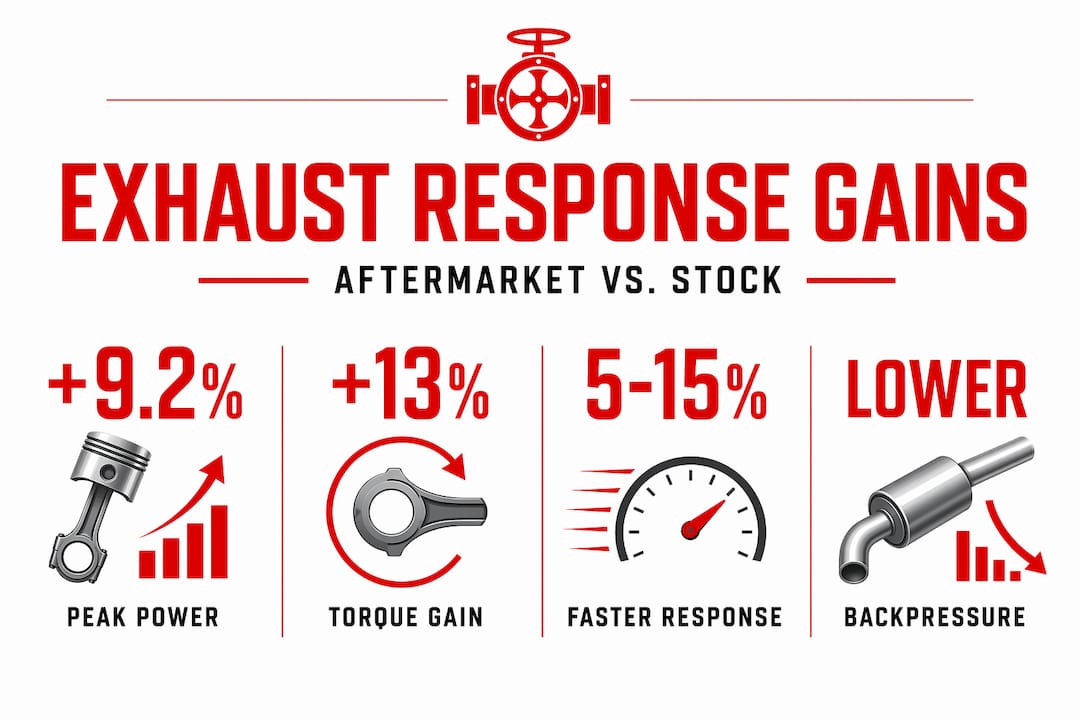
A full aftermarket exhaust system can increase horsepower and torque by 5 to 15 percent, particularly in the mid to high RPM range, by addressing these restrictions across the entire exhaust path.
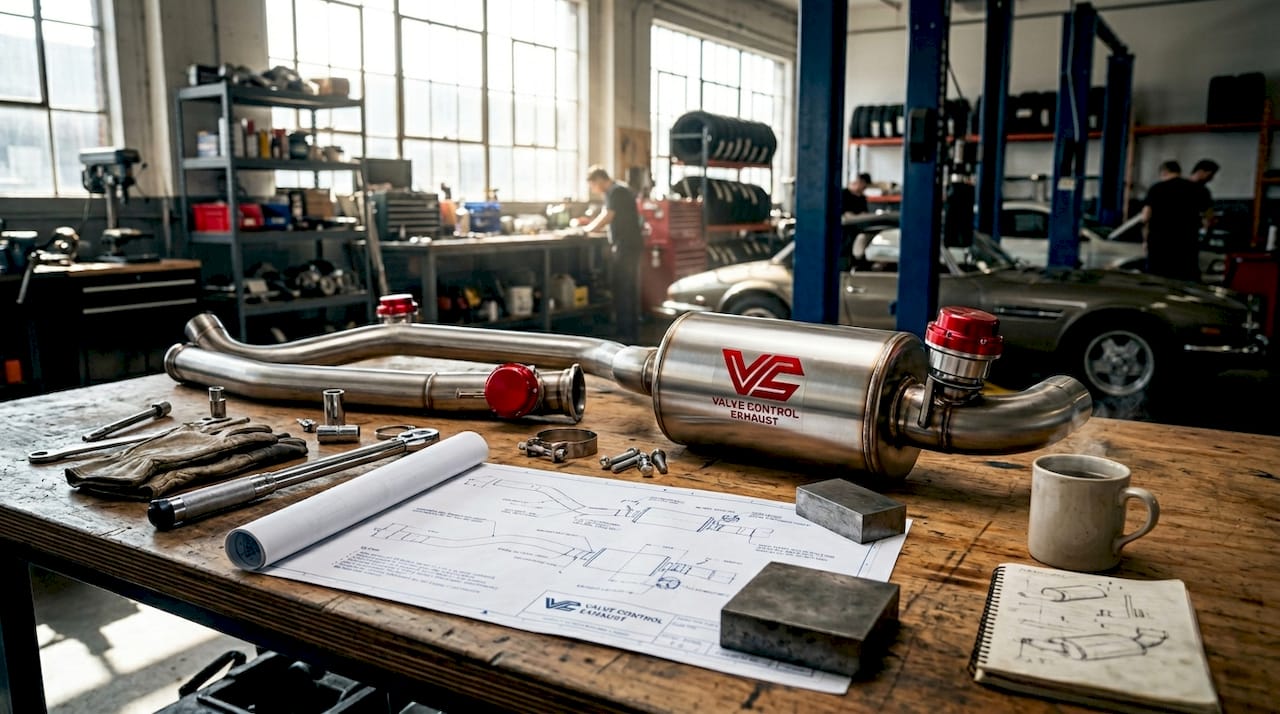
One detail that separates informed enthusiasts from casual buyers: the location of the restriction matters enormously. Critical restrictions near the turbine and exhaust valves affect response far more than what happens at the muffler or tailpipe. This is why a downpipe or mid-pipe upgrade on a turbocharged car often produces more noticeable response improvement than a cat-back swap alone.
Pro Tip: On a turbocharged vehicle, prioritize the downpipe before spending money on a cat-back system. The downpipe sits directly after the turbocharger and has the greatest influence on boost buildup and transient response.
What the data actually shows
The performance claims around aftermarket exhausts are not just marketing. Dyno testing and peer-reviewed research back up the gains with real numbers.
A direct comparison study on a 2NR-VE engine showed that replacing the factory exhaust pushed maximum power from 82.5 HP to 91.6 HP and maximum torque from 131.2 Nm to 154.4 Nm. Those are not marginal improvements. A 10 percent power gain and nearly 18 percent torque gain from an exhaust swap alone represent a meaningful change in how the car feels under acceleration.
| Metric | Stock exhaust | Aftermarket exhaust | Change |
|---|---|---|---|
| Maximum power | 82.5 HP | 91.6 HP | +11% |
| Maximum torque | 131.2 Nm | 154.4 Nm | +18% |
| Brake thermal efficiency | Lower (high EBP) | Higher (reduced EBP) | Significant |
| Ignition delay | Increased | Reduced | Measurable |
The torque number is particularly telling for throttle response. Torque is what you feel when you press the gas pedal. More torque in the mid-range means the engine responds faster and more decisively to throttle inputs, which is exactly what the response boost from exhaust upgrades are designed to deliver.
“Reducing restriction improves combustion efficiency and power build under load, contributing directly to perceived throttle response improvements.” — Experimental research on exhaust backpressure effects
There is also a nuanced finding worth understanding. Research on turbo-compound systems found that within specific operating windows, controlled backpressure can improve specific fuel consumption by up to 6.43 percent and boost maximum power by 11 percent at 5,000 RPM. This is called backpressure supercompensation, and it means backpressure is not universally bad. Its effects depend on the engine design and the RPM range being targeted.
Nuances: pipe sizing, RPM windows, and tuning
Here is where a lot of enthusiasts make expensive mistakes. They assume that the biggest possible exhaust pipe will produce the best results. It does not work that way.
Gas velocity matters as much as pipe diameter. If you oversize the exhaust, gases move through the system too slowly at low RPM. That drop in velocity reduces the scavenging effect and can actually hurt low-end torque, making the car feel flat and unresponsive around town even if peak power improves at high RPM.
| Pipe sizing | Low-RPM response | High-RPM power | Overall drivability |
|---|---|---|---|
| Stock (undersized) | Acceptable | Limited | Comfortable but restricted |
| Correctly sized aftermarket | Improved | Strong | Best balance |
| Oversized aftermarket | Reduced | Peak gains | Poor everyday feel |
Oversizing exhaust diameter reduces gas velocity and hurts low-RPM torque and drivability despite improving peak flow numbers. The right pipe diameter depends on your engine’s displacement, power output, and the RPM range where you spend most of your time driving.
Turbocharged engines add another layer of complexity. On a forced-induction car, reduced post-turbine restriction allows the turbocharger to spool faster and build boost more quickly. That directly reduces turbo lag and improves the transient throttle response that makes turbocharged cars feel alive. But if the exhaust is too free-flowing, the turbo may struggle to maintain adequate drive pressure across its operating range.
ECU calibration is the piece most people skip. After installing an aftermarket exhaust, the engine management system is still running fuel and ignition maps optimized for the stock exhaust’s flow characteristics. A proper ECU remap allows the engine to take full advantage of the improved flow, adjusting fuel delivery, ignition timing, and boost targets to match the new exhaust’s behavior. Without it, you are leaving a significant portion of the available gains on the table.
Practical advice for choosing your exhaust upgrade
Getting the most from an aftermarket exhaust upgrade comes down to matching the system to your specific vehicle, driving style, and goals. Here is what to prioritize:
- Match the system to your engine type. Naturally aspirated engines benefit most from header and mid-pipe upgrades that improve scavenging. Turbocharged engines see the biggest response gains from downpipe and mid-pipe work that reduces post-turbine restriction.
- Avoid buying based on sound alone. The loudest exhaust is rarely the most effective one. Focus on flow data, pipe diameter specifications, and real-world dyno results for your specific vehicle.
- Plan for ECU tuning. Budget for a professional remap when you buy the exhaust. The two upgrades work together, and the exhaust alone rarely delivers its full potential without recalibration.
- Check legal requirements before purchasing. Many aftermarket exhausts exceed local noise ordinances or remove emissions equipment. Know your local regulations before committing to a system, especially if the car is street-driven daily.
- Use a professional installer. Exhaust leaks at the header or mid-pipe connections can actually hurt performance by allowing exhaust gases to escape before they reach the sensors and catalytic converters the ECU relies on.
You can review detailed performance comparisons across premium exhaust brands to understand how different systems perform on specific vehicle platforms before making a decision.
My take on what the data misses
I’ve spent years looking at dyno sheets, reading peer-reviewed exhaust research, and talking to engineers who build these systems. Here is what I keep coming back to: the horsepower number is the least useful metric for understanding why an exhaust upgrade transforms a driving experience.
What actually changes how a car feels is torque delivery in the 2,500 to 5,000 RPM range. That is where you live on public roads. That is where throttle response translates into confidence, into the ability to accelerate out of a corner cleanly, to merge decisively, to feel like the car is responding to you rather than catching up to your inputs.
I’ve seen enthusiasts chase peak power numbers with oversized exhaust systems and end up with cars that feel worse to drive despite technically making more horsepower at the top of the rev range. The system harmony point is not a cliché. Exhaust, intake, and ECU calibration need to be developed together. When they are, the improvement in real-world response is immediately noticeable and not just on a dyno.
The automotive aftermarket has matured to the point where quality valved exhaust systems can give you the best of both worlds: aggressive flow characteristics when you want performance, and quieter operation when you want discretion. That flexibility changes the calculus entirely for daily-driven performance cars.
My honest advice: start with the downpipe or mid-pipe on a turbocharged car, budget for the tune, and evaluate the system as a whole before adding more components. The response improvement you feel from doing it right will be more satisfying than any peak power number.
— Info
Get the right exhaust system for your vehicle
If you’ve read this far, you already understand that choosing an aftermarket exhaust is about more than picking the one that sounds best on a YouTube video. The right system depends on your engine, your driving habits, and how the components work together.

Valvecontrolexhaust specializes in performance exhaust systems for high-output vehicles including Audi, BMW, Ferrari, and Lamborghini, with adjustable valve technology that lets you control both sound and flow characteristics in real time. Their performance exhaust buyer’s guide covers top-tier brands including IPE, Armytrix, Akrapovic, and Ryft with real performance data for each platform. If you want a deeper technical breakdown of how pipe sizing and calibration affect your specific model, their practical exhaust evaluation is the place to start.
FAQ
Why does aftermarket exhaust improve throttle response?
Aftermarket exhausts reduce backpressure, allowing the engine to expel combustion gases faster and with less effort. This improves combustion efficiency and allows power to build more quickly under throttle input.
Does a cat-back exhaust improve engine response?
A cat-back system improves flow from the catalytic converter back, which helps at higher RPM. For the biggest response gains, especially on turbocharged engines, a downpipe or mid-pipe upgrade targeting restriction near the turbo produces more noticeable results.
Can too large an exhaust pipe hurt performance?
Yes. Oversized pipes reduce exhaust gas velocity, which weakens the scavenging effect and can reduce low-end torque and everyday drivability even if peak power improves at high RPM.
Do I need an ECU tune after installing an aftermarket exhaust?
A tune is strongly recommended. The factory ECU runs fuel and ignition maps calibrated for the stock exhaust’s flow characteristics. Remapping after an exhaust upgrade allows the engine to fully use the improved flow and typically adds measurable power and response beyond the exhaust alone.
How much power can an aftermarket exhaust add?
Real-world dyno testing shows gains of 5 to 15 percent in horsepower and torque from a full aftermarket exhaust system, with one documented study showing an 11 percent power increase and 18 percent torque gain on a production engine after replacing the factory exhaust.
Recommended
- Decisive Evaluation: Matching IPE, FI, Armytrix, Akrapovic, Valvetronic and Ryft Exhausts to Your Priorities – Valve Control Exhaust
- Tuning the Exit: Practical Evaluation of IPE, FI, Armytrix, Akrapovic, Valvetronic and Ryft Exhausts – Valve Control Exhaust
- Performance Exhaust Buyer’s Guide: IPE, FI, Armytrix, Akrapovic, Valvetronic & Ryft – Valve Control Exhaust
- Precision Audit: Choosing Between IPE, FI, Armytrix, Akrapovic, Valvetronic and Ryft Exhausts – Valve Control Exhaust