
Most people assume a Lamborghini sounds the way it does because it’s simply loud. That’s wrong. Why Lamborghini exhaust sounds unique has everything to do with a precise combination of engine architecture, acoustic engineering, exhaust geometry, and deliberate sound philosophy. This is not accidental noise. Every frequency, every wail, every operatic crescendo at high revs is the result of engineering decisions made with the same care as the aerodynamics or suspension tuning. If you’ve ever stood next to a Huracán at full throttle and felt something primal, this article explains exactly why.
Table of Contents
- Key Takeaways
- Why Lamborghini exhaust sounds unique starts with the engine
- Acoustic engineering and exhaust system design
- Aftermarket exhausts and how they change the sound
- Lamborghini vs. Ferrari: a sound philosophy comparison
- What makes all the technical factors coalesce
- My take on what Lamborghini’s exhaust sound really means
- Upgrade your Lamborghini’s exhaust with confidence
- FAQ
Key Takeaways
| Point | Details |
|---|---|
| Engine architecture drives the tone | V10 and V12 configurations with specific firing intervals create Lamborghini’s signature high-pitched wail. |
| CFD shapes the sound | Acoustic engineers use Computational Fluid Dynamics to synchronize exhaust pulses and suppress harsh resonances. |
| Aftermarket systems sharpen the character | Brands like Novitec and Gintani unlock more intensity while adding active valve control for daily usability. |
| Lamborghini vs. Ferrari is a philosophy gap | Lamborghini prioritizes raw aggression; Ferrari targets melodic refinement. Both are deliberate choices. |
| Natural aspiration is non-negotiable | Naturally aspirated engines deliver unfiltered, authentic sound that turbocharged alternatives cannot replicate. |
Why Lamborghini exhaust sounds unique starts with the engine
You cannot separate the exhaust note from the engine producing it. Lamborghini’s identity is built on two engine configurations: the 5.2-liter naturally aspirated V10 and the naturally aspirated V12. Both are architecturally unusual, and that unusualness is the origin of the sound.
The V10 in the Huracán uses an odd number of cylinders per bank, five on each side. This matters because it creates uneven firing intervals compared to a conventional V8, which fires in a more symmetrical pattern. The result is a high-pitched, almost frantic wail that builds intensity as revs climb. A V8 rumbles. The Huracán screams. That distinction is not about volume. It’s about the spacing between combustion events and how those pulses stack against each other in the exhaust system.
The V12 in the Aventador takes this further. With twelve cylinders firing rapidly, the exhaust pulses overlap in a way that creates a near-continuous high-frequency crescendo. There are no gaps. No lulls. The sound is dense, relentless, and operatic in a way that no six or eight cylinder engine can physically replicate.
Here’s what makes Lamborghini engine noise characteristics stand apart from competitors at a fundamental level:
- Cylinder count: More cylinders mean more frequent exhaust pulses, which creates a smoother, higher-pitched sound at the top of the rev range.
- Odd bank configuration (V10): Uneven firing intervals produce an irregular, aggressive cadence that sounds alive and unpredictable.
- High redline: Both the V10 and V12 rev past 8,000 RPM, which means the exhaust note reaches frequencies most engines never touch.
- Natural aspiration: No turbocharger muffles or delays the combustion sound. What the engine produces goes directly into the exhaust system without interference.
Pro Tip: When listening to a Lamborghini at a track day or event, pay attention to the sound between 5,000 and 8,000 RPM. That’s where the firing interval overlap becomes audible as a continuous, layered scream rather than individual combustion pulses.
Acoustic engineering and exhaust system design
The engine provides the raw material. The exhaust system is where that material gets sculpted into something intentional. Lamborghini’s acoustic engineers treat the exhaust as an instrument, not just a pipe that routes gases out of the car.
Computational Fluid Dynamics is central to this process. CFD software allows engineers to simulate how exhaust gases flow through the system at different RPMs and temperatures, identifying where pulses reinforce each other and where they cancel out. The goal is to amplify the frequencies that sound dramatic and suppress the metallic harshness that would otherwise make the note fatiguing.

Tuned-length headers are one of the most consequential design decisions in the exhaust system. By precisely calculating the length of each header tube, engineers can time the arrival of exhaust pulses at the collector so they reinforce rather than interfere with each other. This is called scavenging, and it does two things simultaneously: it improves exhaust gas evacuation for better power output, and it shapes the acoustic signature of the engine.
Here is how the major design elements combine to produce what makes Lamborghini exhaust special:
- Header tube length: Tuned to specific frequencies based on engine displacement and RPM range, reinforcing the desired sound profile.
- Collector design: The point where individual header tubes merge determines how exhaust pulses interact, directly affecting tone and smoothness.
- Material selection: Stainless steel, titanium, and Inconel each have different resonant properties. Titanium, used in high-performance applications, is lighter and produces a sharper, more metallic ring compared to stainless steel.
- Active exhaust valves: Factory Lamborghinis use electronically controlled butterfly valves that open or close based on driving mode. In Sport or Corsa mode, the valves open fully, removing restriction and releasing the full acoustic character of the engine.
- Muffler bypass routing: The piping layout determines how much the muffler attenuates the sound. Shorter, more direct routing preserves more of the raw exhaust note.
Pro Tip: If you own a Lamborghini and want to understand how much the factory valves affect your exhaust note, listen to the difference between Strada and Corsa mode at the same RPM. The valve opening alone accounts for a significant portion of the volume and tonal shift you hear.
Aftermarket exhausts and how they change the sound
Factory Lamborghini exhausts are impressive. Aftermarket systems are where things get genuinely extreme. The Lamborghini exhaust sound explained through aftermarket upgrades reveals how much acoustic headroom the factory system deliberately leaves on the table for regulatory and comfort reasons.
Novitec exhaust upgrades on the Revuelto add approximately 33 bhp while sharpening the acoustic profile to recall the raw, unfiltered screams of historic Lamborghini V12s. That’s a 3% power gain alongside a fundamentally different character. The Revuelto with the Novitec system sounds less like a modern grand tourer and more like a race car that happens to have a license plate.
Gintani takes a different approach on the Aventador SVJ. Their systems use minimal baffling and large diameter tubing to preserve exhaust pulse energy through the entire system. The result is maximum intensity and clarity. You hear every combustion event. Nothing is softened.
What separates the best aftermarket systems from cheap alternatives comes down to a few specific factors:
- Butterfly valve integration: Active butterfly valves allow drivers to toggle between a subdued sound for city driving and full aggression for track use. This is not just a convenience feature. It’s the difference between a car you can live with daily and one that gets you noise complaints every time you start it.
- Material weight: Titanium systems from brands like Akrapovič save significant weight compared to the factory system, which improves the power-to-weight ratio beyond just the horsepower number.
- Resonator removal: Many aftermarket systems delete the resonator entirely, which removes a significant amount of high-frequency attenuation and produces a rawer, more aggressive tone.
- Catalytic converter options: High-flow or sport catalysts preserve more exhaust pulse energy than factory units, contributing to both sound and performance gains.
The SVJ’s exhaust note with an aftermarket system is widely regarded as one of the loudest and most aggressive V12 sounds ever produced. That’s not hyperbole. It’s a measurable outcome of removing the restrictions the factory system uses to meet noise regulations.
Lamborghini vs. Ferrari: a sound philosophy comparison
Understanding how Lamborghini exhaust differs from Ferrari’s requires understanding that both brands make deliberate choices. Neither approach is accidental, and neither is objectively better. They serve different emotional purposes.
Lamborghini prioritizes aggressive, raw volume and emotional impact. Ferrari targets a refined, almost orchestral quality where the exhaust note feels precise and musical rather than violent. You can hear this difference clearly when comparing a Huracán to a 458 Italia at similar RPMs. The Lamborghini hits you. The Ferrari sings to you.
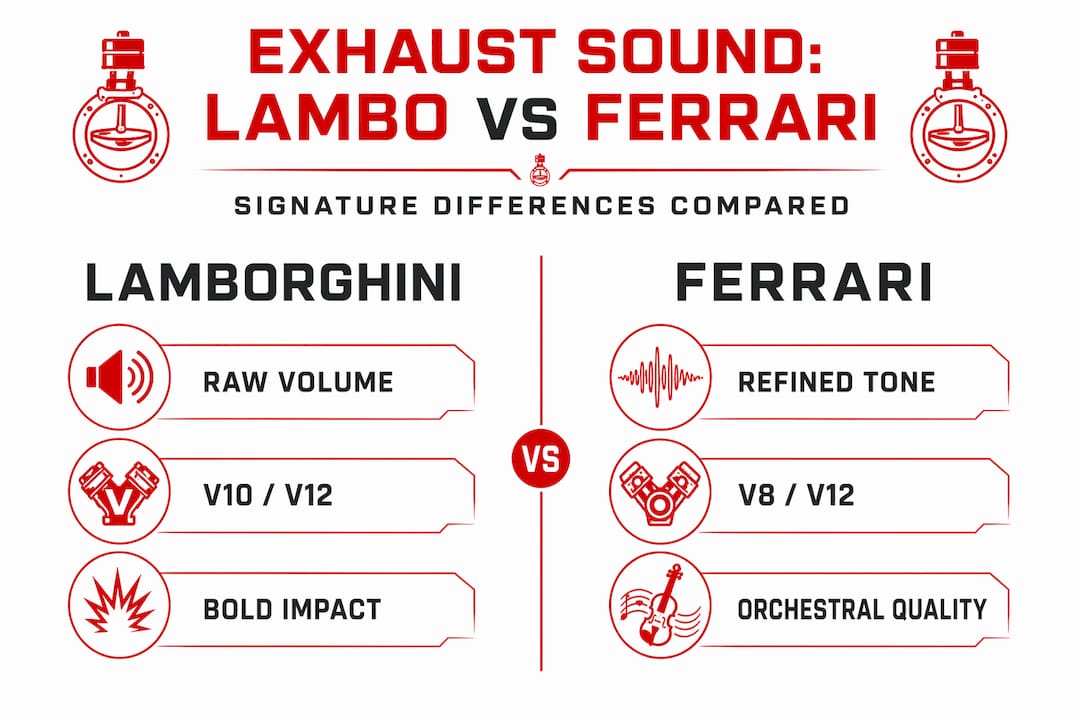
| Feature | Lamborghini | Ferrari |
|---|---|---|
| Engine type | V10 / V12 naturally aspirated | V8 / V12 naturally aspirated or turbocharged |
| Sound character | Raw, aggressive, high-volume | Refined, melodic, precise |
| Firing order emphasis | Odd-bank intervals for irregular cadence | Flat-plane crank for sharp, even pulse |
| Exhaust philosophy | Maximum emotional impact | Acoustic refinement and musical quality |
| Active valve approach | Dramatic mode-based shifts | Subtle, progressive transitions |
| Cultural identity | Rebellious, theatrical, extreme | Elegant, performance-focused, sophisticated |
This difference reflects brand heritage as much as engineering. Lamborghini was founded as a challenge to Ferrari, and that adversarial origin still shapes how the cars are built and how they sound. The sound philosophy prioritizes emotion over refinement, which is a specific engineering goal, not a limitation.
What makes all the technical factors coalesce
When you ask whether Lamborghini exhaust sound is distinctive, the answer is yes, and the reason is that no single factor creates it. The unique sound of Lamborghini is the product of multiple systems working together in a specific way.
Firing intervals, exhaust pulse timing, and harmonic resonance combine to produce the defining sound. Change any one of these variables and the character shifts noticeably. This is why turbocharged engines, even powerful ones, cannot replicate the Lamborghini note. A turbocharger absorbs exhaust energy before it can express itself acoustically. The pressure differential that creates the turbo boost also muffles the pulse energy that would otherwise translate into sound.
Natural aspiration is not just a performance choice at Lamborghini. It’s a sound choice. The Revuelto’s hybrid V12 retains natural aspiration specifically because the engineers and product team understand that electrification without it would fundamentally change the acoustic identity of the car.
There are also regulatory constraints that shape the engineering challenge. Modern noise regulations in Europe and the US require that production cars meet specific decibel limits at defined RPMs. Lamborghini’s acoustic engineers work within those constraints to preserve as much character as possible, which is why the active valve system exists. It’s a compliance tool that doubles as a sound control system.
What enthusiasts should specifically listen for in a Lamborghini exhaust:
- The transition from idle burble to mid-range growl between 2,000 and 4,000 RPM
- The point where the note shifts from growl to scream, typically around 5,500 RPM in the V10
- The harmonic layering at full throttle near redline, where multiple frequencies overlap into a single dense wall of sound
- The crackle and pop on deceleration, which is the result of unburned fuel igniting in the exhaust system
My take on what Lamborghini’s exhaust sound really means
I’ve spent time with both factory and aftermarket Lamborghini exhaust systems, and the honest truth is that the factory system is more impressive than most enthusiasts give it credit for. People chase aftermarket upgrades immediately, sometimes before they’ve actually learned to listen to what the stock system does at full throttle on a track.
What I’ve found is that the Novitec and Gintani systems are genuinely transformative, but they change the character as much as they amplify it. The factory V12 in Sport mode has a layered complexity that a straight-piped system sometimes flattens into pure volume. Louder is not always more interesting.
The thing most people overlook is that Lamborghini’s sound is engineered to create a specific emotional response. It’s not just noise. It’s a communication between the car and the driver. When the note shifts at 6,000 RPM, it’s telling you something about what the engine is doing. That information is part of the driving experience in a way that no digital sound synthesis can replicate.
My honest opinion is that if you’re considering a Lamborghini, you should spend time listening to the car before modifying it. Drive it in every mode. Take it to a track. Understand what the factory engineers intended. Then, if you want more, the aftermarket options from brands like Novitec and Akrapovič are genuinely excellent. But start with what you have. It’s more than most people realize.
— Info
Upgrade your Lamborghini’s exhaust with confidence
If this breakdown has you thinking seriously about what your Lamborghini could sound like with the right exhaust system, Valvecontrolexhaust has done the research so you don’t have to start from scratch.

Valvecontrolexhaust covers the full spectrum of performance exhaust options for Lamborghini owners, from IPE and Armytrix to Akrapovič and Ryft, with detailed sound and performance audits for each. Their valve control exhaust systems are specifically designed to give you real-time control over your exhaust note, so you can drive quietly through the city and open everything up when the road deserves it. For anyone serious about getting the most out of a Lamborghini’s acoustic identity, their buyer guides and system evaluations are the most thorough resource available.
FAQ
What makes Lamborghini exhaust sound different from other supercars?
Lamborghini’s V10 and V12 naturally aspirated engines produce high-frequency exhaust pulses through odd-cylinder bank configurations and rapid firing intervals, creating a raw, aggressive wail that turbocharged or lower-cylinder-count engines cannot replicate.
Does the exhaust system design affect Lamborghini’s sound?
Yes. Tuned-length headers, CFD-optimized collector geometry, and active butterfly valves all shape the acoustic signature, reinforcing desirable frequencies and suppressing harsh resonances across the RPM range.
Are aftermarket exhausts worth it on a Lamborghini?
Aftermarket systems from brands like Novitec and Akrapovič deliver genuine gains in both sound intensity and power output, with active valve systems preserving daily usability. The Novitec system on the Revuelto adds around 33 bhp alongside a sharper acoustic profile.
Why does natural aspiration matter for Lamborghini’s sound?
Naturally aspirated engines send exhaust pulse energy directly through the system without a turbocharger absorbing it first. This preserves the raw acoustic character that defines Lamborghini’s signature tone at high revs.
How does Lamborghini’s sound compare to Ferrari’s?
Lamborghini prioritizes dramatic volume and raw aggression, while Ferrari focuses on a refined, melodic exhaust note. Both approaches are deliberate engineering choices reflecting each brand’s distinct identity and cultural heritage.
Recommended
- Engineered Sound: A No-Nonsense Comparison of IPE, FI, Armytrix, Akrapovic, Valvetronic & Ryft – Valve Control Exhaust
- Valved Performance Exhausts: A Critical Evaluation of IPE, FI, Armytrix, Akrapovic, Valvetronic and Ryft – Valve Control Exhaust
- Decisive Sound and Performance Audit: IPE, FI, Armytrix, Akrapovic, Valvetronic & Ryft Evaluated – Valve Control Exhaust
- Performance Exhaust Buyer’s Guide: IPE, FI, Armytrix, Akrapovic, Valvetronic & Ryft – Valve Control Exhaust