
Automatic exhaust valve operation is controlled by the Engine Control Unit (ECU), which reads real-time engine data including RPM, throttle position, and load to trigger valve position changes without any driver input. The industry term for this technology is a valvetronic or valved exhaust system, though enthusiasts often describe the process as how exhaust valves toggle automatically. A butterfly valve rotates 90 degrees inside the exhaust pipe, shifting between a closed position that builds backpressure and an open position that maximizes flow. The result is a system that delivers quiet cruising on the highway and a full-throated roar under hard acceleration, all without you touching a button.
How do exhaust valves toggle automatically?
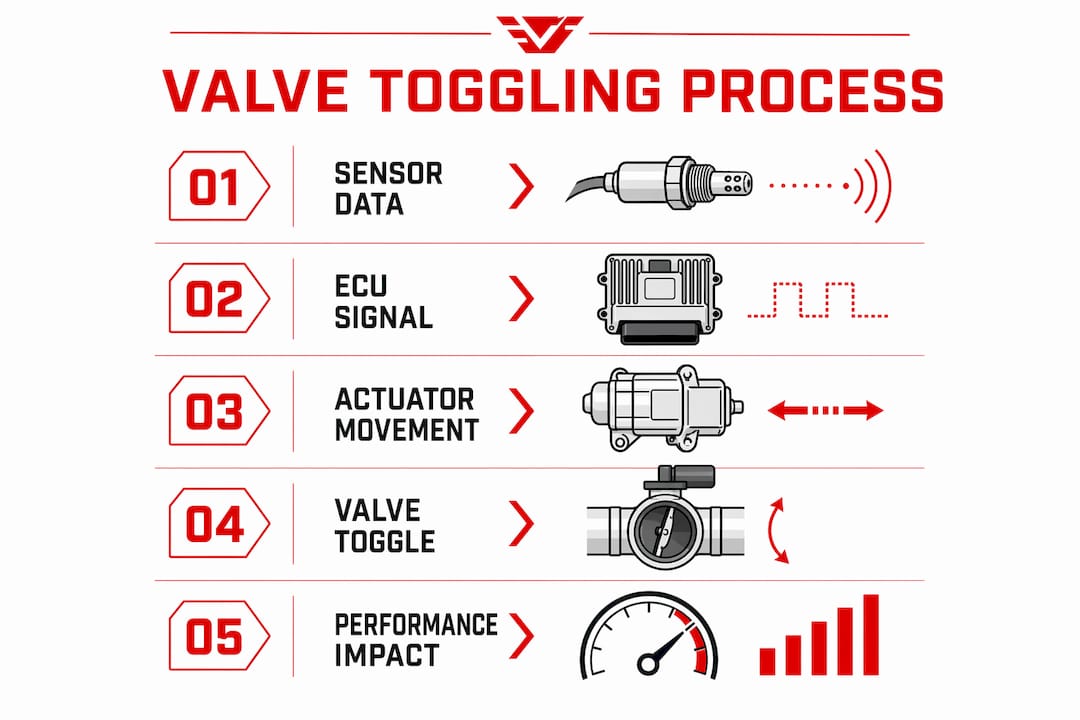
The core mechanism behind automatic toggling is a butterfly disc mounted inside the exhaust pipe. When the ECU signals a position change, an actuator rotates that disc roughly 90 degrees. That single rotation either blocks or opens the exhaust path, changing both backpressure and sound character instantly.
The ECU does not guess. It reads a continuous stream of sensor data covering throttle angle, engine load, vehicle speed, and RPM. When those inputs cross a programmed threshold, the ECU sends a command to the actuator. The automatic toggling provides balanced torque and power increases tuned precisely to driving conditions. This is why the transition between quiet and aggressive modes feels seamless rather than abrupt.

Valvetronic systems from brands like Armytrix, IPE, and Akrapovic all use this same fundamental logic. The ECU acts as the brain, the actuator acts as the muscle, and the butterfly valve is the physical gate controlling exhaust flow.
What components enable automatic valve toggling?
Three hardware layers work together to make automatic valve control possible: the valve assembly itself, the actuator, and the ECU with its sensor network.
The butterfly valve assembly sits inside the exhaust pipe, typically at the muffler section. It is a flat disc on a rotating shaft. When closed, it restricts flow. When open, exhaust gases pass with minimal resistance.
Actuators are the devices that physically move the valve. Two types dominate the market:
- Electric motor actuators use a small servo or stepper motor to rotate the valve shaft. They respond in milliseconds and can hold any position between fully closed and fully open.
- Vacuum actuators use engine vacuum pressure to pull a diaphragm that moves the valve. They are simpler mechanically but operate in binary states: open or closed.
The ECU and CAN bus tie everything together. CAN bus integration lets exhaust valves sync automatically with factory drive modes, opening in Sport and closing in Comfort without any driver input. On BMW M cars and Ferrari models, this integration is factory-standard. On aftermarket systems from Armytrix or FI Exhaust, a plug-and-play controller module taps into the existing CAN bus to replicate that behavior.
Pro Tip: If you are installing an aftermarket valved system on an Audi or BMW, confirm the controller module supports your specific CAN bus protocol before purchasing. Incompatible modules default to manual-only control, which defeats the purpose of automatic toggling.
Electronic vs. vacuum actuators: which controls valves better?
The actuator type defines how well your exhaust system responds to real-world driving. Here is a direct comparison of the two technologies:
| Feature | Electronic Actuator | Vacuum Actuator |
|---|---|---|
| Control range | Variable, 0%–100% open | Binary: open or closed |
| Response speed | Milliseconds | Slower, pressure-dependent |
| Heat and moisture resistance | Requires shielding | Naturally more resistant |
| Precision | High, programmable | Low, fixed positions |
| Typical application | Performance and luxury vehicles | Budget and entry-level systems |
| Long-term reliability | High with proper protection | Prone to sluggishness over time |
Electronic actuators react in milliseconds with precise variable control. That speed matters on a track where RPM climbs fast and you need the valve fully open before the engine reaches peak power. Vacuum actuators are slower and offer no middle ground. They are either blocking flow or not.
The tradeoff is environmental durability. Motor actuators are sensitive to road grime and salt, which is a real concern on daily-driven vehicles in northern states. Vacuum actuators handle heat and moisture better by design. That said, vacuum-actuated systems remain common in lower-cost products but are less reliable and responsive than electric actuators preferred by enthusiasts for performance upgrades.
Pro Tip: On a daily driver that sees winter roads, wrap electronic actuators in heat-resistant shielding tape and apply dielectric grease to all electrical connectors at installation. This adds years to actuator life.
How does valve position affect performance and sound?
Valve position directly controls two things: backpressure inside the exhaust system and the acoustic character of the exhaust note. These two variables are linked, and the function of exhaust valves goes well beyond simple noise control.
When the valve is closed, backpressure increases. Higher backpressure at low RPM improves torque by slowing exhaust gas exit and keeping combustion pressure in the cylinder longer. It also muffles the exhaust note, which is exactly what you want during early morning neighborhood driving or highway cruising.
When the valve opens fully, backpressure drops. The engine breathes freely, exhaust gases exit faster, and peak horsepower increases. The sound opens up into the aggressive, high-frequency note that makes a Ferrari 488 or Lamborghini Huracán sound the way it does at full throttle.
The key performance benefits of automatic toggling include:
- Low RPM torque gain from increased backpressure in closed mode
- Peak power increase from unrestricted flow in open mode
- Exhaust drone reduction during highway cruising with the valve partially or fully closed
- Emissions compliance through controlled flow at idle and low load
Valve timing affects combustion chamber integrity and engine efficiency in addition to modifying exhaust noise. This means automatic valve control is not just a sound trick. It is a genuine performance tool that affects how efficiently your engine converts fuel into power.
How do OEM and aftermarket systems implement auto valve control?
Both factory and aftermarket systems use the same underlying logic, but they differ significantly in how you interact with them and how much you can customize the behavior.
OEM systems on vehicles like the BMW M3, Ferrari Roma, or Audi RS6 integrate valve control directly into the factory drive mode selector. Here is how a typical OEM implementation works:
- The driver selects a drive mode (Comfort, Sport, or Sport Plus) via the center console.
- The mode selection sends a command over the CAN bus to the exhaust valve controller.
- The controller adjusts valve position to match the selected mode’s target sound and performance profile.
- The ECU continues monitoring RPM and load, making micro-adjustments within the selected mode.
Aftermarket systems from brands like Armytrix, Akrapovic, and FI Exhaust add a layer of user customization that OEM systems rarely offer. Sophisticated aftermarket systems offer remote controls and smartphone apps allowing manual toggling and programming of automatic open RPM thresholds. You can set the valve to open automatically above 3,500 RPM, for example, keeping the car quiet in traffic and loud on the on-ramp.
Auto-Mode lets users program valves to open above chosen RPMs, ensuring quiet low-speed cruising and aggressive high-speed performance without any manual switching. This RPM threshold programming is one of the most valued features among enthusiasts who want the system to behave intelligently without constant input. You can read a detailed breakdown of how these systems compare in the OEM vs. aftermarket valve control guide from Valvecontrolexhaust.
What maintenance do automatic exhaust valves require?
Automatic exhaust valve systems are durable, but they are not maintenance-free. The actuator type determines where your attention should focus.
For electronic actuator systems, the primary threats are environmental:
- Road salt and grime corrode actuator motor housings and electrical connectors over time
- Vibration from the exhaust system can loosen wiring harness connections
- Heat cycling causes connector pins to expand and contract, eventually causing intermittent faults
- Annual inspection of actuator mounts and wiring is the minimum recommended schedule
For vacuum actuator systems, the failure modes are different:
- Vacuum lines crack or harden with age, causing slow or incomplete valve movement
- Diaphragms inside the actuator can tear, resulting in a valve stuck in one position
- Moisture ingress into vacuum lines causes sluggish response in cold weather
Common troubleshooting steps for both types include checking for fault codes related to the exhaust valve circuit, manually cycling the valve by hand to confirm the shaft moves freely, and inspecting actuator mounting brackets for cracks or looseness. For a complete maintenance schedule, Valvecontrolexhaust publishes detailed guidance on exhaust valve system upkeep covering both electronic and vacuum systems.
Key takeaways
Automatic exhaust valve systems use ECU-driven actuators to toggle a butterfly valve between backpressure-building and flow-maximizing positions, delivering both performance gains and sound control without driver input.
| Point | Details |
|---|---|
| ECU controls valve position | The ECU reads RPM, throttle, and load data to trigger valve changes in real time. |
| Electronic actuators outperform vacuum | Electronic actuators respond in milliseconds with variable control; vacuum systems are binary and slower. |
| Valve position affects torque and power | Closed valves build low-RPM torque; open valves maximize high-RPM horsepower and exhaust flow. |
| CAN bus enables drive mode sync | Factory and aftermarket systems use CAN bus to align valve position with Sport or Comfort modes automatically. |
| RPM thresholds add customization | Aftermarket systems let you program specific RPM points where valves open automatically for hands-free sound control. |
The shift to electric actuation changed everything
I have followed valved exhaust technology for years, and the move from vacuum to electric actuation is the single biggest leap this technology has made. Vacuum systems were clever for their time. They worked. But they were blunt instruments. You got open or closed, loud or quiet, with no middle ground and no real precision.
Electric actuators changed the equation entirely. The ability to hold a valve at 40% open during a spirited canyon run, then snap it fully open at redline, is not a gimmick. It produces a measurably different power curve and a sound character that responds to how you are actually driving. On a BMW M4 or a Lamborghini Huracan, that responsiveness is part of what makes the car feel alive.
What I find underappreciated is how much the CAN bus integration matters for daily usability. A system that automatically goes quiet when you select Comfort mode and opens up in Sport mode means you never have to think about it. The car reads your intent and responds. That is the version of this technology worth investing in.
My advice for anyone upgrading: do not buy a system based on sound clips alone. Confirm it supports automatic RPM-based toggling and CAN bus integration for your specific vehicle. A system that only offers manual remote control is a step backward from what modern electronics can deliver. Brands like Armytrix, IPE, and Akrapovic have all solved this well. The exhaust sound and performance relationship is worth understanding deeply before you commit to a system.
— Info
Upgrade your exhaust valve system with Valvecontrolexhaust
If you are ready to move beyond stock exhaust behavior, Valvecontrolexhaust specializes in electronic valve control systems built for Audi, BMW, Ferrari, and Lamborghini. Their systems deliver real-time sound and performance control through automatic RPM-based toggling and full CAN bus integration.

The performance exhaust buyer’s guide from Valvecontrolexhaust covers IPE, FI Exhaust, Armytrix, Akrapovic, Valvetronic, and Ryft side by side, with detailed breakdowns of actuator type, CAN bus compatibility, and sound profiles. If you want to compare specific systems before buying, the leading valved exhaust analysis gives you the technical depth to make a confident decision.
FAQ
How does the ECU know when to toggle the exhaust valve?
The ECU monitors RPM, throttle position, and engine load in real time. When those values cross a programmed threshold, it sends a signal to the actuator to change valve position.
What is the difference between a valvetronic and a standard exhaust?
A valvetronic exhaust includes a motorized butterfly valve that opens and closes automatically based on driving conditions. A standard exhaust has no valve and maintains fixed backpressure at all times.
Can i program my own RPM threshold for automatic valve opening?
Yes. Most aftermarket systems from brands like Armytrix and FI Exhaust include a controller that lets you set a specific RPM above which the valve opens automatically, giving you quiet low-speed driving and full sound at high RPM.
Are electronic actuators more reliable than vacuum actuators?
Electronic actuators offer faster response and variable control but require protection from road grime and salt. Vacuum actuators resist heat and moisture better but are prone to sluggishness and binary-only operation over time.
Do automatic exhaust valves affect emissions?
Yes. Valve timing precision extends the exhaust valve’s role into engine efficiency and emissions management. Controlled valve position at idle and low load helps maintain proper combustion conditions and exhaust gas treatment.