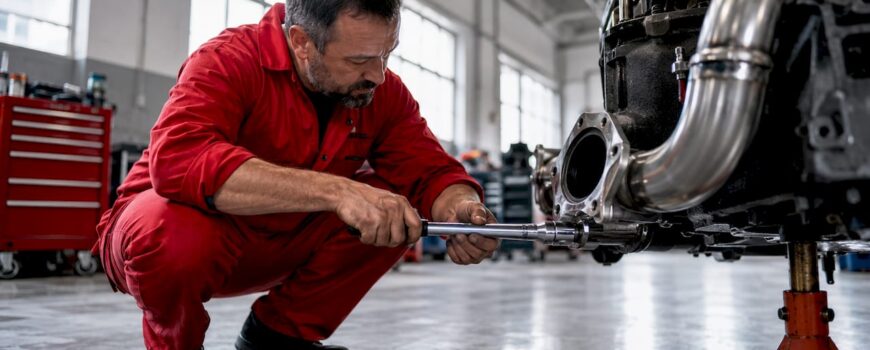
Common turbo exhaust setup errors are assembly and installation mistakes that directly cause boost leaks, exhaust leaks, and premature turbocharger failure. These faults show up on vehicles from BMW M-series to Audi RS platforms and affect every DIY tuner who skips a step or rushes a torque sequence. The damage is not always immediate. A small exhaust leak at the turbo flange can quietly rob boost pressure for weeks before you notice the performance drop. This guide covers the most critical turbo exhaust installation mistakes, how to recognize them, and exactly how to fix them.
1. common turbo exhaust setup errors at the flange
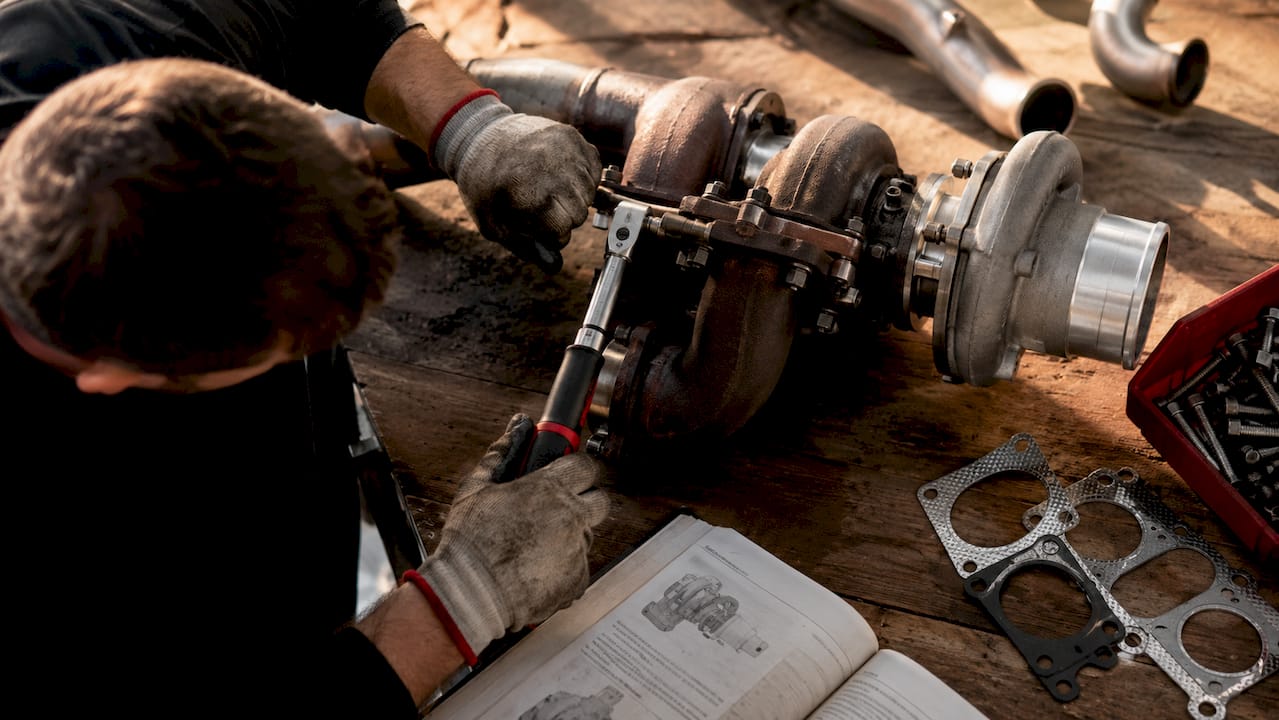
Flange installation is where most turbo exhaust problems start. Dirty mating surfaces prevent proper sealing, causing boost loss and soot deposits around the joint. Old gasket material, carbon buildup, rust, and grime all act as micro-gaps that exhaust gas exploits under pressure.
The most frequent flange mistakes include:
- Not cleaning mating surfaces. Carbon and rust prevent the gasket from seating flat. Use a wire brush and gasket scraper on both faces before assembly.
- Reusing old or damaged gaskets. A compressed gasket will not re-seal. Replace it every time you pull the flange.
- Misaligning the flange before tightening. Hand-thread all fasteners first. Never torque one side down while the other side floats.
- Using cheap hardware. Budget studs stretch under heat cycles. Grade 8 or OEM-spec hardware is the minimum standard.
- Skipping the torque sequence. Uneven tightening patterns distort flange faces and create persistent leaks. Always use a star pattern across multiple passes.
- Overtightening. Excessive torque crushes gaskets and warps mounting surfaces. More torque does not mean a better seal.
Pro Tip: Torque flange bolts in three passes at 30%, 60%, and 100% of the spec value. This distributes clamping load evenly and prevents gasket distortion.
2. clamping and pipe connection mistakes
Clamp errors are the second most common category of turbo exhaust installation mistakes. They are also the easiest to overlook because the joint looks secure until the engine reaches operating temperature.
- Placing clamps before final seating. Tighten clamps only after the pipe is fully seated and aligned. Clamping a misaligned pipe locks in the misalignment permanently.
- Over-tightening or under-tightening. Both cause problems. Over-tightening strips threads and crushes pipe ends. Under-tightening allows the joint to work loose under vibration.
- Skipping alignment checks. Misaligned pipes before clamping create mechanical stress at the joint. That stress cracks welds and opens leaks within a few heat cycles.
- Ignoring thread condition. Heat cycles corrode threads fast. Chase threads with a tap or die before reinstalling hardware.
- Not rechecking after the first heat cycle. Thermal expansion settles joints and loosens clamps. Retorque everything after the first full warm-up and cool-down cycle.
Pro Tip: Use a staged tightening approach: snug the clamp finger-tight, run the engine to operating temperature, let it cool completely, then torque to spec. This accounts for thermal settling and prevents leaks that show up after the first drive.
The high-rev exhaust setup guide from Valvecontrolexhaust covers clamp alignment and tightening sequences in detail for performance applications.
3. lubrication setup errors that kill turbos fast
Lubrication mistakes cause the most expensive damage of all common turbo setup faults. Turbo bearing damage from dry starts occurs within seconds. The oil film that centers the shaft and prevents metal-to-metal contact disappears the moment oil supply is interrupted or delayed.
The most damaging lubrication errors are:
- Skipping pre-lubrication before first startup. Turbo shafts require a fully pressurized oil film before the shaft spins. Crank the engine with the fuel pump fuse pulled for 10–15 seconds before the first start to prime the oil circuit.
- Reusing old or clogged oil feed lines. Partial oil feed restrictions reduce flow even when the dash oil pressure gauge reads normal. The gauge measures system pressure, not flow volume at the turbo.
- Ignoring oil return line angle. The drain must flow downhill at a steep angle. A kinked or flat drain line causes oil to pool in the center housing, which leads to seal failure and oil burning.
- Using old, contaminated oil. Installing a new turbo with dirty oil introduces abrasive particles directly into fresh bearings. Always change the oil and filter before starting a newly installed turbo.
“Turbo lubrication failure occurs in seconds,” notes Melett’s Tom Wright. “The focus must be on a clean, unrestricted oil supply, not just turbo replacement.” This means inspecting the entire oil feed path end to end, not just the turbo itself.
4. recognizing symptoms of turbo exhaust setup faults
Catching exhaust system tuning errors early saves you from replacing a turbo that is actually fine. Most symptoms point directly to the type of fault causing them.
| Symptom | Likely Cause |
|---|---|
| Ticking noise at cold start, fades in 30–60 seconds | Exhaust flange or gasket leak sealing as metal expands |
| Persistent ticking at all temperatures | Cracked manifold or failed gasket |
| Soot marks near turbo flange or joints | Active exhaust leak at that location |
| P0299 underboost code, max wastegate duty | Physical boost leak or exhaust restriction |
| Oily residue at turbo inlet | Oil seal failure, often from oil logging |
Cold-start ticking that fades within a minute is a classic exhaust leak signature. The metal expands with heat and temporarily closes the gap. That symptom alone tells you to inspect the flange before replacing any turbo components.
For boost-related codes, PCM wastegate duty cycle tracking separates physical leaks from control strategy faults. A P0299 code with the wastegate commanded fully closed and boost still low points to a physical leak or restriction, not a sensor or solenoid problem. Use an OBD scanner alongside the soapy water bubble test to confirm the leak location before pulling any parts.
Exhaust leaks near the turbo are frequently misattributed to turbo failure. Checking sealing integrity first prevents unnecessary and expensive turbo replacements.
5. wrong hardware and heat shield placement
Hardware selection is an underrated source of turbocharger exhaust issues. Standard zinc-plated bolts corrode and seize in exhaust applications within one season. The correct choice is stainless steel or nickel-plated hardware rated for temperatures above 1,000 degrees Fahrenheit.
Heat shields protect sensors, wiring, and rubber components from radiant heat. Removing or repositioning a heat shield during a turbo install and forgetting to reinstall it causes wiring harness damage, oxygen sensor failures, and even fire risk. Every bracket and shield that came off during the install goes back on before the engine starts.
Anti-seize compound on exhaust fasteners prevents future seizure but must be applied correctly. Use a thin, even coat on the threads only. Keep it off the sealing surfaces. Too much anti-seize on the wrong surfaces contaminates gaskets and reduces clamping force.
6. skipping root cause analysis before reinstalling
Replacing a turbo without fixing the root cause of the original failure guarantees a repeat failure. This is the most expensive mistake in the entire list. The new turbo fails for the same reason the old one did, and the exhaust leaks return with it.
The most common overlooked root causes include:
- Failed crankcase seals or clogged breathers. These force oil into the intake and exhaust, logging the turbo center housing and burning oil through the exhaust.
- Debris in the intake or exhaust system. A broken compressor wheel fragment left in the intercooler pipes will destroy the new turbo at first startup.
- Blocked or kinked oil drain lines. The drain must be clear before the new turbo goes in. A blocked drain causes immediate oil seal failure.
- Worn or leaking injectors. Fuel washing the cylinders dilutes oil and accelerates bearing wear in the new unit.
Pro Tip: Before installing a replacement turbo, blow compressed air through the entire intake path from the air filter to the compressor inlet. Any debris that comes out would have gone straight into your new turbo at startup.
Valvecontrolexhaust covers the connection between exhaust setup and turbo performance in depth, including how exhaust backpressure from installation errors affects spool time and power delivery.
Key takeaways
Fixing turbo exhaust setup errors requires clean surfaces, correct torque sequences, primed oil lines, and a full root cause inspection before any new parts go in.
| Point | Details |
|---|---|
| Clean flanges before assembly | Carbon, rust, and old gasket material prevent sealing and cause boost leaks. |
| Torque in a star pattern | Multiple-pass star sequences prevent flange distortion and gasket failure. |
| Prime oil before first start | Crank without fuel for 10–15 seconds to pressurize the oil circuit before startup. |
| Recheck clamps after heat soak | Thermal settling loosens clamps; retorque after the first full warm-up cycle. |
| Fix root causes before replacing turbos | Skipping root cause diagnosis causes repeat failures and wasted parts. |
What i’ve learned after years of watching turbos die unnecessarily
The single most common pattern I see is impatience. A builder spends hours pulling a turbo, gets the new one in hand, and rushes the reinstall because the hard part feels done. That is exactly when the expensive mistakes happen.
The torque sequence gets skipped because “it’s close enough.” The oil feed line gets reused because it looks fine. The clamps get tightened once and never rechecked. Every one of those shortcuts shows up later as a symptom that gets blamed on the turbo itself.
The diagnostic side is equally misunderstood. Cold-start ticking that fades in under a minute is not a turbo problem. It is a gasket telling you exactly where the leak is. Chasing that symptom with an OBD scanner and a soapy water bottle costs nothing. Replacing a turbo that did not need replacing costs a lot.
The root cause issue is the one that genuinely frustrates me. I have seen the same vehicle come back three times with a failed turbo because nobody checked the crankcase breather the first time. The fix was a $15 breather valve. The three turbos were not.
Use quality hardware, follow the factory torque specs, prime the oil system, and do not reinstall anything until you know why the last one failed. That sequence is not complicated. It just requires patience.
— Info
Get the right exhaust system for your turbo build

A correct turbo setup deserves an exhaust system built to the same standard. Valvecontrolexhaust evaluates premium performance exhaust systems from IPE, Armytrix, Akrapovic, Fi Exhaust, Valvetronic, and Ryft, focusing on build quality, sealing integrity, and real-world installation fit for Audi, BMW, Ferrari, and Lamborghini platforms. Their performance exhaust buyer’s guide covers the specific installation considerations that prevent the flange and clamp errors covered in this article. If you want a critical analysis of leading systems before you buy, Valvecontrolexhaust has done the work for you.
FAQ
What causes ticking noise after a turbo install?
Exhaust leak ticking at cold start that fades within 30–60 seconds points to a flange or gasket leak that seals as the metal expands with heat. Inspect the turbo flange and exhaust manifold gasket first before replacing any components.
How do i know if my turbo has a boost leak or a control fault?
Scan for a P0299 code and monitor PCM wastegate duty cycle. If the wastegate is commanded fully closed and boost is still low, the fault is a physical leak or restriction, not a sensor or solenoid issue.
Why does my new turbo keep failing?
Repeated turbo failures almost always trace back to an unfixed root cause such as a clogged oil feed line, failed crankcase seal, or debris left in the intake path. Replace the turbo only after identifying and correcting the original failure cause.
Do i need to prime the oil before starting a new turbo?
Yes. Crank the engine with the fuel pump fuse removed for 10–15 seconds before the first start. This pressurizes the oil circuit and prevents dry-start bearing damage, which can occur within seconds of startup.
When should i retorque exhaust clamps?
Retorque all exhaust clamps after the first complete heat cycle, meaning after the engine reaches full operating temperature and cools back down to ambient. Thermal expansion settles joints and loosens hardware during that first cycle.