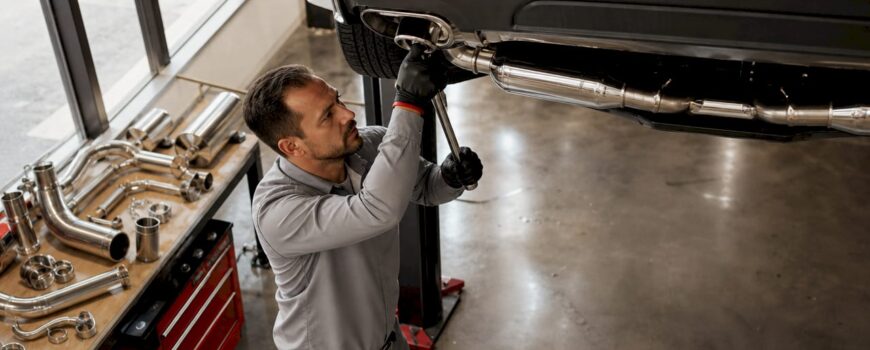
Specialist fitting is the single most important factor in whether a luxury exhaust system performs as engineered. The industry term for this work is precision exhaust installation, and it covers far more than bolting on pipes. On vehicles like Ferrari, Lamborghini, Audi, and BMW, the exhaust integrates directly with valve control systems, engine sensors, and NVH (noise, vibration, and harshness) management. A misaligned turbo flange or an incorrectly torqued V-band clamp can trigger dashboard warning lights, create exhaust drone at around 2,000 RPM, and void manufacturer warranties. Professional installations carry warranty protection covering six months on labor and one year or 12,000 miles on parts. That coverage alone separates expert fitting from any DIY attempt.
Why luxury exhaust requires specialist fitting: the engineering gap
Luxury exhaust systems are not standard aftermarket parts. They are precision-engineered assemblies built to tolerances that standard mechanics rarely encounter. Understanding this gap explains why specialist exhaust installation is non-negotiable for high-end vehicles.
The components themselves demand expert handling:
- V-band clamps and turbo flanges require exact alignment before any fastener is tightened. Even a small angular offset creates turbulence, audible drone, and eventual cracking at the joint.
- Valve control actuators connect directly to the vehicle’s ECU. Incorrect wiring or positioning causes fault codes and disables the active sound mode entirely.
- Stainless steel and titanium sections require TIG welding by someone trained in thin-wall exotic alloys. Standard MIG welding on these materials produces porous, brittle joints that fail under heat cycling.
- Heat-resistant alloy sections near turbochargers reach temperatures that warp flanges if the installer does not follow a staged warm-up sequence after fitting.
The material complexity alone rules out generic installation. Luxury exhausts built for vehicles like the Audi RS6 or BMW M5 also integrate with the vehicle’s active exhaust valve system, which requires compatibility assessment and specialized components to preserve both sound quality and performance targets.
Pro Tip: Before any luxury exhaust installation begins, request that the installer confirm compatibility between the exhaust valve actuator and your vehicle’s ECU software version. A mismatch here causes faults that no amount of mechanical adjustment will fix.
What goes wrong without a specialist?
Non-specialist installation of a luxury exhaust produces predictable failures. The list is not theoretical. These are the faults that professional workshops see repeatedly when correcting amateur work.
-
Exhaust drone at cruise RPM. Drone is caused by misaligned flanges that create standing pressure waves in the exhaust path. Specialists report this commonly triggers at 2,000 RPM and turns a pleasurable driving experience into an exhausting one on any highway run.
-
Exhaust leaks from gasket failure. Improper gasket seating or flange warping from incorrect torque allows hot gases to escape. These leaks are a safety hazard and accelerate corrosion of surrounding components.
-
Dashboard warning lights. Sensor misalignment or valve control faults from incorrect actuator positioning trigger CEL (check engine light) codes. Clearing these codes without fixing the root cause causes them to return within days.
-
Thermal damage to bodywork and sensors. Without proper heat shielding, carbon fiber bodywork and wiring looms absorb radiant heat from the exhaust. Heat soak damage to paint and sensors is expensive to repair and often not covered by insurance.
-
Rattles and joint failures within the first 1,000 miles. Incorrect torque on V-band clamps does not fail immediately. Thermal expansion during aggressive driving causes rattles and leaks to emerge within 500–1,000 miles of installation.
The common thread across all five failures is the same. DIY installers and general mechanics lack the specialized tools required: vehicle lifts that allow full underside access, calibrated torque tools, and diagnostic scan systems that read valve actuator status in real time.
How specialists achieve a correct fit every time
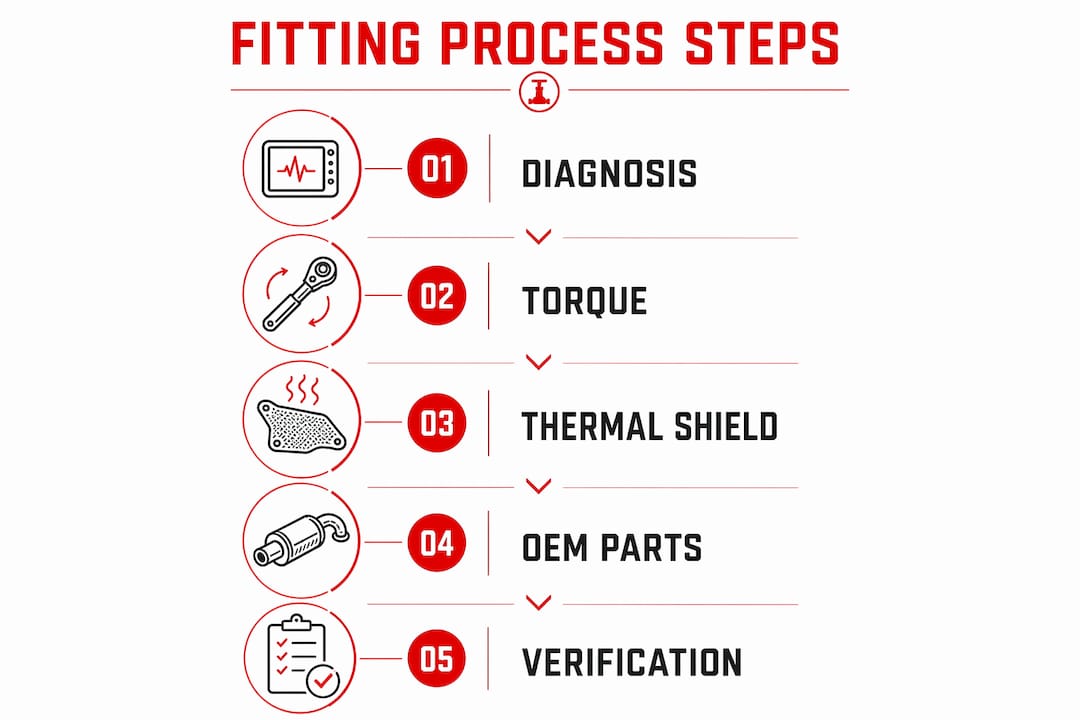
Professional fitting is a multi-step diagnostic and mechanical process. Specialists treat luxury exhaust work as a control-systems problem, not a fabrication task. That mindset changes every step of the installation.
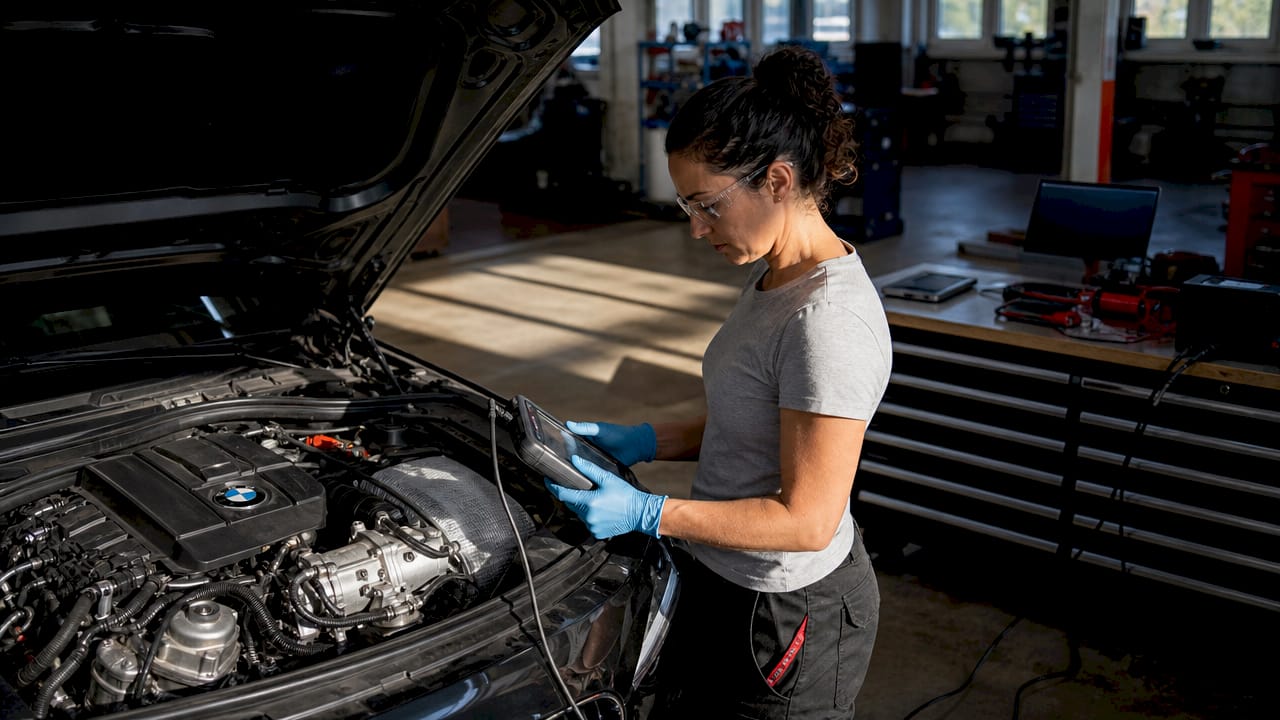
Diagnostic verification before and after fitting
A specialist begins with a scan-tool interrogation of the existing exhaust system to log any pre-existing fault codes. After installation, smoke testing confirms zero leaks across every joint and gasket surface. NVH mapping checks for resonance frequencies that indicate misalignment. This three-step diagnostic sequence catches problems before the car leaves the workshop.
Torque sequencing on clamps and flanges
Torque specifications on V-band clamps are not arbitrary numbers. They are calculated to allow controlled thermal expansion without joint movement. Specialists follow manufacturer torque sequences, tightening in stages rather than to final torque in a single pass. Correct torque sequences prevent the thermal expansion rattles and leaks that appear within the first 1,000 miles of hard driving.
Thermal management and heat shielding
Specialists install heat shields around carbon fiber bodywork, wiring looms, and fuel lines wherever the exhaust routing passes close to these components. This is not optional on vehicles like the Ferrari 488 or Lamborghini Huracán, where the exhaust exits near the rear diffuser and bodywork. Thermal management is the step most often skipped by non-specialists, and it is the one that causes the most expensive long-term damage.
Pro Tip: Ask your installer to show you the heat shield placement plan before work begins. If they cannot produce one, that is a clear sign they are not equipped for luxury exhaust work.
OEM-grade components throughout
Specialists use OEM-grade gaskets, clamps, and actuators matched to the specific vehicle model. Generic hardware introduces dimensional variation that undermines even a technically correct installation. On a Valvecontrolexhaust active valve system, the actuator must meet the exact stroke and response time specified for the vehicle’s ECU to recognize it as functioning correctly.
What are the real benefits of professional exhaust fitting?
The case for professional fitting goes beyond avoiding problems. The benefits are concrete and measurable for any luxury car owner.
- Warranty coverage. Professional installations carry labor and parts warranties that DIY work cannot provide. Six months on labor and one year or 12,000 miles on parts is standard at qualified workshops.
- Sound quality. Precise flange alignment and OEM-grade sealing surfaces preserve the exhaust note the manufacturer or aftermarket brand engineered into the system. A misaligned system sounds different from the first drive.
- Vehicle value. Documented professional installation protects resale value. Buyers of used Ferraris, Lamborghinis, and high-spec BMWs check service records. An undocumented exhaust modification raises red flags.
- Engine response. A leak-free, correctly routed exhaust maintains the back-pressure profile the engine management system expects. Leaks alter this profile and reduce throttle response.
- Compliance with manufacturer specifications. Luxury vehicles like those supported by Valvecontrolexhaust require that exhaust upgrades meet specific compatibility standards to avoid voiding the powertrain warranty.
| Benefit | What it means in practice |
|---|---|
| Warranty protection | Six months labor, one year or 12,000 miles on parts |
| Sound quality | Correct flange alignment preserves the engineered exhaust note |
| Vehicle value | Professional records support resale price on luxury models |
| Engine response | Leak-free systems maintain correct back-pressure for ECU mapping |
| Compliance | Meets manufacturer specs and protects powertrain warranty |
Key takeaways
Luxury exhaust specialist fitting is the only method that preserves engineered performance, sound quality, and warranty coverage on high-end vehicles.
| Point | Details |
|---|---|
| Precision torque is non-negotiable | Incorrect V-band torque causes leaks and rattles within 500–1,000 miles of driving. |
| Diagnostics are part of the job | Scan-tool checks and smoke testing before and after fitting catch faults before they become failures. |
| Thermal management protects the car | Heat shielding around carbon fiber and wiring prevents expensive long-term damage. |
| Warranties require professional work | Six-month labor and one-year parts coverage is only available through qualified installers. |
| OEM-grade parts matter | Generic hardware introduces dimensional variation that undermines even a technically correct fit. |
The part most enthusiasts underestimate
I have seen the same mistake repeated across dozens of luxury exhaust consultations. The owner buys a genuinely excellent system, spends serious money on the hardware, and then tries to save on installation. The result is always the same: drone at highway speeds, a check engine light within a week, and a return visit to a specialist that costs more than the original fitting would have.
The reason this happens is a fundamental misunderstanding of what a luxury exhaust system actually is. It is not a set of pipes. It is an active exhaust system with valve actuators, ECU integration, and sound-tuning logic built into the hardware. Treating it like a standard bolt-on part is the mistake. A specialist brings scan tools, torque sequences, and thermal management knowledge that no YouTube tutorial replicates.
My advice to any enthusiast considering a self-install or a budget fitting shop: price the rework before you commit to the shortcut. The cost of correcting a bad installation on a Ferrari or Lamborghini exhaust typically exceeds the cost of doing it right the first time. Precision is not a luxury on these cars. It is the baseline requirement.
— Info
Valvecontrolexhaust and expert fitting for luxury vehicles
Valvecontrolexhaust builds active valve exhaust systems for Audi, BMW, Ferrari, and Lamborghini with real-time sound and performance control built in. Getting that technology to perform as designed requires the same level of precision fitting described throughout this article.
Valvecontrolexhaust supports owners with detailed fitment guidance and compatibility verification for every system it produces. Whether you are upgrading an Audi RS or specifying a system for a Lamborghini Huracán, the exhaust customization process starts with matching the right hardware to the right vehicle and ends with a verified, leak-free installation. Explore the full range of valve-controlled exhaust options and find the system built for your car.
FAQ
Why does luxury exhaust fitting require specialist tools?
Luxury exhaust systems integrate with ECU-controlled valve actuators and require calibrated torque tools, diagnostic scan systems, and smoke testing equipment that general mechanics do not carry. Without these tools, correct installation is not achievable.
What causes exhaust drone after a non-specialist installation?
Exhaust drone is caused by misaligned flanges that create pressure waves in the exhaust path. Specialists report this commonly appears at 2,000 RPM and is directly linked to incorrect flange alignment during fitting.
Does professional exhaust fitting come with a warranty?
Yes. Qualified workshops provide warranty coverage of six months on labor and one year or 12,000 miles on parts. DIY installation carries no warranty protection.
Can a bad exhaust installation trigger warning lights?
Yes. Sensor misalignment or valve actuator faults from incorrect fitting trigger check engine light codes. These codes return after clearing unless the underlying installation error is corrected.
How does specialist fitting protect vehicle value?
Documented professional installation appears in the service record and reassures buyers that the exhaust modification meets manufacturer specifications. Undocumented modifications reduce buyer confidence and resale price on luxury vehicles.