
Exhaust customization in luxury vehicles is defined as the engineered modification of acoustic signature and flow performance through precise geometry, material selection, and valve control. This is not a bolt-on aftermarket hobby. Brands like Lamborghini and Akrapovič treat exhaust engineering as a core expression of vehicle identity, validating every system against strict OEM acoustic standards. The result is a driving experience shaped by turbulence control, pressure wave timing, and flow optimization. Understanding why exhaust customization matters in luxury cars means understanding why sound, performance, and brand character are inseparable.
Why exhaust customization matters for luxury performance and sound
The acoustic quality of a luxury exhaust is determined by physics, not volume. X-pipe placement and post-merge routing directly control turbulence and rasp. Position an X-pipe too close to the outlet and you get a harsh, unrefined tone. Give the pressure waves enough distance to stabilize after the merge point and the result is a smooth, layered sound that complements the engine’s natural character.
Material choice amplifies this effect. Titanium is the preferred material in premium systems because it reduces weight while delivering a sharper, more resonant tone compared to stainless steel. Lamborghini’s titanium exhaust systems for the Urus and Huracán are engineered with this principle at their core, combining advanced material science with geometry validated through internal acoustic testing.

Stepped tubing adds another layer of precision. By splitting and multiplying pressure waves at specific intervals, stepped sections emphasize desirable frequencies and suppress unwanted noise without relying heavily on muffler packing. This is why a well-engineered luxury exhaust sounds full and intentional rather than loud and chaotic.
Performance gains follow the same logic. Better flow through optimized pipe routing reduces back pressure, which translates directly into horsepower and torque improvements. The acoustic refinement and the performance gain are products of the same engineering decision.
Pro Tip: When evaluating a custom exhaust for a luxury vehicle, ask the fabricator specifically about X-pipe distance from the outlet and whether stepped tubing is used. These two factors separate refined systems from simply loud ones.
Key factors that define a high-quality luxury exhaust upgrade:
- Routing geometry that controls pressure wave timing and turbulence
- Titanium or high-grade stainless steel construction for weight and tone
- Stepped tubing sections to shape frequency response
- Precise X-pipe or H-pipe placement relative to the merge point
- Compatibility with the vehicle’s existing ECU and emissions setup
Cat-back vs. axle-back: which upgrade suits your luxury car?
The two most common entry points for custom exhausts for luxury cars are cat-back and axle-back systems, and the difference between them is substantial.
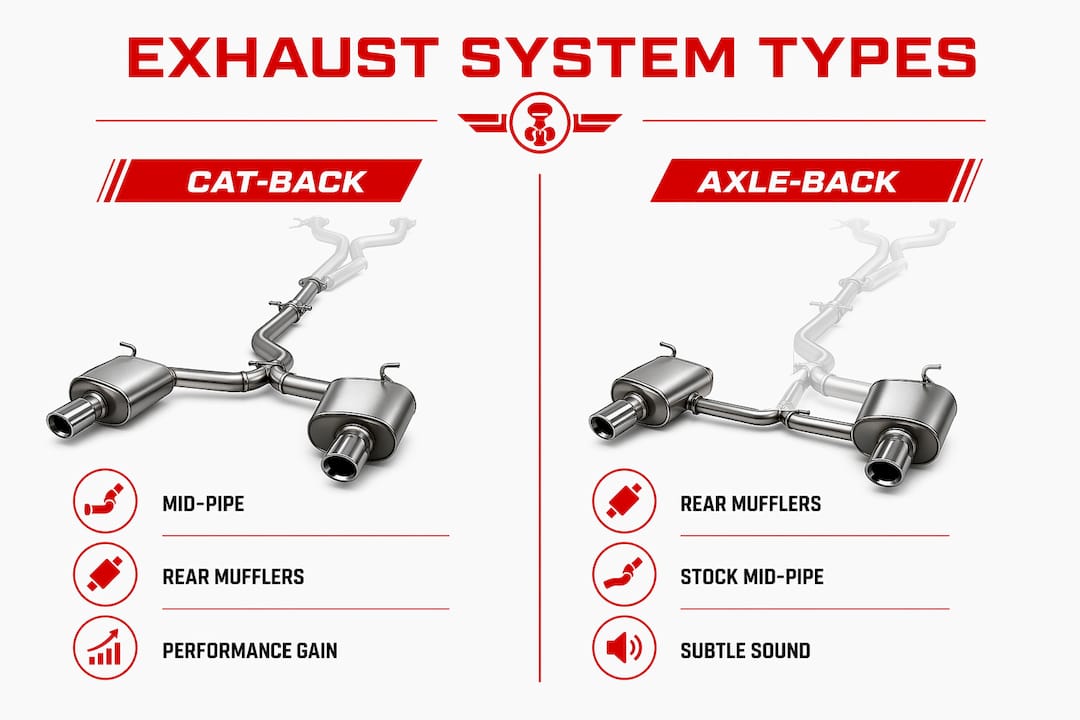
A cat-back system replaces everything from the catalytic converter back, including the mid-pipe and rear mufflers. This full replacement removes the most restrictive sections of the stock system, which is why cat-back systems typically deliver 10 to 20 HP gains along with a transformative change in exhaust note. The trade-off is installation complexity. A cat-back typically requires 2 to 4 hours of professional labor and precise alignment to avoid leaks or drone.
An axle-back system swaps only the rear mufflers, leaving the mid-pipe and catalytic converter untouched. The result is a more modest change in sound and axle-back systems produce roughly 1 to 3 HP gains, which reflects the limited scope of the modification. Installation takes about one hour and requires fewer specialized tools. For owners who want a subtle audio upgrade without committing to a full system overhaul, axle-back is the logical starting point.
| Feature | Cat-back system | Axle-back system |
|---|---|---|
| Sections replaced | Mid-pipe and rear mufflers | Rear mufflers only |
| Typical HP gain | 10 to 20 HP | 1 to 3 HP |
| Sound change | Transformative | Modest |
| Installation time | 2 to 4 hours | About 1 hour |
| Cost | Higher | Lower |
| Best for | Full acoustic overhaul | Subtle personalization |
Pro Tip: On turbocharged luxury platforms like the BMW M5 or Audi RS7, cat-back systems deliver the most noticeable gains because the turbo already suppresses much of the exhaust note. Axle-back changes on these cars can feel underwhelming without addressing the mid-pipe.
Why luxury exhaust sound is engineered, not just amplified
Luxury brands do not design exhaust systems to be loud. They design them to be right. Lamborghini treats exhaust sound as a component of the vehicle’s engineered acoustic identity, not a volume enhancement. Every frequency, every harmonic, and every resonance is validated against the brand’s standard before a system reaches production.
This distinction matters when you are choosing an aftermarket upgrade. A system that simply removes muffler packing and increases decibels is not a luxury upgrade. It is a regression. The exhaust sound functions as a mechanical signature that communicates engine personality and creates emotional connection between driver and machine. Destroying that signature with brute loudness eliminates the very quality that makes a luxury car feel special.
“Good exhaust tone depends on exhaust flow physics and geometry. Routing and timing trump simple loudness for a refined sound.” — Fluid MotorUnion
Regulations complicate this further. Many aftermarket systems are not legal for road use due to noise and emissions restrictions, which means the most aggressive-sounding options are often track-only configurations. Premium manufacturers and brands like Akrapovič navigate this by engineering systems that meet road-legal standards while still delivering a character that exceeds the stock setup. Understanding the unique sound of Lamborghini exhausts requires understanding this balance between regulation, engineering, and brand intent.
Practical considerations when customizing your luxury car exhaust
Before committing to a luxury vehicle exhaust upgrade, define your primary goal. The decision tree looks different depending on whether you want maximum performance gains, a specific acoustic character, or simply a more personal touch on an already refined car.
Here are the core considerations that should shape your decision:
- Performance vs. sound priority. Cat-back systems address both. If your goal is purely acoustic refinement with minimal mechanical disruption, a high-quality axle-back or a valved muffler replacement may be sufficient.
- Material selection. Titanium offers the best weight-to-tone ratio but carries a premium price. High-grade 304 or 316 stainless steel is a durable, cost-effective alternative that still outperforms stock mild steel systems.
- Valved systems for flexibility. Valved exhausts allow drivers to switch between aggressive and quiet modes without removing any hardware. This is particularly valuable for daily-driven luxury cars where neighborhood noise levels matter as much as track presence. Valvecontrolexhaust specializes in exactly this type of system for platforms including Ferrari, Lamborghini, Audi, and BMW.
- Installation complexity and future-proofing. A cat-back system installed without proper alignment creates exhaust leaks that degrade both sound and performance over time. Factor in professional installation costs and confirm the system is compatible with any planned ECU or tune upgrades.
- Maintenance requirements. Titanium systems require less corrosion maintenance than stainless steel but are more sensitive to impact damage. Review exhaust valve maintenance requirements before committing to a valved system, especially if the car sees winter driving.
The role of exhaust in the luxury experience extends beyond the drive itself. A well-chosen system holds its value, complements the vehicle’s resale profile, and signals to other enthusiasts that the owner understands the engineering behind the car.
Key takeaways
Exhaust customization in luxury vehicles delivers both acoustic identity and measurable performance gains when it is grounded in geometry, material quality, and valve control rather than simple volume increases.
| Point | Details |
|---|---|
| Geometry drives sound quality | X-pipe placement and stepped tubing shape tone more than muffler size or tip diameter. |
| Cat-back outperforms axle-back | Cat-back systems deliver 10 to 20 HP gains and transformative sound; axle-back offers modest 1 to 3 HP changes. |
| Luxury sound is engineered | Lamborghini and Akrapovič validate exhaust acoustics as part of brand identity, not volume targets. |
| Valved systems offer daily flexibility | Adjustable valves let drivers switch between aggressive and quiet modes without hardware changes. |
| Material choice matters | Titanium reduces weight and sharpens tone; stainless steel offers durability at lower cost. |
The case for treating exhaust sound as a design decision
After spending years evaluating exhaust systems across platforms ranging from the Audi RS6 to the Ferrari 488, the pattern I keep returning to is this: the owners who are most satisfied with their upgrades are the ones who approached sound as a design decision, not a loudness competition.
The most common mistake I see is choosing a system based on a YouTube clip recorded at wide-open throttle. That tells you almost nothing about how the car sounds at 2,000 RPM on a morning commute, which is where you will actually spend most of your time. The exhaust sound at idle and partial throttle is where engineering quality reveals itself. Drone, rasp, and resonance at cruise speed are the failure modes that no highlight reel shows you.
The second mistake is ignoring routing. I have seen beautifully made systems installed on premium cars that drone badly because the fabricator did not account for pressure wave timing through the mid-pipe. The hardware was excellent. The geometry was wrong. The result was a car that sounded worse than stock at highway speed.
What actually works is the approach Lamborghini and Akrapovič use: start with the acoustic target, then engineer backward through geometry, material, and valve placement to hit it. Valvecontrolexhaust applies this same logic to their valved systems, which is why their fitments on BMW and Ferrari platforms consistently deliver the character owners are looking for without the drone penalty.
Exhaust sound is not a feature you add. It is a property you engineer. Treat it that way and the result will still feel right five years from now.
— Info
Upgrade your luxury exhaust with Valvecontrolexhaust
Valvecontrolexhaust builds valved exhaust systems specifically for high-performance luxury platforms including Audi, BMW, Ferrari, and Lamborghini. Their systems give you real-time control over sound mode, letting you run quiet in residential areas and open up the full acoustic character when the road calls for it.
If you are ready to move beyond stock and want a system that balances engineered refinement with genuine performance gains, the performance exhaust buyer’s guide at Valvecontrolexhaust covers IPE, FI Exhaust, Armytrix, Akrapovič, Valvetronic, and Ryft in detail. It is the clearest starting point for any enthusiast who wants to make an informed decision rather than a loud one.
FAQ
What does exhaust customization actually do for a luxury car?
Exhaust customization modifies acoustic signature and flow performance through geometry, material selection, and valve control. The result is a combination of refined sound character and measurable power gains, typically 10 to 20 HP for cat-back systems.
How does a luxury exhaust differ from a standard aftermarket system?
Luxury exhaust systems like those from Lamborghini and Akrapovič are engineered to a specific acoustic identity validated through internal testing, while standard aftermarket systems typically prioritize volume over tonal refinement or flow optimization.
Are valved exhaust systems worth it for daily-driven luxury cars?
Valved systems are the most practical upgrade for daily drivers because they allow switching between quiet and aggressive sound modes without any hardware changes, preserving neighborhood usability while delivering full character on demand.
Is a cat-back or axle-back system better for a luxury sports car?
Cat-back systems are the stronger choice for owners who want both performance gains and a transformed sound profile. Axle-back systems suit owners who want modest audio personalization with simpler installation and lower cost.
Do aftermarket exhausts on luxury cars affect road legality?
Many high-performance aftermarket systems are not legal for road use due to noise and emissions regulations. Confirm road-legal certification before purchasing, particularly for daily-driven vehicles in states or countries with strict sound ordinances.