
Exhaust pulse tuning is the practice of timing reflected pressure waves so a low-pressure (rarefaction) wave arrives at the exhaust port during valve overlap, actively scavenging the cylinder and improving volumetric efficiency at a target RPM. This is the real mechanism behind performance headers — not simply reducing backpressure. For luxury sports car owners, valve-controlled systems make this practical: valves open at high RPM to deliver race-style scavenging, then close at low speeds to keep the car street-legal and quiet, a balance MotorTrend’s engineering analysis confirms is achievable without sacrificing either goal.
Key facts at a glance:
- The performance gain comes from scavenging, not low backpressure alone
- Primary pipe length and collector geometry set which RPM the tuning targets
- Valve-controlled systems from brands like Valve Control Exhaust, Akrapovic, Armytrix, IPE Exhaust, Fi Exhaust, Valvetronic, and Ryft Exhaust let you shift between tuned and muffled modes on demand
- Pulse tuning is RPM-specific; downstream changes (mufflers, tailpipes) can disrupt it
Table of Contents
- What is exhaust pulse tuning and how do the physics work?
- Why scavenging beats backpressure reduction as the real goal
- How valve-controlled exhausts change the equation for luxury sports cars
- Practical limits, tradeoffs, and U.S. legal considerations
- Is pulse tuning the right mod for your luxury car?
- How exhaust pulse tuning evolved historically
- How engine type changes the pulse tuning picture
- How do you verify that pulse tuning is actually working?
- What pulse tuning does to emissions and fuel efficiency
- Software and engine management integration in modern vehicles
- Key Takeaways
- The part most buyers get wrong
- Valvecontrolexhaust builds valve systems that actually fit your car
- Primary sources and further reading
What is exhaust pulse tuning and how do the physics work?
Two things happen the instant an exhaust valve opens. Gas particles begin moving down the pipe — relatively slowly. Simultaneously, a pressure wave launches from the valve at close to the speed of sound in the pipe, which in a hot exhaust environment runs roughly 1,700 ft/sec. That wave is what pulse tuning actually exploits.
When the wave reaches a change in cross-section — a collector, a merge, an open pipe end — part of it reflects back as a negative (low-pressure) wave. If the pipe length is right for the engine’s RPM, that negative wave arrives back at the exhaust port exactly during valve overlap, when both intake and exhaust valves are briefly open. The result: the low-pressure zone pulls fresh charge in and pushes residual exhaust out simultaneously. That’s scavenging, and it’s the primary performance mechanism in a well-designed header.
The acoustic variables that control all of this:
- Primary pipe length — longer pipes time the wave for lower RPM; shorter pipes target higher RPM
- Pipe diameter — sets gas velocity and pulse intensity, not wave timing
- Collector geometry and area ratio — determines reflection amplitude and pulse width
- Temperature — hotter exhaust gases raise the local speed of sound, shifting the tuned RPM slightly upward
- Merge/nozzle sections — tapered transitions broaden the effective tuning band by spreading reflection energy across multiple RPM points
Statistic callout: Pressure waves travel at roughly 1,700 ft/sec inside a hot exhaust pipe. A primary tube that is too long or too short by even a few inches can shift the tuned RPM band noticeably on a high-revving engine.
Pro Tip: Packaging constraints on luxury cars — tight engine bays, catalytic converter placement, underbody clearances — often force primary length compromises. Understanding how exhaust packaging affects tuner choice before you spec a system saves expensive rework.
Why scavenging beats backpressure reduction as the real goal
The backpressure myth runs deep in car culture. The idea that “less restriction = more power” is not wrong, but it’s incomplete — and chasing it alone leads to oversized pipes that actually hurt performance. Engineering sources are clear: a well-timed negative wave at valve overlap can create a partial vacuum at the exhaust port far stronger than anything the piston’s intake stroke generates on its own.
Short primaries push the tuned band toward high RPM, which is why naturally aspirated sports cars with short headers scream at the top of the rev range. Long primaries shift torque lower, useful for street driving or towing. Get the diameter wrong — too large — and gas velocity drops, the pulse weakens, and the scavenge effect disappears entirely regardless of how well the length is calculated.
A few practical implications:
- Torque band shape is a direct result of primary length, not just cam timing
- Collector design matters as much as primary length; a poorly designed merge can scatter pulse energy across all connected pipes rather than reflecting it cleanly
- Pipe diameter is not “bigger is better” — oversizing kills the velocity that makes scavenging work
Pro Tip: If a seller pitches a system purely on “reduced backpressure” without mentioning scavenging or tuned primary length, that’s a signal they don’t fully understand what they’re selling.
How valve-controlled exhausts change the equation for luxury sports cars
A fixed header is tuned for one RPM range. Drive below that range and you’re leaving performance on the table; drive above it and the tuning works against you. Valve-controlled systems solve this by letting the exhaust behave differently depending on conditions.
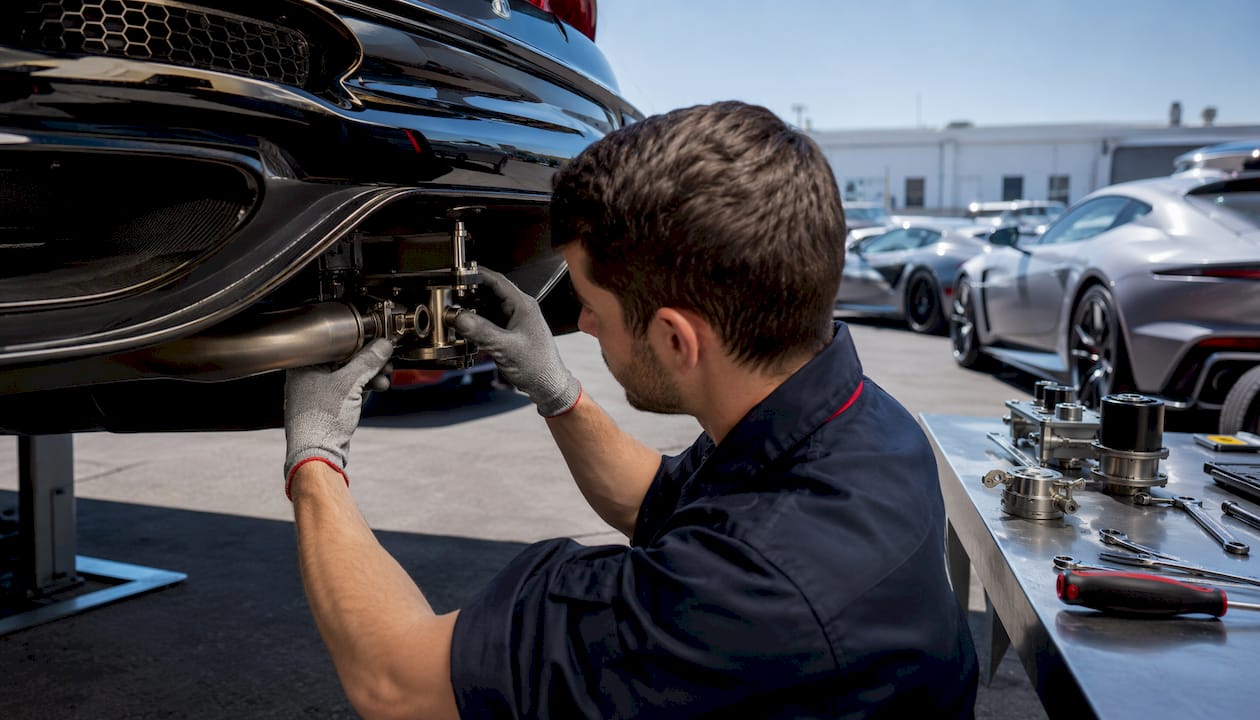
With valves open at high RPM, the system presents a high-flow path that preserves pulse tuning and scavenging. With valves closed at low speeds or in comfort mode, the exhaust routes through baffled sections that reduce noise without requiring the header geometry to change. The key insight from MotorTrend’s analysis is that pressure wave tuning and backpressure minimization can be treated as separate factors — valve systems make that separation physically real.
Common valve behaviors on modern systems:
- Automatic RPM switching — valves open above a set threshold, typically mapped to the engine’s power band
- Driver-mode maps — Sport, Comfort, and Track modes trigger different valve positions via the ECU
- Manual override — wired switches or app-based controls for immediate driver input
- CAN bus integration — on Audi, BMW, Ferrari, and Lamborghini platforms, valve commands travel over the vehicle’s existing data network
Tradeoffs to expect: added weight from actuators and wiring, packaging complexity in tight engine bays, and the risk that a valve closing at the wrong RPM point disrupts the very scavenging it was meant to preserve. Electronically controlled exhaust systems require careful ECU mapping to avoid that scenario.
Practical limits, tradeoffs, and U.S. legal considerations
Pulse tuning is inherently RPM-specific. Outside the tuned band, the engine can actually perform worse than a simpler system because the returning wave arrives at the wrong phase. Designers use tapered collectors and multi-stage reflections to broaden the effective band, but there’s always a tradeoff between peak gain and bandwidth.
Downstream changes are a particular hazard. Swapping a muffler or increasing tailpipe diameter after the header is designed can shift or destroy the tuned effect entirely. The system is a resonant assembly; change one component and the whole tuning shifts.
U.S.-specific considerations:
- State and local noise ordinances vary widely. California’s vehicle code, for example, sets specific decibel limits for modified exhaust. Check your state’s DMV regulations and local municipal codes before installing any aftermarket system.
- Emissions compliance — catalytic converter placement affects both pulse timing and legal status. Removing or relocating cats to optimize primary length can trigger OBD-II fault codes and fail a smog inspection in emissions-testing states.
- Heat management — luxury cars carry dense sensor arrays, wiring harnesses, and composite underbody panels close to the exhaust path. Any system that changes routing needs to account for clearances and heat shielding.
Is pulse tuning the right mod for your luxury car?
The owner who benefits most is someone who tracks their car occasionally or wants variable sound on the street, not someone looking for a simple drone reduction. A valve-controlled system is a meaningful engineering change, not a bolt-on accessory.
Pricing varies considerably by vehicle platform and materials (titanium vs. stainless), but a quality valve-controlled aftermarket system with professional installation typically costs significantly more than a basic muffler swap. The installation process for a luxury car involves more than wrenching.
A realistic installation sequence:
- Compatibility check (1–2 days) — confirm fitment, emissions equipment location, ECU access
- Parts sourcing (1–4 weeks) — many systems are built to order
- Fabrication and fitting (1–3 days) — header fitment, valve placement, heat shielding
- ECU integration (half day to 1 day) — map valve trigger points to RPM and driver modes
- Dyno tuning (half day) — verify tuned RPM band, check for fault codes, confirm sound levels
Questions to ask any installer or seller:
- Can you show before/after dyno results on this specific platform?
- How does the valve trigger integrate with my ECU or CAN bus?
- What happens to emissions compliance and OBD-II codes?
- What’s the warranty on actuators and welds?
Red flags: a seller who can’t produce dyno data, no ECU integration plan, or vague answers about heat shielding and sensor clearances. The engine response checklist for high-performance cars is a useful reference before any conversation with an installer.
Pro Tip: Ask specifically whether the dyno data was collected on your engine family, not a different displacement or configuration. Pulse tuning is sensitive enough that results from a 4.0L V8 don’t reliably predict outcomes on a 3.0L inline-six.
How exhaust pulse tuning evolved historically
The physics were understood long before anyone called it “pulse tuning.” Early racing engineers in the 1950s noticed that certain header lengths produced dramatic power gains at specific RPM points and began mapping those relationships empirically. By the 1960s, Formula 1 teams were building equal-length headers with precision-machined collectors specifically to exploit wave timing, and the practice spread to production performance cars through the 1970s and 1980s.
Two-stroke engine development actually drove much of the early theory. The expansion chamber — a tuned exhaust used on two-stroke race bikes — uses both a negative wave to assist cylinder filling and a positive wave to prevent fresh charge from escaping through the exhaust port. That dual-wave logic informed how four-stroke engineers thought about collector design. By the 1990s, simulation software replaced much of the “cut and try” dyno work, and today tools like Ricardo Wave allow engineers to model wave behavior across the full RPM range before cutting a single piece of pipe.
How engine type changes the pulse tuning picture
Naturally aspirated engines benefit most directly from pulse tuning. With no turbocharger in the exhaust path, the header geometry has a direct line to the cylinder, and a well-timed negative wave can produce meaningful gains in volumetric efficiency across a useful RPM band.
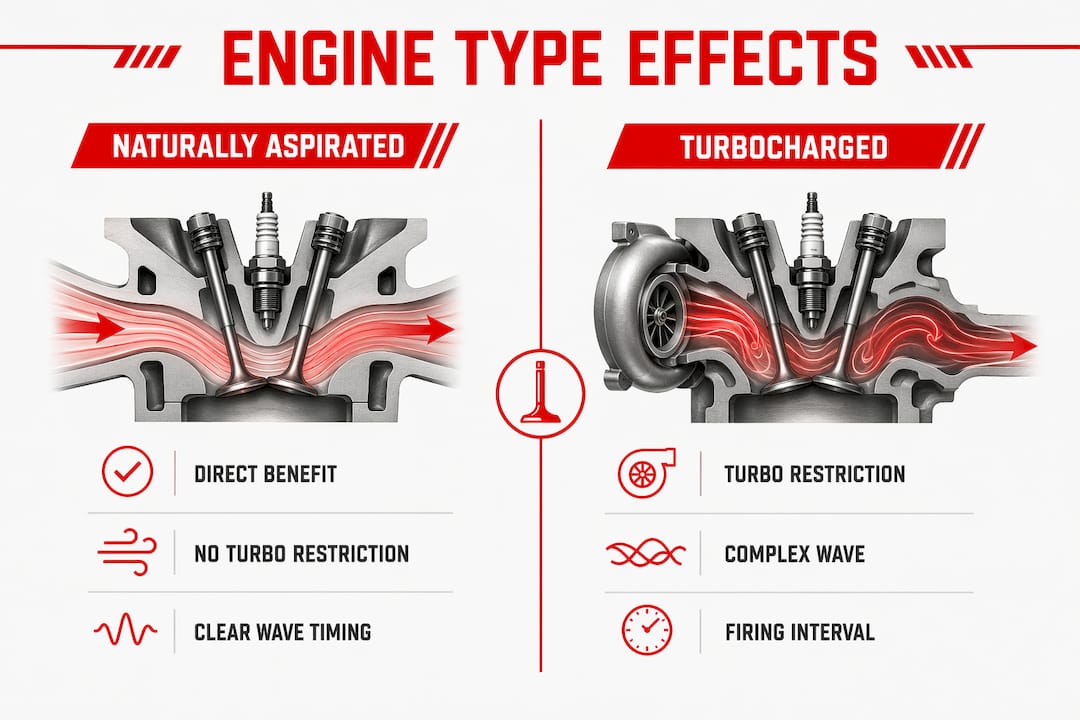
Turbocharged engines present a different challenge. The turbocharger sits in the exhaust path and acts as a large restriction that absorbs and scatters pressure waves. Primary pipe length in a turbocharged application is primarily about delivering evenly spaced pulses to the turbine wheel for consistent spool, not about timed scavenging at the cylinder. The wave reflection dynamics at junctions become secondary to turbine efficiency. Some twin-scroll turbo designs partially recover pulse separation, but the scavenging mechanism that defines naturally aspirated pulse tuning is largely absent.
For the V8 and V10 engines common in Ferrari and Lamborghini platforms, firing interval irregularities on each bank mean the collector “sees” uneven pulse spacing. This actually reduces sensitivity to exact primary length, giving designers slightly more flexibility — but it also means the characteristic sound of those engines is partly a product of those uneven pulses interacting at the collector.
How do you verify that pulse tuning is actually working?
The dyno is the primary tool. A chassis dynamometer with a wideband oxygen sensor and a torque curve plotted across the full RPM range will show whether the tuned band is where the designer intended. A sharp torque peak at a specific RPM followed by a drop is the signature of a narrowly tuned system. A broader, flatter curve suggests the designer used tapered collectors or multi-stage reflections to spread the effect.
Pressure transducers placed in the primary pipes can directly measure wave timing and amplitude, confirming whether the negative wave arrives during valve overlap at the target RPM. This is standard practice in professional header development but less common in aftermarket installation shops. If a shop offers it, that’s a strong signal of technical competence.
Wideband AFR logging during a road pull can also reveal scavenging effects indirectly: a well-scavenged cylinder pulls in more fresh charge, which shows up as a leaner AFR at the tuned RPM before the ECU compensates. OBD-II data logging via tools like HP Tuners or EFI Live can capture this in real time on modern platforms.
What pulse tuning does to emissions and fuel efficiency
The relationship is nuanced. Better scavenging means more complete combustion and a cleaner burn, which can reduce raw hydrocarbon and CO emissions at the tuned RPM. That’s a genuine benefit. The complication is catalytic converter placement. Moving the cat further from the exhaust port to optimize primary length reduces catalyst light-off temperature, slowing the time it takes to reach operating temperature after a cold start — the period when most tailpipe emissions occur.
Fuel efficiency follows a similar pattern: at the tuned RPM, the engine fills cylinders more completely, which means it can produce the same power at a slightly leaner mixture. Outside the tuned band, the effect reverses. Net fuel economy impact on a street-driven luxury car is typically small in either direction, but emissions compliance in states with strict testing (California, New York) requires careful attention to cat placement and OBD-II readiness monitors.
Software and engine management integration in modern vehicles
Modern luxury sports cars don’t just bolt on an exhaust — they negotiate with it. The ECU controls fuel trim, ignition timing, and valve timing in response to sensor data, and an aftermarket exhaust that changes exhaust backpressure or wave timing will trigger compensations throughout the engine management system.
On platforms like BMW’s MSD80/MSD81 or Ferrari’s Bosch Motronic variants, exhaust valve position can be mapped directly into the ECU’s operating strategy. Valve trigger points are assigned to RPM thresholds, driver mode selections, or even throttle position. This means the exhaust system becomes part of the engine’s performance map rather than a passive downstream component.
Brands like Akrapovic, Armytrix, IPE Exhaust, Fi Exhaust (Fi), Valvetronic, and Ryft Exhaust all offer varying degrees of ECU or CAN bus integration. Some use plug-and-play harnesses that intercept existing valve control signals; others require a standalone controller or a full ECU tune. The depth of integration matters: a system that only opens a valve without informing the ECU of the change misses the opportunity to retune fuel and ignition maps for the new exhaust state, leaving performance gains on the table.
Key Takeaways
Exhaust pulse tuning works by timing reflected pressure waves to scavenge cylinders at a target RPM, and valve-controlled systems are the most practical way to capture that benefit on a street-driven luxury sports car.
| Point | Details |
|---|---|
| Scavenging is the mechanism | Timed negative waves improve cylinder filling; backpressure reduction alone does not explain performance gains. |
| Pipe length sets the tuned RPM | Shorter primaries target high RPM; longer primaries favor low-end torque — geometry is the tuning tool. |
| Valve systems enable dual-mode use | Open valves deliver race-style pulse timing at high RPM; closed valves maintain street-legal noise levels. |
| Downstream changes disrupt tuning | Swapping mufflers or resizing tailpipes after header design can shift or eliminate the scavenging effect. |
| Valvecontrolexhaust for luxury fitment | Valvecontrolexhaust offers valve-controlled systems with ECU integration for Audi, BMW, Ferrari, and Lamborghini platforms. |
The part most buyers get wrong
The conversation around exhaust upgrades almost always starts with sound and ends with horsepower claims. What rarely gets discussed is the RPM band where those gains actually live — and whether it overlaps with how the owner actually drives the car.
A system tuned for peak scavenging at 6,500 RPM on a Ferrari V8 is genuinely impressive on a track. On a Tuesday morning commute, it’s irrelevant. The real value of a valve-controlled system isn’t that it makes more power everywhere — it’s that it lets you choose when the tuning is active and when the car behaves like something you can drive past a school without attracting attention.
The other thing experienced tuners rarely say loudly enough: small collector changes move the tuned band more than most owners expect. A shop that swaps a collector without re-running the dyno is guessing. Valve control also prevents the street complaints that kill otherwise excellent builds — one noise ordinance citation can make an owner regret the whole project. Longevity on luxury platforms is real too; quality actuators on a well-installed system last the life of the car with routine inspection, but a poorly routed harness near a heat source will fail within a season.
Valvecontrolexhaust builds valve systems that actually fit your car
Most aftermarket exhaust companies design for sound first and figure out the engineering later. Valvecontrolexhaust starts from the other direction: valve placement, ECU integration, and primary geometry are engineered together for each platform, so the scavenging effect is preserved when the valves open and the noise stays controlled when they close.

The system covers Audi, BMW, Ferrari, and Lamborghini platforms with full CAN bus integration and installation support, meaning the valve trigger points are mapped to your actual ECU — not a generic controller zip-tied under the dash. If you’re ready to evaluate your options, the performance exhaust buyer’s guide covers IPE, Fi, Armytrix, Akrapovic, Valvetronic, and Ryft alongside Valvecontrolexhaust’s own approach, with the technical detail you need to make a real comparison. Start there, then reach out for a fitment consultation specific to your vehicle.
Primary sources and further reading
Engineering articles, header design guides, and dyno-method references for owners and tuners who want to go deeper:
- Burns Stainless — exhaust header theory: primary length, wave speed, and practical dyno tuning methodology
- EPI Inc. — exhaust system technology: scavenging mechanism, collector design, and the case against oversized piping
- F1Technical — exhaust tuning commentary: pipe length effects, strategies to broaden tuning bands, and valved system tradeoffs
- MotorTrend — exhaust science: practical analysis of pressure wave tuning and valve system benefits for street/performance use
- Wikipedia — Tuned exhaust: accessible overview of four-stroke and two-stroke tuning principles
- EndTuning — exhaust systems: practical warnings about downstream changes disrupting tuning
For further reading, search for: ECU mapping for valved exhausts, chassis dyno methodology for header development, and your state’s vehicle noise compliance regulations (start with your state DMV and local municipal code).
This article is general technical information for enthusiast purposes. Confirm emissions compliance, noise ordinance requirements, and installation specifics with a qualified professional for your vehicle and jurisdiction.