Variable valve exhaust, known in the industry as an active exhaust system, is the definitive performance upgrade over fixed exhaust for any driver who wants both power and sound control. Fixed systems lock you into a single exhaust flow setting, forcing a compromise between low-end torque, high-end power, and cabin noise. Variable valve systems break that compromise entirely. Brands like BMW M-series, Porsche, Ferrari, and Lamborghini have adopted active exhaust as standard equipment precisely because the advantages are measurable and immediate. This article explains why variable valve exhaust outperforms fixed across every dimension that matters to a performance car owner.
Why variable valve exhaust outperforms fixed on power and torque
Active variable exhaust systems deliver 5–8% increases in horsepower and torque by dynamically controlling backpressure and scavenging across the full RPM range. That gain is not cosmetic. It translates directly to faster throttle response, stronger mid-range pull, and a wider effective powerband.
The mechanism is straightforward. At low RPM, the valve partially closes to build backpressure, which improves exhaust scavenging and keeps torque strong off the line. At high RPM, the valve opens fully to reduce restriction and let the engine breathe freely. A fixed exhaust forces a single compromise between these two demands and can never satisfy both at once.
“Performance gains from active exhaust systems come from real-time control of backpressure and scavenging, which optimize powerband width and throttle response.”
Variable valve timing principles reinforce this further. VVT systems allow real-time cam timing adjustments that maximize torque at low RPM and peak power at high RPM simultaneously. When you pair variable cam timing with a variable exhaust valve, the engine operates at its theoretical best across every driving condition. A fixed exhaust discards that advantage the moment exhaust gases hit a static pipe diameter.
The loudness variation is also measurable. Active systems produce 8–10 dB(A) variation at 3,000 RPM between open and closed valve positions. That range is the difference between a car that sounds aggressive on demand and one that drones at every speed.
What sound control advantages do variable valve exhausts offer?
Sound control is where variable valve exhaust separates itself most clearly from fixed systems in daily driving. Electronic valve modulation lets you switch between a quiet, subdued note for highway cruising and a full, aggressive exhaust character for spirited driving, all within seconds.
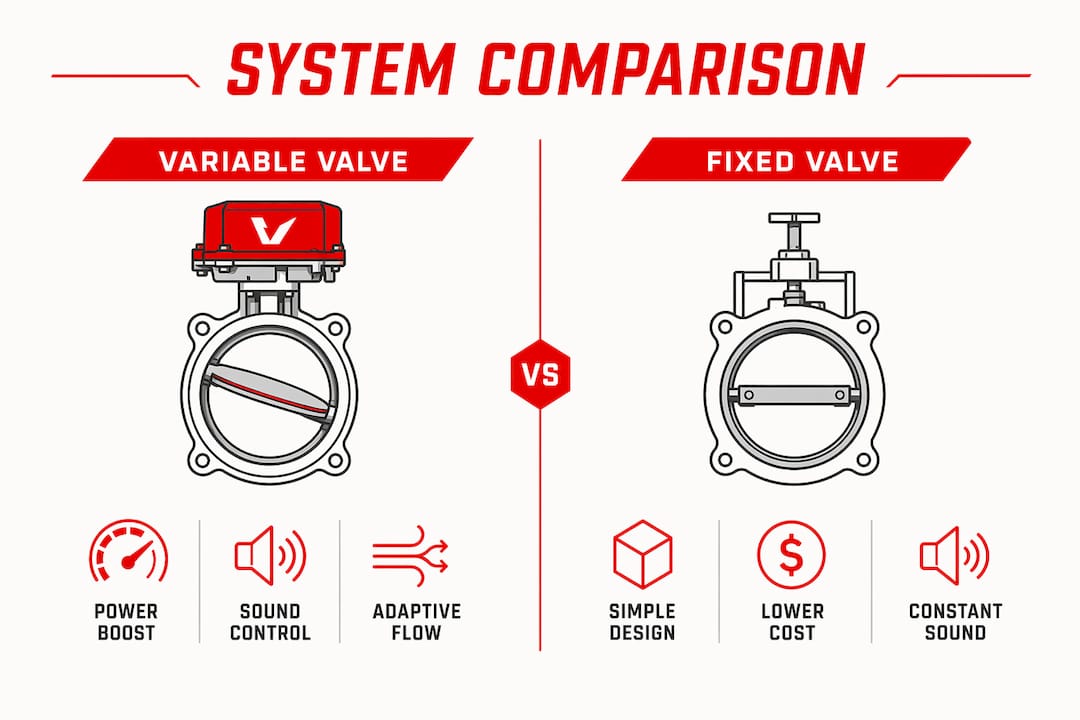
Fixed systems produce one sound at every condition. That means either tolerating cabin drone on the highway or sacrificing the aggressive note you want at full throttle. Variable systems solve both problems simultaneously. BMW M-series vehicles use valve-controlled exhaust to deliver driver-selectable sound modes, letting the driver choose comfort or sport without any mechanical change.
The practical benefits for enthusiasts include:
- Quiet mode for early morning departures, residential streets, and highway cruising without drone
- Sport mode that opens the valve fully for maximum exhaust note at track days or open roads
- Automatic mode on many systems that reads throttle position and adjusts valve opening in real time
- Reduced cabin fatigue on long drives because the valve eliminates the resonance frequencies that fixed pipes amplify
Pro Tip: If your car has a sport exhaust button that only changes the sound slightly, an aftermarket variable valve system will give you a far wider range between quiet and loud than any OEM fixed pipe can.
Valvecontrolexhaust covers the full depth of exhaust valve sound control for drivers who want to understand exactly how valve position shapes the character of their car’s note.
Electronic vs vacuum valves: which technology suits your car?
Not all variable valve exhaust systems use the same actuation technology. The two main types are electronic valves and vacuum-operated valves, and they behave very differently in practice.
| Feature | Electronic valves | Vacuum valves |
|---|---|---|
| Modulation range | 0–100% infinite control | Mostly binary (open/closed) |
| Response speed | Instant | Slower |
| Sound precision | High | Moderate |
| Durability in harsh conditions | Requires high IP protection | More resistant to heat and moisture |
| Tuning flexibility | Near-infinite | Limited |
Electronic exhaust valves enable infinite modulation from fully closed to fully open, giving you precise sound and performance tuning at any throttle position. That precision is what makes modern active exhaust systems feel so responsive. Vacuum valves operate mostly in binary states, either open or closed, which produces a less refined transition between sound modes.
The trade-off is durability. Electronic valve motors are vulnerable to degradation from road salt, moisture, and grime. Mechanical vacuum valves handle heat and moisture better, making them a more reliable choice in climates with heavy road salt use or extreme temperature swings.
Pro Tip: If you drive in a northern state with heavy winter road salt, prioritize electronic valve systems with an IP67 or higher motor rating. That single specification prevents the most common failure mode in active exhaust systems.
For drivers in mild climates who want maximum tuning flexibility, electronic valves are the clear choice. For drivers in harsh environments who prioritize long-term reliability over infinite modulation, vacuum valves remain a practical option.
How variable valve exhaust fits modern emissions and consumer expectations
Active exhaust systems have evolved beyond pure performance to become tools for emissions compliance and brand identity. That evolution explains why automakers now treat variable valve exhaust as a standard feature rather than an optional upgrade.
The numbered list below shows how variable valve exhaust serves multiple functions simultaneously:
- Emissions management. Valve timing affects internal EGR behavior and catalyst efficiency. Variable exhaust supports emissions compliance by adjusting exhaust flow to keep catalysts in their optimal temperature range.
- Brand identity. Ferrari, Lamborghini, and Porsche use active exhaust to create a signature sound that is instantly recognizable. Fixed systems cannot replicate that character across different driving modes.
- Dual-personality driving. The same car can be a quiet daily driver in the morning and a track-focused machine in the afternoon. Fixed exhausts force you to choose one personality permanently.
- Regulatory compliance. Noise regulations in European cities and some American municipalities require vehicles to operate below specific decibel limits. Variable valve systems let a car meet those limits in closed-valve mode while remaining unrestricted on private roads.
BMW and Porsche have both expanded variable valve exhaust across their lineups, including models that were previously fixed-pipe only. That trend reflects consumer demand for exhaust customization that goes beyond simple performance gains.
Common pitfalls and maintenance tips for variable valve exhaust owners
Variable valve exhaust systems require more attention than fixed pipes, but the maintenance demands are manageable with the right habits.
The most common failure points are:
- Electronic motor corrosion. Salt and moisture penetrate poorly sealed motor housings and cause valve actuator failure. Inspect motor seals annually if you drive in winter conditions.
- Wiring harness damage. Heat cycles and road debris can crack insulation on valve control wiring. Check harness routing at every service interval.
- Carbon buildup on valve seats. Partial valve positions trap carbon deposits over time. A full-open run at high RPM periodically clears most buildup naturally.
- Vacuum line degradation. On vacuum-operated systems, rubber lines harden and crack with age. Replace vacuum lines every three to four years as a preventive measure.
Pro Tip: After any winter season, spray the valve actuator housing and linkage with a quality corrosion inhibitor. This one step extends actuator life significantly in salt-belt climates.
Oil quality also affects variable valve timing response speed. Degraded oil slows cam phaser response and can trigger system fault codes that affect exhaust valve behavior on integrated systems. Use the manufacturer-specified viscosity and change intervals without extension. Valvecontrolexhaust publishes a detailed luxury exhaust maintenance guide that covers inspection schedules for Audi, BMW, Ferrari, and Lamborghini applications specifically.
Key Takeaways
Variable valve exhaust outperforms fixed systems because it adapts exhaust flow, backpressure, and sound output in real time, delivering measurable power gains and complete sound control that no fixed pipe can match.
| Point | Details |
|---|---|
| Measurable power gains | Active exhaust delivers 5–8% more horsepower and torque through dynamic backpressure control. |
| Sound range advantage | Variable valves produce up to 8–10 dB(A) variation, eliminating highway drone while preserving aggressive character. |
| Electronic vs vacuum choice | Electronic valves offer infinite modulation; vacuum valves suit harsh climates better due to mechanical durability. |
| Emissions and compliance | Variable valve exhaust helps meet noise regulations and emissions targets that fixed systems cannot address. |
| Maintenance priority | Protect electronic actuators from salt and moisture with high IP-rated motors and annual inspections. |
The real reason enthusiasts keep choosing variable valve exhaust
I have spent years working with active exhaust systems on vehicles ranging from BMW M3s to Lamborghini Huracáns, and the single most underrated benefit is not the power gain. It is the civility. The ability to drive a 600-horsepower car through a quiet neighborhood at 7 a.m. without waking anyone, then open the valves fully on an on-ramp and hear the full exhaust character, changes how you relate to the car entirely.
Fixed exhaust owners often accept drone as the price of performance. That trade-off is unnecessary. Variable systems give you both ends of the spectrum without compromise, and that is what exhaust customization actually means in practice.
The future of this technology points toward tighter integration with hybrid and electric platforms. Some hybrid systems already use variable exhaust valves to manage thermal efficiency alongside sound. As electrification increases, active exhaust will likely become the primary tool for preserving the acoustic identity of performance vehicles that still carry an internal combustion component.
The value for money argument is also stronger than it appears. A quality aftermarket variable valve system costs a fraction of a full exhaust replacement and delivers a wider performance and sound range than most fixed cat-back systems at any price point. For any enthusiast who drives their performance car in real-world conditions, variable valve exhaust is not an upgrade. It is the correct specification.
— Info
Upgrade your exhaust with Valvecontrolexhaust
Valvecontrolexhaust builds active exhaust systems specifically for Audi, BMW, Ferrari, and Lamborghini, with both OEM-compatible and full aftermarket configurations available.

Their performance exhaust buyer’s guide covers leading brands including IPE, FI Exhaust, Armytrix, Akrapovic, Valvetronic, and Ryft with side-by-side comparisons of sound character, power gains, and build quality. If you want a direct comparison of leading valved exhaust systems before committing to a purchase, that resource gives you the technical depth to make a confident decision. The Valvecontrolexhaust team is available to match the right system to your specific vehicle and driving conditions.
FAQ
What is a variable valve exhaust system?
A variable valve exhaust system uses electronically or vacuum-controlled valves inside the exhaust to adjust backpressure and sound output in real time. This allows the driver to switch between quiet and aggressive exhaust modes on demand.
How much power does a variable valve exhaust add?
Active variable exhaust systems deliver 5–8% increases in horsepower and torque by optimizing backpressure and scavenging across the RPM range. Gains vary by engine configuration and valve design.
What is the difference between electronic and vacuum exhaust valves?
Electronic valves offer infinite modulation from 0% to 100% open with instant response, while vacuum valves operate mostly in binary open or closed states. Electronic valves provide more refined sound control; vacuum valves are more durable in harsh environments.
Can a variable valve exhaust help with noise regulations?
Yes. Variable valve exhaust systems allow a vehicle to operate in a quiet, low-decibel mode that meets local noise ordinances while remaining fully open for performance driving in unrestricted areas.
Do variable valve exhaust systems require special maintenance?
Electronic valve actuators need protection from road salt and moisture, ideally through high IP-rated motor housings and annual inspections. Vacuum systems require periodic rubber line replacement to prevent cracking from heat cycles.