
The role of exhaust in resale value is direct and measurable. A stock or OEM+ exhaust signals a well-maintained vehicle to buyers, while a loud or unvalved aftermarket system raises immediate concerns about aggressive driving, mechanical abuse, and legal compliance. The exhaust system is one of the first things a buyer hears and inspects. Getting it right before you sell can mean the difference between a clean transaction and a prolonged negotiation that costs you real money.
How does an exhaust system affect buyer perceptions and resale negotiations?
Buyers make fast judgments based on sound. A car that rumbles aggressively at idle or drones through a test drive triggers a specific mental association: this vehicle was driven hard. That perception sticks, even when the engine and drivetrain are in perfect condition.

Exhaust leaks or MOT advisories related to the exhaust system amplify this concern. Buyers treat these as evidence of deferred maintenance, not just a minor part issue. The result is a lower offer, sometimes significantly lower, before any other negotiation begins.
Dealers apply the same logic at trade-in. Dealerships appraise modified exhausts lower because reverting a vehicle to stock involves real labor costs and market risk. That cost gets passed directly to you as a reduced trade-in offer. The buyer or dealer is not being unreasonable. They are pricing in the work they expect to do.
Private buyers use the exhaust as a negotiation lever too. Even when the aftermarket system is a quality branded unit, buyers assume aggressive driving history and push for a discount. You end up defending a modification most buyers did not ask for and do not want.
Pro Tip: If you are selling privately, remove the aftermarket exhaust before listing the car. Sell the exhaust separately to enthusiast forums or marketplaces. You recover more of your investment and remove the buyer’s main objection in one move.
What types of exhaust modifications impact resale value?
Not all aftermarket exhausts carry the same resale risk. The type of system you install determines how much value you preserve or lose when it comes time to sell.
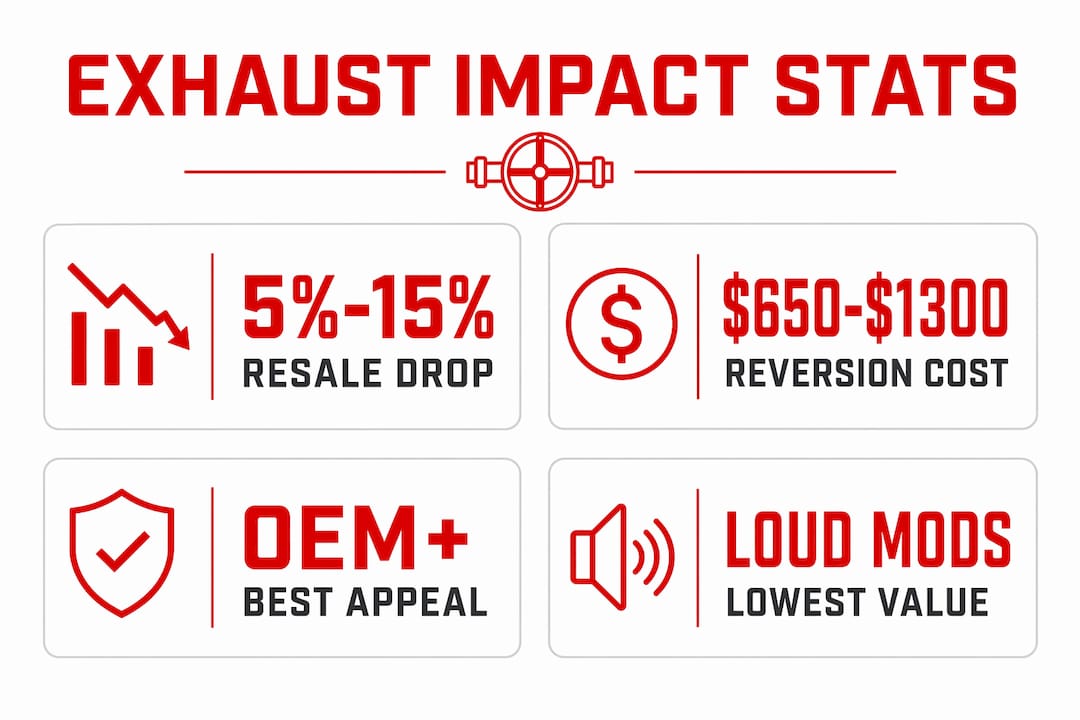
Loud, unvalved aftermarket exhausts typically reduce resale value by 5%–15%. Dealers factor in $650–$1,300 in reversion costs when appraising these vehicles. That is a real, quantified hit to your return.
Muffler deletes are the worst offenders. They are cheap to install, loud by design, and almost impossible to justify to a mainstream buyer. They also create legal exposure in states with noise ordinances, which shrinks your buyer pool dramatically.
Valved performance systems occupy a different category entirely. Quality branded valved exhausts preserve appeal in enthusiast markets by offering togglable sound from quiet to aggressive. A buyer who wants a stock-sounding daily driver can close the valves. A buyer who wants the full performance note can open them. That flexibility protects your resale position.
The OEM+ category sits between stock and full performance. These systems provide a subtle sound improvement and minor performance gains without alienating mainstream buyers. They are the safest modification choice from a resale standpoint.
| Exhaust type | Resale impact | Buyer appeal |
|---|---|---|
| Factory stock | Best resale value | Broadest buyer pool |
| OEM+ upgrade | Neutral to slight positive | Mainstream and mild enthusiasts |
| Valved premium system | Neutral in enthusiast markets | Enthusiasts and performance buyers |
| Loud unvalved aftermarket | 5%–15% value reduction | Narrow niche only |
| Muffler delete | Highest value loss | Very limited buyer pool |
Pro Tip: When buying a performance exhaust system, keep the original factory exhaust in storage. Reinstalling it before sale costs far less than the discount a buyer will demand for the modification.
What are the financial costs of aftermarket exhaust modifications?
The numbers on exhaust modifications rarely work in a seller’s favor. Aftermarket exhaust systems cost between $800 and $3,000 for parts, plus $300 to $600 for professional installation. That is a total outlay of up to $3,600 on a modification most buyers will discount rather than reward.
Most sellers do not recoup these costs at resale. Mainstream buyers prefer stock configurations for reliability and regulatory compliance. They are not willing to pay a premium for a modification they did not request and may need to reverse.
The financial math gets worse at trade-in. Dealers discount trade-in valuations to cover the labor and parts required to restore the vehicle to factory condition. You pay for the modification going in and pay again in reduced value going out.
The exceptions are narrow but real:
- A well-documented power upgrade with supporting modifications, including a tasteful OEM+ exhaust, can add a small premium in enthusiast markets.
- Valved systems on high-performance vehicles like BMW M cars or Ferrari models may hold their value better because the target buyer expects and appreciates the upgrade.
- Selling the aftermarket exhaust separately, outside the vehicle transaction, is consistently the most effective way to recover your investment.
The bottom line is straightforward. If you modify for personal enjoyment, budget for the modification as a cost you will not recover. If you modify with resale in mind, choose a valved or OEM+ system and keep the factory exhaust stored safely.
How does vehicle type and market segment change the resale impact?
The exhaust impact on resale is not uniform across all vehicles. Market segment determines how much damage a loud system does, or whether it does any damage at all.
Mainstream buyers strongly prefer factory stock exhaust systems for reliability, quiet operation, and regulatory compliance. A modified exhaust on a family sedan or commuter hatchback is almost always a liability. The buyer pool for these vehicles includes parents, city commuters, and first-time car owners. None of these groups want a loud exhaust.
Loud exhausts narrow the buyer pool further by creating legal exposure. Several U.S. states enforce noise ordinances that can result in failed inspections or citations. A buyer in California or New York faces real compliance risk with an unvalved aftermarket system. That risk becomes your problem at negotiation time.
Performance and enthusiast vehicles follow different rules. A BMW M3, Audi RS6, or Lamborghini Huracán attracts buyers who understand and often expect performance modifications. The resale impact depends heavily on market segment: loud exhausts devalue commuter cars but can be neutral or mildly positive for high-performance vehicles when the system is branded and installed correctly.
The key variable is buyer expectation. When a buyer shops for a performance vehicle, they arrive with different criteria than a buyer shopping for a practical daily driver. Matching your exhaust choice to your vehicle’s natural buyer profile is the single most effective way to protect resale value.
Cabin drone between 2,000–3,000 RPM is a specific reason aftermarket exhausts repel typical buyers. Valved systems control sound levels to avoid this drone, preserving daily-driver comfort and broadening buyer appeal even on performance vehicles.
Key Takeaways
Retaining or reinstalling the factory exhaust before sale is the single most effective strategy to protect resale value, regardless of vehicle type.
| Point | Details |
|---|---|
| Stock exhaust maximizes value | Factory exhaust signals reliability and broadens your buyer pool more than any modification. |
| Loud systems cost 5%–15% | Unvalved or muffler-deleted exhausts reduce resale value and trigger dealer trade-in discounts of $650–$1,300. |
| Valved systems reduce risk | Togglable valved exhausts appeal to both enthusiasts and practical buyers, limiting resale damage. |
| Sell parts separately | Removing and selling the aftermarket exhaust outside the vehicle transaction recovers more of your investment. |
| Market segment matters | Loud exhausts hurt commuter cars most; performance vehicles with enthusiast buyers face milder impact when the system is quality-branded. |
What I’ve learned about exhaust mods and resale the hard way
Most owners underestimate how much a loud exhaust narrows their buyer pool. You might love the sound on a Sunday drive, but when you list the car, you are suddenly marketing to a fraction of the people who would otherwise consider it. That is a real cost, and it shows up in how long the car sits and what price you finally accept.
The move I consistently recommend is keeping the factory exhaust. Store it properly, reinstall it before sale, and list the aftermarket system separately on enthusiast forums. You will almost always recover more money that way than by including it with the car and hoping the buyer shares your taste.
The one exception I have seen work is a quality valved system on a genuine performance vehicle, with full documentation and the factory exhaust available as an option. That combination gives the buyer flexibility and confidence. It signals that the car was modified thoughtfully, not just made louder. The exhaust customization approach matters as much as the hardware itself.
Know your buyer before you modify. A commuter sedan buyer wants quiet and stock. An M3 buyer might welcome a valved upgrade. Getting that read right is worth more than any specific brand choice.
— Info
Valvecontrolexhaust: performance sound without the resale penalty
Valvecontrolexhaust builds valved exhaust systems specifically for high-performance vehicles including Audi, BMW, Ferrari, and Lamborghini. The adjustable valve technology lets you control sound in real time, from a quiet OEM tone for daily driving to a full performance note when you want it.
That flexibility is exactly what protects resale value. A buyer who wants a stock-sounding car can close the valves. A buyer who wants the performance experience can open them. You are not locking future buyers into your preferences. The 2026 buyer’s guide covers the full range of valved and performance exhaust options, with detailed comparisons to help you choose a system that fits your vehicle and protects your investment at resale.
FAQ
Does a modified exhaust lower resale value?
Yes. Loud or unvalved aftermarket exhausts typically reduce resale value by 5%–15% and cause dealers to discount trade-in offers by $650–$1,300 to cover reversion costs.
What exhaust type is best for resale value?
The factory stock exhaust delivers the best resale outcome for most vehicles. A quality valved system is the next best option, particularly for performance vehicles sold in enthusiast markets.
Should I remove my aftermarket exhaust before selling?
Reinstalling the original factory exhaust before sale is the most effective strategy to preserve resale value. Sell the aftermarket system separately to recover your investment outside the vehicle transaction.
Do valved exhausts hurt resale value?
Quality valved systems minimize resale risk by offering adjustable sound levels. They appeal to both practical buyers and enthusiasts, making them far less damaging than fixed loud or unvalved alternatives.
Does exhaust condition affect trade-in offers?
Exhaust leaks, advisories, or visible modifications cause dealers to lower trade-in offers. Dealers price in the cost of restoring the vehicle to factory condition, and that cost comes directly out of your offer.