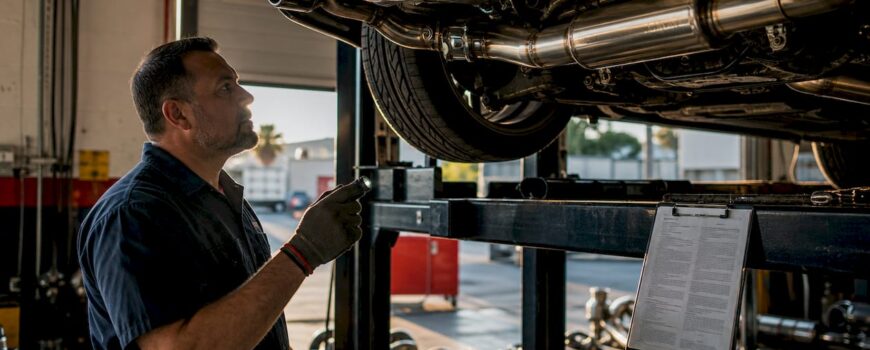
A legal sports car exhaust modification requires CARB compliance, a functioning catalytic converter, and documented proof of installation to pass inspection and avoid fines. The California Air Resources Board and the EPA set the two most consequential regulatory frameworks for exhaust modification legality in the United States. As of january 1, 2026, California enforces real-time CARB EO validation at Smog Check stations, with civil penalties reaching $500 per violation. This sports car exhaust legal checklist covers every requirement you need to verify before you bolt on a new system.
1. Verify your CARB Executive Order number first
CARB Executive Order compliance is the single most important step in any luxury vehicle exhaust compliance guide. Every aftermarket exhaust system installed on a California-registered vehicle must carry a valid EO number that appears as active in the CARB Aftermarket Parts Database. If the number is missing, expired, or revoked, your vehicle fails Smog Check automatically.
Follow these steps to confirm EO status before purchase or installation:
- Go to the CARB Aftermarket Parts Database and search by EO number or brand name.
- Confirm the EO status reads “Active,” not “Revoked” or “Expired.”
- Open the EO document and read the “Applicability” section carefully.
- Match your exact vehicle: year, make, model, engine type, transmission, drivetrain, and trim level.
- Physically inspect the installed part for an engraved EO number. Stickers and packaging labels are legally insufficient and will not satisfy an inspector.
CARB EO applicability is almost never generic. An EO that covers a BMW 340i with a rear-wheel-drive automatic transmission does not automatically apply to the xDrive all-wheel-drive version of the same car. That distinction has cost owners hundreds of dollars in fines.
Pro Tip: Screenshot the CARB database entry showing your EO number as “Active” on the day of installation. CARB revokes EO numbers regularly, and that timestamp protects you if a revocation happens after your install.
2. Confirm the EO number is engraved on the part itself
Physical engraving is a mandatory legal requirement, not a quality indicator. EO engraving on parts must appear directly on the component, not on a sticker, box, or receipt. Inspectors check the part, not the paperwork.
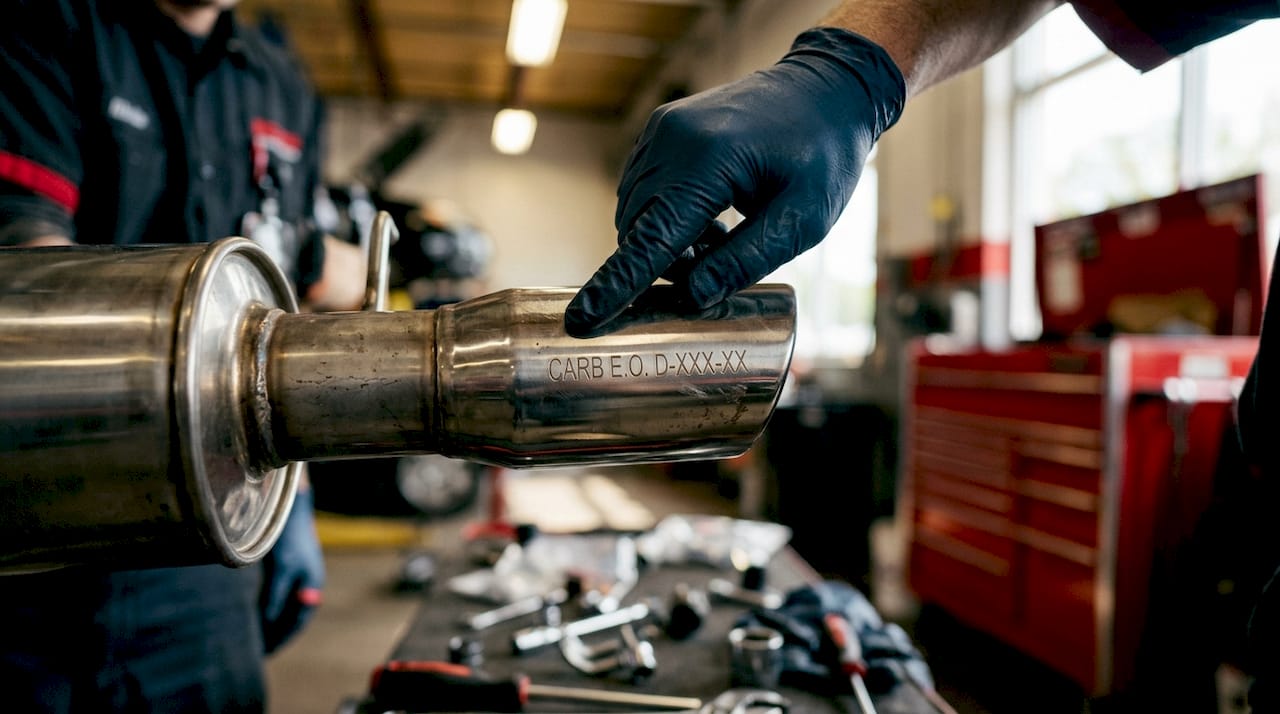
Run your finger along the pipe, collector, or muffler body and locate the stamped or laser-engraved EO number. If you cannot find it, the part does not meet California standards regardless of what the seller told you. Many aftermarket exhausts are marketed as CARB-compliant but apply only to specific vehicle variants, and the engraving requirement is one of the fastest ways to catch a non-compliant part before it causes a failed inspection.
3. Keep your catalytic converter intact
Removing a catalytic converter violates the federal Clean Air Act. Catalytic converter removal triggers penalties, failed emissions tests, and potential impoundment in states with active enforcement programs. This applies to every vehicle on a public road, regardless of how the car is titled or where it was purchased.
The catalytic converter is not optional equipment on a street-driven sports car. Ferrari, Lamborghini, Audi, and BMW all ship their performance vehicles with converters that meet federal and state emissions standards. Replacing a factory converter with an aftermarket unit requires a CARB-certified replacement in California. Straight-piping past the converter location is illegal on any public road in any state.
Pro Tip: If you want a louder, freer-flowing exhaust note without removing the converter, a valve-controlled system lets you open and close bypass valves electronically. You keep the converter, stay legal, and still control the sound.
4. Maintain a functioning muffler
Muffler removal is illegal in almost every state. Mufflers must be maintained in good working order under state vehicle codes, and a straight pipe with no muffler fails both noise and equipment inspections. The myth that muffler cutouts are legal on public roads persists in enthusiast communities, but law enforcement and inspection stations do not recognize that distinction.
A functioning muffler does not mean a restrictive one. High-flow mufflers, resonated axle-back systems, and valve-controlled exhausts all satisfy the legal requirement while delivering significantly more sound and flow than stock. The legal requirement is presence and function, not a specific decibel output at idle.
5. Know your state’s exhaust noise limits
Exhaust noise limits vary by state and enforcement method. Noise limits near 90 dB reflect the EPA standard, but individual states apply their own thresholds and measurement methods. Some states use fixed decibel limits measured at a set distance. Others use audibility-based rules that give officers more discretion.
The table below shows how enforcement approaches differ across representative states:
| State | Noise standard | Enforcement method |
|---|---|---|
| California | 95 dB at stationary test | CARB and BAR inspection |
| New York | 90 dB at 50 feet | Officer discretion and roadside test |
| Texas | No fixed dB limit | Audibility-based officer judgment |
| North Dakota | Minimal restrictions | Equipment presence check only |
| Florida | 95 dB limit | Roadside and inspection enforcement |
For high-performance vehicles like a Ferrari 488 or Lamborghini Huracán, factory exhaust systems already push near legal limits at wide-open throttle. Aftermarket systems without sound management can exceed legal thresholds at normal driving speeds. A decibel management guide for supercars covers how to measure and stay within limits without sacrificing performance character.
6. Understand the “off-road use only” label trap
“Off-road use only” labels provide zero legal protection on public roads. Authorities treat these labels as admissions of non-compliance, not exemptions from state law. Installing a part labeled “off-road use only” on a street-driven car and then driving it on public roads is a violation regardless of what the packaging says.
This is one of the most common and costly mistakes sports car owners make. A seller can legally manufacture and sell a non-compliant exhaust for track use. The moment you install it on a street car, the liability transfers to you. No disclaimer on a box changes that legal reality.
7. Prepare your documentation before inspection
Smog Check stations in California verify EO numbers in real time through the CARB database. Real-time EO validation means installation-era proof is not enough. If CARB revoked the EO after your install, the car fails today regardless of when you bought the part.
Prepare the following before any inspection:
- A printed or digital copy of the CARB EO document showing your vehicle’s trim in the applicability section
- Photos of the engraved EO number on the installed part
- The original purchase receipt with the part number and seller information
- Installation records from the shop, including date and technician name
- A current screenshot of the CARB database showing the EO as “Active”
Installers and retailers face expanded liability under AB 1260 starting july 1, 2024. Shop owners and online sellers can incur fines for selling or installing non-compliant parts. That means a reputable installer has strong incentive to verify compliance before the job starts, and you should ask them to document that verification.
8. Know how to appeal a failed inspection
A failed Smog Check is not always final. If your EO number was active at installation and was later revoked without your knowledge, you have grounds to appeal. Document the original installation date, the EO status at that time, and any CARB communication about the revocation.
Contact the Bureau of Automotive Repair in California to initiate a formal appeal. Bring every document from the preparation list above. Appeals succeed most often when owners can show the part was compliant at installation and the revocation was administrative rather than a product defect finding.
9. Check state laws before relocating or traveling
States like North Dakota and South Dakota apply far more permissive aftermarket exhaust rules than California. A system that passes inspection in South Dakota may fail immediately upon California registration. This creates a real problem for owners who relocate or buy modified vehicles from out of state.
Before registering a modified sports car in a new state, research that state’s emissions testing requirements and equipment standards. States without emissions testing programs generally require only that a muffler is present and functional. States with active emissions programs, including California, New York, and Massachusetts, require full compliance with their specific certification standards. The exhaust customization guide for luxury cars covers how to approach modifications that hold up across multiple regulatory environments.
10. Use a valve-controlled system to manage compliance and sound
A valve-controlled exhaust system is the most practical solution for owners who want performance sound without legal risk. Valvecontrolexhaust builds systems for Audi, BMW, Ferrari, and Lamborghini that use electronically adjustable valves to control exhaust note and volume in real time. You can run a quieter setting for urban driving and open the valves on a track or open road.
This approach addresses the core tension in exhaust modification legality. You keep the catalytic converter, retain a functioning muffler, and control sound output to stay within legal decibel limits. The bypass setup guide for sports cars explains how valve positioning affects both sound and compliance in practical terms.
Key takeaways
A legal sports car exhaust modification requires a valid, engraved CARB EO number matched to your exact vehicle trim, a retained catalytic converter, a functioning muffler, and complete documentation ready for real-time inspection verification.
| Point | Details |
|---|---|
| CARB EO verification | Confirm your EO number is active in the CARB database and matches your exact trim level. |
| Physical engraving required | The EO number must be engraved on the part itself. Stickers and packaging do not satisfy inspectors. |
| Catalytic converter retention | Removing a converter violates the federal Clean Air Act and causes automatic inspection failure. |
| Documentation before inspection | Keep EO documents, installation photos, receipts, and a current CARB database screenshot. |
| State law variation | A system legal in South Dakota may fail California registration. Check destination state laws before relocating. |
What I’ve learned about trusting seller claims on exhaust compliance
The single biggest mistake I see sports car owners make is trusting a seller’s compliance claim without verifying it themselves. A seller can list “CARB-compliant” in a product title and still be selling a part that does not apply to your specific vehicle configuration. The CARB database is free, public, and takes about three minutes to check. There is no excuse for skipping it.
The “off-road use only” label issue is even more frustrating because it preys on enthusiasts who genuinely want to stay legal. The label sounds like a legal disclaimer. It is not. It is a manufacturing classification that shifts liability to the buyer the moment the car touches a public road. I have spoken with owners who paid $500 fines on parts they believed were street-legal because they read the marketing copy instead of the EO document.
My practical advice: treat every exhaust purchase like a contract. Read the applicability section of the EO document the way you would read a warranty. If your exact drivetrain and trim are not listed, the part is not legal for your car, full stop. And once it is installed, check your EO status once a year. CARB revokes numbers without notifying vehicle owners, and an annual check costs nothing.
— Info
Valvecontrolexhaust: performance exhaust built for street and compliance
Valvecontrolexhaust designs valve-controlled exhaust systems for high-performance vehicles including Audi, BMW, Ferrari, and Lamborghini. Each system uses electronically adjustable valves to give you real-time control over exhaust volume and character, so you can meet legal noise limits on the street and open up the full sound on a track day.

The systems are built with CARB compliance requirements in mind, and Valvecontrolexhaust provides detailed fitment documentation to support inspection preparation. For a thorough breakdown of how leading valved systems compare on compliance, sound quality, and fitment, the performance exhaust buyer’s guide covers the key decision points. You can also read the critical analysis of leading systems for a direct look at how valve-controlled exhausts perform against fixed aftermarket options.
FAQ
What is a CARB EO number for exhaust systems?
A CARB Executive Order number is a certification issued by the California Air Resources Board confirming that a specific aftermarket exhaust part meets California emissions standards. Every aftermarket exhaust installed on a California-registered vehicle must carry a valid, active EO number engraved directly on the part.
Can I install an “off-road use only” exhaust on my street car?
No. “Off-road use only” labels provide no legal protection on public roads and are treated by authorities as admissions of non-compliance. Installing such a part on a street-driven vehicle exposes you to fines and inspection failures.
What happens if my exhaust EO number gets revoked after installation?
Your vehicle will fail a California Smog Check because EO revocations are tracked in real time in the CARB database. Check your EO status annually and keep documentation of the original installation date and EO status to support any appeal.
Do exhaust noise limits apply the same way in every state?
No. Noise limits vary by state, with the EPA standard near 90 dB serving as a general reference. Some states use fixed decibel thresholds measured at a set distance, while others rely on officer discretion using audibility-based rules.
Is removing a catalytic converter legal for a street-driven sports car?
No. Removing a catalytic converter violates the federal Clean Air Act and causes automatic failure in any state with an emissions testing program. The requirement applies to all street-driven vehicles regardless of performance level or vehicle age.