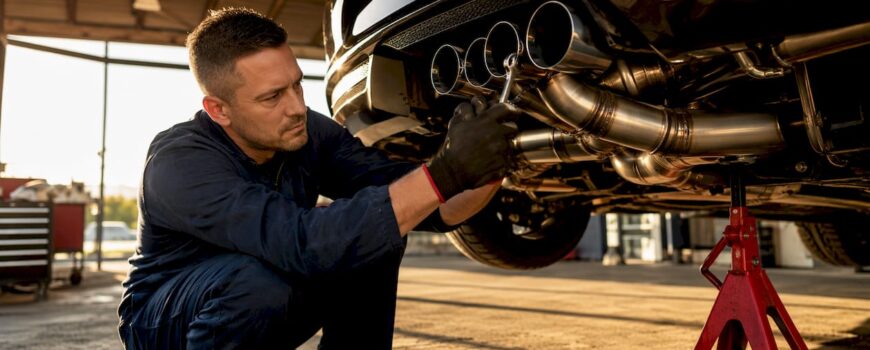
Swapping your stock exhaust for a lighter performance system does more than change the sound. The real payoff is in how the car moves: faster acceleration, sharper throttle response, more confident cornering, and better braking, all from shedding pounds in one of the heaviest bolt-on components on the vehicle. These performance exhaust weight reduction benefits compound with every other mod you’ve done, because less mass means every horsepower you already have works harder.
The gains aren’t just about raw speed. Reducing exhaust weight lowers rotational mass, cuts unsprung load near the suspension, and shifts the vehicle’s polar moment of inertia in ways that make the car feel genuinely more alive. Heat management and long-term durability improve too, especially with titanium construction. Valvecontrolexhaust has built its entire product philosophy around this intersection of weight, flow, and real-time sound control for platforms like Audi, BMW, Ferrari, and Lamborghini.
Key benefits at a glance:
- Faster acceleration from reduced total vehicle mass
- Sharper throttle response due to lower exhaust inertia and backpressure
- Better cornering and braking from reduced rear-end and unsprung weight
- Improved heat dissipation with titanium or high-grade stainless steel
- Enhanced durability and corrosion resistance over stock mild steel systems
- Customizable sound profiles, from refined cruising tone to full-throttle aggression
Pro Tip: Weight removed from behind the rear axle, exactly where most cat-back systems sit, has a disproportionate effect on handling. It lowers polar moment of inertia, which makes the car rotate more eagerly into corners and settle faster under braking.
Table of Contents
- How material choice drives exhaust weight savings
- How a lighter exhaust changes how your car actually handles
- How exhaust weight reduction works with airflow to multiply gains
- What Valvecontrolexhaust brings to lightweight performance exhaust
- How weight reduction compares to other performance modifications
- Valvecontrolexhaust: real-time control for performance-focused drivers
- Key Takeaways
How material choice drives exhaust weight savings
The single biggest variable in exhaust weight is material. Stock systems use mild steel, which corrodes quickly and adds unnecessary mass. Aftermarket systems step up to aluminized steel, stainless steel, or titanium, each with a different weight, cost, and performance profile.
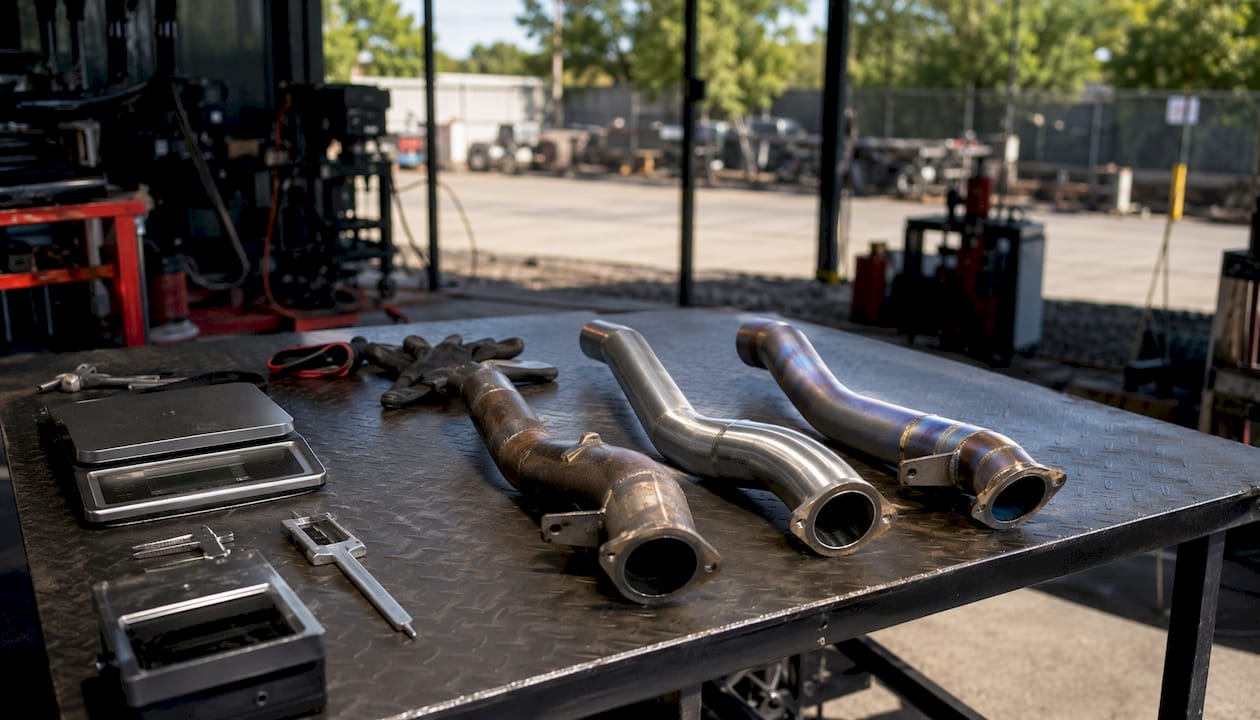
Titanium exhausts can reduce system weight by 35–50% compared to stainless steel equivalents. Titanium exhausts can reduce system weight by 35–50% compared to stainless steel equivalents. A typical 4-cylinder cat-back in stainless steel weighs 32–40 lbs; the titanium version of the same system comes in at 15–22 lbs. For V6 and V8 full systems, stainless runs 45–65 lbs versus 22–35 lbs for titanium.
| System type | Stainless steel | Titanium |
|---|---|---|
| 4-cylinder cat-back | 32–40 lbs | 15–22 lbs |
| V6/V8 full system | 45–65 lbs | 22–35 lbs |
| Heat resistance | Moderate | Superior |
| Corrosion resistance | Good | Excellent |
| Cost | Lower | Higher |
| Best use | Daily driving, budget builds | Track, supercars, weight-critical builds |
Titanium’s advantages go beyond weight. It maintains structural integrity at extreme temperatures and forms a natural oxide layer that resists corrosion without coatings. That matters on headers and manifolds where heat soak is constant. Stainless steel is still a strong choice for street builds: it delivers most of the weight benefit at a fraction of the cost, and its deeper, resonant sound suits many enthusiasts better than titanium’s sharper, more exotic tone.
Material comparison at a glance:
- Titanium: lightest, best heat resistance, highest cost, exotic sound
- Stainless steel: proven, cost-effective, good durability, deeper tone
- Aluminized steel: budget option, heavier, shorter service life
- Mild steel (OEM): heaviest, most corrosion-prone, lowest performance
Cost versus performance is a real trade-off. Stainless gives you roughly 80–90% of the real-world benefit at a fraction of titanium’s price. Titanium makes sense when every pound counts, such as track cars, time-attack builds, and high-end exotics where the budget allows.
How a lighter exhaust changes how your car actually handles
Dropping 20–30 lbs from the rear of a vehicle, which is exactly what a full titanium system achieves, improves acceleration, braking, and handling balance in ways that a simple horsepower number never captures. The physics are straightforward: weight behind the rear axle increases polar moment of inertia, making the car sluggish to rotate. Remove it, and the car responds faster to steering inputs.

Enthusiasts who switch to titanium exhausts consistently report sharper handling and better response, attributed to lower sprung mass and improved weight distribution. On a rear-heavy platform like a Porsche 911, shaving weight at the back nudges the balance closer to 50/50. On a lightweight car like a Miata at roughly 2,300 lbs, dropping 15–20 lbs with an exhaust swap is a meaningful percentage of total mass.
Dynamics improvements from exhaust weight reduction:
- Lower center of gravity reduces body roll in high-speed corners
- Reduced unsprung load lets suspension react faster to road surface changes
- Less rear bias improves braking stability and turn-in response
- Lower total mass means the same braking force decelerates the car faster
- Reduced axle fatigue extends tire life during aggressive driving
Throttle response sharpens too, and not just from the weight loss. Less mass in the exhaust path means gases exit faster, which reduces the inertia the engine works against on every combustion cycle. The result is a more immediate pedal feel, especially noticeable in mid-corner acceleration where lag is most frustrating.
How exhaust weight reduction works with airflow to multiply gains
Weight reduction and airflow improvement aren’t separate benefits. They happen together in a well-designed performance system, and the combination is what makes the upgrade feel so different from stock.
A performance exhaust reduces backpressure by replacing restrictive baffles and narrow OEM piping with straighter, larger-diameter tubing. On turbocharged engines, this lets the turbo spool more freely, which is why aftermarket exhausts typically add 5–12 wheel horsepower on turbo platforms. The raw horsepower number is modest, but the throttle feel improvement is immediate and consistent. Drivers notice it more than the dyno does.
Airflow-related performance advantages:
- Faster exhaust gas evacuation reduces pumping losses on every stroke
- Quicker turbo spool time from lower backpressure behind the turbine
- More efficient combustion from better cylinder scavenging
- Reduced exhaust gas temperatures under sustained load
- Modest fuel efficiency gains of around 1–2% on highway driving from lower engine strain
Valvecontrolexhaust’s valve-controlled systems add another layer here. By adjusting exhaust flow in real time, the valve technology optimizes both backpressure characteristics and sound output depending on driving mode. At low RPM or in traffic, the valves restrict flow for a quieter, more refined note. Open them up under hard acceleration and the system flows freely, delivering both the sound and the performance the driver wants.
What Valvecontrolexhaust brings to lightweight performance exhaust
Valvecontrolexhaust occupies a specific position in the performance exhaust market: systems engineered for luxury and high-performance platforms where weight, sound, and throttle response all matter equally. Their valve technology goes beyond what a fixed-geometry exhaust can do, because the driver controls the exhaust character in real time rather than accepting a single compromise tuned at the factory.
Users of Valvecontrolexhaust systems report meaningful improvements in engine response and the ability to dial in sound profiles that match the driving situation, whether that’s a quiet highway cruise or a full-throttle run on a back road. That flexibility is the core differentiator on platforms like the BMW M4, Ferrari 488, or Lamborghini Huracán, where the stock exhaust is already competent but still leaves performance and character on the table.
Why Valvecontrolexhaust stands out:
- Real-time valve control for dynamic sound and flow adjustment
- Engineered specifically for Audi, BMW, Ferrari, Lamborghini, and other high-performance platforms
- Material choices that balance weight reduction with heat resistance and longevity
- Sound customization from refined to aggressive without a fixed compromise
- Compatibility across a wide range of luxury and performance vehicles
Pro Tip: On a platform like the BMW M4 G82 or Lamborghini Huracán, the OEM exhaust is already heavier than it needs to be. A full system swap to a valve-controlled, lightweight alternative addresses weight, flow, and sound in a single installation rather than requiring multiple separate mods.
How weight reduction compares to other performance modifications
Weight reduction is often undervalued because it doesn’t show up as a big number on a dyno sheet. A turbo upgrade or ECU tune produces headline horsepower figures. An exhaust swap produces a modest power gain but a much broader set of improvements across acceleration, handling, braking, and throttle response simultaneously.
The key insight from performance engineers is that weight reduction improves every aspect of vehicle performance more evenly than chasing marginal horsepower gains. A 50-hp tune makes the car faster in a straight line. Dropping 30 lbs from the rear makes it faster everywhere, including through corners and under braking, without adding stress to the engine or drivetrain.
Lowering exhaust weight also reduces mechanical stress on suspension components and the drivetrain, which extends component life under track use. A power upgrade does the opposite: it increases load on every downstream component. That’s a meaningful distinction for anyone who drives hard regularly.
Compared to other weight-reduction mods, an exhaust swap delivers a strong return. Carbon fiber body panels, lightweight wheels, and stripped interiors all reduce mass, but none of them also improve flow, reduce backpressure, and change the sound character of the car. The exhaust is the one mod that does all four at once, which is why it consistently ranks among the first upgrades serious enthusiasts make when building a performance-focused car or motorcycle.
Valvecontrolexhaust: real-time control for performance-focused drivers
If you’re running a high-performance vehicle and you want the weight savings, the flow improvement, and the ability to actually control how the car sounds and performs, a fixed exhaust is a compromise you don’t need to make.

Valvecontrolexhaust builds systems specifically for platforms like Audi RS, BMW M, Ferrari, and Lamborghini, where the stock exhaust is the single biggest obstacle between the car you have and the car it should be. The valve technology gives you a quiet, refined note for daily driving and a full-open, unrestricted flow for when you want the car to perform at its best. You get the weight reduction, the improved throttle response, and the sound customization in one system, without choosing between them.
Check out Valvecontrolexhaust’s leading valved exhaust systems or explore the full performance exhaust comparison covering IPE, Armytrix, Akrapovic, Valvetronic, and Ryft to see exactly where each system fits and why Valvecontrolexhaust’s approach stands apart for luxury and performance platforms.
Key Takeaways
A lightweight performance exhaust delivers faster acceleration, sharper throttle response, and better handling by reducing rear-end mass, backpressure, and rotational inertia simultaneously.
| Point | Details |
|---|---|
| Titanium saves the most weight | Titanium systems weigh significantly less than stainless steel equivalents, cutting a substantial amount of weight from the rear. |
| Location of weight matters | Removing weight behind the rear axle lowers polar moment of inertia, improving cornering and braking more than central weight loss. |
| Airflow and weight work together | Aftermarket exhausts add 5–12 wheel horsepower on turbo engines while also sharpening throttle feel through backpressure reduction. |
| Weight reduction beats power mods broadly | Dropping exhaust weight improves acceleration, handling, and braking together, without increasing drivetrain stress. |
| Valvecontrolexhaust adds real-time control | Valvecontrolexhaust systems combine lightweight construction with adjustable valve technology for dynamic sound and flow on Audi, BMW, Ferrari, and Lamborghini platforms. |