
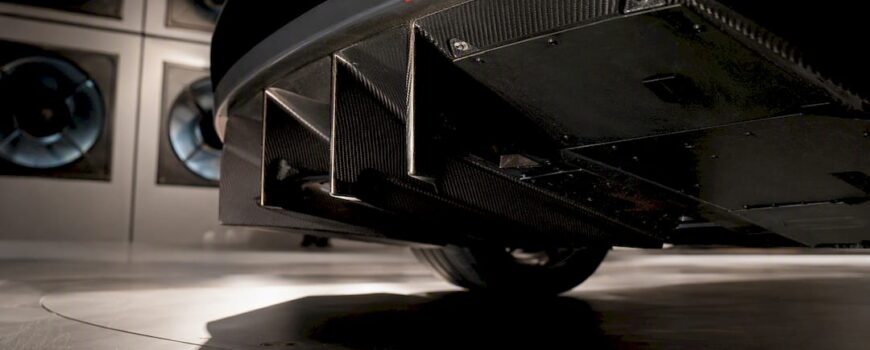
A rear diffuser is an expansion chamber that recovers pressure from underbody airflow, converting that low pressure zone into downforce and better high speed stability. It works by accelerating air under the car and then slowing it back down gradually before it rejoins the air behind the bumper. The trade-off is real: get the angle or sealing wrong, and you add drag or trigger flow separation rather than grip. It only pays off when the underbody ahead of it is flat and the car sits low enough to feed it clean air.
TL;DR:
- A diffuser’s effectiveness depends heavily on a flat, sealed underbody with minimal obstructions, low ride height, and correct mounting points.
- Improving diffuser performance involves optimizing the ramp angle around 7 degrees, placing the throat forward, and installing flow control fins like strakes and skirts.
- CFD and wind tunnel data show large potential gains on fully sealed race cars, but street cars with obstructed underbodies see much smaller, less predictable benefits.
- Diffusers work best when paired with a front splitter, proper exhaust flow, and balanced rake to maximize pressure recovery and downforce.
- Improper angle, damage, or lack of upstream airflow can cause flow separation, increasing drag and reducing any potential aerodynamic advantages.
Table of Contents
- How Does a Rear Diffuser Work? The Venturi Effect Explained
- Ramp Angle, Length, Strakes, and Skirts: The Variables That Decide Everything
- What the CFD and Wind Tunnel Data Actually Show
- Street Cars vs. Race Cars: When a Diffuser Actually Helps
- Buying or Building a Diffuser: Materials and Fitment Checks
- Splitters, Wings, and Exhaust Flow: The Diffuser Doesn’t Work Alone
- Common Myths About Rear Diffusers, Cleared Up
- Why Exhaust Design and Diffuser Performance Are Connected
- How a Diffuser Changes the Way Your Car Handles
- Rear Diffuser Function in Road Cars vs. Race Cars
- The History Behind Modern Diffuser Design
- What I’ve Learned Fitting Diffusers on the Shop Floor
- Get the Right Fit for Your Car’s Airflow
- Sources
- FAQ
How Does a Rear Diffuser Work? The Venturi Effect Explained
Picture the underside of a car as a garden hose with your thumb partially over the end. Squeeze the opening and the water speeds up. That’s the venturi principle at work, and it’s the same physics governing what happens under a car’s floor. Air entering the space beneath the front bumper gets squeezed between the road and the flat underbody, and squeezed air moves faster. Faster-moving air carries lower pressure, following Bernoulli’s principle, and that pressure difference between the top of the car and the bottom is what pulls the chassis toward the pavement.
The diffuser’s job starts right where that squeezed, accelerated flow needs somewhere to go. Rather than letting high-speed underbody air slam into the slower-moving, higher-pressure air trailing the car, the diffuser opens up gradually, giving that air room to decelerate and expand before it exits. Engineers who study this describe the diffuser less as a wing and more as a pressure-recovery device that smooths the handoff between underbody flow and the ambient air stream behind the car.
That smoothing matters more than most people realize. Without a diffuser, air rushing out from under the car meets ambient air at wildly different speeds and pressures, and that mismatch creates a churning, low-energy wake. A wake like that drags on the car the same way an open parachute does, just with less drama. A well-shaped diffuser lets the pressure equalize in stages instead of all at once, which can shrink that turbulent wake and, in some cases, reduce drag rather than add it.
None of this works if the throat, the narrowest point where the diffuser begins, is poorly located or poorly shaped. A few things determine whether a diffuser recovers pressure cleanly or just creates a mess of separated flow:
- The throat needs to sit as far forward and as low as the chassis allows, since that’s where the underbody flow is fastest and the suction effect is strongest.
- The transition from throat to exit has to be gradual. A sharp-angled ramp asks the airflow to change direction too quickly, and it detaches from the surface instead of following it.
- The exit needs to blend into the car’s rear-end geometry rather than dumping air into a chaotic bumper cutout.
- Side sealing matters as much as the ramp angle; for example, techniques to keep wipers flat in crosswinds illustrate how aerodynamic stability and preventing flow separation are crucial in maintaining effective pressure differentials. Air sneaking in from the sides ruins the pressure differential the diffuser is built to create.
Statistic Callout: Numerical modeling on realistic road car geometry found that a diffuser with a 7-degree venturi angle paired with diagonal sealing skirts produced a downforce coefficient of −0.887, an increase of roughly 1,780% over a flat-underfloor baseline. That’s not a rounding error. It’s the difference between a car that generates almost nothing at the rear and one where the underbody is doing real aerodynamic work.
The takeaway from the fluid mechanics is straightforward even if the equations aren’t: a diffuser doesn’t create downforce out of nothing. It manages a pressure difference that already exists under the car, and it does that job well only when the geometry gives the air a smooth, gradual path back to ambient pressure.
Ramp Angle, Length, Strakes, and Skirts: The Variables That Decide Everything
Two diffusers can look nearly identical and perform completely differently, because the variables that matter are mostly invisible from a glance. Ramp angle, length, throat placement, and the small vertical fins bolted to the underside all interact, and getting one wrong undercuts the rest.
Ramp angle is the first lever, and it’s the one most people overcorrect. Steeper angles accelerate more air and recover more pressure, which sounds like a straightforward win. But push the angle too far and the airflow can’t follow the surface anymore. It separates, the low-pressure zone collapses, and downforce drops off a cliff, sometimes worse than having no diffuser at all. For road-oriented geometries, roughly 7 degrees tends to sit near the practical optimum before separation risk climbs sharply. Race cars with dedicated sealing and active flow management can push steeper, but that comes with a much narrower margin for error.
Length and throat position decide where on the car the downforce actually acts. A diffuser with its throat pushed forward and a long, gradual ramp pulls the low-pressure zone toward the middle of the car, which tends to help balance rather than just adding rear-biased grip. A short, steep diffuser concentrates suction right at the back, which can help rear traction but do little for front-end stability at speed.
Strakes and fences are the detail that separates a working diffuser from a decorative one. These vertical fins run along the length of the diffuser channel and do two jobs: they prevent high-pressure air from creeping in sideways, and they keep the flow organized instead of letting it swirl and stall prematurely. Diagonal skirts serve a similar purpose at the diffuser’s edges, sealing the boundary between the low-pressure underbody zone and the ambient air just outside the car’s footprint.
Here’s the order most tuners should think through when evaluating or designing a diffuser setup:
- Confirm ride height and rake first. No amount of clever geometry compensates for a diffuser that’s too far off the ground to accelerate air meaningfully.
- Set ramp angle conservatively, closer to that 7-degree range, before pushing steeper.
- Add strakes or fences to control the flow before increasing angle further, since they extend the usable angle range.
- Seal the sides with skirts to stop lateral air infiltration, which otherwise undermines everything upstream.
- Check throat placement relative to the rest of the underbody to make sure the pressure zone lands where you want the balance shift.
Material stiffness belongs in this conversation too, even though it’s not strictly a shape variable. A diffuser under load is being pulled toward the road surface by the very suction it creates, sometimes with hundreds of pounds of force. A diffuser that flexes under that load loses its designed geometry mid-corner, which means the pressure recovery you engineered on paper doesn’t happen at the moment you need it most.
Pro Tip: If you’re comparing two diffusers with similar ramp angles, check for strakes before you check for anything else. A smooth ramp without flow-management fins is far more likely to stall at speed than one with even a couple of basic fences.
What the CFD and Wind Tunnel Data Actually Show
Numbers from controlled testing give you something marketing copy never will: a sense of scale. The gap between “a diffuser helps” and “a diffuser produces this much downforce under these conditions” is where informed buying decisions actually happen.
The most detailed public data point comes from a RANS-based CFD study on realistic road car geometry, which tested a 7-degree venturi diffuser fitted with diagonal sealing skirts. That configuration produced a downforce coefficient of −0.887, an increase of about 1,780% compared to a flat-underfloor baseline with no diffuser at all. That’s a striking number, but it comes with a caveat worth sitting with: the baseline was a flat underfloor with zero diffuser treatment, which is close to a best-case scenario for showing improvement. It’s a controlled comparison, not a promise of what any given street car will see once you factor in exhaust piping, subframes, and suspension arms hanging into that airflow.
Racing gives a different kind of data point, one measured in pounds rather than percentages. On top-level race cars, a fully sealed and properly angled diffuser can contribute more than 1,000 pounds of downforce, a figure that comes with its own cost: more parasitic drag and a top-speed penalty engineers accept because cornering speed matters more than a few extra miles per hour on the straights.
| Testing context | Reported result | Key caveat |
|---|---|---|
| CFD study, 7° venturi + diagonal skirts | CL = −0.887 (~1,780% vs. flat-floor baseline) | Baseline had no diffuser treatment at all |
| Top-level race cars | Diffuser contributes 1,000+ lb downforce | Comes with added parasitic drag, lower top speed |
| Production street cars, obstructed underbody | Effect much smaller than either figure above | Exhausts and suspension parts disrupt clean flow |
Statistic Callout: The near-1,780% figure and the 1,000-pound race figure describe two different worlds. One is a lab comparison against a diffuser-free baseline. The other is a measured contribution on a purpose-built race chassis with a fully sealed, flat underbody. Neither number tells you what your daily-driven coupe will gain from a bolt-on diffuser, and that gap is exactly why realistic expectations matter more than headline percentages.
CFD results also need a grain of salt for a structural reason, not just a context reason. Simulations model airflow under idealized, steady conditions. Real cars pitch, roll, and ride on suspension that compresses under braking and load transfer, changing the ride height and rake the diffuser was designed around moment to moment. That’s why researchers caution against treating CFD output as a direct prediction for street performance. Physical wind tunnel testing and, ideally, real-world validation still matter before anyone claims a specific downforce number for a road car.
Street Cars vs. Race Cars: When a Diffuser Actually Helps
A diffuser needs three things to work the way the physics promises: a flat underbody, minimal side air infiltration, and enough ride height clearance to accelerate air without scraping. Race cars are built around those three requirements from the ground up. Most production cars aren’t.
Walk under a typical sedan or coupe and you’ll find exhaust piping running lengthwise, a rear subframe, control arms, and often a spare tire well, all interrupting what would otherwise be a smooth surface. Every one of those obstructions breaks up the underbody flow before it ever reaches the diffuser. A diffuser bolted onto that kind of underbody is fighting an uphill battle before it even gets to do its intended job, and on cars with no underbody paneling at all, a rear diffuser is closer to a styling cue than an aero device.
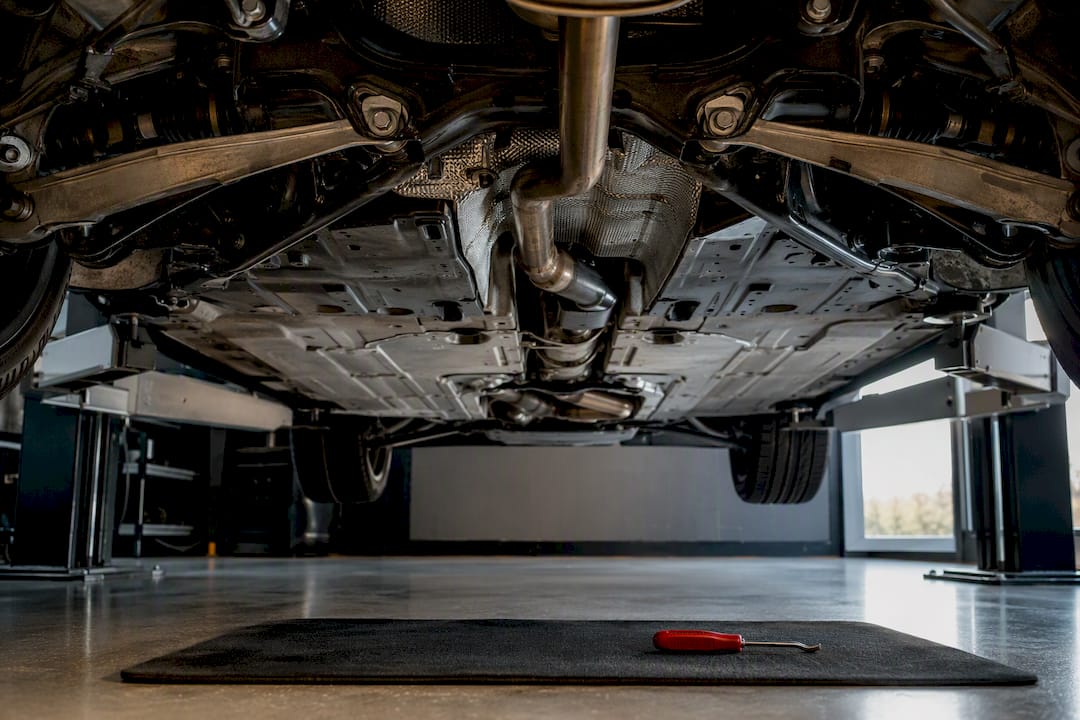
That’s the honest split between road cars and track-prepared cars. A street car with a full flat undertray, a lowered ride height, and a properly sealed diffuser can see a genuine, measurable aerodynamic benefit. A stock car with a factory plastic diffuser insert bolted under an otherwise open, cluttered underbody is mostly along for the ride visually.
A few practical checkpoints tell you which category your car falls into before you spend money on a diffuser:
- Does the underbody already have flat paneling from the front subframe back, or is it exposed metal with hanging components?
- Is the ride height low enough that the diffuser’s throat sits close to the road surface, or does the whole underbody sit high enough that airflow barely accelerates?
- Is the car’s rear suspension geometry going to let the diffuser stay at a consistent angle under braking and load, or will it constantly shift out of its designed range?
- Are you tracking the car, where the sustained high speeds needed to generate meaningful downforce actually happen, or mostly driving it around town where the effect barely registers?
Ground clearance and legality round out the practical picture. A diffuser that drags on speed bumps and steep driveway approaches won’t survive long, and some track and street-legal classes have explicit rules about how far bodywork can extend past the bumper line. Check your class rules before fabricating anything aggressive.
Buying or Building a Diffuser: Materials and Fitment Checks
The material question comes down to a trade-off between weight, stiffness, and cost. Carbon fiber is the performance standard: light, extremely stiff, and resistant to the flexing that ruins a diffuser’s designed geometry under aerodynamic load. It’s also the most expensive option by a wide margin, and repair after a scrape or impact usually means replacement rather than a patch job. Fiberglass and ABS plastic cost far less and are easier to repair, but they weigh more and flex more under the same suction loads, which can quietly erode the performance gains the shape was designed to deliver.
Whatever material you choose, follow these steps before committing:
- Check ground clearance at full suspension compression, not just at static ride height, since bottoming out is what destroys a diffuser fastest.
- Confirm the attachment points spread load across multiple mounting locations rather than a handful of bolts, since suction forces under a diffuser can reach into the hundreds of pounds and concentrated mounting points are the first thing to fail.
- Inspect for interference with exhaust tips, subframes, or heat shields before final installation, especially on cars where the exhaust exits near the diffuser’s throat.
- Plan for road damage. A diffuser sitting low and wide is the first thing to contact a speed bump, curb, or steep driveway, so budget for eventual scrapes.
- Have a professional handle fitment on anything model-specific or performance-critical, since a diffuser mounted at the wrong angle can do more harm than leaving the stock bumper alone.
Pro Tip: Before you fabricate or buy anything, get the car on a lift and run your hand along the underbody from front to back. If you feel more gaps, brackets, and exposed metal than flat panel, a diffuser is going to underperform no matter how good its shape is. Fix the airflow feeding it first.
Splitters, Wings, and Exhaust Flow: The Diffuser Doesn’t Work Alone
A diffuser rarely performs in isolation, and treating it as a standalone part is one of the more common mistakes enthusiasts make when planning an aero upgrade. It’s one piece of a system, and the other pieces change what the diffuser can actually deliver.
- A front splitter feeds the diffuser its raw material. It forces high-speed, clean air under the car instead of letting it spill around the sides, and a diffuser starved of fast-moving air upstream can’t recover much pressure no matter how well it’s shaped.
- A rear wing or spoiler lowers the pressure in the air just behind the car, and that lower exit pressure lets the diffuser run a steeper ramp angle before stalling. Cars running big wings often pair them with more aggressive diffuser geometry for exactly this reason.
- Exhaust routing into the diffuser is a deliberate tactic on some performance builds. Dumping exhaust flow into the diffuser channel energizes the underbody air and can boost the pressure recovery effect, but it introduces a wrinkle: downforce becomes throttle-dependent, changing with engine load in a way a purely passive setup doesn’t.
- Rake, the difference in ride height between front and rear, changes the whole underbody’s effective volume. Raising the rear slightly increases underbody volume and can behave like an oversized diffuser, though it also opens the door to more side inflow unless the sealing is tightened to match.
None of these elements work in a vacuum, which is why race teams tune splitter, wing, rake, and diffuser together rather than bolting parts on one at a time and hoping they add up.
Common Myths About Rear Diffusers, Cleared Up
The biggest misconception is visual: not every part shaped like a diffuser is doing a diffuser’s job. Plenty of factory bumper inserts have vertical fins molded into black plastic purely for styling, with no ramp, no throat, and nothing feeding them clean underbody air. They look the part in a parking lot and do essentially nothing at speed.
Angle mistakes are the second big trap. A steeper ramp doesn’t automatically mean more downforce. Push past the point where airflow can follow the surface, and the flow separates, killing the pressure recovery and sometimes adding drag instead of downforce, the opposite of the intended result.
A diffuser also doesn’t work in isolation from the rest of the car’s aero. Without a front splitter feeding it clean air and proper underbody sealing keeping high-pressure air from sneaking in sideways, even a well-shaped diffuser delivers a fraction of its potential.
Finally, physical damage matters more than most owners assume. A scraped or bent diffuser doesn’t just look rough; it changes the geometry that made it work, and a deformed ramp angle or cracked strake quietly erodes performance long before it becomes visibly obvious.
Why Exhaust Design and Diffuser Performance Are Connected
Exhaust flow and diffuser performance intersect more than most owners realize, and it’s an area Valvecontrolexhaust has built its business around. Valvecontrolexhaust specializes in customizable exhaust systems with real-time adjustable valves, letting drivers dial in sound and performance characteristics for European and luxury performance vehicles, including Audi, BMW, Ferrari, and Lamborghini platforms.
The connection to diffuser performance comes down to exit location and flow energy. When exhaust piping routes near or into the diffuser channel, the exhaust’s own velocity can add energy to the underbody air passing through, reinforcing the pressure recovery effect rather than disrupting it. That interaction is throttle-dependent, meaning it changes as engine load and exhaust flow rate change.
A few things worth knowing if you’re planning both diffuser and exhaust work on the same car:
- Exhaust exit position relative to the diffuser throat affects whether the two systems reinforce or interfere with each other.
- Valve control lets you manage exhaust flow characteristics without changing hardware, which matters if you’re tuning for both sound and underbody airflow behavior.
- Model-specific fitment matters here as much as it does with diffuser installation, since exhaust routing varies significantly between chassis platforms.
Anyone tackling a diffuser on a BMW M5 platform, for instance, can see how the two systems relate by looking at a model-specific example like the Akrapovic carbon fiber diffuser for the F90 M5, where exhaust tip placement and diffuser geometry are designed to work together rather than against each other.
How a Diffuser Changes the Way Your Car Handles
Downforce at the rear axle doesn’t just add grip, it changes the entire balance of the car. A diffuser generating meaningful suction shifts the front-to-rear traction balance rearward, and that shift shows up most under braking and at high-speed corner entry, where the car needs the rear tires to stay planted while weight transfers forward.
Cars that were previously nervous or loose at the rear end during fast direction changes often settle noticeably once a functioning diffuser is added, because the low-pressure zone underneath resists the kind of lift that destabilizes the rear at speed. That stability gain is speed-dependent, though. Downforce from a diffuser scales with the square of airspeed, so the handling benefit that feels dramatic at 100 miles per hour is nearly unnoticeable in a parking lot or at city speeds.
There’s a flip side worth taking seriously. A diffuser that stalls mid-corner, whether from too steep an angle or a sudden ride-height change under load, doesn’t just lose downforce gradually. It can lose it abruptly, and a sudden rear-grip loss at speed is far more dangerous than never having had the extra downforce in the first place. That’s part of why professional setups pair aggressive diffuser angles with careful suspension tuning to keep the ramp’s effective angle within a safe operating window throughout the range of body movement the car experiences on track.
Rear Diffuser Function in Road Cars vs. Race Cars
The core physics behind rear diffuser function stays identical whether you’re looking at a Formula 1 car or a tuned street coupe. Underbody air accelerates, pressure drops, and the diffuser recovers that pressure gradually on the way out. What changes dramatically is everything surrounding that physics.
Race cars are engineered from the floor up around the diffuser. The underbody is a fully flat, sealed panel with no exposed suspension or exhaust components disrupting flow, ride height is set and monitored constantly, and every other aero element, splitters, wings, and bargeboards, is tuned specifically to feed the diffuser clean, fast air. That’s how race cars reach the four-figure downforce numbers seen in top-level competition.
Road cars almost never get that treatment, even performance-oriented ones. Underbody paneling is often partial at best, exhaust systems and suspension components hang into the airflow path, and ride height is set for comfort and ground clearance rather than aerodynamic optimization. A bolt-on diffuser on a car like this can still help, but the gains are a fraction of what the same shape would produce on a fully sealed race underbody.
The practical implication for enthusiasts: judge a street diffuser by what it can realistically achieve on a partially obstructed underbody, not by race-car downforce figures. A diffuser paired with a proper flat undertray and lowered ride height on a track-prepped street car sits in a middle ground, capable of real, measurable gains, just well short of what a purpose-built race chassis delivers.
The History Behind Modern Diffuser Design
Underbody aerodynamics as a serious downforce strategy trace back to Formula 1 in the late 1970s, when the “wing car” era used venturi-shaped underbodies and sliding skirts to seal the sides, generating enormous ground-effect downforce with minimal drag penalty. Governing bodies eventually banned full ground-effect underbodies and sliding skirts on safety grounds, since the downforce could vanish suddenly if the seal broke, but the diffuser at the rear survived in a more regulated, smaller form.
From there, diffuser design became a game of working within tighter and tighter rule packages. Teams pushed strakes, fences, and increasingly elaborate throat shapes to extract more pressure recovery from a shrinking legal footprint, a pattern that repeated across successive rule eras in top-level racing.
Diffusers migrated into road car design mostly through motorsport-derived styling first, with plastic fins appearing on production bumpers as visual cues borrowed from racing long before most of those cars had the flat underbody needed to make them functional. Genuine functional diffusers on road cars are a newer development, arriving alongside more serious factory aero packages on performance models and the aftermarket’s growing access to CFD tools that let smaller shops validate ramp angles and skirt placement without a wind tunnel budget.
What I’ve Learned Fitting Diffusers on the Shop Floor
The cars that see real gains from a diffuser almost always share one trait before any fabrication starts: a flat, sealed undertray already in place. Adding a diffuser to a car that still has an exposed subframe and dangling exhaust hangers is chasing a number that underbody clutter won’t let you reach.
A few checks before cutting anything: measure ride height at all four corners loaded and unloaded, run a hand along the undertray for gaps or missing fasteners, and if you can manage it, tape a few tufts of string or ribbon under the car for a quick low-speed flow check on a test drive. It tells you more about where air is actually escaping than staring at the shape on a lift ever will.
The outcomes that show up most often on the shop floor aren’t dramatic top-speed changes. They’re better composure under braking and more confidence turning in fast, which matters more to most owners than a lap-time number ever will.
— Info
Get the Right Fit for Your Car’s Airflow
Getting diffuser performance right means matching it to a car’s actual exhaust routing, not guessing at clearance and hoping for the best. Some ecommerce sellers offer genuine components sourced directly from authorized manufacturers, with compatibility spanning Audi, BMW, Porsche, Ferrari, Lamborghini, and Mercedes-AMG platforms, so the fitment questions this article raised about exhaust interference and throat placement have real answers instead of guesswork.

The product lineup covers the parts that actually interact with underbody airflow: exhaust components that determine exit routing near the diffuser throat, downpipes that shape flow further upstream, and accessories for finishing a build once the aero and exhaust plan is locked in. For readers weighing how a valved exhaust setup changes throttle-dependent airflow behavior near a diffuser, the Remus Throttle Responder is worth a look as a real-world example of adjustable exhaust control hardware.
If you’re planning a diffuser install alongside exhaust work on a European or luxury performance platform, reach out through the Valvecontrolexhaust product catalog for model-specific fitment guidance before you buy anything, and check current pricing directly on the product pages.
Sources
The claims in this article rest on a small set of sources worth reading directly if you want to dig deeper. The MDPI/Applied Sciences CFD study backs the 7-degree angle guidance and the 1,780% downforce figure, and it’s the strongest quantitative source here. The Car and Driver feature on diffuser physics grounds the racing downforce figures and the rake-tuning discussion. The Grassroots Motorsports explainer supports nearly every practical claim about strakes, skirts, sealing, and why production-car underbodies limit diffuser effectiveness.
- A Numerical Aerodynamic Analysis on the Effect of Rear Underbody Diffusers on Road Cars
- The Physics of Diffusers: How to Make a Car Really Suck — Car and Driver
- Diffusers: What you need to know | Grassroots Motorsports
FAQ
Does a Rear Diffuser Increase Drag?
It can go either way. A well-sealed diffuser with the right ramp angle often reduces drag by shrinking the turbulent wake behind the car, while a poorly angled or unsealed diffuser can increase drag by triggering flow separation instead of smooth pressure recovery.
Is a Rear Diffuser Just for Looks?
On many production cars, yes, largely. Factory diffuser inserts sitting under an exposed, cluttered underbody with no flat sealing behave more like styling cues than functional aero parts, since effective pressure recovery requires clean upstream airflow that most stock underbodies don’t provide.
What Is the Point of Using a Diffuser?
The point is pressure recovery: a diffuser lets high-speed, low-pressure air from under the car return to ambient pressure gradually instead of all at once, which generates downforce and reduces the size of the turbulent wake trailing the car.
What Is the Difference Between a Spoiler and a Diffuser?
A spoiler or wing manipulates airflow above and behind the car to create downward force through disrupted airflow at the rear, while a diffuser works entirely underneath the car, managing the pressure of underbody airflow before it exits.
Does a Rear Diffuser Work Without a Front Splitter?
It can still generate some effect, but nowhere near its potential. A front splitter feeds clean, fast-moving air under the car, and a diffuser starved of that upstream flow has far less pressure to recover regardless of how well its ramp is shaped.