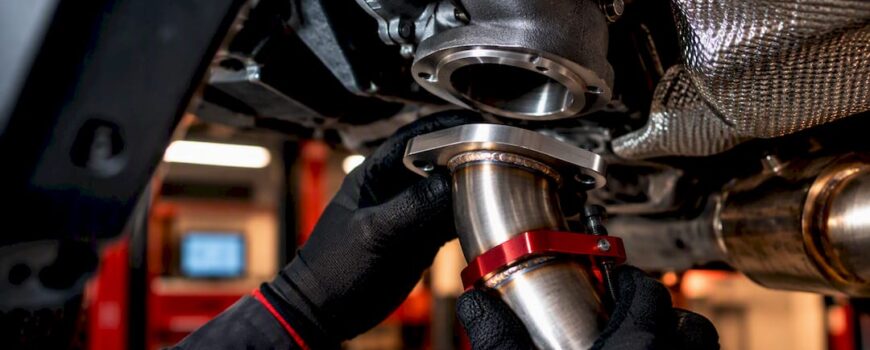
A downpipe upgrade earns its keep: quicker turbo spool, a fatter midrange, and genuine peak power gains that most drivers can feel within the first mile. Without an ECU tune, though, expect modest results, typically a modest horsepower gain. Pair the same downpipe with a Stage 2 tune and that number can jump past 60 HP depending on the platform. The hardware removes the restriction; the tune is what actually cashes in on it.
TL;DR:
- A downpipe alone provides a modest horsepower increase mostly from reduced backpressure, but the full gains require a Stage 2 tune to unlock significant power and torque.
- Removing restrictions improves turbo spool and reduces lag, especially on small-displacement turbo fours, but factory ECUs need tuning to optimize these benefits safely.
- For street use, high-flow catted downpipes offer nearly the same flow benefits as catless options while maintaining better emissions control and odor management.
- The total upgrade costs typically range from $800 to over $2,000, including parts, labor, and tuning, with premium hardware and custom tuning increasing the price.
- Proper heat management is essential for durability, especially for track use, requiring heat shields or wraps to prevent damage and ensure reliability.
Table of Contents
- Downpipe Upgrade Benefits: What You Actually Get in HP, Torque, and Spool
- Why Most of the Gains Are Locked Behind an ECU Tune
- Catted, Catless, or High-Flow Catted: Which One Fits a Street Car
- What a Downpipe Install Actually Costs and How Long It Takes
- Heat, Durability, and What Track Driving Changes
- Choosing a Downpipe: A Practical Checklist
- Valve Control Exhaust: Matching the Right Downpipe to Your Platform
- Should You Buy One Now, or Wait?
- Ready to Shop Downpipes? Here’s Where to Start
- Sources
- FAQ
Downpipe Upgrade Benefits: What You Actually Get in HP, Torque, and Spool
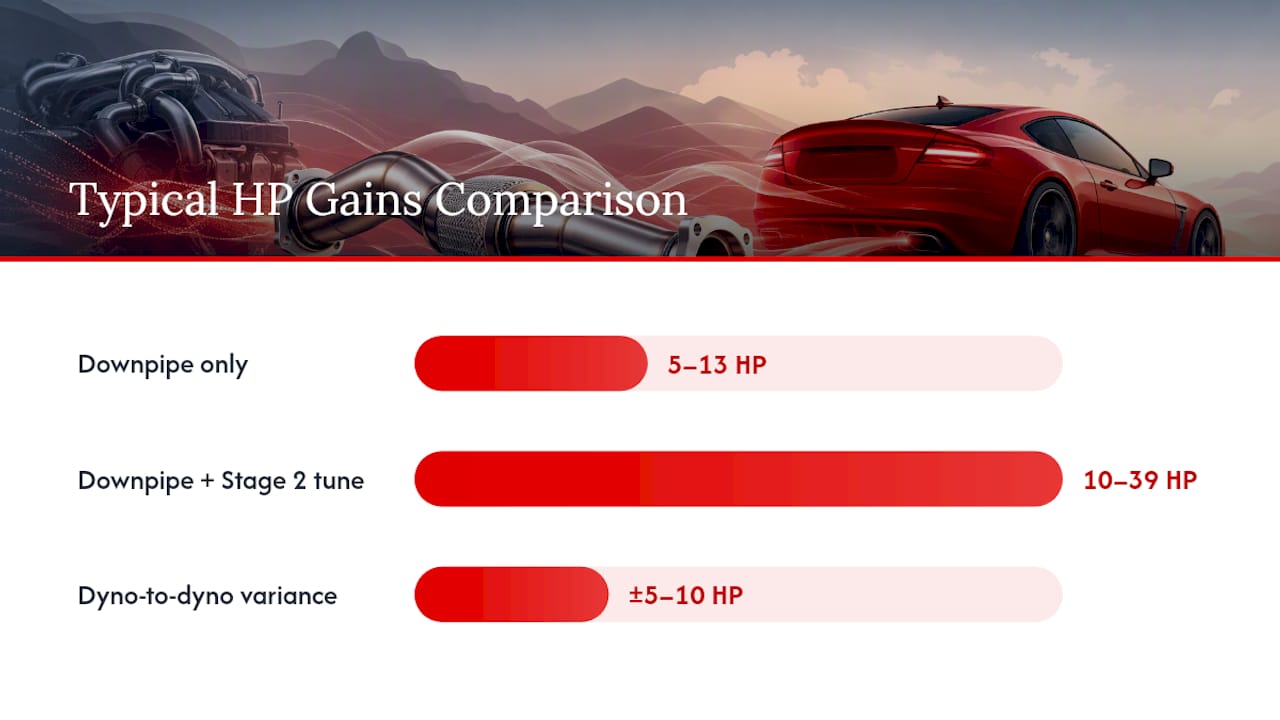
The numbers vary by platform, but the pattern doesn’t. A downpipe alone, running on the factory ECU calibration, typically adds a modest horsepower gain at the wheels. That’s a real but modest bump, and it comes almost entirely from reduced backpressure rather than any change in fueling or boost targets. Once you add a Stage 2 tune into the mix, gains commonly increase significantly, allowing the calibration to use the extra flow the hardware just freed up.
Dyno testing across different platforms backs this up consistently. ThreePiece’s dyno comparisons show downpipe-only runs landing in the single digits to low teens on several common turbo platforms, with tuned runs on the same cars roughly doubling or tripling those figures. Wheel numbers will always read lower than crank estimates, and dyno-to-dyno variance of 5 to 10 HP on the same car is normal, so don’t chase a specific number from a forum post as if it’s gospel for your exact setup.
The spool improvement is where a lot of the “seat of the pants” excitement comes from. A stock downpipe, especially on cars with catalytic conversion mandates, creates backpressure right where the turbine wants to spin freely. Removing that restriction lets exhaust gas velocity increase immediately after the turbine, which speeds up spool and cuts lag on many applications, with spool RPM often dropping into an earlier window on the tachometer.
Here’s where the returns tend to concentrate:
- Small-displacement turbo four-cylinders (think 2.0T platforms) often see the largest percentage gains because factory downpipes on these engines are heavily restricted from the start.
- V6 and V8 twin-turbo platforms see smaller percentage gains but larger absolute torque numbers, since there’s more air being moved overall.
- Cars with factory catalytic converters mounted close to the turbo tend to benefit more than those with already-efficient stock setups.
Quick reference: typical gain ranges
| Setup | Horsepower gain | Torque gain |
|---|---|---|
| Downpipe only, stock tune | Moderate horsepower gain | Minimal, mostly midrange feel |
| Downpipe + Stage 2 tune | Significant horsepower gain | Notable torque gain |
Why Most of the Gains Are Locked Behind an ECU Tune
Factory engine management is conservative by design. The stock ECU is calibrated around the stock downpipe’s restriction, which means it caps boost, pulls timing at certain loads, and manages fueling within a narrow band that assumes the old exhaust geometry is still there. Bolt on a freer-flowing downpipe and the ECU mostly just sees a different backpressure signal. It doesn’t know to push more boost or add timing. That’s the entire reason downpipe horsepower gains stay small until a tune tells the computer what to do with the new hardware.
Running a big turbo exhaust efficiency improvement on a stock tune isn’t dangerous in most cases, but it can trigger a handful of predictable symptoms:
- A check engine light tied to catalyst efficiency codes, most commonly P0420, especially with catless or very low-cell-count catted pipes.
- Slightly inconsistent air-fuel ratios as the factory O2 sensors read a different exhaust environment than they’re calibrated for.
- Occasional flat spots or odd boost behavior at certain RPM ranges where the stock map wasn’t expecting the change.
Pro Tip: If you’re not tuning right away, ask your shop to check for a “de-cat” fault code workaround or O2 sensor spacer before you commit to a catless pipe. It’s a lot cheaper to solve a CEL now than to chase a mystery drivability issue three months later.
As a rule of thumb, most Stage 2 setups treat the tune as mandatory, not optional. If you’re planning to stop at just a downpipe for now, you’ll get smaller, safer gains and can skip the tune until you’re ready to go further. One more thing worth knowing before you touch anything under warranty: the Magnuson-Moss Warranty Act generally prevents a manufacturer from voiding your entire warranty just because you installed an aftermarket part, unless they can show that specific part caused the failure in question. It’s a useful thing to know, not a blank check to modify recklessly.
Catted, Catless, or High-Flow Catted: Which One Fits a Street Car
The three main downpipe styles trade power for compliance in different amounts, and picking the wrong one for your driving habits is the most common regret enthusiasts report. A catless downpipe removes the catalytic converter entirely, maximizing flow and typically producing the biggest advantages of downpipe upgrade the hardware alone can offer; however, it can also lead to noticeable exhaust odor in the cabin, so it’s important to diagnose the source first to stop car odour for good. A stock-style catted downpipe maintains full emissions compliance but sacrifices some of that flow gain. A high-flow catted downpipe, usually built around a 200-cell metallic catalyst, splits the difference.
Industry testing consistently points to the 200-cell metallic catalyst as the practical sweet spot for street-driven cars, since it recovers most of the flow benefit of going catless while still doing meaningful emissions filtering.
The tradeoffs break down like this:
- Catless: Maximum flow and the loudest, rawest sound, but a near-certain emissions test failure and a real chance of noticeable exhaust odor in the cabin at idle or low speed.
- Stock-style catted: Full compliance and quiet daily manners, but it leaves real horsepower on the table compared to either alternative.
- High-flow catted (200-cell): Roughly 90 percent of the catless flow benefit with dramatically better odor control, sound manners, and a fighting chance at passing inspection depending on your local requirements.
Catless setups still make sense for cars that live at the track and get trailered there, where emissions testing and daily cabin comfort simply aren’t part of the equation. For anything that sees regular street use, a catted downpipe built to preserve inspection compliance is the more livable call, and it’s worth reading up on catless versus catted tradeoffs before you buy either style.
What a Downpipe Install Actually Costs and How Long It Takes
Budgeting for this upgrade means pricing three separate things: the part, the labor, and the tune, since skipping any one of them changes the math significantly.
- Part cost. Economy catless or basic catted downpipes start around $250 to $400. Premium options in stainless or titanium construction with a proper 200-cell metallic catalyst commonly run $500 to $900, sometimes more on exotic platforms with limited aftermarket support.
- Labor. A bolt-on downpipe swap on a common platform with easy underbody access usually takes 1 to 2 hours of shop time. Custom fitment work, common on lower-volume or exotic chassis, can stretch to 3 to 5 hours if flanges need modification or O2 sensor bosses have to be relocated.
- Tune. A basic Stage 2 flash tune generally lands between $300 and $700, depending on whether it’s an off-the-shelf map or a custom dyno tune for your exact combination of parts.
Put together, a realistic all-in budget looks like $800 to $1,200 on the low end for a basic catted pipe with a shelf tune, $1,200 to $1,800 for a mid-tier setup with custom flash tuning, and $1,800 to $2,000-plus on the high end for premium hardware, custom fabrication, and a dyno-tuned calibration, a range that lines up closely with ThreePiece’s real-world budget data. Shops charging premium hourly rates in major metro areas will push the labor side of that estimate higher regardless of parts chosen.
Heat, Durability, and What Track Driving Changes
Improved flow doesn’t just move exhaust gas faster. It changes where heat concentrates in the engine bay. A downpipe upgrade often reduces some backpressure-related heat buildup right at the turbine housing, but it can shift thermal load to new spots further down the pipe, particularly near tunnel sections that weren’t designed around a different exhaust routing.
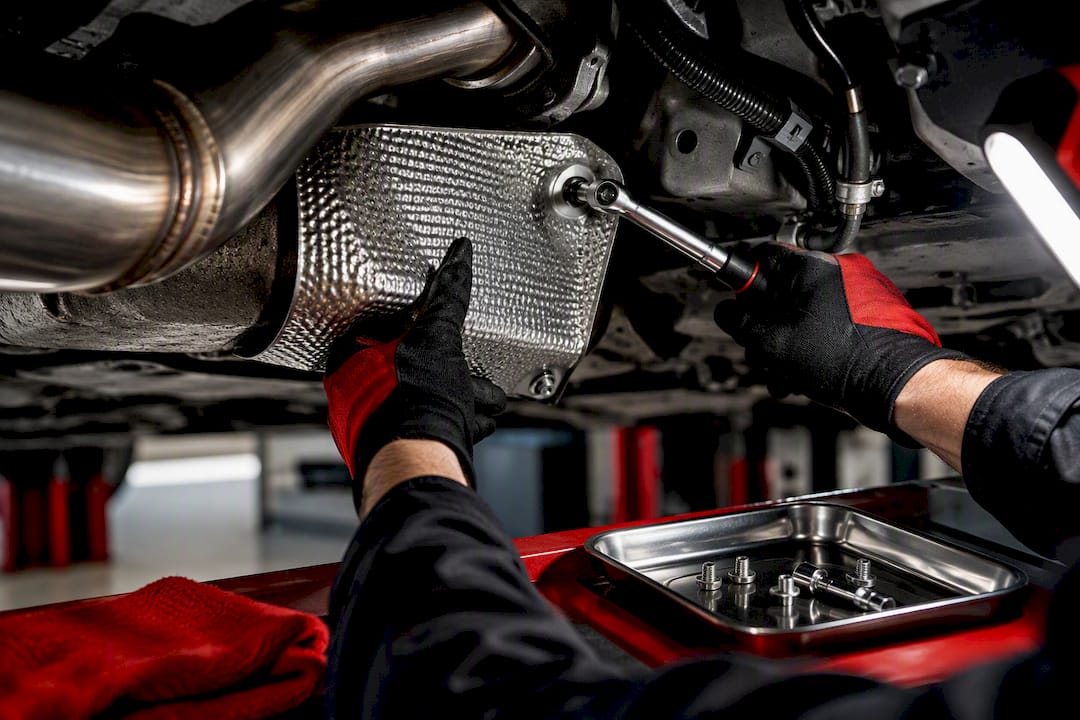
Shops that install these regularly recommend budgeting for basic heat management alongside the part itself: a heat shield near sensitive wiring or hoses, exhaust wrap on sections routed close to plastic components, and a visual check that the new pipe’s routing doesn’t sit closer to a fuel line or brake hose than the factory setup did. None of this is expensive, but skipping it is how a great-sounding install turns into a melted wiring harness six months later.
Pro Tip: If you’re tracking the car regularly, have your tuner build in a slightly more conservative timing and boost margin than a street-only map would use. Repeated high-load pulls raise average EGTs over a session, and a little headroom now avoids a much worse conversation with your turbo later.
Track-focused owners should also shorten their inspection intervals. Check O2 sensor wiring, exhaust hangers, and heat shield fasteners every few track days instead of waiting for a scheduled service, since vibration and heat cycling both accelerate wear faster under sustained load than in normal commuting.
Choosing a Downpipe: A Practical Checklist
Not every downpipe on the market is built to the same standard, and the cheapest option is often cheap for a reason. Before buying, check these details against your specific platform:
- Material and wall thickness. Look for 304 or 321 stainless steel with adequate wall thickness. Thin-wall pipes crack at welds sooner, especially with heat cycling.
- Diameter sizing. The downpipe’s diameter should match or slightly exceed the downstream piping. A downpipe that’s oversized relative to everything after it doesn’t help and can actually hurt low-end torque on smaller engines.
- Catalyst type. Confirm whether it’s catless, a low-cell catted option, or a 200-cell high-flow catted design, and match that choice to how the car is actually driven.
- O2 sensor provisions. Make sure the bosses for your factory O2 sensors are in the right location and angle for your specific vehicle, not just “universal fit.”
- Documented platform fitment. Ask for proof the exact part has been installed on your model and year, not just the general chassis family.
Before you buy, ask the shop or tuner these questions:
- Do you have dyno numbers from this exact downpipe on my platform, with and without a tune?
- What’s your fitment and return policy if the O2 sensor bosses don’t line up correctly?
- What guidance can you give on emissions compliance for my state or region?
- What tune map do you recommend pairing with this specific part?
Red flags worth walking away from: no fitment data for your specific model, noticeably thin metal at the flanges, missing O2 sensor provisions, or a shop that can sell you the part but won’t talk you through a tune recommendation. If a shop’s troubleshooting advice sounds vague, it’s worth comparing it against a detailed DIY fitment error guide before committing.
Valve Control Exhaust: Matching the Right Downpipe to Your Platform
The downpipe lineup is designed for compatibility with various luxury and performance car platforms, which matters more than it sounds. A downpipe that’s a perfect fit on one chassis variant can be the wrong diameter or flange pattern on the next model year of the same nameplate.
For street-driven luxury and performance cars, the practical recommendation lines up with what the data already shows: a high-flow catted option paired with a Stage 2 tune captures most of the available performance increase without inviting an automatic emissions test failure or a cabin full of exhaust smell at stoplights.
A few things worth knowing before you shop the lineup:
- Compatibility spans multiple luxury and performance brands rather than a single chassis family.
- Options exist for drivers who want adjustable sound and backpressure characteristics rather than one fixed setup.
- Genuine parts are sold direct from authorized manufacturers, which matters if you’re trying to avoid a knockoff that doesn’t match the fitment data you were promised.
Should You Buy One Now, or Wait?
A downpipe is the right next move if you’re already planning a Stage 2 tune or bigger turbo work down the line. Buy it early and you’re not paying for labor twice. If you’re on a stock tune with no plans to change that, or you’re driving somewhere with strict emissions testing, a modest gain and a possible CEL might not be worth the tradeoff yet. When in doubt, talk to a shop that knows your specific platform before you commit.
— Info
Ready to Shop Downpipes? Here’s Where to Start
Genuine parts are sold direct from authorized manufacturers, not gray-market knockoffs with mystery fitment, which matters once you’ve read through how sensitive these installs are to flange sizing and O2 sensor placement.

Browsing the Down Pipe category gets you straight to the platform-specific options for Audi, BMW, Porsche, and other supported chassis, while the Exhaust Parts category covers supporting components like flanges, gaskets, and O2 sensor hardware you’ll want on hand for the install. Need valve controllers, tips, or mounting hardware to round out the build? The Accessories category covers that side of things. If you want the flow benefits without giving up daily drivability, start by reading how a catted downpipe protects your inspection pass, then reach out for a fitment check on your exact model and year before placing an order.
Sources
- What Is a Downpipe ? Benefits, Performance Gains & Installation Guide 2026 – Onlymechanic
- Are downpipes worth it? Real dyno numbers and honest verdict – ThreePiece
- How the downpipe unlocks the horsepower trapped in your turbocharged car – AutoRacing1
- Magnuson-Moss Warranty Act – FTC
FAQ
How Much HP Will a Downpipe Add?
Without a tune, expect roughly 5 to 20 horsepower depending on your platform and how restrictive the factory downpipe was to begin with. Add a Stage 2 tune, and that range commonly climbs to 20 to 60-plus horsepower along with 30 to 80-plus lb-ft of added torque.
What Are the Advantages of Having a Downpipe?
The main advantages are faster turbo spool, stronger midrange torque, and a more responsive throttle feel, on top of the raw horsepower gain. Many owners also fit one purely for the deeper, more aggressive sound it unlocks, even before chasing peak numbers.
Does a Bigger Downpipe Make a Difference?
A larger diameter helps up to a point, but oversizing it relative to your downstream piping can actually hurt low-end torque on smaller engines by slowing exhaust gas velocity. Matching diameter to your specific platform’s turbo size and piping matters more than simply going as big as possible.
How Much HP Do Lower Downpipes Add?
Lower downpipes (also called catless or high-flow versions installed closer to the turbo) tend to land in the same 5 to 20 HP range without a tune, with the bigger jump coming once paired with a proper calibration. The exact number depends heavily on your engine platform and whether you’re running catless or a high-flow catted design like a 200-cell metallic catalyst.
Does Valve Control Exhaust Sell Downpipes for My Car?
Downpipe compatibility spans a range of luxury and performance brands, including Audi, BMW, Porsche, Mercedes-AMG, Ferrari, and Lamborghini. Current pricing and specific model fitment are available on the Down Pipe product page.