
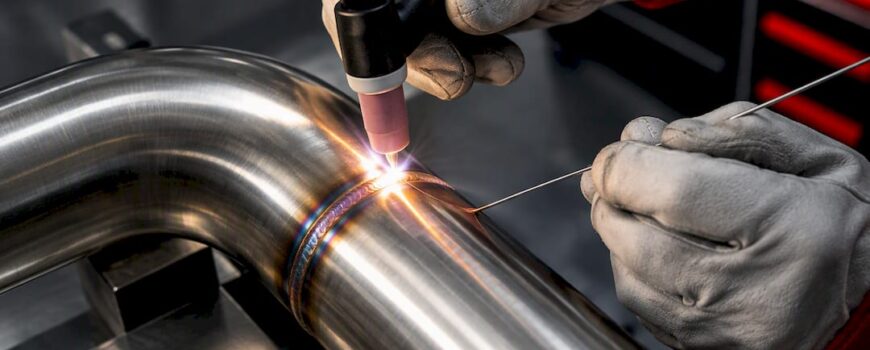
For high-temperature automotive exhaust components, 321 stainless steel is usually the better choice because its titanium stabilization preserves hot strength and prevents weld-area intergranular corrosion under cyclical exhaust temperatures. It resists the carbide precipitation that weakens standard 304 near welds, holds up better under sustained heat, and forms a more stable oxide scale. That combination is why headers, manifolds, and turbo-adjacent sections favor it over cheaper alternatives.
TL;DR:
- 321 stainless steel is preferred for high-temperature exhaust parts because it resists carbide precipitation and maintains strength up to nearly 900°C.
- The addition of titanium in 321 bonds preferentially with carbon, preventing chromium carbide formation and reducing intergranular corrosion at welds.
- Welding 321 requires niobium-stabilized filler rods, like Grade 347, and care must be taken to avoid excessive heat buildup during fabrication.
- For continuous high-heat components such as headers and turbo housings, 321 outperforms 304 and 316 in strength, oxidation resistance, and weld durability.
- In cooler or salt-exposed areas, 304 or 316 may be more cost-effective, but 321’s longevity at high temperatures justifies its higher price where conditions demand it.
Table of Contents
- 1. Chemistry and metallurgy: what makes 321 different
- 2. High-temperature behavior: creep strength, oxidation, and safe service ranges
- 3. Practical comparison: 321 versus 304 and 316 for exhaust use
- 4. Welding, forming, and fabrication notes builders must know
- 5. Applications in exhaust systems: where 321 gives material advantage
- 6. Durability and maintenance: expected life, common failure modes, inspection tips
- 7. Datasheet synthesis and practitioner notes
- 8. Selection checklist and short recommendation for builders and buyers
- 9. Author’s perspective on cost versus longevity in real projects
- How Valve Control Exhaust supports high-temperature exhaust projects
- Sources
- FAQ
1. Chemistry and metallurgy: what makes 321 different
Grade 321 starts as a standard 18/8 chromium-nickel austenitic steel and adds titanium as a stabilizing element. That single addition changes how the alloy behaves once it gets hot. According to the WorldStainless and Atlas grade datasheet, titanium is added specifically to avoid intergranular corrosion in the 425 to 850°C carbide precipitation range, which makes 321 suitable for applications running at temperatures approaching 900°C.
The mechanism is straightforward:
- Titanium bonds preferentially with carbon in the steel, forming titanium carbides instead of chromium carbides.
- This keeps chromium dissolved in the matrix, where it continues protecting the steel from corrosion instead of being locked up at grain boundaries.
- Without that protection, chromium carbides form along grain edges during welding or prolonged heat exposure, leaving those zones depleted of chromium and vulnerable to attack.
A higher-carbon variant, 321H, exists for applications that need more structural creep resistance at sustained high temperatures. The controlled carbon content in 321H trades a bit of the corrosion margin for extra hot strength, which matters in parts that see continuous heat rather than short bursts.
2. High-temperature behavior: creep strength, oxidation, and safe service ranges
Creep is the slow, permanent deformation a metal undergoes under constant stress at elevated temperature, and it is the limiting factor for exhaust components that spend hours at near-peak heat rather than momentary spikes. A header that survives a dyno pull might still sag or crack years later if the metal creeps under its own weight and vibration at sustained operating temperature.
Therma 321H is rated by manufacturers for continuous service at high temperatures near 850°C, according to Outokumpu’s product specification, with good oxidation resistance extending to intermittent service near 900°C. That distinction between continuous and intermittent duty matters for exhaust design: a turbo housing that cycles hard on track days operates differently than a daily-driven manifold that sees steady, moderate heat.

Exceeding these thresholds accelerates two failure paths at once; understanding the impact of thermal cycling on surface durability is essential, as discussed in interior ceramic coating insights. First, the protective oxide layer that normally shields the base metal starts to break down faster than it can rebuild, exposing fresh metal to oxidation. Second, thermal cycling, the repeated heating and cooling that happens every time the engine starts and stops, stresses that oxide scale mechanically. Scale that would otherwise sit stable under constant heat starts to flake and crack under cyclic loading, exposing new surface to oxidize again.
Outokumpu also notes that optimizing a stainless grade for high-temperature performance often comes at some cost to aqueous corrosion resistance, so designers weigh both factors rather than chasing heat tolerance alone. In practice, this means keeping condensate out of the system and avoiding chloride exposure where possible, since 321’s strength at high temperature does not automatically translate into wet-corrosion resistance.
3. Practical comparison: 321 versus 304 and 316 for exhaust use
The three grades most fabricators weigh against each other each solve a different problem, and picking the wrong one shows up as premature cracking, rust, or warped flanges within a season or two.
- 321 retains strength at temperatures where 304 begins to soften, and its titanium stabilization prevents the intergranular corrosion that can develop at weld seams once carbides start precipitating, according to AZoM’s technical overview.
- 316 adds molybdenum for better resistance to chloride pitting, which helps in road-salt or coastal environments, but it does not match 321’s hot strength, so it is a better fit for components that see moisture more than sustained heat.
- 304 remains the economical choice for lower-heat sections such as mid-pipes and muffler internals, where peak temperatures stay well below the range where carbide precipitation becomes a concern.
Cost and availability tilt the decision too. 304 is cheaper and more widely stocked, which is why it still dominates mid-pipe and muffler construction; you can read more about where it fits in our breakdown of T304 exhaust properties. 321 costs more and is a narrower stock item, but for headers, manifolds, and turbo-adjacent sections that see both high heat and welded joints, the added cost buys longevity that 304 cannot match in that specific environment.
4. Welding, forming, and fabrication notes builders must know
Titanium’s stabilizing benefit has one practical catch: it does not transfer well across a welding arc. Per the WorldStainless and Atlas datasheet, because titanium burns off or is lost during welding, fabricators typically use niobium-stabilized Grade 347 filler rod when joining 321 parent metal. Niobium survives the arc better and preserves the weld’s resistance to intergranular corrosion without requiring a post-weld heat treatment.
A few fabrication points worth planning around:
- Specify 347 filler for any TIG or MIG weld on 321 tubing or sheet, since standard 308 or 316 filler will not carry the same stabilization benefit.
- Mandrel bend rather than crush bend wherever possible; 321 forms cleanly under mandrel bending, and you can see real examples in our mandrel-bent exhaust guide.
- Inspect welds visually after cooling for discoloration patterns that suggest uneven heat input, since inconsistent penetration is more likely to create localized carbide zones even with correct filler.
Pro Tip: Keep interpass temperatures low when multi-pass welding 321, since excess heat buildup during welding increases the risk of carbide precipitation right where you least want it.
Surface finish is the other tradeoff to plan for. AZoM notes that 321 does not polish well and is not recommended for decorative applications, so it is a functional choice rather than a show-finish one. If a mirror-polished tip or visible section matters to the build, plan to source those pieces in a different grade or finish rather than expecting 321 to take a high shine.
5. Applications in exhaust systems: where 321 gives material advantage
321’s properties map cleanly onto the hottest, most stressed parts of an exhaust system, while cooler downstream sections often do fine on a cheaper grade.
- Headers and manifolds see the highest and most cyclic heat in the system, making 321’s carbide resistance and hot strength directly relevant.
- Turbo housings and hot downpipe sections combine high sustained temperature with vibration, a combination that plays to 321’s creep resistance.
- Expansion joints and flanges near the turbo benefit from stable dimensional behavior under repeated thermal cycling.
- Mid-pipes and muffler internals rarely reach the carbide precipitation range, so 304 remains a sound, less expensive choice there.
A high-output turbo build pushing sustained boost benefits from 321 in the housing and downpipe flange area, where our turbo exhaust efficiency guide covers the broader heat management picture. A dedicated race header that sees short, extreme heat spikes leans on 321’s oxidation resistance during those peaks. A long-run, highway-driven turbocharged car, by contrast, spends more time in sustained moderate heat, which is exactly the creep-limited scenario 321H addresses.
6. Durability and maintenance: expected life, common failure modes, inspection tips
321 exhaust components tend to fail in a handful of predictable ways, and knowing which one you are looking at changes what you do about it.
- Creep-related sagging or cracking shows up in long-serving high-heat sections, usually near mounting points where stress concentrates.
- Oxidation and scaling appear as flaking or discolored surface buildup, accelerated by thermal cycling rather than steady heat.
- Chloride pitting shows up in salt-exposed regions or after winter road treatment, since 321’s high-temperature optimization does not extend to strong wet-corrosion resistance.
- Weld-area cracking points to incorrect filler metal or excessive heat input during fabrication rather than a fault in the base material.
Inspect welded joints and weld toes at regular service intervals for hairline cracking, and check for excessive scale buildup on the hottest sections. Draining condensate rather than letting it sit, and avoiding prolonged contact with road salt or acidic residue, extends service life meaningfully since aqueous corrosion resistance is the tradeoff 321 makes for its heat performance.
7. Datasheet synthesis and practitioner notes
Pulling the manufacturer and reference data together gives a consistent picture. The Outokumpu Therma 321H specification sets continuous service around 850°C with intermittent tolerance closer to 900°C, while AZoM’s grade overview confirms 321’s resistance to intergranular corrosion after heating and its unsuitability for polished, decorative work. Both align with the WorldStainless and Atlas datasheet on welding: use 347 filler, and skip post-weld annealing since the niobium in the filler does the stabilizing job the parent metal’s titanium cannot do across an arc.
Titanium does not transfer well across a welding arc, so 347 filler carries the stabilization the weld needs to resist intergranular corrosion, without requiring extra heat treatment afterward.
Some exhaust suppliers source components built to similar fabrication standards and provide genuine parts from authorized manufacturers rather than unverified substitutes.
— Info
8. Selection checklist and short recommendation for builders and buyers
Before specifying a grade, run through the conditions the part will actually see rather than defaulting to habit.
- Estimate peak and cyclic operating temperature for the specific component, not just the engine bay average.
- Flag every welded joint, since that is where grade selection matters most.
- Note any chloride exposure from road salt, coastal air, or marine use.
- Set a budget ceiling and compare it against 321’s premium over 304.
- Decide whether finish matters, since 321 is functional rather than decorative.
| Factor | Favors 321 | Favors 304/316 |
|---|---|---|
| Sustained heat above carbide range | Yes | No |
| Welded joints near high heat | Yes | No |
| Chloride or road-salt exposure | No | 316 preferred |
| Budget-limited mid-pipe or muffler | No | 304 preferred |
| Decorative polished finish required | No | Yes |
When ordering, request the 321 or 321H spec sheet and mill certificate from the supplier, and ask directly what filler they weld with. That single question tells you more about build quality than most marketing copy.
9. Author’s perspective on cost versus longevity in real projects
On a high-heat turbo build, spending more upfront on 321 for the downpipe flange and hot-side sections has consistently paid off compared to watching a 304 equivalent develop weld-area cracking within a season of hard driving. The fabrication is marginally more demanding, mostly around filler selection, but that extra step is minor next to a repeat repair bill. The rule that holds up: spend on 321 where the heat and welds concentrate, and save the budget on 304 everywhere the temperature allows it.
— Info
How Valve Control Exhaust supports high-temperature exhaust projects

Once you know which grade a component needs, sourcing it correctly is the next hurdle. Some suppliers provide genuine parts direct from authorized manufacturers, compatible across various luxury and performance car brands, reducing uncertainty about part fitment.
- Browse Exhaust Parts for mandrel-bent sections, headers, and hardware suited to high-heat applications.
- Check the Down Pipe category for catted and non-catted options, including street-legal setups covered in our catted downpipe guide.
- Explore Accessories for clamps, hangers, and finishing components that round out a build.
Always confirm the exact material spec, 321 or T304, on the individual product page before ordering, since the right grade depends on where the part sits in your exhaust system.
Sources
- Stainless steel grade sheets (WorldStainless / Atlas datasheet PDF)
- Stainless Steel – Grade 321 (UNS S32100) | AZoM
FAQ
What are the downsides of stainless steel exhaust?
Stainless exhaust costs more than mild steel and, in high-temperature grades like 321, does not polish to a decorative finish. It also offers less resistance to chloride pitting than nickel-molybdenum grades like 316 in salt-heavy environments.
Is 304 or 321 stainless steel better?
Neither is universally better; each suits different parts of an exhaust system. 321 retains strength at higher temperatures and resists weld-area corrosion better, according to AZoM, making it the better choice for headers and manifolds, while 304 is the more economical option for cooler mid-pipe and muffler sections.
What grade stainless steel is best for exhaust?
For the hottest, most heavily welded sections such as headers and turbo housings, 321 is generally the preferred grade because of its titanium stabilization and resistance to intergranular corrosion, per the WorldStainless and Atlas datasheet. Cooler downstream sections often perform fine in 304.
Is 321 stainless better than 316?
321 and 316 solve different problems: 321 is optimized for hot strength and weld-area corrosion resistance, while 316 adds molybdenum for better resistance to chloride pitting in wet or salty environments. For exhaust components exposed mainly to heat, 321 tends to hold up better; for parts facing heavy road salt or coastal moisture, 316 has the edge.