There is no single U.S. track day noise limit. Each circuit and each organizer sets its own, and most land between roughly 95 and 105 dB measured at 50 feet from the track edge. Some events set no limit, a few sit far lower, and the number can change from one event to the next at the same track. Check the event’s own rules before you load the car.
TL;DR
- No national standard exists. Published U.S. limits in 2026 listings range from 86 dB to 105 dB, and some tracks list no restriction at all.
- Most clubs measure at 50 feet from the track edge. The organizer’s event rules are the final word, not the track’s general reputation.
- A paddock free-rev usually reads lower than a car at full throttle on track, so leave margin below the posted number.
- Going over means a black flag, a fix and possibly removal from the event.
- A valved or muffled exhaust lets you run loud on the street and quiet on track day, if the system is built for it.
Table of Contents
- Why there is no single U.S. limit
- Published limits at U.S. tracks
- How noise is measured
- What happens when you go over
- How to check and reduce your exhaust noise before the day
- Valves and quiet modes
- Street legality is a separate question
- Our perspective
- Choosing parts for a track-ready car
- FAQ
- Sources
Why there is no single U.S. limit
Noise at a race track is a local matter. A track’s limit comes from its neighbors, its city or county rules, its insurance and its operating permits, and then the organizer renting the track adds its own requirements on top.
Portland shows how this works in practice. The city’s Noise Review Board minutes record that a 2022 SOVREN event at Portland International Raceway ran under a 110 dBA variance, while the 2023 event, held without a variance, had to meet a 103 dB trackside limit. Same track, same club, a seven-decibel swing, because the permit changed.
That is also the answer to why one car can pass at one circuit and fail at another. Three things differ: the number itself, the place the microphone sits and the test method (static, drive-by or both). A car that reads 100 dB at a track with a 103 dB cap and a lenient meter position can read the same 100 dB and still be turned away at a track capped at 95.

Published limits at U.S. tracks
The table below collects limits stated in organizer and club listings. Treat them as examples of the spread, not as a lookup chart. Limits get revised, and a different organizer at the same track may use a different number.
| Track | Organizer or source | Stated limit | Notes |
|---|---|---|---|
| Lime Rock Park | NASA Northeast | 86 dB standard | Special no-sound-event timing listed |
| Palmer Motorsports Park | SCCA Track Night | 95 dB | Measured 50 feet from track edge |
| Circuit of the Americas | ChampCar, The Dual | 96 dBA | At 50 feet |
| Road America | ChampCar, 2020 supplemental rules | 96 dBA | At 50 feet |
| Atlanta Motorsports Park | Track Night 2026 | 98 dB | At 50 feet from track edge |
| Portland International Raceway | SCCA Track Night | 102.9 dB | At 50 feet from track edge |
| MotorSport Ranch Cresson | Track Night 2026 | 103 dB | At 50 feet, in force at all times |
| Thompson Speedway | SCCA Track Night | 103 dB | In force at all times |
| Roebling Road Raceway | SVRA | Under 104 dB | Two over-limit readings mean a flag |
| WeatherTech Raceway Laguna Seca | Speed SF listing | 105 dB | Event-specific |
| Road Atlanta | Chin Track Days | No restriction | Quiet hours Sunday 10 a.m. to noon, unmodified street cars only |
| Watkins Glen International | NASA Northeast | No sound caps listed |
Two patterns stand out. First, 103 to 105 dB is a common ceiling for open-lapping days. Second, club racing and endurance series tend to sit lower, around 96 dB, because their grids are larger and louder over a full day.
Some limits are about time, not volume. NASA Northeast lists New Jersey Motorsports Park as prohibiting loud vehicles before 8:30 a.m., and The Ridge’s supplemental regulations bar race-car engines before 8:00 a.m. or after 7:00 p.m. A car that is legal at noon can still be stuck in the paddock at 7:30 a.m.
How noise is measured
The 50-foot rule
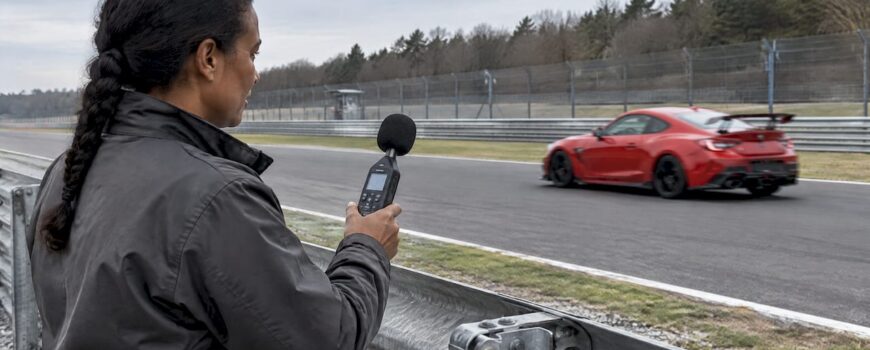
The most common reference is 50 feet from the edge of the track, as several of the listings above state. A meter operator stands at that distance and reads the car at speed on the nearest straight or corner exit. Some organizers use dBA weighting and some say only “dB”, so read the rule closely.
At NCM Motorsports Park, vehicles must pass measurements taken 50 feet from the track, and anyone who tries to evade the test must make mechanical changes or be excluded.
Static tests in the paddock
Some organizers check cars at tech inspection or in the paddock with a revved engine. Static numbers are measured at a different distance and angle from drive-by numbers, so a quoted static figure does not convert directly to the on-track limit.
The key warning comes from ChampCar: a paddock free-rev does not reproduce the full-throttle, loaded noise a car makes on track, so trackside readings can exceed what a static test predicted. If your car squeaks past a static check, do not assume you are safe at speed.
For a deeper look at the two test types, see our guide to what static and drive-by tests actually require.
Why the same car passes at one track and fails at another
- Different numbers. 86 dB and 105 dB are both real limits.
- Different microphone positions. A meter near a tight corner exit reads louder than one on a long straight.
- Different loads. A drive-by at full throttle is louder than a cruise past the meter.
- Different enforcement. One organizer tests every car at the gate. Another only meters cars that sound loud to the flaggers.
- Different permits. As Portland showed, the same event can face a different cap from year to year.
What happens when you go over
Consequences depend on the organizer, but the pattern is consistent: a warning, a fix, then removal.
Under ChampCar’s rule BCCR 9.14, excessive noise earns a black flag and the car must be repaired before returning to the track. A second offense means disqualification and removal from the event.
SVRA’s page for Roebling Road is a little more forgiving: two readings over 104 dB get the car flagged off the course, with a chance to fix the problem and re-enter. Either way, the fix has to happen in a paddock, on your own time, usually with whatever tools and parts you brought.
That is why a spare muffler, a set of sealed joints or a way to quiet the system quickly is cheap insurance. Losing a track day fee to a loud tailpipe is the most avoidable way to waste a weekend.
How to check and reduce your exhaust noise before the day
1. Find the event’s own rule
The organizer’s Event Supplemental Rules are the final source for the sound limit, where it is measured and how it is enforced. The track website, a forum thread or a friend’s memory of last year is not. Forum posts often quote older numbers, and limits can change when a permit does.
Look for four things: the number, the unit (dB or dBA), the distance, and whether it is static, drive-by or both. If any of the four is missing, email the organizer.
2. Measure your car honestly
A phone app is a rough guide only. If you can, take a calibrated meter to an open area, stand at 50 feet from the car’s path and have someone drive past at the throttle load you will use on track. Repeat in the gear and rpm range you will run at the loudest point of the lap.
3. Leave a margin
ChampCar advises leaving margin rather than designing exactly to the advertised maximum, since a free-rev understates real track noise. If the cap is 103 dB, aim for the mid-90s on your own tests. Weather, tire noise, a hot day and a different meter operator can all add a few decibels.
4. Fix the common causes
ChampCar’s guidance is to use a quality muffler, seal the joints, route the exhaust safely and carry extra muffling, turn-outs, packing and flex joints. In practice that means:
- Check for leaks at flanges and clamps. A small leak is louder than it sounds.
- Replace worn muffler packing before the event, not at the gate.
- Know which part of your system makes the noise: a straight-through section, a downpipe without a catalytic converter or an open valve.
- Carry the parts and tools to make a quick change.
Valves and quiet modes
The cleanest solution for a car that lives on the street and visits a track is a valved system. With the valves closed, the exhaust routes through the quieter path. With them open, you get the louder, freer-flowing character. Because the change is electronic, you can run quiet at the track entrance and in the paddock, then decide what the day allows.

Two cautions. A closed valve helps only as much as the baffled path behind it, so a system built mainly for volume may still exceed a low cap with valves closed. And if a valve sticks or fails open, you are back to the loudest setting without warning. Our checklist for when an aftermarket exhaust valve stays closed covers the failure the other way round, and it is worth knowing both. For setup details, see exhaust noise control setup for luxury sports cars and how valves shape the sound of your drive.
If your track schedule includes strict venues, look at systems with a published decibel rating. For example, the Porsche RSR rear muffler rated at 98 dB is built around a stated sound figure, and track-oriented axle-back designs exist for popular platforms. A manufacturer’s figure is a starting point. Its test conditions are not the organizer’s, so still leave margin.
Street legality is a separate question
Track limits only apply on the track. Your daily drive is governed by state and local noise laws, which are a different set of rules. New York, for example, has been cited with limits of 76 dB at 35 mph or less and 82 dB above that for most vehicles, and other states use their own standards or none at all. Our sports car exhaust legal checklist walks through that side, and the supercar exhaust decibel management guide covers keeping both worlds in order.
If you are modifying a car mainly for track use, remember that removing emissions equipment such as catalytic converters is a separate legal issue from noise. A track-only setup is not a license to drive that car on public roads.
Our perspective
We see the same mistake every season: a driver buys an exhaust for how it sounds on the street, then discovers at the gate that the track measures something else. The number on the box rarely matches the number on the meter.
Our advice is to buy for the strictest track you expect to visit, not the loosest. A system that can go quiet on demand gives you the most options, because a 95 dB event and a 105 dB event can both fit in the same season. Valves are not a workaround for the rules. They are a way to meet the rules at the track and still enjoy the car everywhere else.
We also tell customers to treat any decibel claim as an input, not a guarantee. Measure the car, leave margin and keep a plan for a quick fix. Our job is to give you parts with a clear, adjustable character, and yours is to confirm the event’s rule before you show up.
— Info
Choosing parts for a track-ready car
If you are building or adjusting a car for track days, we carry valved systems, mufflers, downpipes and controllers for European and luxury performance cars, including Audi, BMW, Porsche, Ferrari, Lamborghini and Mercedes-AMG. Start with exhaust parts for mufflers and full systems, or browse accessories for controllers and add-ons. We sell genuine products from authorized manufacturers, and the listing for your model shows what fits.
If you are still comparing system types, our performance exhaust buyer’s guide lays out the options, and why variable valve exhaust outperforms fixed systems explains the advantage for mixed street and track use.
FAQ
What is the typical track day noise limit in the U.S.?
Most published limits fall between about 95 and 105 dB at 50 feet from the track edge. Some tracks, such as Lime Rock, list lower figures, and some events list no restriction. Always confirm with the organizer.
Does a quiet exhaust mode count for the test?
Only if the valves stay in that mode during the test and the car stays under the limit at full throttle. Organizers measure what the car actually does. Set the mode before you arrive and confirm it works reliably.
Is my car safe if it passes a static test?
Not necessarily. A paddock free-rev does not match the load and throttle of a lap, so on-track readings can be higher. Leave several decibels of margin below the posted number.
Where do I find the limit for my specific event?
Read the organizer’s Event Supplemental Rules or event listing, which state the limit, the distance and the enforcement. If the details are unclear, contact the organizer directly before the day.
What happens if I get flagged for noise?
Usually a black flag, then a repair before you return. At some organizers a second offense ends your day, as in ChampCar’s rules. Others, like SVRA at Roebling Road, allow you to fix the car and re-enter.
Sources
- Portland Noise Review Board minutes, April 12, 2023
- NASA Northeast track maps and information
- SCCA Track Night, Palmer Motorsports Park
- ChampCar, The Dual at COTA supplemental rules
- ChampCar, Road America supplemental rules
- Track Night, Atlanta Motorsports Park
- SCCA Track Night, Portland International Raceway
- Track Night, MotorSport Ranch Cresson
- SCCA Track Night, Thompson Speedway Motorsports Park
- SVRA, Roebling Road Raceway
- Speed SF, Laguna Seca 105 dB event
- Chin Track Days, Road Atlanta
- International Race Drivers Club, The Ridge supplemental regulations
- SCCA Time Trials Nationals at NCM Motorsports Park
- ChampCar sound requirements