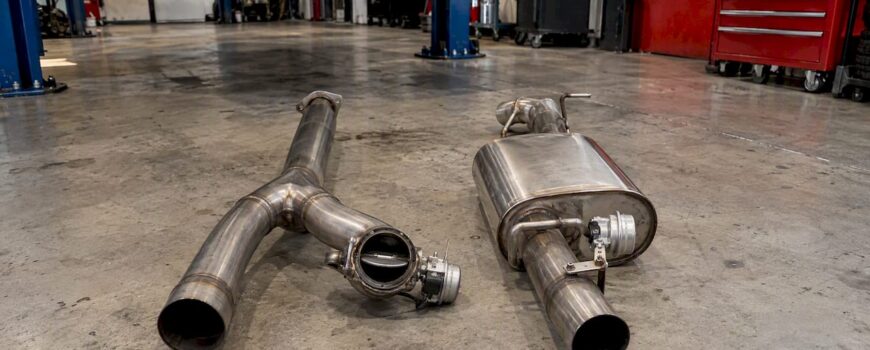
An exhaust cutout is a bypass that lets gases skip the muffler, usually opened by a pull cable or a switch. A valved exhaust builds a valve into the muffler or pipe, so the system has two sound modes and the muffler stays in the circuit. Both give you a quiet mode and a loud mode. The valved system is the more refined and more flexible of the two. It is also the better fit for a late-model luxury or performance car, where cabin comfort, drivability and daily use matter.
Below we cover how each works, how they compare on sound, flow, drone and control, where a valved muffler sits next to a cat-back, and what U.S. law means for your choice.
TL;DR
- A cutout opens a separate exit ahead of the muffler. A valved exhaust routes gas through a muffler with an internal flap that opens or closes.
- Valved systems usually sound better at part throttle and cruise, because the muffler stays in the flow path when the valve is closed.
- A cutout is simple and cheap in concept, but it is a bolt-on bypass. A valved system is engineered as a complete sound-and-flow design.
- A valved muffler is a component. A cat-back is the whole section behind the catalytic converter, and it can include valves.
- Check your state’s noise rules and keep every emissions part intact before you modify anything.
Table of Contents
- What an exhaust cutout actually is
- What a valved exhaust does differently
- Cutout vs. valved exhaust: side-by-side
- Sound: tone, volume and drone
- Flow and power: what to expect
- Valved muffler vs. cat-back: they are not rivals
- Which one should you choose?
- Installation and compatibility
- Laws and noise limits in the U.S.
- Our perspective
- Find a valved system for your car
- FAQ
- Sources
What an exhaust cutout actually is
A cutout is a Y-pipe or a plate-and-flap assembly placed between the headers (or downpipe) and the muffler. When closed, all exhaust goes through the normal path. When open, a large share of it leaves through the new opening and never touches the muffler. Older cutouts were opened by a lever or cable. Today most are electric, with a motor that swings a gate or flap and a switch or remote that controls it.
The idea is blunt and effective. You get the sound of a nearly open pipe on demand and a normal tone the rest of the time. In practice, much depends on where the exit points. Many cutouts dump gas out under the car through a short outlet, sometimes with a tube to move the noise further back. That is why owners often describe the sound as raw, with a harsh edge, rather than polished.
What a valved exhaust does differently
A valved exhaust places the valve inside the muffler or in a dedicated section of the pipe. Closed, gas follows the long, baffled route through the muffler, which keeps the tone quiet. Open, a straighter path takes over and the muffler’s quieting effect drops sharply. The gas still leaves through the same tips, so the sound is shaped by the system’s own acoustics and not by a hole in the pipe.

This is also how factory active exhausts work. On GM’s dual-mode system, closed valves send exhaust through the mufflers, while open valves let it bypass them under acceleration, and in some cases the valves open automatically at or above 3,500 RPM. Automakers use valves for a practical reason: engineers can meet pass-by noise rules at certain speeds while limiting the backpressure penalty at higher speeds and loads.
Those factory systems are controlled by the engine computer, which sets valve position from engine speed, pedal position and drive mode. They also depend on stable power to the control electronics, which is why the battery’s role in engine management matters if you add or retrofit electronic valve controls. Aftermarket valved systems typically trade the computer logic for a handheld remote or app, so you decide when the valves open.
For a deeper look at the mechanics, see our guide to how electronically controlled exhaust works and our explainer on how exhaust valves toggle automatically.
Cutout vs. valved exhaust: side-by-side
| Factor | Electric cutout | Valved exhaust |
|---|---|---|
| Where the valve sits | Ahead of the muffler, on a bypass branch | Inside the muffler or in a dedicated valve section |
| Closed-mode sound | Normal muffler tone, sometimes with slight leakage or flutter | Fully routed through the muffler, designed to be quiet |
| Open-mode sound | Loud and raw, often with an exit point under the car | Loud but tuned, exits through the tips |
| Drone at cruise | Depends on the base muffler | Can be managed by keeping valves closed at highway speed |
| Design | Add-on to an existing system | Engineered as part of the system |
| Control | Switch or remote, on or off | Remote, app or automatic logic, often with partial positions |
| Typical buyer | Trucks, project cars, older builds | Late-model sports and luxury cars, daily drivers |
| Install | Cut and weld or clamp into an existing pipe | Bolt-on cat-back, axle-back or muffler swap |
The differences are less about “which gets louder” and more about how each behaves when you are not at full throttle.
Sound: tone, volume and drone
Volume gets the attention, but tone decides whether you enjoy the car on a Tuesday commute. With a cutout, the bypass branch sits ahead of the muffler, so open mode removes most of the silencing. The sound is loud and often sharp. Because the outlet may be near the floor, the cabin can pick up more of it.
A valved muffler is built with the open sound in mind. Chambers, perforated cores and tip design are tuned around both valve positions, so open mode tends to sound fuller and closed mode quieter than a typical cutout setup. If you want numbers on how much changes between modes, read our breakdown of valved exhaust sound levels in dB.
Drone, the low-frequency hum at highway rpm, is where valves earn their keep. Close them at cruise and the system behaves like a quiet stock one. Our piece on how valve exhaust changes cabin sound goes deeper on cabin effects, and why exhaust sound matters for performance vehicles covers what drivers listen for.

Flow and power: what to expect
An open path reduces restriction, and that is the logic behind both designs. The gains depend on the engine. A naturally aspirated V8 with restrictive stock mufflers will respond differently from a turbocharged four-cylinder, where the downpipe and catalytic converter set most of the restriction. Engineers working on valves stress that valve designs need to balance noise, regulation compliance and backpressure, which is exactly why a purpose-built valved muffler and a bolted-on bypass can behave differently.
Our design view is simple: a valve that is part of the muffler can be shaped for flow when open, while a bypass has to work around whatever muffler is already on the car. For more on the fixed versus adjustable question, see why variable valve exhaust outperforms fixed systems.
No honest source promises a fixed horsepower number from a valve alone. Your results depend on the engine, the tune and the rest of the exhaust path.
Valved muffler vs. cat-back: they are not rivals
This is the other half of the search, and the two terms sit on different levels.
- Cat-back describes where the system starts: everything from the catalytic converter backward, including mid-pipes, resonators, the muffler and the tips.
- Valved muffler describes a part: a muffler with an internal valve. It can be sold alone, as an axle-back, or built into a full cat-back.
So a cat-back can absolutely include valves. Many performance cat-backs ship with one or more valved mufflers and a controller. An axle-back, which replaces only the section behind the rear axle, can have valves too, and it is the lighter-touch route. A full cat-back changes more pipe, which can matter for tone and flow when you want the biggest change. Parts closer to the engine, such as the downpipe, sit ahead of the cat-back and change the car in a different way.
If you want to see how the pieces fit together, our exhaust system anatomy guide walks through each section.
Which one should you choose?
Choose a valved exhaust if:
- You drive a late-model European or luxury performance car and want the factory refinement to stay when the valves are closed.
- You commute on the highway and need to control drone.
- You want the loud mode to sound tuned, not raw.
- You want a remote or app, and the option to change the mode at a stoplight or in a neighborhood.
Choose a cutout if:
- You have an older or project vehicle where cost and simplicity come first.
- Your existing muffler is already good, and you only want an on-demand bypass.
- You accept more raw sound and more installation work (cutting and welding or clamping into the pipe).
For most owners of the cars we serve, the valved route is the better match. Our buyer’s guide to performance exhausts covers how to weigh system types, and OEM vs. aftermarket exhaust performance explains what you gain over the factory setup.
Installation and compatibility
Fit is where many purchases go wrong. Check these before you order:
- Exact model and year. Exhaust routing differs between trims, drivetrains and model years. A part for a 4WD version may not fit a 2WD car.
- Emissions hardware. Some cars have a gasoline particulate filter (often called OPF) on newer models. Parts are made in versions with and without it, so confirm which one you have.
- Controller and wiring. Electric valves need a power feed and a controller. Plan where the receiver sits and how it connects to the car’s power.
- Tips and clearance. Tip diameter and bumper cutouts decide whether the finished car looks right.
- Who installs it. A shop that knows your platform will save time, especially when sensors or heat shields are in the way.
The exhaust parts category is organized so you can narrow by vehicle before you commit.
Laws and noise limits in the U.S.
Two separate issues apply: emissions and noise.
Emissions. The EPA describes aftermarket defeat devices as parts whose principal effect is to bypass, defeat or render inoperative emissions controls. Its enforcement policy generally focuses on manufacturers and sellers of such devices, fleet tampering, and shops that routinely delete emissions controls. The same policy does not address vehicles built and used exclusively for competition. Practically, that means you keep the catalytic converters and sensors your car was certified with and treat any bypass that sits upstream of them with caution.
Noise. Rules are set mostly by the states. Most states prohibit mufflers that create excessive or unusual noise, and some use a decibel limit, for example 95 dBA in California, Maine and Montana. The same overview notes that many states ban muffler cutouts and bypass valves outright. A valved system that stays quiet in closed mode gives you a way to stay within the rules in town and open up only where it is lawful, such as on a track day. Check your state vehicle code and local ordinances first, because enforcement differs by area. For practical tips on staying within limits, read our supercar exhaust decibel management guide.
Our perspective
We build our catalog around one idea: you should not have to choose between a quiet car and a loud one. A valve lets one exhaust be both.
When we compare a bolt-on cutout with a purpose-built valved system, the difference shows up in the quiet mode. A system designed around its valve keeps the muffler working when you want calm, and opens a clean path when you want sound. That is the experience our customers with Audi, BMW, Porsche, Mercedes-AMG and exotic platforms are after.
We sell genuine products from authorized manufacturers, and we focus on remote electronic valve control so the driver, not the hardware, decides the mood of the drive. If you want the long version of why we favor adjustable systems, start with the benefits of installing a valve control exhaust system.
Info
Find a valved system for your car
We carry customizable valved exhaust systems, downpipes, controllers and accessories for European and luxury performance vehicles. Every system is built around remote electronic valve control, so you can switch between a quiet cruise and a full-volume run.

Browse the exhaust parts for your make and model, add a controller or tips from accessories, and check out online. If you want to compare brands of valved systems before you choose, our comparison of high-performance systems is a good place to start. You can also start from our home page.
FAQ
What does an electric exhaust cutout do?
It opens a second exit in the exhaust ahead of the muffler, so gases can skip the muffler and the car gets louder. A switch or remote moves a motorized gate, so you can close it for normal driving. The result is an on-demand bypass, not a retuned muffler.
What is the point of an exhaust valve?
A valve lets one exhaust system do two jobs. Closed, gas flows through the muffler for low noise. Open, it takes a freer path for more sound and less restriction. Automakers use them to meet noise rules while limiting backpressure at higher loads.
Can a cat-back exhaust have valves?
Yes. Cat-back describes the section from the catalytic converter to the tips, and that section can include one or more valved mufflers plus a controller. An axle-back with valves is a smaller option that changes only the rear section.
Are valved exhausts and cutouts street legal?
That depends on your state and on the parts. Federal rules prohibit defeating emissions controls, and many states limit noise or ban cutouts and bypass valves. Keep all certified emissions hardware, check your state vehicle code, and keep the valves closed where noise limits apply.
Sources
- GM Dual-Mode Exhaust Tech Info & Wiki
- Valves in exhaust-systems (Venghaus, 2004)
- Valve application in Exhaust Line Systems, Institute of Noise Control Engineering (2017)
- EPA Tampering Policy: Enforcement Policy on Vehicle and Engine Tampering (2020)
- These Mods Could Make Your Car Too Loud To Be Legal (SlashGear)