Aftermarket exhausts generally deliver more peak horsepower and torque than OEM systems. Stock exhausts are engineered around noise, emissions, and warranty compliance first, with performance as a secondary concern. If you want the most power your engine can produce, aftermarket is the path. If you want a quiet cabin, zero emissions risk, and zero dealer friction, OEM is the safer choice.
The three trade-offs that matter most:
- Peak power potential: A full aftermarket system (headers, high-flow cats, cat-back) can add 30–50+ HP on V8 platforms; a cat-back alone typically adds 10–40 HP depending on the vehicle. OEM replacements add nothing.
- NVH (noise, vibration, harshness): Aftermarket systems are louder and often produce highway drone. OEM systems are tuned to suppress both. Valved systems from brands like Valvecontrolexhaust split the difference with driver-selectable modes.
- Legal and warranty considerations: Removing catalytic converters or installing non-CARB-compliant parts can trigger EPA violations and fail smog tests. Aftermarket parts alone cannot void your warranty under Magnuson-Moss, but they can complicate related claims.
By driving goal:
- Daily commuter: OEM replacement or a quiet axle-back with resonators intact
- Weekend spirited driving: Cat-back or valved system with adjustable sound control
- Track car: Full header-back with tune; emissions compliance is secondary
- Luxury grand touring: Valved aftermarket system for sound customization without sacrificing refinement
Key Takeaways
Aftermarket exhausts deliver measurable performance gains over OEM systems, but the right choice depends on use case, emissions compliance, and sound tolerance, not peak horsepower alone.
| Point | Details |
|---|---|
| Performance gains vary by stage | Cat-back systems add 10–40 HP; a full header-back system can add 30–50+ HP on V8 platforms. |
| Drone is the most common regret | Fixed aftermarket systems often produce highway drone at 1,800–2,500 RPM; retain resonators or choose a valved system to manage it. |
| Emissions compliance is non-negotiable | CARB EO numbers are required for street use in California and several other states; removing catalytic converters violates federal EPA rules. |
| Material quality determines longevity | Premium 304 stainless or titanium systems from reputable brands can match or exceed OEM durability; budget parts with thin walls and poor welds often fail within two years. |
| Valvecontrolexhaust for mixed-use owners | Valved systems from Valvecontrolexhaust offer driver-selectable sound and flow, making them the practical choice for luxury and performance vehicles used daily and on weekends. |
Table of Contents
- How does exhaust design actually change engine performance?
- How do aftermarket exhausts change sound, and can you control drone?
- What materials last longest, and does weight actually matter?
- What are the emissions and warranty risks of going aftermarket?
- How much does an exhaust upgrade actually cost?
- How do you choose between OEM, aftermarket, and a valved system?
- Why valved exhaust systems often solve the trade-off better than fixed aftermarket
- What’s the right exhaust choice for your driving goals?
- A perspective on what the exhaust market gets wrong
- Valvecontrolexhaust: adjustable systems built for performance vehicles
- Sources
How does exhaust design actually change engine performance?
Exhaust flow is the single biggest mechanical lever. When exhaust gases exit the combustion chamber faster and with less restriction, the engine can draw in a fresh charge more efficiently on the next intake stroke. That translates directly to horsepower and throttle response, especially in the mid-to-upper RPM range.
The physical mechanism behind this is scavenging. As a pulse of exhaust gas travels down the pipe, it creates a low-pressure wave that reflects back toward the cylinder. Time that wave correctly with valve overlap, and it actually helps pull fresh air-fuel mixture into the cylinder before the intake valve fully opens. Headers are designed specifically to exploit this effect. Short-tube headers favor high-RPM power; long-tube headers produce stronger scavenging at lower RPM and typically add more total torque across the curve. The trade-off is that long-tube headers are more invasive to install and almost always require a tune.
Aftermarket systems use wider-diameter, mandrel-bent pipes and less restrictive mufflers to reduce backpressure throughout the system. Mandrel bending is worth understanding: it maintains the pipe’s full internal diameter through every curve, while compression bending (common on budget parts) pinches the pipe and creates a flow restriction right where you least want one. The difference shows up on a dyno, particularly above 4,000 RPM.
Pipe diameter matters, but bigger is not always better. Too large a diameter at low flow velocities reduces exhaust gas velocity, which weakens scavenging and hurts low-end torque. Most performance systems are sized for a specific displacement and RPM target, which is why a 3-inch cat-back that works beautifully on a 5.0L V8 can actually hurt a 2.0L four-cylinder.
Typical bolt-on gain ranges (hedged by platform and tune status):
- Axle-back only: 5–15 HP, primarily acoustic change
- Cat-back system: 10–40 HP depending on vehicle and design
- Headers + high-flow cats + cat-back: 30–50+ HP on many V8 platforms
- Turbocharged vehicles: gains vary significantly based on downpipe and boost management
Pro Tip: If you add a cat-back without a tune on a modern direct-injection engine, you may see little to no measurable gain on a dyno. The ECU’s fuel trims and ignition timing are calibrated around the stock system’s backpressure. A proper tune unlocks what the hardware already allows. For turbocharged platforms, check out the turbo exhaust efficiency guide before speccing pipe diameter.
A staged approach makes financial sense: start with an axle-back or cat-back for sound and modest gains, then add headers and a tune when the budget allows. Each stage compounds on the last, and the gains from headers and high-flow cats are where the numbers get genuinely interesting.
How do aftermarket exhausts change sound, and can you control drone?
The short version: aftermarket systems are louder, lower in pitch, and more aggressive in tone. OEM exhausts are acoustically engineered with specific resonator tuning, muffler packing, and pipe lengths calculated to cancel standing waves at highway cruise speeds. When you remove those elements, you get more sound, but not always the sound you wanted.

Aftermarket systems reduce backpressure through wider tubing and freer-flowing muffler and resonator configurations, which produces that louder, deeper tone most enthusiasts are after. The problem is drone. Drone is a sustained, low-frequency resonance that builds at specific engine speeds, typically 1,800–2,500 RPM, which happens to be exactly where most people cruise on the highway. It’s not the aggressive burble you hear at a stoplight. It’s the sound that makes a two-hour drive genuinely fatiguing.
What causes drone and how to reduce it:
- Resonator deletion: Removing the resonator is the most common cause of drone. Resonators are tuned to cancel specific frequencies. Delete them and those frequencies amplify.
- Pipe length and diameter: Longer pipes at larger diameters shift resonant frequencies lower, which can push drone into the cruise RPM band.
- Muffler design: Straight-through (perforated core) mufflers flow well but offer less frequency cancellation than chambered designs.
- Practical fixes: Add a resonator back into the system, use a valved system that closes partially at cruise, or choose a cat-back that retains the factory resonator location.
Decibel note: A 3 dB increase doubles perceived sound energy. Many aftermarket systems measure 5–10 dB louder than stock at wide-open throttle. At highway cruise, even a 3 dB increase can become fatiguing over distance. Local ordinances vary widely, and some municipalities enforce sound limits as low as 95 dB at a set distance. Check your local rules before you buy.
For a complete protocol on measuring and comparing exhaust sound before committing to a system, the aftermarket exhaust sound testing guide walks through the process in detail.
Pro Tip: Test drive two scenarios before buying: a cold start in a residential area (your neighbors’ experience) and a 30-minute highway cruise at 70 mph (your experience). Most buyers only hear the car at idle or during a short blip. The highway drone test is the one that changes minds.
What materials last longest, and does weight actually matter?
Material choice determines how long your exhaust lasts and how much it costs to replace. OEM systems on most modern vehicles use aluminized steel, which is mild steel with an aluminum-silicon coating. It resists corrosion adequately in dry climates but degrades faster in road-salt environments. Most OEM systems last 5–8 years in the Rust Belt before showing significant corrosion at welds and flanges.
Material comparison at a glance:
- Aluminized steel: Lowest cost, adequate corrosion resistance in dry climates, shorter service life in salt-heavy regions
- 409 stainless steel: Mid-tier, better corrosion resistance than aluminized, common on mid-range aftermarket systems, good balance of cost and longevity
- 304 stainless steel: Premium grade, significantly better corrosion resistance, used on high-end aftermarket systems, typically carries longer warranties
- Titanium: Lightest option (roughly 40–45% lighter than comparable steel), excellent corrosion resistance, premium cost, used primarily on track and exotic applications
Weight savings from titanium are real but context-dependent. On a 3,500-pound daily driver, saving 15–20 lbs of unsprung and semi-sprung exhaust weight is a rounding error. On a dedicated track car where every pound affects lap times, it matters. For a BMW M3 or Porsche 911 GT3, the handling argument for titanium is legitimate. For a daily-driven Audi A4, 304 stainless is the practical ceiling.
Premium aftermarket brands can equal or exceed OEM durability, but budget aftermarket parts often use thinner-gauge materials and inferior welds that fail at the seams first. The failure modes to watch: weld cracking at the collector (headers), flange leaks where sections join, and hanger bracket fatigue from vibration.
For real-world fitment examples across luxury platforms, the OEM-replacing exhaust examples page covers material and compatibility specifics for vehicles like the BMW M-series and Audi RS models.
What are the emissions and warranty risks of going aftermarket?
The legal risk is real and specific. In the United States, the EPA prohibits removing or rendering inoperative any emissions control device on a vehicle used on public roads. Catalytic converters are the primary concern. Installing a test pipe or straight-pipe in place of a catalytic converter is a federal violation, regardless of whether your state has emissions testing.
California adds another layer. The California Air Resources Board (CARB) requires that any aftermarket exhaust part sold or installed in California carry an Executive Order (EO) number, which confirms the part has been tested and approved for use on specific vehicle applications. A system without a CARB EO number is not legal for street use in California, and several other states follow California’s emissions standards. Always verify the EO number before purchasing if you’re in a CARB-compliant state.
Practical steps to stay compliant:
- Verify the CARB EO number for your specific year, make, and model before purchasing any cat-back or header system
- Keep all catalytic converters in place unless replacing with CARB-approved high-flow units
- Ask the vendor for written documentation of emissions compliance for your vehicle
- In non-CARB states, confirm your state’s emissions testing requirements before removing resonators or modifying the cat system
On the warranty side, the Magnuson-Moss Warranty Act protects you more than most dealers suggest. A dealer cannot void your entire powertrain warranty simply because you installed an aftermarket exhaust. They must demonstrate that the aftermarket part caused the specific failure they’re denying. An exhaust system does not cause a transmission failure. However, if you install headers and the engine develops an oil leak at the head gasket from heat exposure, the connection is easier to argue. The practical advice: keep your OEM parts.
Pro Tip: Store your OEM exhaust components in labeled bags with photos of the original install. If a warranty claim comes up, you can reinstall the stock system before the dealer inspection. Valvecontrolexhaust specifically recommends this practice for customers installing valved systems on vehicles still under factory warranty.
How much does an exhaust upgrade actually cost?
Budget ranges vary significantly by system type and vehicle platform.
Typical price ranges (parts only):
- Axle-back system: $300–$800 for domestic platforms; $600–$1,500 for European/luxury
- Cat-back system: $500–$1,500 domestic; $1,200–$3,500 European/luxury
- Full header-back (headers, high-flow cats, cat-back): $1,500–$4,000 domestic; $3,000–$8,000+ European/luxury
- Valved/adjustable systems: $1,500–$6,000 depending on platform and valve configuration
Labor adds $150–$600 for a cat-back on most vehicles, more for headers (which often require removing heat shields, O2 sensors, and sometimes the engine mount on transverse layouts). A tune, when required, adds $400–$1,200 for a professional dyno session. Budget for new hardware: exhaust gaskets, flange bolts, and O2 sensor extensions are often not included with aftermarket systems and can add $50–$150.
Installer checklist before you commit:
- Confirm the shop has experience with your specific platform (European fitment is not the same as domestic)
- Ask whether the system requires O2 sensor relocation and whether that’s included in the labor quote
- Verify that all hangers and mounting points align with factory locations, or ask what modifications are needed
- Request a post-install inspection for exhaust leaks at flanges and collector welds before leaving the shop
- Ask about the break-in period for new packing materials (some mufflers smoke slightly for the first 100–200 miles)
Fitment issues that add cost: mismatched flange diameters, routing conflicts with heat shields or suspension components, and O2 sensor bung placement that doesn’t match the factory location. Fitment differences by model are more significant on luxury platforms than most buyers expect.
How do you choose between OEM, aftermarket, and a valved system?
Start with one question: what is this car primarily used for? The answer determines everything else.
Step-by-step decision checklist:
- Define primary use: Daily commuter, weekend spirited driving, track days, or luxury grand touring?
- Set your budget: Include parts, labor, tune if needed, and hardware. Don’t budget for parts alone.
- Check emissions compliance: Are you in a CARB state? Does the system you’re considering have an EO number for your vehicle?
- Assess warranty exposure: Is the vehicle still under factory warranty? Are you willing to store OEM parts?
- Decide on sound tolerance: Do you drive long highway stretches regularly? Drone is a dealbreaker for many buyers who loved the sound at idle.
- Evaluate expected gains: Are you after measurable HP, or primarily sound? A cat-back on a stock engine without a tune may deliver more sound than power.
Red flags to avoid:
- Systems with no brand name, no warranty, and no fitment documentation
- Headers sold without matching high-flow cats (emissions risk and potential lean condition)
- Vendors who cannot provide a CARB EO number for California-registered vehicles
- “Universal fit” systems on European platforms (they rarely fit without fabrication)
Pros and cons by path:
- OEM replacement: Zero emissions risk, perfect fit, no warranty friction. Zero performance gain, no sound change.
- Axle-back/cat-back aftermarket: Moderate sound improvement, modest power gains, relatively easy install. Potential drone, limited top-end gains without headers.
- Full header-back: Maximum power potential, significant sound change. Most invasive install, tune required, emissions scrutiny.
- Valved/adjustable system: Sound and flow on demand, daily civility preserved, compliance-friendly. Higher upfront cost, requires proper ECU integration on some platforms.
For real-world fitment examples across luxury makes, the OEM-replacing exhaust examples page is a useful starting point.
Why valved exhaust systems often solve the trade-off better than fixed aftermarket
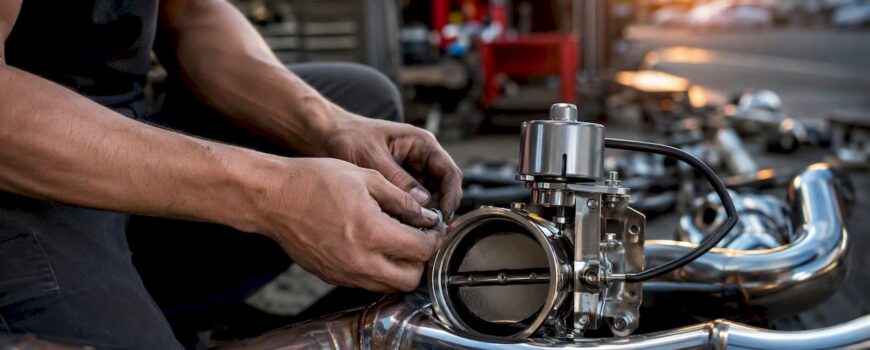
A fixed aftermarket exhaust makes one compromise and lives with it forever. A valved system doesn’t. When the valve is closed, exhaust gas routes through a more restrictive path, which keeps sound levels close to OEM and reduces drone at cruise. Open the valve electronically and the gas takes the freer-flow path, dropping backpressure and opening up the sound. One car, two personalities, controlled from the cabin.
The mechanism is straightforward: an electronic actuator moves a butterfly valve inside the muffler or mid-pipe. Valved systems enable driver-selectable sound and flow characteristics, which is why they’re the dominant choice for mixed-use owners who need a quiet commute Monday through Friday and an aggressive note on a canyon road Saturday morning.
Where valved systems outperform fixed aftermarket:
- Mixed-use owners who drive the same car daily and on weekends
- Owners in neighborhoods or HOAs with noise sensitivity
- Luxury GT owners (Ferrari, Lamborghini, AMG) who want sound customization without sacrificing refinement
- Drivers in states where noise ordinances are enforced at specific dB limits
Compatibility considerations:
- Some platforms require ECU integration for the valve controller to sync with factory drive modes (Comfort, Sport, Sport+)
- Vehicles with active exhaust from the factory may need specific valve placement to avoid conflicts with OEM actuators
- High-flow valved systems on turbocharged platforms should be spec’d with the downpipe in mind, since the downpipe is often the primary restriction
Pro Tip: On BMW M-series and Audi RS platforms with factory active exhaust, a valved aftermarket system that integrates with the OEM mode switch gives you the best of both worlds: factory-quiet in Comfort mode, full aftermarket character in Sport+. Valvecontrolexhaust documents this integration for several M and RS applications specifically.
The critical analysis of leading valved systems breaks down how different valve configurations compare on flow, sound control, and real-world durability.
What’s the right exhaust choice for your driving goals?
Here’s the short version by use case:
- Daily commuter: Keep OEM or install a quality OEM-replacement system. No emissions risk, no drone, no warranty friction. The performance gains from an aftermarket system on a commuter car rarely justify the trade-offs.
- Weekend enthusiast car: A cat-back from a reputable brand, or a valved system if you also drive it daily. Add a tune if you’re adding headers. This is where most enthusiasts get the best return on investment.
- Track car: Full header-back with high-flow cats, a proper tune, and titanium if weight matters. Emissions compliance is secondary if the car is trailered to events, but check your track’s sound limits.
- Luxury GT (Ferrari, Lamborghini, BMW M, AMG): A valved aftermarket system is the correct answer for nearly every owner in this category. The factory exhaust is already good; the goal is character and adjustability, not raw HP from headers.
On combining upgrades: exhaust plus tune plus intake is a coherent package that compounds gains. Exhaust alone without a tune on a modern ECU often leaves half the performance on the table. Intake alone without exhaust is similarly limited. If the budget only allows one, the exhaust is usually the better starting point for sound and feel, but plan the tune into the budget from the beginning.
A perspective on what the exhaust market gets wrong
Most buyers focus on peak horsepower numbers and sound clips. Both are misleading. A dyno number measured at the wheels on a specific car, on a specific day, with a specific tune, tells you almost nothing about what you’ll feel on a public road. And a sound clip recorded with a phone microphone outside the car tells you nothing about what you’ll hear inside it at 75 mph on the interstate.
The real question most buyers don’t ask is: what does this car feel like to drive every day with this system installed? A well-chosen cat-back that improves mid-range response and sounds great without droning is worth more than a full header-back that adds 45 HP at redline and makes every highway trip exhausting.
Valved systems get dismissed by some enthusiasts as a compromise, which misses the point entirely. The ability to be quiet when you want to be quiet and loud when you want to be loud is not a compromise. It’s the correct engineering solution for a car that serves more than one purpose. The owners who understand this tend to be the ones who’ve already owned a loud fixed aftermarket system and lived with it for a year.
The other thing the market undervalues is fitment quality. A $4,000 system that fits perfectly and seals cleanly at every flange will outperform a $6,000 system with a leaking collector weld every single time. Ask your installer about their experience with your specific platform before you buy the parts.
Valvecontrolexhaust: adjustable systems built for performance vehicles
If you’ve read this far, you already know that the best exhaust for a mixed-use performance car isn’t the loudest one or the most restrictive one. It’s the one you can actually control.
Valvecontrolexhaust specializes in valved exhaust systems for European and luxury performance vehicles, including Audi, BMW, Porsche, Ferrari, Lamborghini, and Mercedes-AMG. The systems use electronic valve control to let you switch between quiet and full-flow modes in real time, from the cabin, without any modification to your OEM emissions equipment. Fitment is documented for specific model years, and the compatibility guidance covers ECU integration for platforms with factory active exhaust modes.
The performance exhaust buyer’s guide walks through selection criteria by platform and driving goal, so you can match the right system to your car before you order. Check your vehicle’s compatibility and get started there.
Sources
- The Best Exhaust Systems for Maximum Horsepower Gains | AmericanMuscle
- Repair vs Performance Parts | Exhaust Systems
- 5 Major Differences Between Stock And Aftermarket Exhausts | Thermal R&D Exhaust