A Stage 2 tune usually calls for a freer-flowing exhaust, most often a high-flow downpipe on a turbocharged car and sometimes a cat-back behind it. The catch is that “Stage 2” has no official definition, so the exact parts depend on your platform and your tuner. On a US street car, those parts also have to keep the emissions equipment your car left the factory with, or be approved to replace it.
This guide covers what Stage 2 means, which exhaust parts normally come with it, how requirements shift by car and tuner, and how to check legality before you spend money.
TL;DR
- Stage 2 generally means a tune paired with supporting hardware. The exhaust piece is most often a downpipe, sometimes with a sports cat or a cat-back.
- Stage labels are aftermarket shorthand, not a standard. Always ask which parts your tuner’s file was written for.
- A downpipe is not strictly required to flash a Stage 2 map, but without it the factory exhaust becomes the bottleneck.
- On the road in the US, the Clean Air Act prohibits removing emissions equipment and selling or installing defeat devices. Keep the catalytic converter, or use an approved one.
- Match the part to your exact model, year and state before you order.
Table of Contents
- What Stage 2 actually means
- Which exhaust parts Stage 2 usually involves
- The tune has to match the parts
- What else Stage 2 asks of the car
- How requirements change by vehicle, engine and tuner
- Is a Stage 2 exhaust legal in the US?
- A pre-purchase checklist
- Perspective
- Shop parts built for Stage 2 setups
- FAQ
- Sources
What Stage 2 actually means
The stage system is an aftermarket habit. Stage 1 is generally a calibration on otherwise stock hardware, running on premium fuel. Stage 2 adds supporting hardware so the car can move more air and shed more heat under sustained load. Stage 3 is a full hardware path, often with a larger turbo and different fuel.
The hardware in Stage 2 does not touch engine internals. Pistons and camshafts belong to bigger builds. Stage 2 is about breathing and cooling: intake, intercooler, charge pipes and exhaust.
The important point is that no authority defines these labels for every vehicle. One tuner may call a premium-fuel calibration with an intercooler Stage 2. Another may reserve the name for cars with a downpipe. A third may attach it to a stock exhaust with an upgraded fuel pump. So when a forum thread or product page says “Stage 2 requires an exhaust,” the honest answer is: it depends on whose Stage 2.
Which exhaust parts Stage 2 usually involves
On a turbocharged car, the exhaust is where most of the flow gains sit, because turbos work best with as little restriction as possible. Here is how the parts typically line up, from the turbo backward.
| Part | What it does | Typical role in Stage 2 |
|---|---|---|
| Downpipe | Replaces the pipe right after the turbo | The most common exhaust requirement on turbo cars |
| Header or manifold | Collects exhaust from the cylinders | More common on naturally aspirated builds |
| Sports cat or catted section | Keeps emissions catalyst with better flow | Preferred when the car must stay street legal |
| Cat-back system | Pipe, resonators and mufflers behind the cat | Sound and some flow; often optional |
| Valve or controller hardware | Opens and closes exhaust paths | Sound control, not usually a tune requirement |
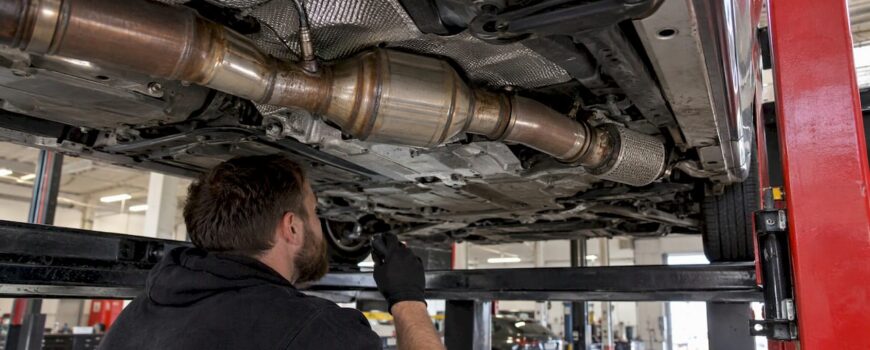
A typical Stage 2 exhaust is a header, sports cat or de-cat pipe, and a downpipe on turbo applications. The legal route is the sports cat. The de-cat route is what causes trouble later, and we cover it below.
The downpipe is the main event
A downpipe lowers restriction right after the turbo, so it spools and flows with less effort. It is not strictly required to flash a more aggressive map. Without it, though, the factory exhaust holds back a meaningful part of what the calibration was written to use.
If you want the detail on what a catted downpipe does for a street car, our guide to passing US inspections with a catted downpipe walks through it, and the role of exhaust in turbo performance explains why post-turbo flow matters so much.
The cat-back is mostly about sound
Many owners assume Stage 2 means a full exhaust. In practice, the cat-back changes sound and some flow, but the tune’s main dependency is usually ahead of it. If you want a louder or more refined note, that is a separate, perfectly good decision. A valved cat-back lets you have a quiet cruise mode and an open mode, which suits a daily-driven car. See how an electronically controlled exhaust works for the mechanics.
The tune has to match the parts
This is the requirement people miss. A downpipe changes the readings the engine computer sees. Those upgrades need a remap to use the extra gas flow, and without one the dash can light up because the exhaust sensor readings no longer match what the car expects.
A tune is written for a specific combination. A file made for one downpipe, intercooler, intake and fuel setup should not be assumed correct for a different setup that carries the same Stage 2 name. Treat any flow hardware change as a tune plus a validation step, not a bolt-on and go.
That is also why a Stage 2 file may rely on a downpipe with one flow level and a catalyst of a certain type. If your parts differ, tell your tuner before the car is flashed. If you are weighing a downpipe on its own, running a downpipe without a tune covers what to expect and how to do it carefully.

What else Stage 2 asks of the car
The exhaust is only part of the picture. Stage 2 builds commonly include:
- A performance intercooler, because boost makes heat and the factory unit is sized for factory power.
- A cold air intake or high-flow filter.
- Upgraded charge pipes and a turbo inlet pipe on some platforms.
- Fueling updates on platforms where the stock pump or injectors run out of headroom.
Heat soak often limits real-world gains more than exhaust restriction does. If your car pulls timing after back-to-back runs, better cooling may matter before a bigger exhaust does. Plan the whole package, then choose the exhaust that fits it.
How requirements change by vehicle, engine and tuner
Three things move the answer.
Platform. A turbocharged four-cylinder, a twin-turbo V8 and a naturally aspirated V10 all respond differently. Turbo cars gain most from the downpipe. Naturally aspirated cars lean on headers and cats.
Tuner. Some define Stage 2 mainly by a downpipe. Others use it for any file more aggressive than Stage 1. Ask for the parts list the file was developed on, not just the stage name.
Emissions hardware. Newer cars carry particulate filters in some markets and extra sensors. A downpipe made for one version of a car may not fit another. Our catalog separates versions for this reason, for example BMW downpipes with and without OPF or the 4WD version for Mercedes-AMG E63 models.
Also check physical fit. Performance systems can leave very little clearance to the crossmember, transmission pan and frame, so installation instructions and clamp placement matter. Contact between the exhaust and the chassis causes drone and rattles.

Is a Stage 2 exhaust legal in the US?
The short answer: parts that keep or properly replace your emissions equipment can be legal. Parts that remove it are not, for use on public roads.
Federal rules
The Clean Air Act prohibits tampering with emissions controls and prohibits manufacturing, selling or installing aftermarket defeat devices. Aftermarket parts whose principal effect is to bypass, defeat or disable any aspect of emissions control may be illegal defeat devices. In plain terms, a catless downpipe on a street car is a problem, whatever stage it is sold under.
The same EPA document says these prohibitions apply for the entire life of the vehicle, whether or not the warranty has ended. A used car sold “as is” does not change that.
The EPA also has data behind the rule. Its testing has shown that a truck’s emissions rise tens or hundreds of times when emissions controls are removed, and that even with filters and catalysts in place, a tuner recalibration aimed at fuel economy can triple NOx.
State rules
States add their own layers. The Minnesota Pollution Control Agency states that tampering with an emissions control system is illegal, and that catalytic converters may not be removed and replaced with converter replacement pipes. It adds that if you work on a part of a previously tampered vehicle, you must perform the correct repair or not do it at all.
California and states that follow its standards go further. Aftermarket parts that modify emissions equipment generally need an Executive Order number from CARB, and a catalyst without one can fail inspection. Check the exact part number against CARB’s current listings and your state program. A part approved for one application should not be assumed approved for another model.
Noise rules differ too. States set their own limits and test methods, so a valved system that is quiet in one mode helps with everyday compliance. Look up your state’s current exhaust noise rule before you drive in the open mode.
Our CARB legal exhaust guide and the sports car exhaust legal checklist take you through the EO and EPA checks step by step.
A pre-purchase checklist
Before you order a Stage 2 exhaust part, run through this list.
- Get the tuner’s parts list. Ask what hardware their Stage 2 file was written for, including downpipe type and catalyst.
- Confirm fitment. Model, year, engine, drivetrain, and particulate filter or not.
- Keep the catalyst. Choose a catted downpipe or sports cat so the car keeps working emissions hardware. Our comparison of catted vs catless for US street cars explains the trade.
- Check your state. Look for EO requirements, visual inspection rules and OBD-II readiness tests.
- Plan the tune. Book the remap and validation along with the install, not after.
- Check clearances and clamps. Follow the instructions and check for contact after installing.
- Keep your paperwork. Save part numbers, receipts and any EO documentation in case of an inspection.
Perspective
We see the same mistake every month: someone buys the loudest, cheapest downpipe because a thread said Stage 2 needs one, then finds out the tune, the inspection and the fitment were never checked.
Our view is that the exhaust should be the most deliberate part of a Stage 2 build. We sell genuine parts from authorized manufacturers, across Audi, BMW, Porsche, Mercedes-AMG, Ferrari, Lamborghini and more, and our approach is to pick a catted downpipe built for your exact version of the car, then add a valved cat-back for sound control.
That combination is designed to give you a freer flow after the turbo and a car that is calm on a Tuesday commute and vocal on a Sunday drive, all from a remote controller. Remote electronic valve control means you decide the volume instead of the exhaust deciding for you.
If you want Stage 2 response without gambling on inspections, start with the catalyst, match the tune, and let the valves handle the rest.
Info
Shop parts built for Stage 2 setups
If you already know your platform, you can go straight to our downpipe selection or browse exhaust parts for cat-backs, mufflers, tips and valve hardware. Controllers and add-ons are in accessories.

We carry fitment for a wide range of European and luxury performance cars. Choose your model and year, check the version notes, and order directly through checkout. For comparing system styles first, our performance exhaust buyer’s guide lays out the options.
FAQ
Do I need a new exhaust for Stage 2?
Usually some exhaust change is part of it, most often a downpipe on a turbo car. But the term is not standardized, so some tuners define Stage 2 around other hardware, such as fueling or cooling. Ask your tuner which parts their file assumes.
Can I run a Stage 2 tune with the stock exhaust?
Sometimes, if the tuner’s Stage 2 file was written for stock exhaust. A more aggressive map without a freer downpipe leaves part of the calibration unused, because the factory exhaust becomes the bottleneck. Confirm with the tuner before flashing.
Is a catless downpipe legal for the street?
No. Under the Clean Air Act, removing or bypassing emissions equipment and selling or installing parts that do so is prohibited, and the EPA says this applies for the life of the vehicle. A catted downpipe that keeps working emissions hardware is the safer route, subject to your state’s rules.
How do I check whether an exhaust part is legal in my state?
Start with your state’s emissions program and, in California or states following its standards, look for a CARB Executive Order number for the exact part and vehicle. Keep the documentation with the car. If you are unsure, ask the inspection station or your state environmental agency.
Does Stage 2 mean the same thing at every tuner?
No. One shop may define it by a downpipe, another by an intercooler, another by a more aggressive file. Compare parts lists rather than stage names.
Sources
- EPA Tampering Policy: enforcement policy on vehicle and engine tampering
- EPA news release on aftermarket defeat device settlements
- Minnesota Pollution Control Agency: vehicle tampering
- Stage 1 vs Stage 2 vs Stage 3 tune: what each requires
- Tuning stages: how much HP a Stage 1, 2, 3 tune adds