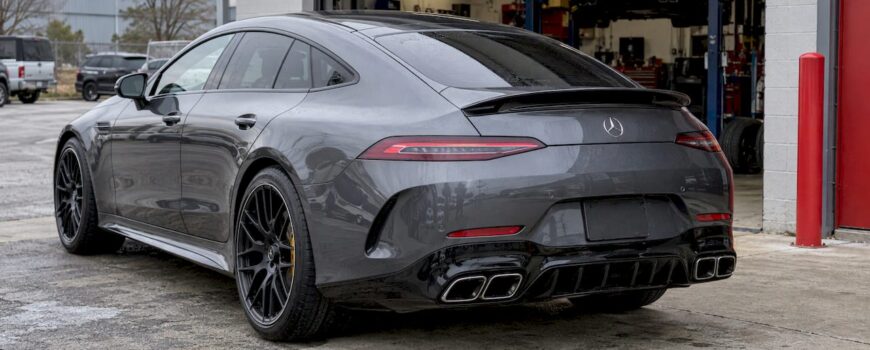
The best exhaust upgrade for an AMG GT 63 is a valved system. It lets you keep the car quiet on the commute and open it up on a good road, and it works with the valve logic the car already uses. Which part you change (axle-back, cat-back or downpipes) decides how much louder, faster-revving and legally exposed the car becomes. This guide covers how the stock system behaves, how the upgrade types differ, what to check before you order, and the U.S. emissions rules you need to know first.
TL;DR
- The factory GT 63 already has a multistage exhaust and AMG DYNAMIC SELECT modes, so a valved upgrade builds on a system that is designed to change character.
- Axle-back, cat-back and downpipe setups differ mostly in how much of the exhaust they replace. Sound, drone and emissions exposure all grow as you go upstream.
- Check your exact model year, version (GT 63 or GT 63 S), what is included, and how the valves are controlled before you buy.
- Federal and California rules restrict parts that alter emission controls. Products with a CARB Executive Order carry the clearest paper trail.
- Browse Mercedes-AMG exhaust systems and downpipes built around remote electronic valve control.
Table of Contents
- How the factory GT 63 exhaust works
- Aftermarket exhaust types for the GT 63
- What to check before you order
- Emissions and noise law in the U.S.
- Sound versus the factory baseline
- Our view: why a valved system suits the GT 63
- Find a valved system for your GT 63
- FAQ
- Sources
How the factory GT 63 exhaust works
The four-door GT 63 is a twin-turbo 4.0-liter V8. Mercedes-Benz USA’s 2019 brochure lists 577 hp for the GT 63 and 630 hp for the GT 63 S, both with a 9-speed AMG SPEEDSHIFT MCT transmission. The same brochure describes a multistage exhaust, RACE and Drift modes, and an AMG Performance Exhaust System with dynamic flaps on the GT 63 S.
Those flaps are the key. They are valves inside the exhaust that open and close to route gas through different paths. Closed, the system is quieter and calmer. Open, it is freer flowing and louder. The car picks the position based on drive mode, so you only get one set of rules.
Mercedes-Benz Canada explains that AMG DYNAMIC SELECT changes throttle, shifting, handling and exhaust note through the console or the steering-wheel AMG DRIVE UNIT controls. RACE and Drift modes are standard on the GT 63. Equipment varies by model year and market, so confirm what your specific car has from its window sticker or build sheet.

What the stock sound is like
Car and Driver’s July 2026 test of the 2025 GT63 Pro recorded 0 to 60 mph in 2.6 seconds and a quarter mile in 10.8 seconds at 128 mph. Its testers described the factory V8 note as muffled by the turbo exhaust, with discreet pops on deceleration. That is a fair baseline. The engine has the performance, and the exhaust is where owners usually want more character.
Before you spend anything, drive the car for a few days in each mode and note where you want a change. Is it the cold-start presence, the cruising volume, the midrange tone or the overrun crackle? Different parts address different complaints, and the next section maps them.
Aftermarket exhaust types for the GT 63
The names describe where a part starts in the exhaust path.
| Setup | What it replaces | What you notice | Things to know |
|---|---|---|---|
| Axle-back | Mufflers and tips behind the rear axle | Tone and volume change at the tailpipes | Smallest change, keeps the stock catalytic converters |
| Cat-back | Everything behind the catalytic converters | Fuller tone, more volume range, usually less back pressure | The most popular route, especially with valves |
| Downpipes | The pipes from the turbos to the rest of the system | Louder, sharper response, more turbo sound | Most affected by emissions law because they sit around the catalysts |
| Controller or remote | The valve actuation, not the pipes | Choose open, closed or in-between on demand | Changes how and when you hear the system |
Why valves matter on a car like this
A fixed exhaust has one personality. On a four-door GT that you may drive to work, on road trips and to the track, one personality is a compromise: either too loud on the highway or not loud enough when you want it. A valved cat-back opens and closes internal paths so the same system can idle quietly and sound aggressive on command. With remote electronic valve control, you set the valves from a remote or controller, so you are not locked to the drive mode the car chooses. Our guide on how exhaust valves toggle automatically shows the logic, and why variable valve exhaust outperforms fixed systems lays out the comparison in more depth.
Matching the upgrade to what you want
- Quiet cruising, loud on demand: a valved cat-back with remote control.
- A bit more tone, nothing dramatic: an axle-back or a valved muffler section.
- Maximum turbo sound and response: downpipes with a cat-back. This is also where the legal questions matter most (see below).
- Control without replacing the pipes: a valve controller from the accessories category, where it suits your setup.
If you want a broader look at ways to shape the sound, see three ways to adjust exhaust sound, from valves to speakers.
What to check before you order
Most returns and unhappy installs come from skipping the same few checks. Go through them before checkout.
1. Exact model and version
The GT 63 and GT 63 S differ in output and, as the brochure shows, in factory exhaust equipment. Newer cars are different again. Match the listing to your model year and body, not just to the name “GT 63.” Our AMG GT exhaust upgrade page covers valved exhausts for U.S. AMG GTs.
2. What is included
List what arrives in the box: the pipes, the mufflers, the valve actuators, the controller or remote, the tips, the clamps and gaskets, and the hangers. A cat-back may or may not include downpipes. Downpipes may or may not include catalytic converters. Our down pipe category lists the variants, including catless and sport-cat options, and our exhaust parts category covers the rest of the system.
3. Valve control
Ask how the valves are operated. Is there a handheld remote, an app, or a link to the car’s drive modes? Can you set the valves open or closed independent of the mode? A system that keeps working at the volume you choose is the point of buying valves in the first place.
4. Materials and finish
Stainless steel and titanium are the common choices. Stainless is durable and cost-effective. Titanium is lighter and has a distinctive tone. Check the tip finish too, since the four tips are the most visible part of the car from behind. Our accessories category also covers tips and rear diffusers.
5. Installation
A cat-back on a car with a lift is a straightforward job for a competent shop. Downpipes mean more disassembly, heat shielding and often more steps. Mechanics who work on luxury cars will already know the work, and it helps to have the fitment confirmed for your exact car before the parts arrive.
6. Warranty and total cost
Add up the system, the downpipes if you want them, installation labor, any alignment or tuning work and shipping. Also check how your dealer treats modified cars during the factory warranty period, since that varies by dealer and by part. Keeping the original parts you remove is a sensible habit, because it makes returning the car to stock simple.
Emissions and noise law in the U.S.
The legal side is the part owners most often skip. It is also where a bad choice costs the most, so read it before you choose between cat-back and downpipes.
The federal rule
SEMA’s garage emissions briefing explains that the federal Clean Air Act prohibits modifying a vehicle to change its emissions output. It also explains that aftermarket parts may be installed if there is a reasonable basis they don’t adversely affect emissions, which is the EPA’s Memo 1A self-certification principle. In California, a CARB Executive Order exempts a part from Vehicle Code 27156. The same briefing says a CARB Executive Order satisfies Memo 1A, which makes the part legal in all 50 states.
In practice:
- A cat-back or axle-back leaves the catalytic converters in place, which keeps the emission-control equipment intact.
- Downpipes are the part that most directly touches emission-control equipment. A part without an Executive Order carries the most risk.
- Whatever you choose, keep the paperwork for any part that has an Executive Order.
California enforcement
CARB’s 2025 settlement with a parts company describes penalties up to $1,500 per Vehicle Code violation and $48,788 per action for strict-liability violations, and notes that the conduct can be illegal nationwide under the federal Clean Air Act. The document shows that regulators pursue sellers and installers as well as owners. If you are in California, our guide to California exhaust law and avoiding a DMV hold walks through the 95 dBA limit and the paperwork. Our page on avoiding an EPA tampering ticket with a valved exhaust covers the federal side for AMG GT owners.

Noise
Noise rules differ by state and city. Many states set a decibel limit or require that the exhaust not be louder than the stock system. This is one more reason valves help: with the valves closed, a system can sit at a lower volume for daily driving and areas where noise is checked. Check your own state’s vehicle code before you buy.
Sound versus the factory baseline
If you drive a stock GT 63 and want to hear what changes, think in terms of three zones.
- Cold start and idle. The stock car can start with a burst and then settle. A valved system lets you decide how much of that you keep, so the early-morning start stays civil.
- Cruise. Drone at highway speed is the usual complaint with fixed aftermarket exhausts. Valves closed are the answer to this complaint.
- Full throttle and overrun. This is where open valves and, if you choose them, downpipes show up. The factory note is muted by the turbos, and a freer-flowing system brings more of the V8 forward.
A Mercedes shop or an owner who has driven the same upgrade in the same model year is a good way to get a feel for what you will hear, and the choice between cat-back and downpipes is the biggest single factor.
For a stock reference point, a 4.0-liter AMG GT V8 is the engine family these upgrade decisions revolve around, and its factory sound is what any aftermarket system is judged against.
Our view: why a valved system suits the GT 63
We build our catalog around one idea: you should decide how loud your car is, and you should be able to change your mind in the same drive. The AMG GT 63 is a good example. It has the power, and its factory exhaust already changes character with the drive mode. A valved system with remote electronic control gives you that same flexibility on your terms.
That is why we focus on valved systems, downpipes, mufflers, tips, controllers and performance parts for European and luxury performance cars, including Mercedes-AMG. We sell genuine products direct from authorized manufacturers, and our compatibility covers a wide range of luxury and performance brands.
Our advice for a GT 63 owner is to start with how you drive. If you want quiet mornings and loud back roads, a valved cat-back with remote control is the first choice. If you want to go further, plan the downpipe decision together with the legal paperwork, not after it.
Info
Find a valved system for your GT 63
We sell customizable valved exhaust systems, downpipes, mufflers, rear diffusers, tips and controllers for European and luxury performance vehicles, with remote electronic valve control for adjustable sound. Start with Mercedes-AMG exhaust systems and downpipes, or go straight to the exhaust parts category to compare systems.
If you are choosing between several system types, our performance exhaust buyer’s guide gives you the criteria to compare them.
FAQ
Does the AMG GT 63 already have a valved exhaust?
The GT 63 S is listed with an AMG Performance Exhaust System with dynamic flaps, and the GT 63 has a multistage exhaust, according to the 2019 brochure. The car opens and closes the flaps according to drive mode. An aftermarket valved system with remote control adds your own choice of open or closed.
Is a cat-back or a downpipe the better first upgrade?
A valved cat-back is the usual first step. It changes the tone and volume range without touching the catalytic converters. Downpipes add more sound and response but are the part most affected by emissions rules, so plan them with the paperwork in mind.
Will an aftermarket exhaust be legal on my GT 63?
Federal law prohibits altering emission controls, and aftermarket parts need a reasonable basis that they do not adversely affect emissions. A part with a CARB Executive Order is accepted in all 50 states, according to SEMA’s briefing. Noise limits also vary by state, so check your state’s rules.
What should I check for fitment?
Match the listing to your model year and version, confirm which parts are in the box, and ask how the valves are controlled. Then confirm the installation plan with a shop that works on luxury cars.
Sources
- 2019 AMG GT 4-Door Coupe brochure, Mercedes-Benz USA
- The AMG GT 4-door Coupe, Mercedes-Benz Canada
- Tested: The Mercedes-AMG GT63 Pro, Car and Driver
- Garage emissions briefing, SEMA
- CARB 2025 settlement agreement on aftermarket parts