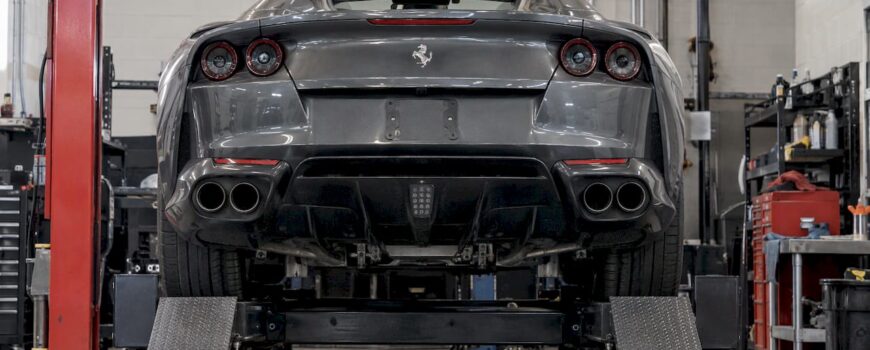
The best Ferrari 812 exhaust setup is one you can control: a system or downpipe set matched to your exact car (Superfast or GTS, with or without the particulate filter) and a valve controller that lets you switch between a quiet cruise and a full V12 soundtrack. Get the fitment right first, then choose how loud and how free-flowing you want the car to be. We supply valve-controlled exhaust parts and downpipes for the 812 Superfast and GTS, built around that approach.
TL;DR
- The 812 Superfast and GTS (2018-2023) use the same 6.5-liter V12, but downpipes are sold separately for cars with and without the particulate filter (OPF), so check which one yours has.
- One published dyno test of a full catless aftermarket system on an 812 GTS showed a rise from the stock 800 hp and 530 lb-ft to 840 hp and 550 lb-ft.
- Remote valve control is what makes a loud V12 livable: you choose the sound by drive mode, time of day or neighborhood.
- Federal law prohibits removing catalytic converters from road vehicles, and noise limits vary by state, so plan your configuration around where the car is driven.
- Talk to your Ferrari dealer about warranty coverage before any modification, and have the install done by a shop that knows V12 Ferraris.
Table of Contents
- What you are actually choosing on an 812
- Fitment: Superfast, GTS and the OPF question
- What to expect: sound
- What to expect: power
- Installation and tuning
- Valve control: setting it up and keeping it safe
- Emissions, noise and warranty: configure for where you drive
- Cost: what to budget
- Where to start
- Your 812, parts matched and valve-controlled
- Our view on 812 exhausts
- FAQ
- Sources
What you are actually choosing on an 812
An 812 exhaust is not one part. It is a chain: exhaust manifolds, downpipes (the pipes carrying exhaust from the manifolds toward the catalytic converters), the catalytic converters themselves, mid-pipes, the mufflers with their valves, and the tips. Each link changes the car differently.
- Downpipes have the biggest effect on flow and raw volume, because they sit closest to the engine. Our 812 range includes Sport 200 cell downpipes that retain high-flow catalytic converters and catless downpipes.
- Valved mufflers change the character of the sound. A valve is a flap inside the muffler: closed, the gases take a longer, quieter path; open, they take a short, free-flowing one.
- Controllers decide when the valves open. A remote or app-based controller lets you set the valves yourself instead of leaving them to the car’s drive mode alone.
- Tips and diffusers are cosmetic and visual. They matter to the look of the rear end, but they do not change the sound much.
If you want a primer on how these parts relate before you shop, our exhaust system anatomy guide walks through each component.
Fitment: Superfast, GTS and the OPF question
The 812 Superfast (coupe) and the 812 GTS (Spider with a retractable hard top) share a drivetrain, and our downpipes are listed for both under a single 2018-2023 fitment. The detail that trips owners up is the OPF, short for gasoline particulate filter, an emissions part fitted to some later cars, mainly for certain markets.
Because the OPF changes the exhaust layout, downpipes come in two families on our site:
| Configuration | Without OPF | With OPF |
|---|---|---|
| Sport 200 cell (high-flow catalytic converters) | Sport 200 cell downpipe | Sport 200 cell downpipe (OPF) |
| Catless | Catless downpipe | Catless downpipe (OPF) |
Before ordering, confirm three things: the model (Superfast or GTS), the model year within 2018-2023, and whether your car has the OPF. If you cannot tell by looking underneath, your VIN and build sheet answer it. Ordering the wrong family is the most avoidable mistake in an 812 exhaust project.
For mufflers, valve kits and controllers across the Ferrari line, browse our Ferrari exhaust systems and valve upgrades page, which lists current stock by model.
What to expect: sound
The 812’s naturally aspirated 6.5-liter V12 is the reason owners modify the exhaust in the first place. It revs high and the stock system is deliberately restrained in places, so any freer-flowing setup is audible immediately.
What changes depends on the part:
- Downpipes only: a louder, rawer note at higher revs, with more mechanical edge. Catless pipes are the most pronounced; high-flow cat pipes keep much of the character with less volume.
- Valved mufflers with downpipes: the widest range. Valves closed gives a calmer cruise than many owners expect; valves open gives the full V12 wail.
- Resonator or mid-pipe changes: these shape tone more than volume, and reduce the drone that can build at steady highway speeds.
The point of valve control is that you do not have to pick one personality. You can leave the car subdued on your street early in the morning and open it on a back road or at a track day.
What to expect: power
Power claims in exhaust marketing are often vague, so here is a concrete published case. The Supercar Blog reported in April 2026 on an 812 GTS fitted with a full catless aftermarket exhaust and dyno-tested by a racing shop. Output rose from the stock 800 hp and 530 lb-ft to 840 hp and 550 lb-ft, with roughly 744 hp measured at the wheels.

Read that for what it is: one car, one dyno, one configuration. Wheel horsepower figures differ from dyno to dyno, and the gain you see depends on which parts you fit and on the engine management. It does show the direction of travel: a freer-flowing exhaust on this V12 is measurable, not just audible.
Installation and tuning
An 812 is a tight, complex car, and exhaust work involves the underbody, heat shielding and sensors. Plan for these points:
- Lift and access. Underbody panels and heat shields come off first. Work on a proper lift with the car cool.
- Sensors. Oxygen sensors need to be moved to the new pipes and routed so the wiring is clear of heat.
- Gaskets and fasteners. Fit new gaskets and torque everything to spec. Exhaust leaks on a V12 are hard to trace after the fact.
- Valve wiring and controller. Mount the controller module, route the harness away from heat and moving parts, and confirm valve movement before the car leaves the shop.
- Warning lights. A modified exhaust can set fault codes, especially with catless or sensor changes. A shop that reads and clears codes and knows when a code is a real issue saves a lot of grief.
Owners talk about this on forums too. One 812 GTS owner described to PistonHeads a flood of warning lights after an exhaust and immobilizer were fitted, and the cause was ultimately traced to the battery. The lesson is to check the basics, such as battery health and voltage, before blaming a new part. On a car with this much electronics, a weak battery produces strange faults.
If you are a mechanic or tuner doing this for customers, keep the vehicle’s fitment documentation with the job and photograph valve operation and sensor routing at handover.
Valve control: setting it up and keeping it safe
Valves are mechanical parts that move every time you change mode, so how they are controlled matters.
What to look for in a controller:
- Independent control. A controller that works separately from the car’s drive modes lets you set the valves where you want them regardless of mode.
- A fail-safe default. A valve stuck closed raises back pressure. On forum discussions, Ferrari V12 owners on PistonHeads warn about controllers that can leave valves permanently closed and risk engine damage, which is why many prefer a setup that keeps independent control and defaults to open.
- Remote operation. A handheld remote or app means you can change the sound without reaching into the cabin controls.
After fitting, test the valves with the engine off and on, listen for rattles, and recheck the clamps and hangers after the first few hundred miles, since heat cycles can loosen fasteners. Wipe polished tips with a quality metal cleaner to keep them clear of carbon and heat staining.
Emissions, noise and warranty: configure for where you drive
The legal side deserves a clear head before you buy.
Catalytic converters. According to a November 2025 Hot Cars report, the EPA prohibits removing catalytic converters under the Clean Air Act, treating it as tampering with federally mandated equipment, and nearly all states follow EPA and DOT standards. For a car that is driven on public roads, a high-flow catalytic converter setup such as our Sport 200 cell downpipes is the configuration that keeps the emissions hardware in place. Catless parts are for vehicles and uses where that is permitted, so check with your state’s rules before you order.
Noise. The same report notes that California enforces one of the strictest passenger vehicle noise limits, at 95 dB, and that New York and Pennsylvania routinely ticket modified-exhaust violations. This is another reason valves help: with valves closed, the car is quieter around town and when you pass an enforcement point.
Warranty. Ferrari’s stated position, as relayed by PistonHeads in January 2024, is that modifications such as an exhaust can affect warranty coverage or extensions. If your 812 is still covered or you plan to buy an extension, ask your Ferrari dealer in writing how a specific exhaust affects that coverage before you fit it.

Cost: what to budget
Exhaust budgets on an 812 vary with the configuration, so use the build list as your guide rather than a single number:
- Downpipes (high-flow or catless, with or without OPF)
- Valved mufflers or a full system
- A valve controller and remote
- Tips, if you want a different look
- Professional installation and any tuning or code clearing
Prices on these parts change, so we publish current figures on each product page rather than quoting them here. Check the product page for your exact configuration, and ask the installing shop for a labor quote with the parts list in hand, so the two add up to a real total.
Where to start
Most owners get to the right build by answering four questions in order:
- Does the car have the OPF?
- Will it be driven on public roads, or mostly on track?
- How loud do you want it with the valves open, and how quiet with them closed?
- Who is installing it, and will they set up and test the valves?
If you are weighing brands and system types more broadly, our performance exhaust buyer’s guide compares them, and our guide to active exhaust systems explains how valve systems work across different cars.
Your 812, parts matched and valve-controlled
We sell genuine parts direct from authorized manufacturers, with compatibility across luxury and performance brands, including a dedicated range for the 812 Superfast and GTS. Start with the Ferrari 812 downpipes, then add valved exhaust parts and a controller from our exhaust parts category.
If you are not sure which downpipe family fits your car, our Ferrari page lists each part by model and year, so you can match it to your build sheet before you order.
Our view on 812 exhausts
We built our catalog around one idea: a V12 this good should not force you to choose between loud and livable. Valved systems with remote control give you both, and the 812 is the car that shows it best.
The 812’s fitment is where most projects succeed or fail. Superfast or GTS, with the OPF or without it: get that right and everything else, from the downpipes to the valves, falls into place. That is why we list each downpipe by configuration instead of offering a single generic part.
We sell genuine parts from authorized manufacturers, because an exhaust is bolted to a car that costs what an 812 costs, and the parts should match it. Our job is to put the right part, with the right valve control, in front of owners, tuners and mechanics who care about the details.
Info
FAQ
Do the Ferrari 812 Superfast and GTS use the same exhaust?
Our downpipes for both are listed under one 2018-2023 fitment. The main split is not the body style but whether the car has the OPF, since the OPF changes the exhaust layout and has its own downpipe versions. Confirm by VIN or build sheet.
How much power does an aftermarket exhaust add to an 812?
One published test of a full catless system on an 812 GTS recorded 840 hp and 550 lb-ft, against 800 hp and 530 lb-ft stock. Results vary by parts, tuning and dyno, so treat that as one data point rather than a promise.
Can I control the exhaust volume with valves?
Yes. A valved muffler setup with a remote or app controller lets you open and close the valves yourself. Choose a controller that gives you independent control and does not leave the valves stuck closed.
Is a catless downpipe legal on the street?
The EPA treats removal of catalytic converters from road vehicles as tampering under the Clean Air Act, and states generally follow federal standards. For a road-driven 812, a high-flow cat configuration keeps the emissions hardware in place. Check your state’s rules before ordering.
Will an exhaust affect my Ferrari warranty?
Ferrari’s position, as reported in 2024, is that modifications can affect warranty coverage or extensions. Ask your Ferrari dealer in writing, with the exact parts listed, before you install.
Sources
- Ferrari 812 GTS with a Novitec exhaust makes more power, The Supercar Blog
- Ferrari 812 Superfast used buying guide, PistonHeads
- 812 exhaust recommendations, PistonHeads Ferrari V12 forum
- Straight pipe exhaust pros and cons, Hot Cars