
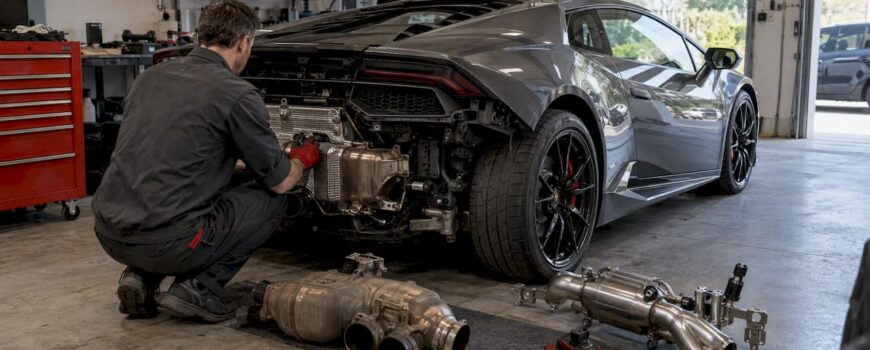
For most Huracan owners, the best exhaust upgrade is a valved, factory-fit system that keeps the catalytic converters in place. This path gives you real sound control, from a quiet morning start-up to an open V10 snarl at full throttle, without the legal exposure that comes with gutted converters or so-called “off-road” test pipes. Expect meaningful tone and response gains, not dramatic horsepower numbers.
TL;DR:
- Most Huracan valved exhaust systems keep catalytic converters in place, offering sound control without legal risks associated with gutted converters.
- Upgrading exhaust alone mainly improves engine responsiveness and tone rather than delivering significant horsepower gains, with larger performance boosts coming from intake modifications.
- Ensure aftermarket parts have proper emissions documentation and fit your specific chassis code to avoid legal issues and fitment problems.
- Reversible installations that reuse OEM hardware are crucial for maintaining resale value and warranty protection, especially when paired with proper documentation.
- Many owners prefer factory-fit, valved systems for versatile sound options, legal compliance, and easier return to stock before dealer service visits.
Table of Contents
- Overview of Exhaust Upgrade Options for the Huracan
- What Performance and Sound Gains You Can Realistically Expect
- Legal and Emissions Compliance Checklist Every Owner Must Run Through
- Fitment, Installation, and Maintenance: What to Expect
- Decision Framework: How to Choose the Right Valved Exhaust for Your Huracan
- How Valve Control Exhaust’s Valved Systems Address Owners’ Priorities
- Comparing Exhaust Upgrades Across Huracan Models and Years
- How an Exhaust Upgrade Affects Resale Value and Insurance
- From Purchase to Tuned: What the Installation Timeline Looks Like
- Warranty Implications and What Dealers Think of Aftermarket Exhaust
- Brands and Community-Favored Systems: What Owners Actually Install
- Balancing the V10’s Voice With the Responsibilities of Ownership
- Where to Start With Valve Control Exhaust
- FAQ
- Sources
Overview of Exhaust Upgrade Options for the Huracan
The Huracan’s naturally aspirated 5.2-liter V10 gives exhaust tuners a lot to work with tonally, even if the power ceiling from exhaust alone is modest. Most aftermarket options fall into a few buckets, and each one changes a different part of the ownership experience.
- Cat-back valved systems replace everything from the converters back and use electronic valves to toggle between a quiet mode and an open, aggressive mode.
- Non-valved cat-back systems lock in one tone permanently, which suits owners who want maximum volume and don’t mind neighbors noticing.
- Center X-pipes merge the two banks before the rear mufflers and tend to sharpen the exotic V10 wail rather than just adding volume.
- Catted downpipes replace the factory downpipe while retaining catalytic converters, improving flow with less legal risk than true test pipes.
Reversibility matters more than most first-time buyers expect. A system that reuses OEM mounting points and factory flap logic can be removed cleanly before a sale or a warranty visit, while permanent modifications (welded sections, cut factory piping) make that much harder.
What Performance and Sound Gains You Can Realistically Expect
Exhaust-only upgrades on a naturally aspirated V10 change how the engine feels more than how hard it pulls on paper. The bigger gains on this platform tend to come from the intake side: a tested high-flow intake on the same 5.2-liter V10 produced up to 26 additional horsepower and 17 lb-ft of torque on a Dynojet run, with airflow up 43% over stock. That figure is useful context, not an exhaust number, but it shows where the larger measurable gains on this engine usually originate.
An exhaust swap by itself typically delivers sharper throttle response, a fuller midrange pull, and a dramatically different tone rather than a big jump in peak horsepower. That subjective improvement, the sound and the way the engine feels like it’s breathing better, is often the real reason owners upgrade in the first place.
Stacking an intake, a catted downpipe, and a tune changes the math and can add real power on top of the exhaust’s tonal benefits. It also raises emissions and legal exposure with every component you add, especially once the downpipe or tune starts touching how the catalytic converters or OBD system behave.
Legal and Emissions Compliance Checklist Every Owner Must Run Through
Federal rules do not bend for expensive cars. The EPA’s Exhaust System Repair Guidelines prohibit removing catalytic converters and installing replacement pipes that bypass emission controls, and the agency’s own tampering enforcement policy makes clear that aftermarket parts defeating emission devices can expose both owners and installing shops to penalties.
A few red flags are worth watching for before you buy:
- “Test pipes” sold as converter replacements with no catalyst inside.
- Vendor language claiming “off-road use only,” which does not exempt a street-driven car from enforcement.
- No emissions documentation, warranty statement, or testing data backing the part.
To stay on the right side of the rules, favor catted downpipes or documented replacement after-treatment parts over straight pipes, ask the vendor or shop for a written emissions statement, and confirm your state’s inspection requirements before you commit to anything that touches the converters.
Fitment, Installation, and Maintenance: What to Expect
A proper installation starts with a dry-fit before anything gets torqued down. Shops familiar with the Huracan’s chassis codes, whether you own an LP610-4, an EVO, or an STO, know to leak-check at idle and re-torque flange bolts after the first heat cycle, which is where most aftermarket exhaust leaks and rattles actually originate.
Valved systems add a layer of complexity because the actuators need to talk to either the car’s factory drive-mode logic or a dedicated aftermarket controller. A controller that mirrors the OEM valve behavior reduces the chance of ECU mismatches, unwanted limp-mode triggers, or false OBD codes.
Once installed, maintenance is mostly about checking actuator function periodically, inspecting heat shielding near the engine bay, and keeping the original hardware so the car can be returned to stock. That last point protects resale value more than most owners realize until they’re trying to sell.
Decision Framework: How to Choose the Right Valved Exhaust for Your Huracan
Start with what you actually want from the car day to day, not just how loud you want it at a cars-and-coffee meet. Rank your priorities across sound character, daily civility (will the neighbors tolerate 6 AM starts), compliance and reversibility, material weight savings, and the length of support behind the product.
Before buying, run through this checklist with any vendor or shop:
- Can you show fitment proof or test-fit data for my specific Huracan chassis code and model year?
- Is there dyno or sound-level data available for this system?
- Do you provide emissions documentation or a reasonable-basis statement for the aftermarket after-treatment hardware?
- What’s the warranty length on the system and the valve actuators specifically?
- What’s the expected service life of the actuators before they need attention?
Pro Tip: Ask for the emissions documentation in writing before you pay, not after the part ships.
Budgets vary widely by system architecture and whether you’re doing a full cat-back versus a downpipe-only swap, with professional installation adding meaningfully to the parts cost depending on local labor rates and whether valve controller wiring needs custom routing.
How Valve Control Exhaust’s Valved Systems Address Owners’ Priorities
Our valved exhaust systems are designed to provide showroom-quiet mornings and track-day presence from the same car, without losing converters or warranty leverage. Real-time valve control lets you switch between those modes on demand, and compatibility spans Lamborghini, Ferrari, Porsche, Audi, BMW, and Mercedes-AMG platforms, enabling this approach to sound customization across a garage of different cars.
Every system comes with fitment documentation and an owner’s guide specific to Huracan valve upgrades so compatibility can be verified before purchase, helping avoid mismatches after installation.
Comparing Exhaust Upgrades Across Huracan Models and Years
The Huracan’s exhaust routing and valve logic changed meaningfully across its production run, and that affects which upgrades fit cleanly. The original LP610-4 uses a different flap control architecture than the later EVO, which revised the factory exhaust valve mapping alongside its broader performance updates. The STO, built around a more track-focused mission, already runs a more aggressive factory exhaust character than the standard EVO, so an aftermarket valved system on an STO is often chosen more for weight savings and fine sound-tuning than for unlocking a dramatically different voice.

Rear-wheel-drive variants like the LP580-2 and Tecnica also differ from the all-wheel-drive versions in underbody packaging, which can change how a downpipe or center section routes and clears suspension components. A system engineered around one drivetrain layout does not automatically bolt on cleanly to another.
This is why fitment proof tied to the exact chassis code and model year matters more on the Huracan than on many other performance cars. A system marketed generically as “fits Huracan” without specifying LP610-4, EVO, Performante, STO, or Tecnica compatibility is a reasonable signal to ask more questions before buying, not necessarily a reason to walk away, but a prompt to get documentation first.
How an Exhaust Upgrade Affects Resale Value and Insurance
Reversibility is the single biggest factor connecting an exhaust upgrade to resale value. A quality bolt-on system that reuses OEM mounting points and keeps the original hardware allows a seller to return the car to stock configuration before a sale, which matters to buyers who want factory warranty eligibility or who simply prefer an unmodified car. A welded, cut, or otherwise permanent modification removes that option and can narrow your buyer pool.
Documentation travels with the car as much as the parts do. A buyer who sees emissions compliance statements, a warranty record, and professional installation receipts is generally more comfortable than one looking at an undocumented modification with no paper trail.
On the insurance side, any aftermarket performance modification is worth disclosing to your carrier, since undisclosed modifications can complicate a claim after an accident or a mechanical failure. Insurers price risk differently depending on the modification and the carrier, so there’s no single industry-wide number to quote here. The practical move is a short call to your insurer before installation, confirming how the specific system you’re installing affects your policy, rather than assuming a valved exhaust is treated the same as a straight-pipe setup.
From Purchase to Tuned: What the Installation Timeline Looks Like
A typical valved exhaust project moves through a few distinct phases, and most delays happen in the small gaps between them rather than in the install itself. Ordering and fitment verification, confirming your Huracan’s chassis code and model year match the system’s documented fitment, is worth doing before the part ships, since post-purchase fitment surprises are the single biggest source of schedule slips.
Once the parts arrive, a shop experienced with the Huracan platform generally handles a dry-fit first, checking flange alignment and valve actuator clearance before committing to final installation. That dry-fit, followed by final mounting, leak-checking at idle, and a heat-cycle re-torque of flange bolts, is where most of the hands-on labor time goes.

After installation, valve actuator integration with the car’s drive modes (or a standalone controller) needs a functional check across each mode, quiet, sport, and track settings if your system offers them, to confirm the valves open and close as expected without triggering false OBD events. If you’ve paired the exhaust with an intake or a tune, that’s when a dyno tuning session typically happens, since the combination of components changes the fueling and timing calibration enough to warrant a professional tune rather than running on a generic map.
Warranty Implications and What Dealers Think of Aftermarket Exhaust
Modifying any emissions-related hardware carries warranty risk, and the exhaust system sits close enough to the emissions path that dealers scrutinize it during service visits. The practical reality is that a dealer or service center can deny warranty coverage for a specific failure if they determine the aftermarket part caused or contributed to it, even if the rest of the car remains under warranty for unrelated issues.
This is a major reason reversibility matters beyond resale. An owner who can swap the factory exhaust back on before a warranty service appointment keeps that leverage intact, while someone running a permanently welded system has no fallback if a dealer flags the modification.
Before buying, it’s worth asking the vendor directly whether they have any documented experience with dealer service interactions on Huracan models, and keeping the factory exhaust in storage rather than reselling it immediately. Some owners find a independent specialist shop familiar with Lamborghini platforms to be a more practical service partner for modified cars, reserving the dealer relationship for issues clearly unrelated to the exhaust.
Brands and Community-Favored Systems: What Owners Actually Install
Huracan owners tend to gravitate toward a handful of system architectures when comparing notes, and the conversation usually centers on valve control sophistication, weight, and how the center X-pipe design shapes the car’s voice. A general technical resource on exotic exhaust character is a useful starting point if you want to understand how X-pipe geometry and muffler chamber design interact before narrowing down a specific system.
Within the valved category, owners commonly debate differences in actuator reliability, how quiet the quiet mode actually is at idle, and how well the valve logic integrates with the car’s factory drive modes versus requiring a separate remote controller. A system that mirrors the OEM valve behavior tends to draw fewer complaints about mismatched ECU signals or unexpected limp-mode triggers.
Weight savings show up as a secondary consideration for most owners, more relevant to STO buyers chasing every pound than to someone running a daily-driven LP610-4. For a deeper technical breakdown of how different system architectures compare on these points, our performance exhaust buyer’s guide walks through the tradeoffs across several well-known architectures.
Balancing the V10’s Voice With the Responsibilities of Ownership
A Huracan’s exhaust note is part of why people buy the car, and chasing that sound is a legitimate reason to upgrade. However, the owners who stay the happiest long-term are the ones who picked a system that protects resale value and keeps them compliant, not just the loudest option at the shop.
For most owners, a factory-fit valved system remains the smartest default choice.
— Info
Where to Start With Valve Control Exhaust
If the framework above matches your thinking about this upgrade, the next step is checking fitment against your specific Huracan chassis code before buying. Genuine components direct from authorized manufacturers are available, with documentation supporting fitment verification and emissions questions discussed here.

- Browse the Exhaust Parts category for valved cat-back and muffler components.
- Check the Down Pipe options for catted downpipes that preserve converters.
- Review Accessories for tips, controllers, and related hardware.
Consider contacting the supplier team before ordering to confirm fitment for your model year or for installation recommendations. Confirming fitment early helps avoid surprises that often delay installation.
FAQ
How much HP does an upgraded exhaust add to a Huracan?
Exhaust-only upgrades on the Huracan’s naturally aspirated V10 typically produce smaller gains than intake changes, with the bigger measurable numbers on this platform coming from airflow upgrades rather than the exhaust alone. A tested intake on the same engine added up to 26 horsepower and 17 lb-ft of torque, which gives useful context for how much of the total gain on this engine tends to come from the intake side rather than the exhaust.
Is the Lamborghini Huracan the fastest car in the world?
No single production car holds an uncontested claim to “fastest in the world,” since the title depends on the specific metric used, top speed, acceleration, or lap time, and changes as new models are released. The Huracan is a genuinely fast supercar, but it competes in a category with several rivals rather than holding an outright speed record.
Is it legal to remove my catalytic converter for a louder exhaust?
No. Federal guidance prohibits removing catalytic converters or installing replacement pipes that bypass emission controls, and EPA enforcement policy makes clear that vendor disclaimers like “off-road use only” do not exempt owners or shops from liability on a street-driven car.
Will an aftermarket exhaust void my Huracan’s warranty?
A dealer or service center can deny warranty coverage for a specific failure if they determine an aftermarket part caused or contributed to it, even while unrelated systems remain covered. Choosing a reversible, factory-fit system lets you restore the original exhaust before a warranty visit, which preserves your options.
What should I look for when choosing a valved exhaust system?
Prioritize documented fitment proof for your exact chassis code and model year, emissions documentation for any downpipe or converter-adjacent part, and a warranty that covers the valve actuators specifically. A system that reuses OEM mounting points keeps the installation reversible, which protects both resale value and dealer warranty standing.