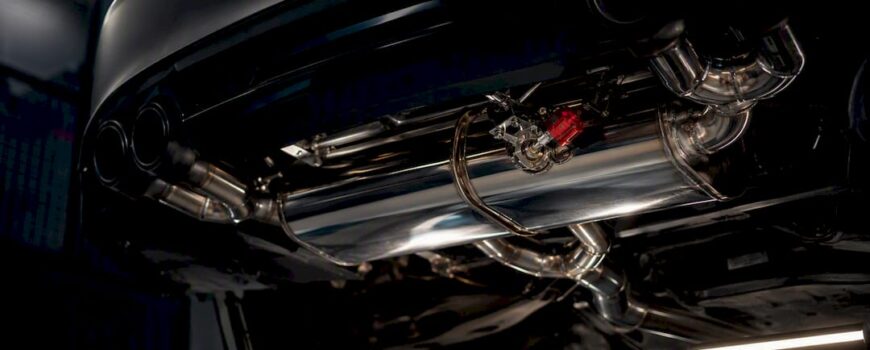
For most M2 owners chasing a louder, more responsive S58 without wrecking daily livability, the answer is a valved catback or an equal-length midpipe paired with a valved rear section. This setup lets you stay quiet on the morning commute and open up on demand, usually improving flow and reducing weight. Some suppliers build compatible components across both M2 generations, with fitment guidance to match.
TL;DR:
- A valved catback system offers a balance of quiet daily driving and open exhaust sound on demand, with weight savings around 18 pounds.
- Equal-length midpipes improve flow and reduce drone without requiring additional tuning, unlike downpipes that often need ECU recalibration.
- Titanium exhausts are lighter and more corrosion-resistant but come at a significantly higher cost compared to stainless steel options.
- F87 and G87 M2 exhaust systems are incompatible without modification due to differences in chassis, routing, and hanger placement.
- Upgrading with a catback or midpipe typically adds modest power gains and improved throttle response, which depend heavily on proper tuning and emissions compliance.
Table of Contents
- What Are Your M2 Exhaust Upgrade Options?
- How Much Power and Sound Can You Actually Gain?
- Titanium or Stainless: Which Exhaust Material Fits Your Build?
- Does an F87 Exhaust Fit a G87 M2?
- What Happens During Installation, and Do You Need a Tune?
- What Will an M2 Exhaust Upgrade Cost You?
- Why Valve Control Exhaust Fits the M2 Upgrade Path
- Will an Exhaust Upgrade Void Your Warranty or Raise Your Insurance?
- How Do the Major Exhaust Brands Compare?
- How Long Will Your New Exhaust Last?
- Will an Exhaust Upgrade Hurt Your Fuel Economy?
- Why Valved Systems Beat the All-or-Nothing Exhaust Debate
- Ready to Upgrade? Here’s How to Buy the Right System
- Sources
What Are Your M2 Exhaust Upgrade Options?
Every M2 exhaust upgrade falls into one of four categories, and picking the wrong one wastes money on gains you’ll never notice.
A catback replaces everything from the catalytic converters back, including the midpipe, mufflers, and tips. An axle-back is a smaller slice of that, just the mufflers and tips behind the rear axle, which changes tone more than it changes flow. A midpipe swap, especially an equal-length design, reshapes how the two banks of cylinders exhale together, smoothing out the drone that stock and even some aftermarket setups produce. A downpipe sits closest to the turbos and does the most for airflow, but it also touches emissions equipment directly.
Here’s how to match the part to the goal:
- Want an aggressive daily tone with easy install and no tune required? Start with a valved catback.
- Chasing smoother midrange pull and less rasp at highway speed? Look at an equal-length midpipe.
- Building for track days where every pound and every psi of backpressure matters? A downpipe delivers the biggest number, but expect emissions and tuning implications.
- Just want a different look and slightly different note without touching flow? An axle-back with new tips is the low-commitment move.
Downpipes deserve a caution flag. Removing or replacing catalytic elements can put your car outside U.S. emissions compliance depending on your state, a point worth understanding before you buy the loudest part on the shelf.
How Much Power and Sound Can You Actually Gain?
Numbers matter more than marketing copy here, so let’s set realistic expectations before you spend a dollar.
A catback or equal-length midpipe alone, without a supporting tune, typically provides modest but noticeable gains in the range most enthusiasts describe as noticeable seat-of-the-pants improvement rather than dyno-chart drama. Add a performance downpipe and a proper reflash, and the combined gain climbs meaningfully higher because you’re addressing backpressure at the turbo outlet instead of just downstream. The catch: those bigger numbers depend on the tune doing its job, not just the hardware being installed.
Weight matters more than most owners expect. Turner’s valved catback for the G87 M2 cuts roughly 18 lbs versus the factory system, and BMW’s own M Performance exhaust for the M2 CS was engineered specifically to shed weight while reshaping the S58’s exhaust note.
What else shifts:
- Valve position changes perceived loudness far more than it changes the measured decibel ceiling at full throttle. Closed valves keep you civil at 7 AM; open valves let the S58 breathe at redline.
- Freer flow sharpens throttle response, since the engine isn’t fighting its own exhaust pressure on the way out.
- Less rotating and unsprung weight at the rear of the car has a small but real effect on handling balance, even if it won’t show up as a dramatic 0 to 60 change on paper.
Titanium or Stainless: Which Exhaust Material Fits Your Build?
Material choice decides how your exhaust ages, how much it weighs, and how much it costs, and the two mainstream options couldn’t be more different.
T304 stainless steel is the standard for a reason. It resists corrosion well, holds up to heat cycling, and costs a fraction of the alternative. Most valved M2 systems, including AeroFlex’s valved sport exhaust, offer T304 as the base tier.
Grade 5 titanium is the upgrade for owners who care about every pound and want a distinct blue-tinted heat patina on the tips. It’s lighter, more corrosion-resistant over the long haul, and priced at a real premium over stainless, often multiples of the cost for the same configuration.
Beyond the raw metal, construction quality separates a good exhaust from a great one:
- Mandrel-bent tubing keeps the pipe’s diameter consistent through every bend, which preserves flow instead of choking it at the turns.
- TIG welding produces cleaner, stronger joints than cheaper stitch-welded alternatives, which matters when you’re cycling through heat and cold for years.
- Tip finish, whether brushed titanium, black chrome, or polished stainless, affects resale perception almost as much as the sound does. A tired-looking tip on an otherwise great system undersells the whole car.
If you’re weighing long-term corrosion resistance on any exterior trim piece, the same logic that applies to coatings on interior surfaces applies here: cheaper finishes degrade faster under UV and road grime.
Does an F87 Exhaust Fit a G87 M2?
No, and this trips up more buyers than any other part of the process. The F87 (2016 to 2021) and G87 (2023 onward) M2 share a badge but not a chassis, and their exhaust routing, hanger positions, and rear valance cutouts differ enough that F87 parts will not bolt onto a G87 without modification.
Before you order anything, check these three things:
- Confirm your exact chassis code and model year. F87 covers the original M2 and M2 Competition; G87 covers the current-generation car. A part listed for one will not fit the other despite similar naming.
- Verify whether the system is a direct bolt-on or requires cutting. Most reputable valved catbacks use OEM mounting points and slip joints for final tip alignment, which means minimal fabrication. Cheaper universal-fit kits often require trimming the factory hangers.
- Check valve control compatibility. Some systems integrate with the OEM valve signal wiring, while others ship with a standalone electronic controller and remote. Mixing an aftermarket controller with factory wiring without confirming compatibility is a common source of installation headaches.
What Happens During Installation, and Do You Need a Tune?
A bolt-on catback or axle-back is a straightforward job. Most shops handle a direct-fit valved catback in a couple of hours, working from factory hanger points and finishing with slip joints to square up the tips.
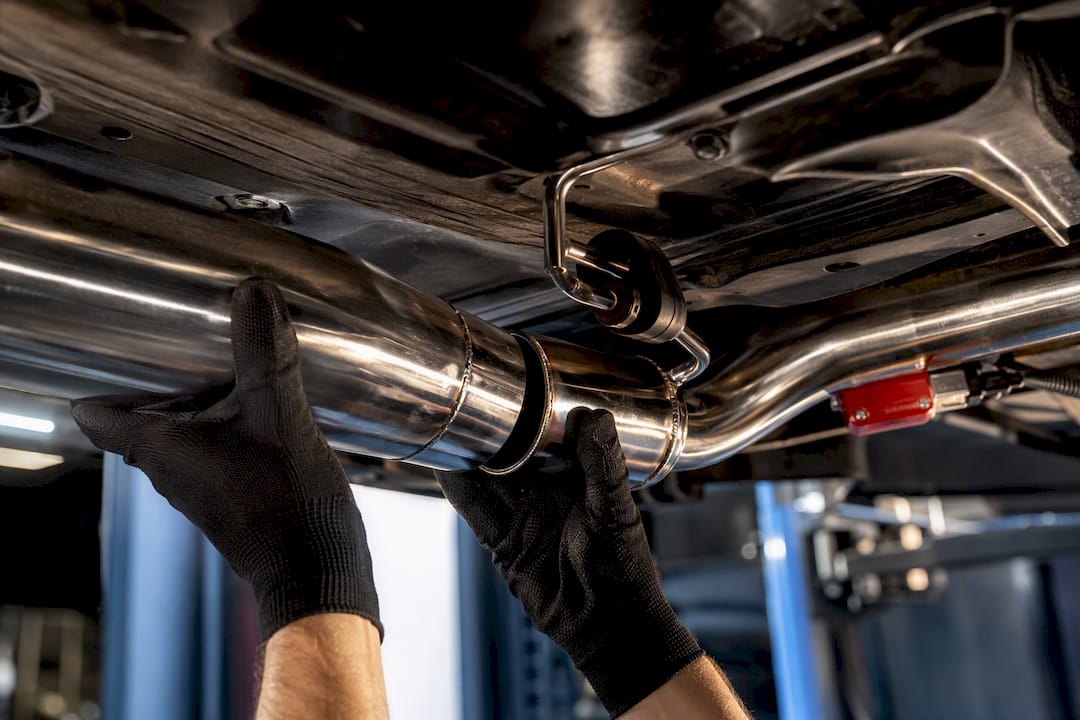
Downpipes and catless parts are a different story. Swapping a downpipe, especially a catless or 200-cell unit like the FI Exhaust Sport 200 Cell downpipe for the F87 M2, changes the oxygen sensor readings the ECU expects to see. Skip the tune, and you’re looking at a check engine light or a car that runs rough in ways a catback swap would never cause.
Before you buy, keep a short checklist handy:
- Confirm your chassis code and model year with the seller before ordering.
- Ask whether the system needs a tune, and if so, whether that tuner has experience specifically with S58-equipped M2s.
- Check if O2 sensor extensions or spacers are included, since a catless downpipe often needs them to prevent a CEL.
- Get a labor time estimate in writing before the shop starts cutting anything.
Pro Tip: Call the shop before you buy the part, not after. A good installer will tell you honestly whether your specific system needs a tune, and a shop that says “just bolt it on and see” for a catless downpipe is one to avoid.
What Will an M2 Exhaust Upgrade Cost You?
Budgeting for an exhaust upgrade means understanding where the price jumps come from, and it’s rarely the labor.
- Axle-back systems in stainless typically start at several thousand dollars.
- Full valved catback systems with equal-length midpipes run higher, with titanium versions commanding a real premium over stainless, reaching into the mid four figures for a full titanium configuration.
- Downpipes alone are usually a smaller line item than a full catback, but factor in tuning cost separately.
Popular valved systems for the G87 and F87 sometimes carry longer lead times than off-the-shelf axle-backs, since demand for equal-length midpipe designs has outpaced some suppliers’ stock.
On compliance: U.S. emissions rules vary by state, and some states enforce visual and functional smog checks that catless or high-flow cat setups can fail. Check your state’s specific requirements, and where federal Clean Air Act rules apply to catalyst removal, verify compliance before installing anything that alters factory emissions equipment.
Why Valve Control Exhaust Fits the M2 Upgrade Path
Some suppliers carry valved exhaust systems and downpipes designed around priorities most M2 owners land on: controllable sound, real flow gains, and hardware that matches factory mounting points instead of fighting them. The inventory includes FI Exhaust downpipes for both F87 and F87N M2 Competition models, giving buyers a path to the sport 200-cell or catless configuration that fits their tuning plans.
A valved system solves the actual conflict M2 owners face daily: wanting a car that’s civil in a parking garage and loud on a mountain road. Electronic valve control, whether through a remote or OEM signal integration, makes that switch instant instead of a compromise you live with in one direction or the other.
What that looks like in practice:
- Product pages listing exact chassis compatibility for both F87 and G87 generations, so you’re not guessing whether a part fits your VIN.
- Downpipe options in sport 200-cell and catless configurations for owners weighing flow gains against emissions considerations.
- Fitment support to confirm your car’s exact configuration before you order, reducing the chance of a return.
If you’re unsure which configuration matches your car, checking your VIN against the listed compatibility before purchase saves a return shipment later.
Will an Exhaust Upgrade Void Your Warranty or Raise Your Insurance?
Modifying your exhaust touches two separate concerns that owners often lump together but shouldn’t: manufacturer warranty and insurance coverage.
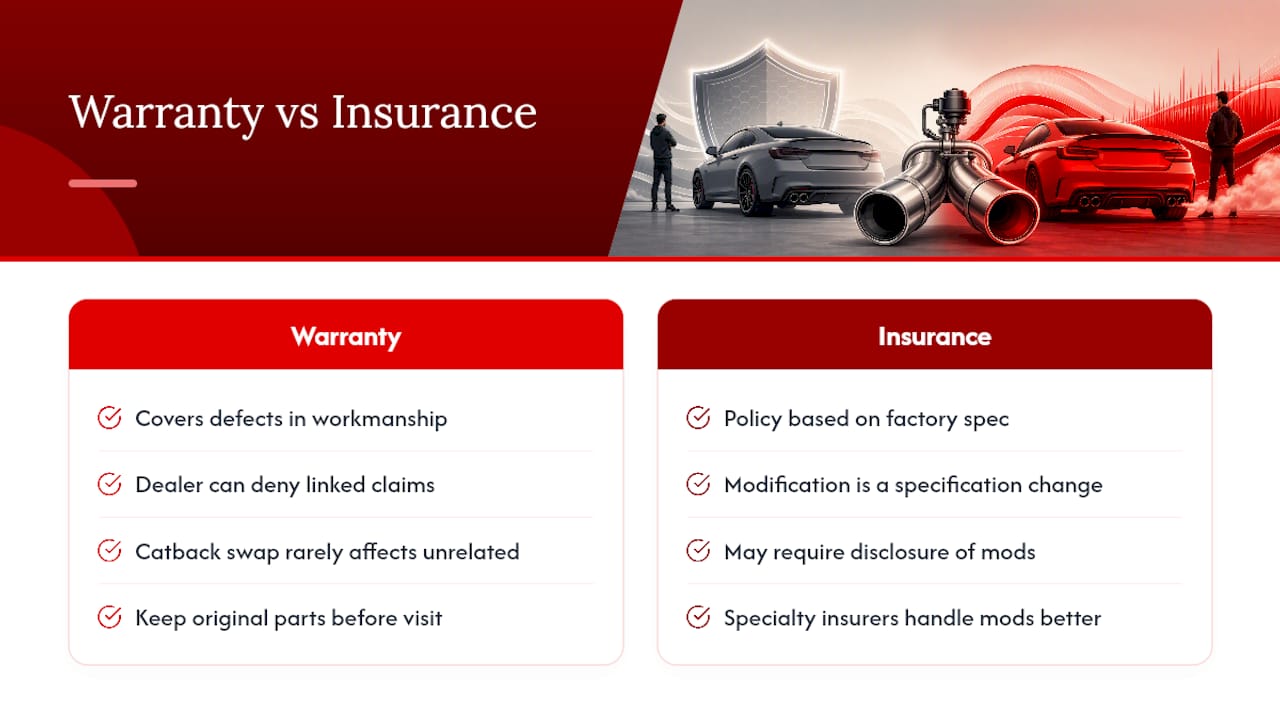
BMW’s factory warranty covers defects in materials and workmanship, and dealerships can deny warranty claims on parts they can demonstrate were damaged or affected by an aftermarket modification. In practice, this means a catback swap alone rarely causes issues with unrelated warranty claims, like an infotainment failure, but a dealer could point to an aftermarket downpipe if a claim involves the turbo, catalytic system, or anything downstream of it. Keeping your original parts and reinstalling them before a dealer visit is common practice among enthusiasts who want to preserve warranty coverage on unrelated repairs.
Insurance works differently. Most standard auto policies are written around the vehicle as it left the factory, and a modified exhaust is technically a change in the vehicle’s specification. Some insurers won’t blink at a catback swap; others require you to disclose performance modifications, and failing to do so can complicate a claim after an accident even if the exhaust had nothing to do with it. Specialty insurers who work with modified and performance vehicles typically handle this more smoothly than a standard carrier, often for a manageable premium difference.
The safest approach: call your insurer before installing anything, ask directly whether an exhaust modification needs to be disclosed, and get the answer in writing if you can.
How Do the Major Exhaust Brands Compare?
The M2 aftermarket exhaust market has matured to the point where most reputable brands cluster around the same core features: valved rear sections, equal-length midpipes, and a choice between T304 stainless and titanium. What actually separates them is execution.
Some brands lean hard into direct-fit simplicity, prioritizing OEM mounting points and slip-joint tip alignment so installation stays a same-day job. Others push harder on flow numbers, betting that track-day buyers will accept a slightly longer install for a bigger gain. A smaller group focuses on acoustic tuning, chasing a specific tone rather than a specific horsepower figure, which shows up in how the equal-length midpipe geometry is engineered.
Price tiers track material and control features more than brand prestige. A stainless axle-back from a well-regarded name and a lesser-known shop often perform similarly on paper; the difference shows up in fit, weld quality, and how the valve controller behaves over years of use. Reviews from owners who’ve run a system through a full winter or two are more useful than a fresh-install video, since valve actuators and slip joints reveal their quality over time, not on day one.
If you want a side-by-side breakdown of specific systems rather than categories, Valve Control Exhaust’s exhaust system face-off walks through how leading valved systems stack up against each other.
How Long Will Your New Exhaust Last?
A quality valved exhaust, built from T304 stainless or Grade 5 titanium with mandrel-bent tubing and TIG-welded joints, should outlast the car’s typical ownership window with minimal attention. The parts most likely to need service aren’t the pipes themselves, but the moving components: the valve actuators.
Electronic valve motors take on the day-to-day wear that stock exhausts never faced, since they’re cycling open and closed hundreds of times over a car’s life. Most hold up well, but road salt, moisture intrusion, and years of heat cycling can eventually slow an actuator’s response or cause it to stick in one position. Keeping electrical connectors clean and dry, and checking for corrosion at the connector points during routine maintenance, extends the life of the control system significantly.
Stainless steel resists rust well but isn’t immune to surface discoloration from heat and road salt, especially in states that treat roads heavily in winter. Titanium fares better here, developing a heat patina rather than corroding, which is part of why enthusiasts who daily-drive through harsh winters often lean titanium despite the price gap.
Mechanically, there’s little to maintain beyond periodic inspection of hangers and slip joints for looseness, since vibration over tens of thousands of miles can work fasteners loose. A five-minute check during an oil change catches this before it becomes a rattle.
Will an Exhaust Upgrade Hurt Your Fuel Economy?
Freer-flowing exhaust components generally have a negligible effect on fuel economy in either direction, and any change you might notice is more likely tied to driving behavior than the hardware itself.
The physics support this. A less restrictive exhaust reduces the work the engine does pushing spent gases out, which theoretically supports efficiency rather than hurting it. In practice, the difference is small enough that most owners won’t see a measurable change on their trip computer unless they also change how they drive, and a louder, more responsive exhaust tends to invite a heavier foot.
Drivability is the more relevant story. A catback or midpipe upgrade alone typically improves throttle response and reduces the flat spots some owners feel in the stock exhaust’s midrange, without introducing rough idle or hesitation. Downpipe swaps are where drivability risk actually shows up, and only when the supporting tune isn’t handled correctly. An uncalibrated ECU reacting to unexpected O2 sensor readings can cause rough idle, hesitation, or a check engine light, none of which are inherent to the hardware itself, but all of which stem from skipping the tuning step.
The takeaway for anyone weighing this upgrade: expect sound and response changes, not fuel economy changes, and treat any drivability issue as a tuning problem to solve rather than a reason to blame the exhaust.
Why Valved Systems Beat the All-or-Nothing Exhaust Debate
The enthusiast forums still frame exhaust upgrades as a binary choice: stay stock and quiet, or go loud and deal with the consequences. That framing was true a decade ago. It isn’t anymore, and clinging to it costs owners money on parts that don’t fit how they actually drive.
The real gap in conventional advice is that most guides obsess over horsepower numbers from a downpipe and tune combo while glossing over the fact that most M2 owners drive their cars to work, to dinner, to the grocery store, far more often than they drive them to a track. A valved catback or equal-length midpipe solves the problem that actually matters for that use case: sound on command, not sound as a permanent commitment.
If you’re prioritizing one thing first, prioritize the valve control feature over the raw flow number. A slightly less aggressive system with reliable electronic valve control will serve you better day to day than a marginally louder fixed system that annoys your neighbors every morning. Fitment and material quality come second. Chasing the biggest claimed horsepower gain before nailing those fundamentals is how enthusiasts end up with a garage full of parts they eventually sell at a loss.
— Info
Ready to Upgrade? Here’s How to Buy the Right System
Once you know whether you’re after a catback, midpipe, or downpipe, the next step is matching that decision to a part number that actually fits your chassis, and that’s where most online exhaust shopping goes wrong. Some suppliers list direct compatibility by chassis and model year across their M2 inventory, so you can order against your VIN’s actual configuration instead of guessing from a generic listing.

Start with the performance exhaust buyer’s guide to compare valve-control features and material options side by side before you commit to a configuration. If you already know you want a downpipe, browse the FI Exhaust catless downpipe for the F87N M2 Competition or the sport 200-cell version for the earlier F87 chassis, and reach out for a fitment check against your VIN before you check out. That one extra step, confirming your exact model year and chassis code against the listed compatibility, is what separates a same-day install from a part that ends up back in a box headed for a return.
Sources
- Performance Valved Catback Exhaust – G87 M2 | Turner Motorsport
- BMW G87 M2 Valved Sport Exhaust System – AeroFlex Performance
- M Performance Track Kit for the BMW M2 and new M Performance exhaust system for the BMW M2 CS.