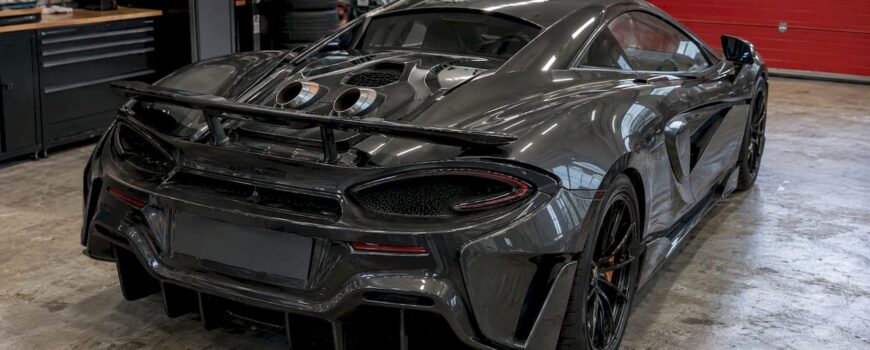
The McLaren 600LT has a top-exit exhaust, and that layout decides almost everything about upgrading it. The tailpipes sit high on the rear deck, the downpipes feed short, straight routing, and any aftermarket system has to work with that packaging. This guide covers how the factory system is built, which parts you can change, what 570S owners should check, and what to know about emissions rules before you order.
TL;DR
- The 600LT’s top-exit routing is shorter than the 570S rear-exit layout. McLaren removed 18 pounds of tubing and 10 pounds of fans as part of the change.
- Your main choices are a valved or straight-through rear system, downpipes, cat bypass pipes, and the controller that sets the valve position.
- 570S owners can add a top-exit conversion style system, but fitment depends on body style and model year, so match the part to your exact car.
- Catalytic-converter changes carry real legal weight. In California, aftermarket converters need a CARB EO number and approval for your vehicle.
- Choose by sound goal first, then fitment, then the supporting parts such as downpipes and tuning.
Table of Contents
- How the 600LT’s factory exhaust is built
- What you can change
- Choosing a 570S exhaust
- Heat, weight and the rest of the car
- Installation and what can go wrong
- Emissions rules to know before you buy
- Our perspective
- Find parts for your McLaren
- FAQ
- Sources
How the 600LT’s factory exhaust is built
The 570S sends its exhaust out of the rear, low under the bumper area. The 600LT moves the tailpipes to the top of the rear deck. According to Engineering Explained’s analysis, that shorter route reduces backpressure and removes 18 pounds of tubing and 10 pounds of fans. The same source ties the change to the 600LT making 30 more horsepower than the 570S.
There is a second benefit. With the pipes out of the way, McLaren had room for a more effective rear diffuser. The same analysis credits the 600LT’s aero changes with 220 pounds of additional downforce at 155 mph compared with the 570S.
What this means for you as an owner:
- Short pipe runs mean the sound is direct. Little sits between the turbos and the tips, so changes to the downpipes or the rear section are easy to hear.
- The packaging is tight. Parts designed for the 600LT account for the top-exit layout and the heat near the rear deck.
- The diffuser and exhaust work together. Anything you change at the rear should respect that relationship.
What you can change
Most aftermarket work on these cars falls into five groups. You can mix them, and each affects sound, response and weight differently.
| Part | What it changes | Best for |
|---|---|---|
| Valved rear exhaust system | Sound range from quiet cruising to loud, plus flow at the rear | Owners who want a switchable car |
| Downpipes | Flow directly after the turbos, with a clear change in tone and response | Owners planning a tune |
| Cat bypass pipes | Removes the catalytic converter section for a louder, rawer sound | Track-oriented cars, subject to local law |
| Tips and rear diffuser parts | Appearance, with some effect on tone | Owners finishing a build |
| Valve controllers | How and when the valves open | Anyone who wants control from the cabin or phone |
Valved rear systems
A valved system gives you two cars in one. With the valves closed, the car stays civil on a morning commute or in a neighborhood. With them open, exhaust flow increases and the twin-turbo V8 gets louder. Our guides explain how exhaust valves toggle automatically and how exhaust valves shape the sound of your drive, which helps if you are new to the idea.
Material matters as well. Stainless steel and titanium both appear on performance systems, and titanium is the lighter option. Sound character depends on the pipe diameter, the muffler design and the valve layout, not on material alone.
Downpipes and cat bypass pipes
Downpipes connect each turbo to the rest of the exhaust. Swapping them gives a clear step in sound and response, which is why they are the usual first move before a tune. We list the McLaren 675LT FI Exhaust Sport 200 cell downpipe for the sibling Longtail, and our cat bypass pipes for the 600 LT 2019-2021 for the 600LT itself. All our downpipes are in the Down Pipe category.
Removing catalytic converters raises the legal questions covered below. Read that section before you decide.
Controllers and accessories
A controller decides when the valves open. Some owners want a remote, some want an app, and some want the valves to follow drive modes. Our overview of three ways to adjust exhaust sound compares those routes. Controllers and related parts sit in our Accessories category.
Choosing a 570S exhaust
Many readers arrive here asking about the best 570S exhaust. The honest answer starts with what you want the car to do, because the 570S and 600LT share a platform but not an exhaust layout.
Rear-exit 570S owners generally choose between two paths:
- Keep the rear-exit layout and upgrade to a valved or lighter system that bolts in place of the factory section.
- Move toward top-exit styling. Some owners convert the 570S to the 600LT’s top-exit look and sound. This is a bigger job, and the wiring and bodywork need planning.
In a forum thread from October 2026, an owner describes a 570S converted to a 600LT-style top-exit with straight pipes and downpipes. That is one owner’s account, and results vary. It does show how popular the conversion has become.
Pick your sound goal first
Be specific. “Louder” is not a goal. These are:
- Quiet when you want it, loud when you don’t: a valved system with a controller.
- Track-day sound with a roll-off for the street: valves plus downpipes.
- Subtle, mostly cosmetic: tips and diffuser parts.
- Maximum drama: a conversion with downpipes and a tune. Plan around local law and your neighbors.
Fitment checklist
Before you order, confirm each of these:
- Model: 540C, 570S, 570GT, 600LT or 600LT Spider. Do not assume one part fits all of them.
- Model year: parts listed for 2019-2021 may not fit earlier or later cars.
- Body style: coupe and Spider differ at the rear.
- Current parts: check whether the car has aftermarket downpipes or a previous conversion.
- Supporting parts: heat shields, brackets and the controller.
If any of these is unclear, send us the VIN or the model details before you order. Browse the McLaren exhaust systems and valve upgrades page and filter by your car. We also keep a 600 LT archive and a 675LT archive if you want to see what exists for the Longtail family.
Heat, weight and the rest of the car
Top-exit cars concentrate heat near the rear deck. The 600LT is designed for it, but when you add parts you should consider what sits nearby, including paint, wiring and the diffuser. Heat shields matter when you fit downpipes. For the bodywork, an installer-backed track pack paint protection film is one way to protect the panels you care about if the car sees track time.
Electrical load is the other thing to plan for. Valve controllers and extra wiring draw a little power, and a car that sits for weeks needs a healthy battery. This overview of high-performance car batteries is worth a look if your supercar spends more time in the garage than on the road.
Weight is a smaller story than most buyers expect. The factory 600LT change saved about 28 pounds across tubing and fans, per the Engineering Explained numbers above, so an aftermarket system will not transform the car on weight alone. Choose it for sound, flow and control.

Installation and what can go wrong
A rear-section swap is manageable for a good shop. Downpipes and bypass pipes take more time, and a top-exit conversion on a 570S takes the most. One builder’s write-up of a 600LT conversion kit on a 570S described roughly two hours of install and several more hours sorting out the wiring. Treat that as one owner’s experience, not a quote.
Plan for the following:
- Use a shop that knows McLarens. The engine bay is tight and the parts are expensive.
- Let the engine cool completely before anyone works on the exhaust.
- Ask about tuning. Downpipes and bypass pipes usually go with a tune, and your installer should tell you what they recommend.
- Check for warning lights after the install, and confirm the valves open and close from the controller.
- Keep the stock parts. If you sell the car or need to return it to stock, you will want them.
Our exhaust system anatomy guide is useful if you want to see how each section connects before you talk to a shop.
Emissions rules to know before you buy
The catalytic converter is where exhaust modifications meet the law. Rules differ by state, so check yours.
In California, aftermarket replacement converters must be CARB-compliant. The converter has to carry a CARB EO number and be approved for the specific vehicle application. California’s Smog Check program goes further: technicians check the converter label and confirm that an approved aftermarket converter is fitted for your model.
In practice:
- If your car is registered in California, choose parts with the right CARB approval for your exact vehicle.
- If you buy cat bypass pipes, treat them as parts for a car that is not driven on public roads where emissions equipment is required, and ask your state’s emissions authority or a local smog technician about your situation.
- Keep documentation for any emissions-related part you install.
Our perspective
We build our catalog around one idea: you should decide how your car sounds, and you should be able to change your mind. On a car like the 600LT, with its short top-exit routing, the exhaust is one of the most direct ways to shape the character of the drive.
That is why we focus on valved systems and the controllers that run them. A closed valve gives you a quiet morning. An open valve gives you the sound you bought the car for. You do not have to pick one for the life of the car.
We sell genuine products direct from authorized manufacturers, and we cover a wide range of European and luxury performance cars, McLaren included. For the 600LT and 570S, we suggest starting with your sound goal, matching the part to your exact model year and body style, and then adding downpipes or a tune only if you want them.
Info
Find parts for your McLaren
We sell valved exhaust systems, downpipes, controllers and accessories for performance and luxury cars, with McLaren fitments included. Start with the McLaren exhaust systems and valve upgrades page, or go straight to the Exhaust Parts category.

If you are comparing system types before you buy, our performance exhaust buyer’s guide walks through the criteria that matter.
FAQ
Does the 600LT exhaust fit the 570S?
Not as a simple swap. The 600LT uses top-exit routing and the 570S exits at the rear, so a conversion involves extra parts, wiring and sometimes bodywork. Plan it with a shop that knows McLarens and confirm fitment for your model year.
Why does the 600LT have a top-exit exhaust?
The shorter routing reduces backpressure and cuts weight, and it freed room for a better rear diffuser. Engineering Explained’s breakdown credits it with 18 pounds less tubing, 10 pounds less fans and 30 more horsepower than the 570S.
What is the first exhaust upgrade for a 600LT?
Most owners start with the sound they want. A valved rear system with a controller gives flexibility, while downpipes change tone and response more sharply and usually go with a tune. Match any part to your exact year and body style.
Are cat bypass pipes legal?
That depends on your state and how the car is used. California, for example, requires CARB-approved aftermarket converters for vehicles operated there. Check with your state’s emissions authority or a local smog technician before you buy.
Sources
- Engineering Explained looks at McLaren’s top-mounted exhaust (Hagerty)
- State Converter Installation Guidelines (Walker Exhaust)
- Aftermarket Converter Requirements in the U.S. (MECA)