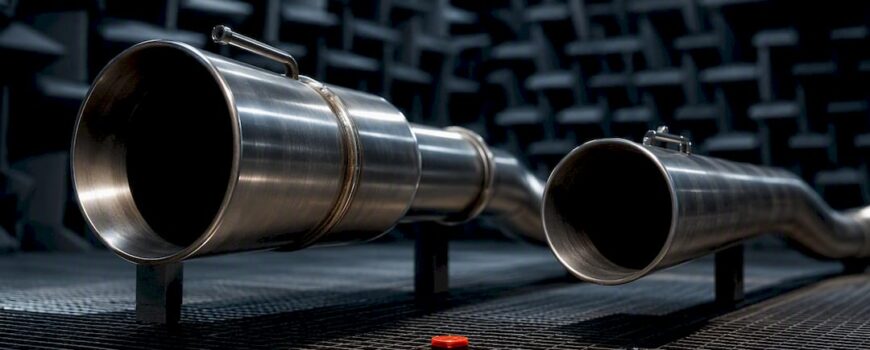
Resonated exhaust setups keep drone in check for daily driving, while non-resonated (resonator delete) setups run louder and raspier with a slightly more aggressive tone. The horsepower differences between the two are typically negligible in a cat-back swap. Legality hinges on what stays untouched upstream, not the resonator itself. Default to resonated if you drive daily; go non-resonated only if you’ve accepted the drone trade-off or you’re building a dedicated track car.
TL;DR:
- Removing the resonator generally results in a louder, raspier exhaust sound with increased cabin drone, especially between 1,800 and 2,800 RPM during highway cruising.
- A resonator’s primary function is to cancel specific drone frequencies, but its removal does not significantly affect horsepower in a standard cat-back system.
- Legality issues mainly arise when modifications also involve removing emissions hardware like catalytic converters or disabling OBD monitoring, not from deleting a resonator alone.
- Using modular exhaust systems allows switching between resonated and non-resonated setups later, minimizing long-term trade-offs.
- Valved exhaust systems offer the ability to toggle between quiet, resonated, and aggressive sounds, eliminating the need for permanent hardware changes.
Table of Contents
- Resonator vs Non Resonated: What a Resonator Actually Does
- What Does Non-Resonated Mean on an Exhaust?
- Resonated vs Non Resonated: How Will Each Actually Sound?
- Do Resonators Reduce Horsepower?
- Is a Non-Resonated Exhaust Legal in the U.S.?
- How Do You Choose Between Resonated and Non-Resonated?
- How Valve Control Exhaust Solves the Resonated vs Non-Resonated Trade-Off
- A Short-Owner’s Take on Resonated vs Non-Resonated
- Get the Sound Without the Compromise
- Primary Sources and Further Reading
- Sources
- FAQ
Resonator vs Non Resonated: What a Resonator Actually Does
A resonator is a tuned chamber built to cancel a narrow band of sound frequencies, not to absorb noise broadly the way a muffler does. The mufflers use absorptive packing to quiet a wide range of frequencies; resonators are reactive devices, engineered to target one specific tone, usually the cabin drone that shows up around certain highway RPMs.
Two designs dominate the aftermarket:
- Helmholtz resonator: a chamber with a narrow neck that cancels sound at a tuned frequency, similar to blowing across a bottle top.
- Quarter-wave resonator (J-pipe): a dead-end tube cut to a length that reflects sound waves back out of phase, canceling a specific frequency.
Placement and pipe geometry shift the tuned frequency, and heat expansion changes it slightly once the system is at operating temperature. That’s why a resonator tuned for one exhaust layout won’t necessarily kill drone on a different chassis, even with the same engine. Purpose-built units, like Helmholtz-style drone killers, are marketed specifically to solve this without meaningfully restricting flow.
What Does Non-Resonated Mean on an Exhaust?
Non-resonated, often called a resonator delete, means the resonator section is removed or swapped for a straight length of pipe. The shops handle it two ways: cutting out the resonator and welding in a straight pipe, or buying a cat-back system that ships without a resonator section from the factory.
- Straight pipe or delete section replaces the tuned chamber, so no frequency-canceling happens.
- Sound gets louder and raspier because the sound waves that would have been canceled now travel straight through.
- Cabin drone at cruising RPM typically increases, sometimes sharply, depending on the vehicle.
- Many aftermarket systems use a modular center section, so you can start resonated and delete it later without buying a whole new exhaust.
That modularity matters more than most buyers realize. Committing to non-resonated permanently is rarely necessary anymore. Understanding the role resonators play in the broader system helps explain why deleting one changes tone more than it changes output.
Resonated vs Non Resonated: How Will Each Actually Sound?
Drone lives in a specific frequency band, usually tied to engine RPM at steady highway cruise, roughly 1,800 to 2,800 RPM on most V6 and V8 platforms. That band resonates with the cabin and pipe geometry, producing the droning hum owners complain about on long drives.
- At idle: both setups sound similar, since idle RPM rarely triggers the drone frequency.
- At cruise: resonated setups stay noticeably calmer; non-resonated setups often develop a persistent hum or buzz that fatigues passengers on longer trips.
- At full throttle: the gap narrows. Both setups get loud, and the added rasp on a non-resonated system reads as more aggressive rather than dramatically louder.
Before committing, test drive a friend’s car with the setup you’re considering, or find an in-cabin cruise RPM recording online for your exact model. Pay attention to 2,000 to 2,500 RPM specifically, since that’s where most cabin drone complaints originate.
Pro Tip: Record a phone video at steady highway speed with your windows up. If the hum makes it hard to hold a phone conversation at that speed, non-resonated will likely bother you daily.
Do Resonators Reduce Horsepower?
Resonators barely restrict flow in a properly sized cat-back system, so removing one in a straightforward cat-back swap produces essentially no measurable horsepower gain. Owner reports and vendor testing consistently show resonated and non-resonated cat-back systems delivering identical performance numbers; the resonator’s job is acoustic, not restrictive.
Where things change is upstream. Catless downpipes, larger headers, and ECU tuning increase flow demand and change backpressure characteristics enough that sound and performance trade-offs become real considerations, not just perception.
- A resonated system paired with a catless downpipe often still drones less than a straight setup with a catted downpipe.
- Big header swaps and tunes amplify raw exhaust noise, making a resonator’s job harder and sometimes insufficient on its own.
- Dyno testing after a resonator delete typically shows a flat or negligible curve change on a stock or mildly modified engine.
If you’re chasing power, look at the downpipe and tune before touching the resonator. Our breakdown of resonator delete versus muffler delete covers this distinction in more detail.
Is a Non-Resonated Exhaust Legal in the U.S.?
The Clean Air Act prohibits tampering with or rendering inoperative any emissions control device, and civil penalties for individuals can reach $4,819 per device, with far steeper penalties for manufacturers and dealers.
A resonator delete itself isn’t an emissions violation. Resonators are acoustic parts, not emissions hardware. The legal risk shows up when a swap also removes or bypasses a catalytic converter, disables OBD monitoring, or otherwise touches emissions components.
EPA guidance lays out a “reasonable basis” test for aftermarket parts: manufacturers need documentation or testing showing the part doesn’t increase emissions. Between FY2020 and FY2023, the EPA settled 172 civil enforcement cases with penalties totaling $55.5 million, much of it tied to aftermarket tampering and defeat devices.
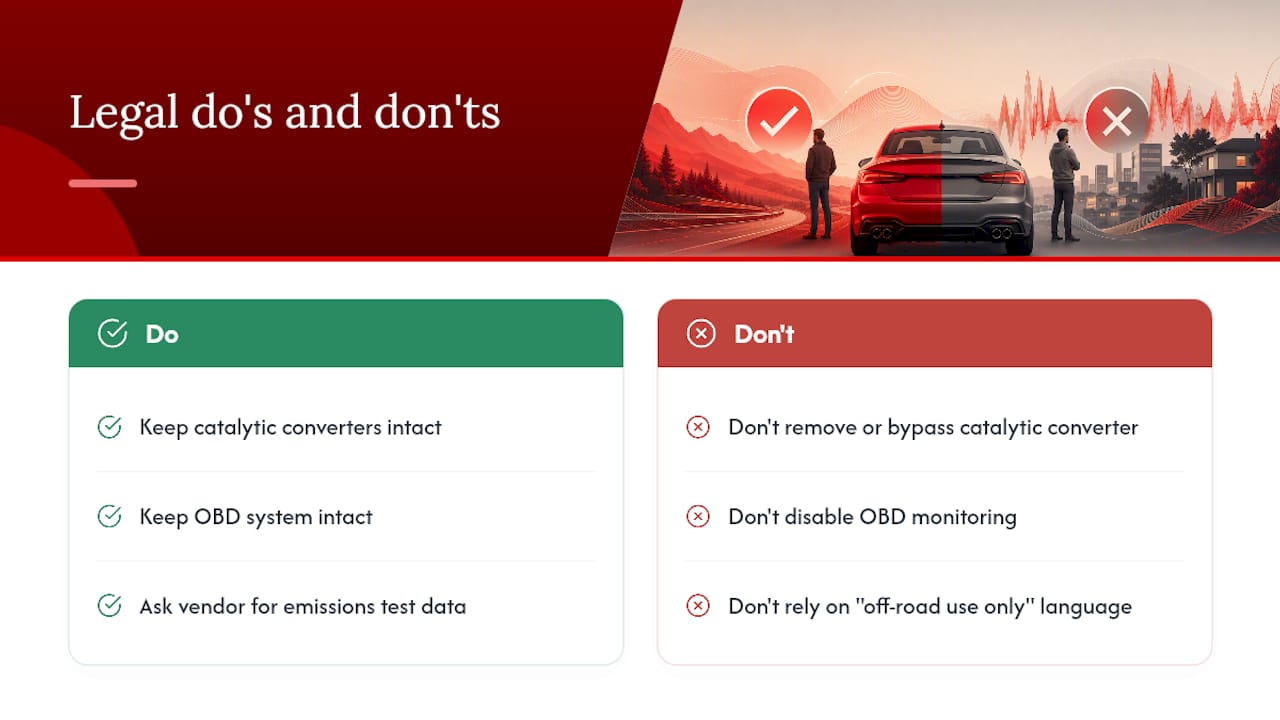
Keep your catalytic converters and OBD system intact, and ask any vendor for written emissions test data before buying a downpipe or midpipe. “Off-road use only” language on a product listing is not a legal shield. Our catted vs catless downpipe guide walks through this in more depth if you’re planning upstream changes.
How Do You Choose Between Resonated and Non-Resonated?
- Decide if the car is a daily driver or a dedicated track/weekend build. Daily drivers almost always favor resonated.
- Think about your typical cruise RPM. If you spend a lot of time at 1,800 to 2,800 RPM on the highway, drone will matter more to you.
- Consider planned future mods. If a catless downpipe or tune is coming later, start resonated now to buffer that extra noise.
- Factor in neighbors and passengers. A quiet garage and a tolerant household make non-resonated easier to live with.
- Think about resale. Resonated setups tend to appeal to a broader pool of future buyers.
Pro Tip: If you’re torn, buy a system with a swappable center section. You can run resonated for a year, then delete it later for the cost of a pipe section instead of a whole new exhaust.
Before buying, ask the seller for proof the part doesn’t affect emissions, confirm the warranty terms, and check the return policy in case the sound isn’t what you expected once it’s on the car.
How Valve Control Exhaust Solves the Resonated vs Non-Resonated Trade-Off
Valved exhaust systems sidestep the whole debate. A remote-controlled valve lets you run quiet and resonated-like at a cruise, then open the system to a louder, more aggressive tone at the push of a button, without swapping hardware.
- Electronic valve control adjusts sound and backpressure in real time from inside the cabin.
- Compatibility spans a range of luxury and performance car platforms.
- Modular downpipes and center sections let owners combine valve control with catted or resonated components depending on local emissions rules.
- Genuine parts sourced directly from authorized manufacturers help reduce guesswork around fitment and emissions documentation.
For owners who don’t want to choose between comfort and aggression, a valved system is the practical middle ground between fully resonated and fully deleted.
A Short-Owner’s Take on Resonated vs Non-Resonated
Most daily drivers are better off resonated. Drone gets old fast on a 45-minute commute, and the horsepower argument for going non-resonated rarely holds up in a simple cat-back swap. Go modular if you can, so a center-section swap stays an option later. And whatever you delete, leave the catalytic converters and OBD system alone.
— Info
Get the Sound Without the Compromise
Valved exhaust systems provide an alternative to picking one exhaust character and living with it. These systems let you toggle between a resonated-quiet cruise and an open, non-resonated growl from a controller, so you are not locked into the trade-off this article discussed.

Browse Exhaust Parts for valved center sections and resonated options built for your platform, or check Down Pipe options if you’re planning upstream changes alongside your exhaust. Need tips, clamps, or modular add-ons? The Accessories category covers that. If you want a broader rundown before buying, our performance exhaust buyer’s guide compares valved options across major brands. Start by browsing your vehicle’s fitment on the Exhaust Parts page and get a clear picture of what a valved setup would cost for your car.
Primary Sources and Further Reading
Legal grounding on tampering comes from the EPA’s Clean Air Act enforcement page and its tampering policy documentation. For resonator theory, see Wilhelm Raceworks on drone reduction and our own exhaust anatomy breakdown.
Sources
- EPA enforcement: criminal provisions of the Clean Air Act
- Aftermarket tampering overview — Clean Air Northeast (EPA)
- Drone reduction — Wilhelm Raceworks
FAQ
What Is Louder, Resonated or Non-Resonated?
Non-resonated exhausts are louder and raspier because there’s no tuned chamber canceling any frequency band. Resonated setups sound closer to stock in tone, with far less drone at cruising RPM.
Do Resonators Reduce Horsepower?
No, not in a typical cat-back swap. Vendor and owner testing shows resonated and non-resonated systems produce essentially the same power output, since resonators cancel sound rather than restrict flow.
Is a Non-Resonated Exhaust Legal?
A resonator delete alone is legal since resonators aren’t emissions hardware. The risk comes from touching catalytic converters or OBD systems, which the Clean Air Act treats as tampering, with penalties up to $4,819 per device for individuals.
Is It Okay to Drive Without a Resonator?
Yes, driving without a resonator is legal and mechanically safe as long as catalytic converters and OBD monitoring remain intact. Expect more cabin drone and a raspier tone, especially at steady highway RPM.
Does Valve Control Exhaust Offer Resonated Options?
Valve Control Exhaust sells resonated center sections and valved systems that let you switch between quiet and open modes, with fitment across Audi, BMW, Porsche, Ferrari, Lamborghini, and Mercedes-AMG. Current pricing and fitment details are available on the Exhaust Parts page.