
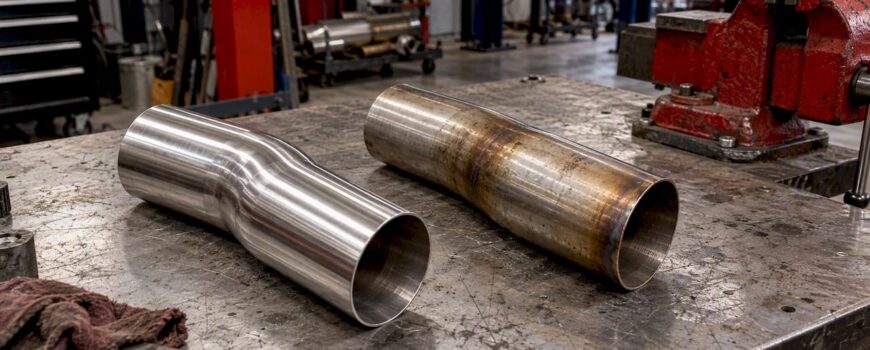
T304 is the better exhaust steel on almost every measure except price. It has more chromium plus nickel, so it resists road salt and rust better and keeps its look for years. T409 is the cheaper ferritic grade. It is strong, handles heat well and outlasts aluminized steel, but it will develop surface rust and a brown patina. If you keep a car for the long haul or drive in salt country, buy T304. If you drive a dry-climate car or want the lowest price on a stainless system, T409 is a sensible choice.
TL;DR
- T304 is austenitic stainless (about 18% chromium, 8% nickel). It resists salt, moisture and surface rust best and costs the most.
- T409 is ferritic stainless (roughly 10.5 to 11.75% chromium, no nickel). It is cheaper and tough on heat, but it browns and corrodes sooner.
- Salt-belt winters, coastal air and long ownership favor T304. Dry climates, short ownership and tight budgets favor T409.
- Both beat aluminized steel for lifespan. Ask which grade is used on each part, since some systems mix grades.
- For turbocharged cars that see hard thermal cycling, 321 is worth a look as well.
Table of Contents
- What the two grades actually are
- T304 vs T409 side by side
- Corrosion resistance: the biggest gap
- Heat: closer than the price gap suggests
- Cost: what the extra money buys
- Climate and driving: match the steel to where you live
- Stainless vs aluminized steel
- Welding and fabrication
- What to check before you buy
- Our perspective
- Find the right stainless exhaust for your car
- Which should you pick?
- FAQ
- Sources
What the two grades actually are
Both are stainless steels, but they belong to different families, and that explains almost everything else in this comparison.
T304 is an austenitic grade. According to a materials comparison from a stainless supplier, it contains about 18% chromium and 8% nickel. The nickel is the key. It stabilizes the structure and gives the steel its strong resistance to chlorides, the main ingredient of road salt.
T409 is a ferritic grade with roughly 10.5 to 11.75% chromium and no nickel, per the same source. That is enough chromium to beat plain or aluminized steel, and not enough to shrug off salt the way 304 does. It is the grade most factory stainless exhausts use because it is cheap, easy to form in volume and strong enough for the job. A stainless-steel specialist notes that 409 is widely used in automotive exhausts where strength and heat resistance are needed without premium corrosion protection.

The “T” in T304 and T409 simply stands for type. You will see “304” and “T304” used interchangeably. If you want a deeper read on the label itself, we cover it in what T304 stainless exhaust means for your car.
T304 vs T409 side by side
| Factor | T304 | T409 |
|---|---|---|
| Steel family | Austenitic | Ferritic |
| Chromium / nickel | About 18% Cr, 8% Ni | About 10.5 to 11.75% Cr, no Ni |
| Salt and moisture resistance | Excellent | Moderate |
| Appearance over time | Stays bright | Browns, surface rust |
| Heat handling | Very good, can relax under cycling | Very good, strong oxidation resistance |
| Price | Higher | Lower |
| Welding | More forgiving | Needs skill and the right wire |
| Best for | Salt belt, coast, long ownership | Dry climates, budget builds |
The rest of this article explains each row so you can decide which one matters most for your car.
Corrosion resistance: the biggest gap
This is the main reason people pay more for 304. Its chromium and nickel content gives it superior resistance to road salt and chlorides compared with 409. In practice that means a 304 system in a Michigan or New England winter is far more likely to look the same in year eight as it did on day one.
409 is not rust-proof, despite the word stainless. It forms a surface layer of orange or brown discoloration. Much of that is cosmetic, and it does not mean the pipe is about to fail, but it never goes away on its own. One supplier guide says 304 can hold a polished look for the life of the system, while 409 develops a brown patina.
That matters most on parts you can see: tips, mufflers, rear diffusers and the visible section of the axle-back. A rusty tailpipe on a clean sports car looks bad even if the metal underneath is sound. If the surface rust has already started, our guide on what works and what doesn’t on stainless exhaust rust explains realistic fixes.

Heat: closer than the price gap suggests
People often assume 304 handles heat better and 409 is the weak link. The picture is more nuanced. A high-temperature stainless steel reference hosted by Stanford says 304 is generally suitable for long-term service up to 870°C, while ferritic grades such as 409 offer excellent oxidation resistance and thermal fatigue properties at these temperatures.
The same document makes a point every builder should absorb: the exhaust environment is highly cyclic and often more demanding than simple design assumptions allow. Heat-up and cool-down cycles are what crack welds and flanges, more than a steady high temperature.
That is why the choice near the engine is different from the choice at the tailpipe:
- Downpipes and headers sit closest to the turbo or manifold and see the harshest cycling. Wall thickness, weld quality and design matter as much as the grade. For turbocharged applications, a stainless supplier points to 321, a titanium-stabilized relative of 304, for its resistance to high-temperature thermal cycling. We go into it in our piece on 321 stainless for exhaust builders.
- Mid-pipes and mufflers run cooler, so corrosion from condensation and salt becomes the bigger concern.
- Tips are about looks. This is where 304 earns its price.
In short, do not pick 304 over 409 for heat alone. Pick it for corrosion and appearance.
Cost: what the extra money buys
304 is the more expensive grade. A trade publication for shops puts it plainly: 304 costs the most, but it does not rust and keeps its looks for the life of the system. Material price is only part of the story, because stainless fabrication in general needs mandrel bending and specialty welding equipment, which is more costly than working aluminized steel.
The price gap between the grades varies by part size, brand and year, so we will not quote a single number here. A fair way to think about it: the premium for 304 is a one-time cost, while a rusty 409 system can mean replacing parts or living with the look. If you plan to own the car for five years or more, the premium usually pays for itself. If you flip cars every two years in Arizona, it probably does not.
Climate and driving: match the steel to where you live
The right grade depends less on the car than on the road it drives on.
Salt belt and coastal states
If your car sees winter brine from the Great Lakes to New England, or lives near the ocean in Florida, the Carolinas or California, go with 304. Salt and constant moisture are exactly what 409 handles worst. One cost guide goes as far as calling stainless a necessity in coastal or salt-belt regions. Extra care helps either way. For the car as a whole, this guide to road salt protection for cars covers what is worth doing before winter.
Dry climates and garage-kept cars
In the Southwest or Mountain West, with little salt and low humidity, 409 can last a very long time. If the exhaust is mostly hidden beneath the car and you do not care about a little discoloration, it is the efficient pick.
Short trips versus long drives
Short trips never get the exhaust hot enough to boil off internal condensation, which speeds corrosion from the inside. A car used this way benefits from the better grade even in a mild climate. Weekend cars that run to full temperature regularly are easier on any steel.
Show cars and daily drivers
If the tips and diffuser are part of the look, 304 keeps them bright. A daily driver that spends its life in traffic and winter weather has the most to gain from it.
Stainless vs aluminized steel
Both grades are an upgrade over aluminized steel, the coated mild steel found on many stock systems. Aluminized steel is cheap and quick to produce, but it is highly susceptible to road salt and moisture and often fails within a few winters, according to a repair cost guide. So even the cheaper stainless grade is a real step up. The comparison between 304 and 409 is a choice between good and best, not between good and bad.
Welding and fabrication
Builders and tuners should note that 409 is not always easy to work with. A trade report on exhaust repair notes that welding 409 takes skill, the right welder and the right wire: a cold weld will not penetrate, and an overly hot one can crack the weld and the pipe. That is a reason to have modifications done by a shop used to stainless, whichever grade you choose.
As a buyer, this makes weld quality a thing to inspect. Look for even, consistent beads, clean flange faces and no pinholes at the joints. Good welding on 409 beats sloppy welding on 304.
What to check before you buy
Grade is one line on a spec sheet. Before ordering a system, check these things:
- Which grade is used on each component. Some systems mix grades, for example one grade for piping and another for mufflers or tips. Ask rather than assume.
- Wall thickness and mandrel-bent construction. Smooth bends flow better and are stronger than crush-bent sections.
- Weld quality on the flanges, header collectors and muffler seams.
- The fit for your exact model and year. A premium grade on a wrong-fit part is wasted money. Our exhaust system anatomy guide helps you tell what each section does.
- Valve and controller hardware if the system has electronic valves. Valve housings and actuators have their own materials and heat limits.
- Genuine parts from an authorized source. Cheap lookalikes often cut corners on the steel itself.
Our perspective
We sell valved exhaust systems and performance parts for European and luxury performance cars, so we hear the 304 vs 409 question constantly. Here is how we see it.
For a car you care about, the exhaust is a visible part of the build. Owners of Porsche, BMW, Audi and Mercedes-AMG models usually notice the tips and the tone long before they think about the alloy. That is exactly why we tell them to treat grade as a decision made once, up front, because swapping an exhaust later costs far more than choosing well the first time.
Our rule of thumb: if the car sees winter salt or coastal air, favor T304 for anything visible and for the long-term parts. If it is a dry-climate weekend car, a well-built system in a lower-cost stainless grade is a fair trade. For hard-working turbo downpipes, the design and welding quality count as much as the label, and 321 is worth discussing.
We also encourage buyers to ask us questions before ordering. Material, fitment and whether you want the valve controlled by remote are all easy to settle ahead of checkout, and difficult to fix afterward.
— Info
Find the right stainless exhaust for your car
If you are ready to shop, browse our exhaust parts for axle-backs, mufflers and tips, or the downpipe category for turbo and performance cars. We sell genuine products direct from authorized manufacturers, with remote electronic valve control on many systems so you can change the sound to suit the drive. Not sure how the brands compare? Our performance exhaust buyer’s guide walks through the main options.
Which should you pick?
Use this quick decision path:
- You live in the salt belt or near the coast: T304.
- You want tips and visible pipes to stay bright: T304.
- You keep cars for many years: T304.
- You live somewhere dry, drive little and want the lowest stainless price: T409.
- You are building a hard-driven turbo car: discuss 321 and weld quality first.
- You are upgrading from aluminized steel: either grade is an improvement; choose by climate and budget.
FAQ
Is T304 better than T409 for an exhaust?
For corrosion resistance and appearance, yes. T304 has more chromium plus nickel, so it resists salt, moisture and surface rust far better. T409 is cheaper and holds up well to heat, so it is not a bad choice, just a less durable one in harsh climates.
Will a T409 exhaust rust?
It can develop surface rust and a brown patina, especially where roads are salted or the air is humid. Much of this is cosmetic and slow to progress, but it will not stay clean like 304. Keeping the car washed and the underbody rinsed in winter helps.
Is aluminized steel good for an exhaust?
It works as a low-cost option, but it is more prone to corrosion from road salt and moisture and often fails within a few winters. Either stainless grade usually lasts longer, so aluminized steel is best reserved for tight budgets or short-term ownership.
Is 321 stainless better than 304?
For high-heat, turbocharged applications, often yes. 321 is a titanium-stabilized version of 304 that resists thermal cycling better, which makes it attractive for downpipes. For tips and rear sections, 304 is usually enough.
Sources
- Exhaust Pipe: 304 or 409 Stainless Steel, How to Choose
- 304 vs. 409 Stainless Steel for Exhaust and Heat Applications
- Aluminized Steel vs 409 vs 304 Stainless Exhaust
- High-Temperature Characteristics of Stainless Steels
- Titanium vs Stainless Steel Exhaust
- Why Offering Performance Exhaust Is a Sound Strategy for Shops
- Custom Exhaust Cost Guide
- Exhaust Pipe Replacement Cost
- Stainless Steel Did Not Kill the Exhaust Repair
- Road salt protection for cars