
Valved exhaust systems are reliable for most performance owners when the actuator is electric, the shop follows proper wiring routing, and the driver cycles the valves regularly. Valve Control Exhaust and other reputable builders have pushed failure rates down significantly compared to early-generation systems, but three variables still decide whether yours lasts: actuator type, install quality, and how the system handles dB regulations in your area. Warranty coverage matters too. Under the Magnuson-Moss Warranty Act, a dealer generally can’t void your factory warranty just because you installed aftermarket parts, though improper installation voiding a manufacturer’s own component warranty is a separate issue entirely.
- Actuator type drives most reliability gaps. Electric units outlast vacuum-driven ones in daily use.
- Materials and welds determine whether a system survives five years of thermal cycling or two.
- Install quality (wiring routing, heat shielding) causes more early failures than any single component defect.
Key Takeaways
Valved exhaust reliability depends far more on actuator type, material grade, and installation quality than on brand name alone, and electric actuators consistently outlast vacuum-driven systems in daily use.
| Point | Details |
|---|---|
| Actuator type drives longevity | Sealed electric actuators outperform vacuum systems, which depend on inconsistent engine vacuum and leak-prone lines. |
| Watch for early symptoms | Rattling at idle, a stuck quiet mode, or an actuator-related check engine light signal trouble before full failure. |
| Maintenance is light but essential | Cycling valves periodically and cleaning carbon buildup prevents most sticking issues before they start. |
| Repairs scale with the failure point | Actuator swaps run $150 to $450, while full assembly replacement can reach $1,800 or more on exotic platforms. |
| Valve Control Exhaust prioritizes serviceable design | The brand builds around sealed electric actuators, documented specs, and professional fitment for reliability-focused buyers. |
Table of Contents
- What Actually Determines Valved Exhaust Reliability
- Why Do Valved Exhaust Systems Fail?
- Which Materials and Actuators Hold Up Longest?
- How Long Do Valved Exhausts Last, and What Maintenance Keeps Them That Way?
- What Does It Cost to Repair a Valved Exhaust System?
- What Should You Check Before Buying a Valved Exhaust System?
- Is a Valved Exhaust Worth the Investment for Serious Owners?
- Get a System Built for Long-Term Reliability, Not Just Sound
- Frequently Asked Questions
- Sources
What Actually Determines Valved Exhaust Reliability
A valved exhaust system lets you switch between a quiet mode and an open, aggressive mode by rotating a valve inside the exhaust path, controlled electronically rather than by a fixed baffle. The mechanism is simple in concept: a butterfly or flap valve sits in the pipe, usually in the axle-back or mid-pipe section, and an actuator rotates it based on signals from a control module.
Here’s what’s actually inside the system:
- Valve itself: typically a stainless steel butterfly or flap, hinged to rotate 90 degrees.
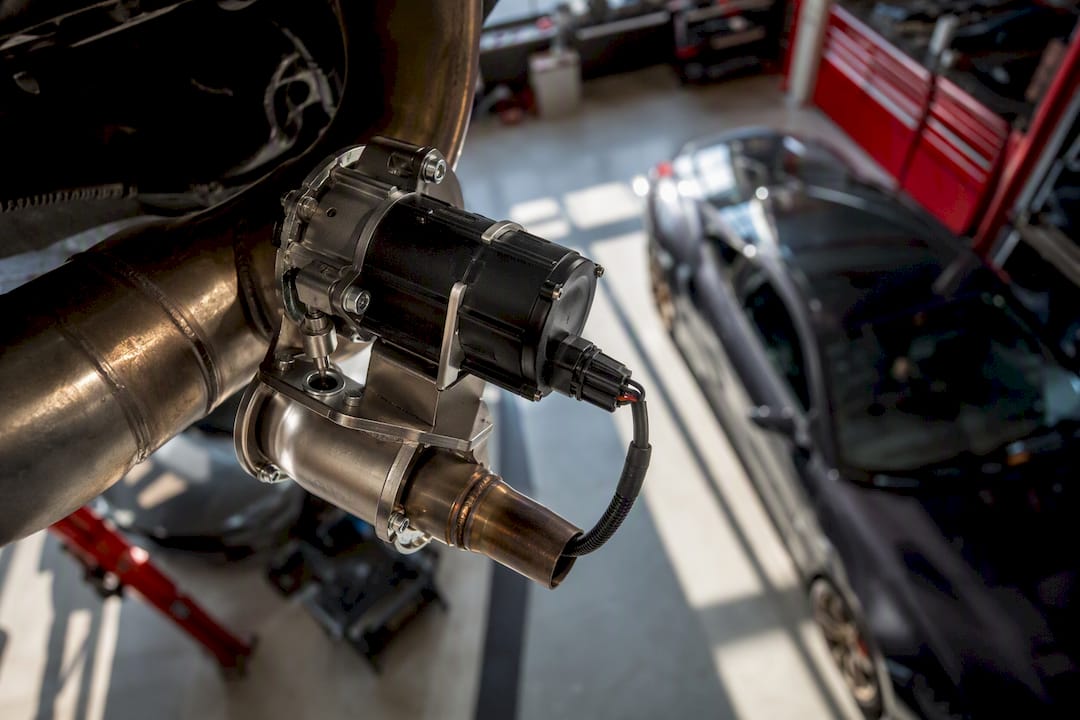
- Actuator: either vacuum-driven (using engine vacuum through a line) or electric (a motor with its own wiring harness).
- Controller: a small module that reads throttle position, RPM, or a manual switch, then commands the actuator.
- Placement: most commonly axle-back or cat-back, positioned to redirect flow through either a straight-through quiet chamber or a more open resonator path.
When the valve is closed, exhaust gas routes through a longer, more restrictive path that dampens sound. Open it, and gas takes the shorter, freer route, which reduces backpressure and can add measurable horsepower and torque at higher RPM, since the system reroutes flow in milliseconds rather than relying on a fixed diameter.
Why Do Valved Exhaust Systems Fail?
Most valved exhaust problems trace back to four culprits: actuator motor failure, a valve or linkage seizing shut (or open), wiring and controller faults, or a cracked weld at the actuator bracket. None of these are mysterious once you know what causes them.
The root causes usually break down like this:
- Heat and corrosion eating away at bushings and shaft seals over years of thermal cycling.
- Carbon buildup on the valve edge, which causes sticking the same way carbon deposits jam engine valves in the combustion chamber.
- Vacuum leaks in older vacuum-actuated systems, where a cracked line means the valve won’t fully open or close.
- Undersized actuators that lack the torque to overcome corrosion or carbon resistance, so they strain and eventually burn out.
- Sloppy installation, especially wiring routed too close to the pipe or vacuum lines pinched during fitment.
- Weld fatigue at the actuator mounting bracket, which cracks under years of vibration and heat expansion.
Community reports on forums have flagged failed welds and repeated valve rattles on lower-quality aftermarket systems as a recurring complaint, which tells you build quality varies wildly across the aftermarket even when the marketing looks similar.
Watch for these symptoms: a rattling or buzzing noise at idle, a check engine light tied to an actuator circuit fault, valves stuck in one position regardless of drive mode, or a “quiet mode” that simply won’t engage anymore. Any of these means it’s time to inspect the system before the problem escalates, not after.
Which Materials and Actuators Hold Up Longest?
Material grade and actuator design predict service life better than brand reputation alone. A system built with 304 or 409 stainless steel, a sealed electric actuator rated for high torque, and a serviceable valve shaft will typically outlast a budget system by years, not months.
Look for these specs when you’re comparing systems:
- 304 stainless steel construction (or better) for the valve housing and shaft, resisting corrosion far longer than mild steel.
- High-temperature coatings on welds and brackets near the actuator, reducing thermal fatigue.
- Sealed, high-torque electric actuators with a proper IP rating for water and dust resistance, since these motors sit exposed under the car.
- Serviceable valve shafts with replaceable bushings or bearings, so a worn part doesn’t force a full assembly swap.
Pro Tip: Check whether the actuator mounts to a welded bracket or a bolted flange with a separate heat shield. Welded-direct mounts transfer more heat into the actuator housing over time, which shortens motor life. A bolted mount with a heat shield gap usually survives longer, even if it looks less “finished” on a spec sheet.
Electric actuators generally outperform vacuum systems on modern turbocharged engines specifically because they don’t depend on inconsistent vacuum signals, and they respond faster when you switch drive modes.
How Long Do Valved Exhausts Last, and What Maintenance Keeps Them That Way?
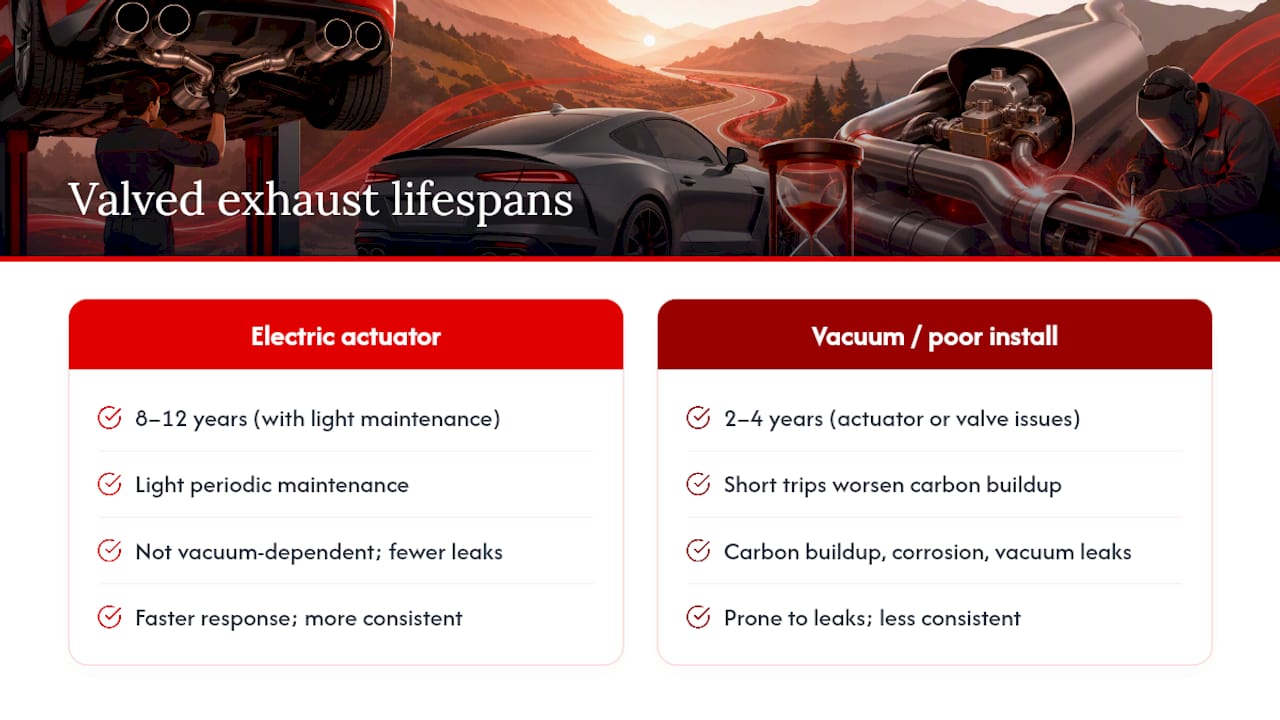
A well-built valved exhaust with electric actuation and proper install typically lasts 8 to 12 years or more, provided you keep up with light, periodic maintenance. Neglect it, and you’re looking at actuator failure or valve seizing within 2 to 4 years, especially in climates with road salt or heavy short-trip driving that never fully burns off carbon.
Maintenance that actually extends lifespan:
- Cycle the valve manually (open and closed) every few months, even if you don’t drive in quiet mode often.
- Clean visible carbon buildup around the valve edge during routine exhaust inspections.
- Check wiring and connectors near the actuator for heat discoloration or fraying insulation.
- Inspect heat shields for gaps or damage that let excess heat reach the actuator housing.
- Listen for early rattle or buzz, which almost always precedes full sticking.
When something feels off, work through diagnostics in this order:
- Note the exact symptom (rattle, stuck mode, warning light) and when it happens.
- Run an OBD-II scan for actuator or circuit fault codes.
- Bench test the actuator if it’s removable, checking for smooth rotation and correct resistance.
- Visually inspect the valve assembly at the axle-back section for carbon, corrosion, or physical damage.
- If the vehicle also shows performance loss or a rough idle, consider a compression or leak-down test, since carbon buildup and valve seat wear can mimic exhaust valve symptoms even when the aftermarket valve system isn’t the actual cause.
Keeping wiring and vacuum lines routed away from direct heat during install remains one of the most repeated pieces of advice from technical sources, and it’s the single cheapest thing a shop can get right or wrong. Read our maintenance tips for longer life for a deeper walkthrough on cycling schedules and cleaning methods.
What Does It Cost to Repair a Valved Exhaust System?
Repair costs depend heavily on whether the actuator, the valve itself, or the wiring is the problem, and whether you’re working with an independent shop or a dealer network. Actuator swaps are usually the cheapest fix; full assembly replacement is the most expensive.
Rough U.S. cost ranges for common repairs:
- Actuator replacement: $150 to $450 for parts, plus labor, if it’s a standalone bolt-on unit.
- Valve or linkage rebuild: $200 to $600, depending on whether the valve itself needs replacing or just the bushings and seals.
- Wiring or connector repair: $80 to $250, often the cheapest fix if caught early.
- Full muffler or valve assembly replacement: $600 to $1,800 or more on luxury and exotic platforms, especially with specialized fitment.
If the system is still under warranty and the failure looks like a manufacturing defect rather than wear from neglect, a warranty claim is usually your fastest and cheapest path. Work through it in this order:
- Stop driving hard until you confirm the valve isn’t stuck in a way that could cause backpressure damage.
- Document every symptom, when it started, and any codes pulled.
- Contact your installer or Valve Control Exhaust directly if it’s their system, since warranty terms often cover actuator and wiring faults.
- If it’s out of warranty, weigh a remanufactured actuator against full replacement based on age and mileage.
What Should You Check Before Buying a Valved Exhaust System?
Before you buy, verify five things: actuator type, material grade, IP rating, warranty length, and whether professional installation is available or required. Skipping this checklist is how enthusiasts end up with a system that sounds great in a YouTube video and rattles apart in eighteen months.
Run through this before checkout:
- Warranty length and what it covers (actuator only, or full assembly and wiring).
- Serviceability, meaning replaceable bushings, seals, or actuator units rather than a sealed, throw-away design.
- Actuator torque and IP rating, listed clearly rather than buried or omitted from the spec sheet.
- Thermal shielding around the actuator and nearby wiring harness.
- Documented field reliability, meaning real owner reports or shop feedback, not just marketing copy.
Red flags include missing actuator specs entirely, flimsy or thin mounting brackets, prices that seem too low with no meaningful warranty, and no network of installers who can service the system if something goes wrong.
Pro Tip: Ask the seller directly what happens if the actuator fails at month 13, one month past a typical one-year warranty. A confident, specific answer tells you more about the company than any spec sheet.
Is a Valved Exhaust Worth the Investment for Serious Owners?
Valved exhausts earn their reputation for reliability when the engineering matches the marketing, and that’s a lower bar than most buyers assume it clears. The gap isn’t between valved and non-valved systems; it’s between systems built with sealed electric actuators and serviceable parts versus ones assembled to hit a price point.
My take: buy based on actuator quality and installer competence, not sound clips. A system that lets you dial between a quiet commute and a wide-open pull is genuinely worth owning, but only if someone thought about the wiring harness as carefully as they thought about the note. Valve Control Exhaust builds around that principle, with service-backed fitment for exactly this reason.
Get a System Built for Long-Term Reliability, Not Just Sound
Valve Control Exhaust exists for owners tired of choosing between a loud exhaust that rattles apart and a quiet one that never lets the engine breathe. The difference here is straightforward: sealed, high-torque electric actuators with replaceable components, professional fitment across Audi, BMW, Porsche, Ferrari, Lamborghini, and Mercedes-AMG platforms, and warranty coverage that actually names what’s protected instead of hiding behind fine print.

Every system ships with documented actuator specs and IP ratings up front, so you’re not guessing at reliability after the fact. Fitment matters as much as the hardware, and that’s why installation guidance and compatibility notes accompany every order rather than getting bolted on as an afterthought. If you’re weighing a purchase for a luxury or performance platform, start by checking why customizable exhaust appeals to car enthusiasts and requesting a fitment quote for your specific model before you commit to a build.
Frequently Asked Questions
How long do valved exhausts typically last?
A well-built system with an electric actuator and proper installation usually lasts 8 to 12 years with light periodic maintenance. Vacuum-actuated or poorly installed systems often show actuator or valve problems within 2 to 4 years.
What causes an exhaust valve to get stuck closed?
Carbon buildup on the valve edge and corrosion around the shaft or bushings are the two most common causes, often worsened by short-trip driving that never lets carbon burn off. Vacuum line leaks can also prevent a vacuum-actuated valve from opening fully.
Are valved exhaust systems legal for street use?
Valved systems can help you stay within stationary noise limits by running in quiet mode, but using open mode on public roads can still draw a citation depending on local decibel enforcement. Check your local regulations before assuming a valve switch makes any sound level compliant.
Does installing an aftermarket valved exhaust void my factory warranty?
Under the Magnuson-Moss Warranty Act, a dealer generally cannot void your entire factory warranty simply because you installed an aftermarket exhaust. They can, however, deny coverage for a specific failure if they can show the aftermarket part directly caused it.
Is an electric actuator really more reliable than a vacuum-driven one?
Yes, in most cases. Electric actuators respond faster and don’t depend on a vacuum source that can leak or fluctuate, which makes them a more consistent, lower-maintenance choice on modern turbocharged engines.
Sources
- Exhaust valve complete guide: Causes & fixes – OnlyMechanic