No, an aftermarket exhaust does not automatically void your factory warranty in the United States. Federal law requires the manufacturer or dealer to prove the specific part caused a specific failure before denying a claim. The major exception: catless downpipes and removed catalytic converters, which violate the Clean Air Act and make denial far easier to justify.
TL;DR:
- Installing an aftermarket exhaust alone does not void your warranty unless it involves removal of emissions hardware like catalytic converters.
- A dealer can only deny a warranty claim if they prove a specific part caused the failure, which is difficult with non-emissions exhaust modifications like cat-back systems.
- Removing or disabling emissions-control devices such as catalytic converters is illegal under federal law and easily linked to warranty denial or fines if detected.
- Upgrading to emissions-compliant parts like EPA-certified downpipes or retaining OEM components minimizes legal and warranty risks.
- Keeping detailed documentation, including receipts, notes on emissions parts, and installer notes, strengthens your case if a warranty dispute arises.
Table of Contents
- Will exhaust void warranty coverage under federal law?
- How do emissions rules change the warranty equation?
- Which exhaust upgrades are actually low risk?
- What should you do if a dealer denies your claim?
- Do extended warranties treat modifications differently?
- How Valvecontrolexhaust helps you stay warranty-defensible
- Have courts actually ruled on exhaust-related warranty voidance?
- What rights do you have when aftermarket parts are involved?
- Can you get a voided warranty reinstated?
- Does a voided warranty affect resale value or insurance?
- Publisher perspective: daily drivers vs track cars
- Sources
Will exhaust void warranty coverage under federal law?
Under the Magnuson-Moss Warranty Act, a dealer cannot deny a warranty claim just because you installed an aftermarket exhaust. The manufacturer has to demonstrate that the part directly caused the failure it’s refusing to cover. This is the single most misunderstood piece of consumer protection in the automotive world, and dealerships count on you not knowing it.
The burden of proof sits with the dealer, not you. If your transmission fails and you have a cat-back exhaust, the dealer has to explain, in technical terms, how a cat-back system caused a transmission failure. In most cases, they can’t, because it didn’t. The FTC has also clarified that dealers cannot require OEM-only parts as a blanket warranty condition unless they can show the non-OEM part actually caused the problem.
Here’s what typically happens in practice:
- Valid denial: A tune paired with an aftermarket exhaust causes detonation that damages a piston. That’s a defensible, documented link.
- Invalid denial: A dealer refuses to cover a failed water pump because you have an axle-back exhaust. There’s no mechanical connection.
- Gray area: A check-engine light appears after an exhaust install and the dealer blames the “modified” car without running actual diagnostics.
Pro Tip: Ask for the specific failure code and technical explanation in writing before you accept any denial. A verbal “it’s modified, so it’s not covered” is not a legal justification.
How do emissions rules change the warranty equation?
Here’s why: a catless downpipe raises exhaust gas temperatures, alters oxygen sensor readings, and frequently triggers check-engine codes tied directly to emissions monitoring. Those signatures give a manufacturer exactly the kind of causal evidence Magnuson-Moss requires. If your turbocharger fails and you’re running a catless downpipe, the dealer doesn’t need to speculate. The data is sitting in the car’s own computer.
The consequences stack up beyond the warranty fight:
- Failed inspections: States with emissions testing will flag a missing or gutted catalytic converter, blocking registration renewal.
- Repair costs: When a manufacturer successfully links a catless downpipe to turbocharger or emissions-system failure, you’re paying out of pocket, and those repairs commonly land in the $3,000 to $6,000 range.
Insurance can get messy too. If an insurer discovers an unpermitted emissions modification after an accident involving engine or exhaust damage, some policies allow them to reduce or deny the claim on the theory that the modification created an undisclosed risk. Read your policy’s modification clause before you assume you’re covered.
Diagnosing a check-engine light after a downpipe swap is its own skill. If you’re chasing a code, this check-engine light diagnostic checklist walks through the most common causes before you assume the worst.
Which exhaust upgrades are actually low risk?
Not every exhaust modification carries the same legal weight. Cat-back systems, which replace everything from the catalytic converter back to the tailpipe, are the lowest-risk category because they never touch emissions hardware. Axle-back systems, which only swap the section from the rear axle to the tip, carry even less exposure. Neither alters how the engine manages emissions, so there’s rarely a mechanical thread a dealer can pull to justify denial.
Higher up the risk scale:
- Headers and long-tube headers replace factory manifolds and can occasionally trigger fitment issues with O2 sensors, but they don’t remove emissions equipment outright.
- Downpipes with the catalytic converter intact sit in a middle zone; legality depends on whether the replacement cat is EPA-certified or CARB-exempt.
- High-flow catalytic converters are only legal as replacements for a failed factory unit and only when EPA-certified or CARB-exempted; swapping a working OEM cat for a “performance” one without that certification can fail inspection.
- Catless downpipes are the highest-risk category across the board, street-illegal nationwide, and the easiest for a manufacturer to link to a failure.
Before buying anything in this category, check for an EPA or CARB Executive Order number on the product listing, and ask the installer to note in writing whether any factory emissions component was removed.
Pro Tip: A bad tune, not the exhaust itself, causes most drivability complaints after an install. If a dealer blames “the exhaust” for a rough idle, ask them to pull the actual O2 sensor data before you accept that explanation.
What should you do if a dealer denies your claim?
Start by asking for the denial in writing. A written explanation naming the specific technical cause is required before you can meaningfully escalate, and a verbal brush-off doesn’t count as a real denial.
From there, build your case:
- Gather every receipt, installer invoice, and maintenance record you have.
- Photograph the modified parts, especially anything showing OEM emissions components are still in place.
- Get an independent diagnostic from a shop unaffiliated with the denying dealer if the dealer’s explanation seems thin.
Once you have documentation, escalate in this order:
- Contact the manufacturer’s regional or national claims department directly, not just the dealership’s service manager.
- File a complaint with your state attorney general’s consumer protection division or the FTC if the manufacturer stalls or refuses to respond.
- Consider small-claims court for repair costs under your state’s threshold if the denial is clearly unsupported and the manufacturer won’t budge.
Most disputes resolve at step one or two. Manufacturers know a poorly justified denial doesn’t hold up well once the FTC gets a letter.
Do extended warranties treat modifications differently?
Yes, and this trips up a lot of owners who assume all warranty coverage works the same way. A factory warranty is backed by federal consumer protection law. An extended warranty or vehicle service contract is a private contract between you and a third-party provider, and Magnuson-Moss’s causation requirement doesn’t automatically apply the same way.
Many service contracts include blanket “no modifications” clauses that are far stricter than what a factory warranty allows. Some providers will void an entire contract for any aftermarket part, regardless of whether it caused anything.
Before installing anything under an extended contract:
- Read the modification clause line by line, not just the summary page.
- Call the provider and ask for pre-approval or a rider covering your specific parts in writing.
- Keep that written confirmation with your other documentation in case a claim ever comes up.
Email confirmation beats a phone call every time. Phone reps say things that underwriters don’t honor.
How Valvecontrolexhaust helps you stay warranty-defensible
Every install should leave a paper trail. Keep your OEM catalytic converters even if you’re not using them, use EPA/CARB-certified parts, and save invoices listing exact part numbers and mileage at install. Ask your shop to note explicitly that no emissions components were removed.
A valved, reversible exhaust system helps here in a way a permanent modification can’t: it’s documented, removable, and doesn’t permanently alter your emissions configuration, which matters if a dealer or insurer ever asks what’s actually different about your car. This installer checklist for staying warranty-defensible covers exactly what to request from a shop.
Pro Tip: Ask your installer three questions: Is this part EPA/CARB listed? Are OEM cats retained? Will you note this on my invoice? If they hesitate on any of the three, keep shopping.
Have courts actually ruled on exhaust-related warranty voidance?
Most exhaust warranty disputes never reach a courtroom. They resolve through manufacturer claims departments or FTC-mediated complaints, largely because Magnuson-Moss’s causation standard is clear enough that manufacturers settle rather than litigate a weak denial. That said, the pattern in documented cases is consistent: outcomes hinge on whether the manufacturer could show a direct mechanical link, not on the mere presence of a modification.
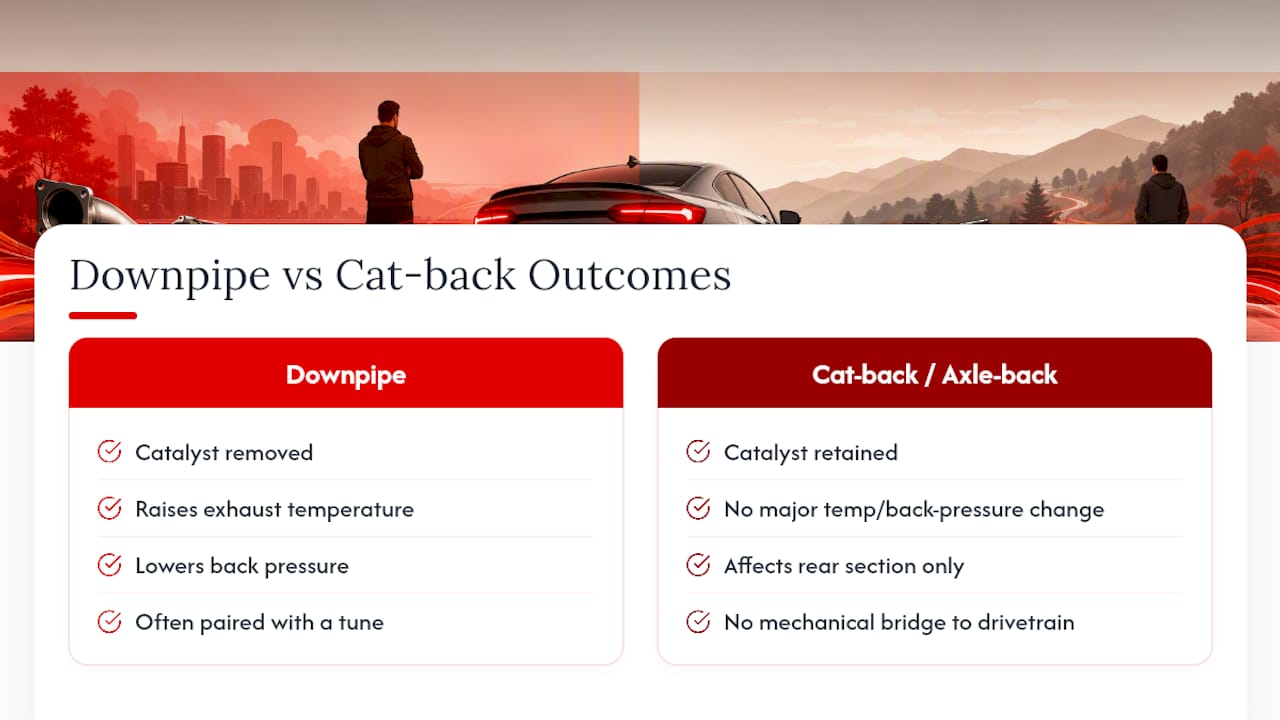
Cases involving catless downpipes and turbocharger failures tend to favor the manufacturer, because the emissions and temperature signatures left by a missing catalytic converter are hard to argue against. A downpipe removes back pressure, raises exhaust gas temperature, and often coincides with a tune, all of which point toward the modification in a way that’s straightforward to document.
Cases involving cat-back or axle-back systems tend to favor the owner, because there’s no plausible mechanical bridge between a rear-section exhaust and something like a failed alternator or transmission component. When these disputes have escalated to state consumer protection offices or small-claims court, denials tied to cosmetic or sound-only modifications generally don’t hold up once the owner produces maintenance records and a written denial statement to challenge.
The lesson isn’t that lawsuits are common. It’s that the legal standard, causation, not mere presence, shapes every outcome whether it’s resolved by a phone call to a regional manager or an actual filing. Owners who lose these disputes are almost always the ones who never got a written explanation from the dealer and had no documentation of their own to push back with.
What rights do you have when aftermarket parts are involved?
You have more legal standing than most owners realize. Magnuson-Moss guarantees your right to use aftermarket and non-OEM parts without automatically losing warranty protection, and it prohibits “tie-in sales” provisions that would force you to use only dealer-branded parts.
Your rights break down into a few practical protections. First, you’re entitled to a specific, documented reason for any denial, not a generic reference to “modifications.” Second, you retain the right to have work performed by any qualified independent shop, not just the dealer, and doing so doesn’t void your coverage on its own. Third, the manufacturer bears the ongoing burden of proving causation for the life of the warranty, not just at the time of a single claim.
None of this means modifications are risk-free. It means the legal default favors you, and the manufacturer has to overcome that default with actual evidence. Reviewing what to verify from any repair visit, using a repair invoice checklist as a guide, helps you build the kind of paper trail that makes your position stronger before a dispute ever starts. Owners who keep clean records rarely end up needing to escalate past a single phone call.
Can you get a voided warranty reinstated?
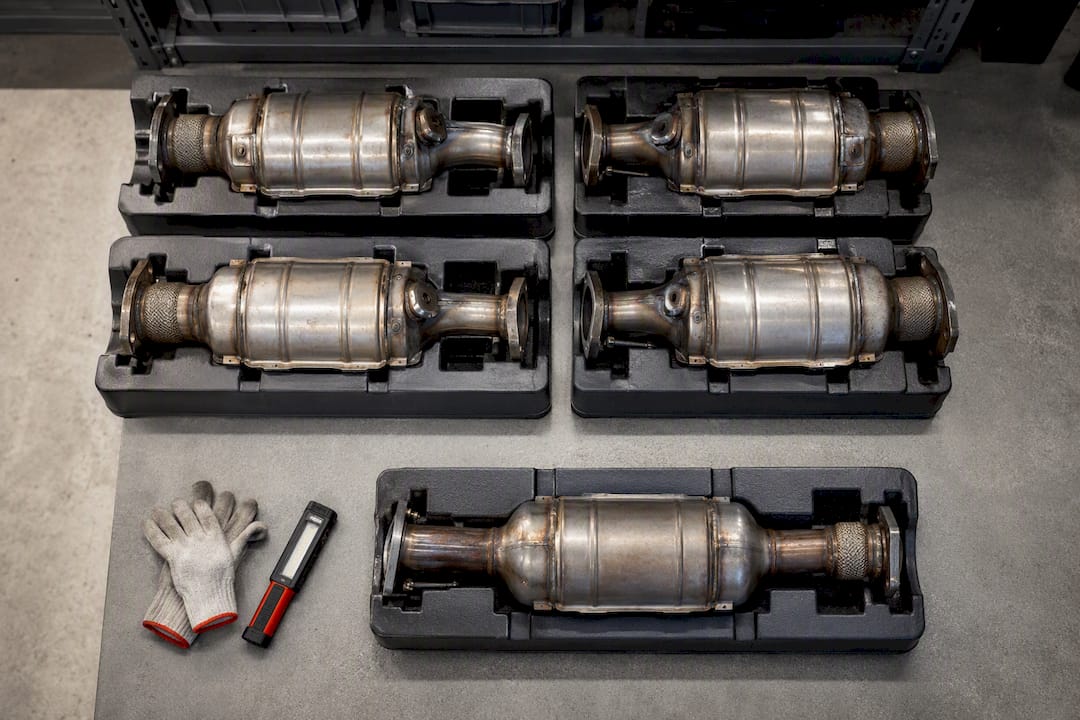
Sometimes, though it depends heavily on why coverage was pulled and whether the underlying issue is fixable. If a dealer voided coverage over a modification that’s still installed, removing the part and returning the vehicle to factory configuration is often the first and most direct step toward reinstatement.
The sequence usually looks like this: revert the vehicle to OEM specifications, get a written inspection report from a certified shop confirming the reversal, and submit that documentation to the manufacturer’s claims department with a formal reinstatement request. Manufacturers aren’t obligated to reinstate automatically, but many will reconsider once the disputed part is gone and there’s a clean inspection on record.
If the void was based on a mistaken denial rather than an actual violation, meaning the dealer never proved causation in the first place, reinstatement is more about disputing the original denial than fixing anything on the car. That’s where the escalation path through the manufacturer, state attorney general, or FTC complaint process matters most.
For emissions-related voids, reinstatement is harder. If a catless downpipe caused a documented failure, replacing it with a certified catalytic converter helps going forward but typically won’t retroactively cover the damage that already occurred. Warranties generally aren’t reinstated for repairs tied to a modification that’s since been removed; the fix applies to future coverage, not past denials.
Does a voided warranty affect resale value or insurance?
It affects both, and buyers researching used performance cars are increasingly savvy about checking. A car with a documented voided warranty, or worse, an undocumented history of emissions tampering, sells for less and takes longer to move. Private buyers and dealers alike will ask directly about exhaust modifications, and a vague or evasive answer tends to kill a sale faster than an honest one.
Insurance carries its own exposure. Some insurers treat undisclosed performance modifications as material changes to risk, and a policy that wasn’t updated to reflect a catless downpipe or a significant power increase could give the insurer grounds to reduce a payout after an accident. This is separate from the warranty question entirely. Even a car with intact factory warranty coverage can face an insurance dispute if the modification wasn’t disclosed at renewal.
The fix on both fronts is the same: documentation. A reversible system with clean installer records, retained OEM parts, and disclosed modifications to your insurer protects resale value and keeps your coverage intact in ways a quietly modified, undocumented car never will.
Publisher perspective: daily drivers vs track cars
Here’s the honest tradeoff. For a daily-driven car, a valved cat-back system is the smart call, full stop. It gives you the sound and response most enthusiasts actually want without touching emissions hardware or creating a causal thread a dealer could use against you. Catless downpipes on a street car aren’t worth the risk they create, legally or financially.
Track-only vehicles are a different conversation, where higher-risk mods make more sense if the car never sees public roads. Either way, documentation and certified installers aren’t optional, and calling your manufacturer before anything irreversible saves you more grief than it costs.
— Info
Sources
- Businesspersons’ Guide to Federal Warranty Law — FTC
- What voids a car warranty? — NerdWallet
- Are catless downpipes legal? — LegalClarity