
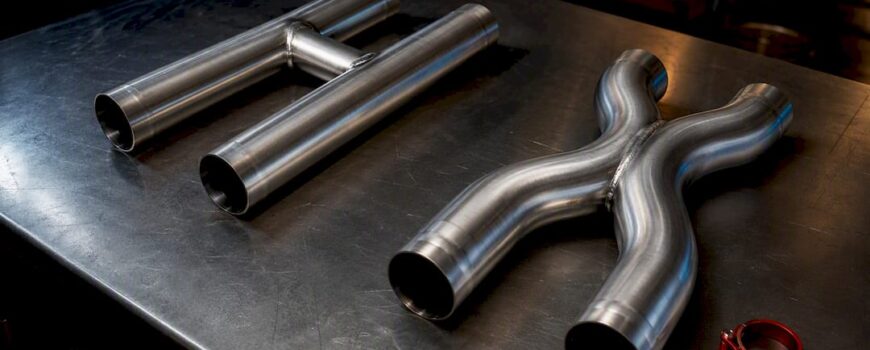
An H-pipe gives you a deeper, traditional muscle-car rumble with a slight low-end torque advantage. An X-pipe trades that for a smoother, higher-pitched tone and a modest edge at higher RPM, often 2–4 hp on near-stock cars. Full-system swaps typically deliver modest horsepower gains regardless of which crossover you pick, so MotorTrend and Hot Rod both frame this as a sound decision first. Jump to the sound section if tone is your priority, or the dyno breakdown if you’re chasing numbers.
TL;DR:
- An X-pipe provides a slight horsepower increase at high RPMs, with gains typically between 2 to 4 horsepower over H-pipes in stock or mildly modified Mustangs.
- H-pipes produce a deeper, more traditional muscle-car tone with more low-end bass, while X-pipes deliver a smoother, higher-pitched sound preferred at higher RPMs.
- Drone at highway cruising speeds is more influenced by muffler choice and resonator placement than by crossover type, so matching components is crucial to control noise.
- Proper installation placement is essential, with the crossover ideally after the catalytic converter to prevent shortening converter life and ensure fitment in the Mustang’s floorpan.
- Valved exhaust systems offer adjustable sound modes, eliminating the need to choose between tone and quiet cruise, and can adapt to changing driving preferences.
Table of Contents
- Sound Differences: Tone, Pitch, and Drone in Real Driving
- Which Pipe Actually Performs Better on the Dyno?
- Where Does the Crossover Actually Fit on a Mustang?
- What Are the Legal and Emissions Risks?
- How Should You Choose Between X-Pipe and H-Pipe?
- What Valve Control Exhaust Sees in the Shop
- Do Materials and Build Quality Actually Matter?
- How Do Crossovers Work With Other Exhaust Upgrades?
- Where Did the X-Pipe and H-Pipe Designs Come From?
- The Verdict on Chasing Horsepower Over Sound
- Get the Sound You Want Without Committing to One Pipe
- Sources
Sound Differences: Tone, Pitch, and Drone in Real Driving
An H-pipe keeps the two exhaust banks mostly separate, joining them with a pair of connecting tubes. That configuration preserves the pulse timing each cylinder bank produces on its own, which is why H-pipes deliver that deep, choppy, old-school muscle-car rumble Mustang owners associate with a classic small-block. You’ll notice it most at idle and low RPM, where the exhaust note has a distinct lope and a heavier bass presence.
An X-pipe merges the two banks into a single crossing chamber, so exhaust pulses from each side actually cross paths and cancel some of the raw, uneven frequencies. The result is a smoother, higher-pitched tone that MotorTrend describes as more refined, and the effect gets more pronounced as RPMs climb, which is why X-pipes get compared to European sports car exhaust notes.
Drone is the real wildcard in this decision. It’s that resonant buzz you feel in the cabin at steady highway cruise, typically occurring in a mid-range RPM band, and it depends more on muffler selection and resonator placement than on crossover choice. A cheap straight-through muffler paired with either pipe style can cause drone, while a well-matched chambered or turbo-style muffler tends to reduce it.
What to listen for before you commit:
- At idle: H-pipes sound choppier and lower; X-pipes sound tighter and less “lumpy.”
- At cruise (1,500 to 2,500 rpm): this is where drone shows up, regardless of pipe type.
- At wide-open throttle: X-pipes open up with a higher, more aggressive wail; H-pipes stay throatier.
- In the cabin vs. outside: a pipe that sounds great from the driveway can be fatiguing on a two-hour highway drive.
Pro Tip: Before swapping crossovers, test drive a friend’s car with the setup you’re considering, at highway speed for at least 15 minutes. Drone is the number one regret among Mustang owners who bought based on a YouTube clip instead of a real cruise.
If you want to fine-tune tone without committing to a fixed pipe, pairing your crossover with the right muffler matters as much as the crossover itself, something covered in more detail in this comparative analysis of performance exhaust systems.
Which Pipe Actually Performs Better on the Dyno?
Dyno charts tell a more modest story than exhaust marketing usually suggests. LS1Tech’s testing shows crossover pipes reshape the torque curve more than they move peak horsepower. H-pipes tend to nudge low-end torque up slightly by equalizing exhaust pulses between banks earlier in the RPM range. X-pipes create a venturi-like scavenging effect, described in detail by Yahoo Autos, that helps pull exhaust gases out more efficiently as RPMs rise.
On a mostly stock Mustang, that translates to real but small numbers:
- X-pipes often show a 2 to 4 hp edge over H-pipes at higher RPM.
- Full crossover-plus-exhaust upgrades commonly deliver 7 to 12 hp overall, regardless of which pipe you chose.
- Peak horsepower differences between H and X configurations are frequently within the margin of dyno-to-dyno variation on a near-stock motor.
Why so small? Firing order, pipe diameter, muffler backpressure, and tune all interact with the crossover in ways that either amplify or erase its effect. A 2.5 inch system reacts differently to an X-pipe than a 3 inch system does. A tune calibrated around stock exhaust flow won’t fully exploit a crossover swap either way.
Where the difference actually starts to matter: high-revving naturally aspirated builds, forced-induction cars pushing more exhaust volume, and cammed motors with altered overlap. In those cases, an X-pipe’s scavenging advantage compounds with the engine’s own higher-rpm breathing needs, and the gap can widen beyond the stock-car numbers above. If you’re building toward a high-rev powerband, it’s worth reading through a dedicated high-rev exhaust tuning guide before locking in a crossover choice. For a street-driven, largely stock Mustang, though, Hot Rod’s builders are blunt about it: the horsepower argument rarely justifies the swap on its own.
Where Does the Crossover Actually Fit on a Mustang?
Placement matters more than most owners realize, and it’s where theory runs into your car’s actual floorpan. Installers generally recommend locating the crossover after the catalytic converters whenever packaging allows it. Placing a crossover pipe before the cats can shorten converter life due to added thermal and pressure stress on a component that’s already working hard.
On a Mustang platform specifically, the biggest constraints come down to:
- Transmission crossmember clearance. Many street builds end up positioning the crossover just behind the transmission because there isn’t room for it further forward.
- Floorpan and ground clearance. X-pipes cross tubes at an angle, which sometimes needs more vertical clearance than a straight H-pipe design.
- Retrofit complexity. H-pipes are usually a more direct swap since the tube geometry is simpler. X-pipes often require custom bends or a shop fitting to clear factory brackets.
- Shop time and cost. Expect a straightforward H-pipe swap to run faster and cheaper than an X-pipe installation that needs mock-up and adjustment.
Before any cutting or welding starts, have your shop mock up the fit dry, confirm cat placement relative to the crossover, and check clearance at full suspension travel, not just on the lift. A breakdown of exhaust system anatomy is worth a read if you want to understand exactly where each component sits before your first shop visit.
What Are the Legal and Emissions Risks?
Removing catalytic converters or disabling emissions equipment is illegal under federal law in the United States. The Clean Air Act carries real penalties for tampering with emissions systems, and that risk applies regardless of whether you’re running an H-pipe or an X-pipe, since both can be installed legally or illegally depending on whether the cats stay intact.
Noise ordinances are the other trap. A loud crossover paired with an aggressive muffler can draw citations in areas with strict decibel limits, and local rules vary widely by city and county.
Keep these points in mind before you build:
- Keep catalytic converters in place; a crossover swap does not require removing them.
- Check your local noise ordinance limits before finalizing muffler choice, especially in urban areas.
- Improper pre-cat crossover placement can shorten converter life and raise your odds of failing an emissions inspection.
- If you want louder sound at the track but need to stay quiet on residential streets, a valved system solves that conflict without breaking any rules.
A legal compliance checklist for performance exhausts covers state-by-state inspection quirks in more depth if you’re unsure what applies where you live.
How Should You Choose Between X-Pipe and H-Pipe?
Run through this before you buy anything:
- Identify your primary use. Daily driver and weekend cruiser favor either pipe based on sound preference alone. Track or drag use shifts the calculus toward performance.
- Assess your engine state. Stock or mildly modified Mustangs won’t see a meaningful performance gap either way. Built, cammed, or turbocharged setups benefit more from an X-pipe’s scavenging effect.
- Rank your priority. If tone matters more than the dyno sheet, pick based on the sound section above, not the horsepower numbers.
- Check your drone tolerance. If you spend a lot of time on the highway, budget extra for muffler and resonator tuning no matter which crossover you choose.
- Set your budget. DIY H-pipe kits are the cheapest entry point. X-pipe installs with custom fitting run higher on labor. A full system replacement makes sense once you’re already replacing mufflers or upgrading downpipes anyway.
Direct matches: H-pipe for stock or mild street builds chasing classic tone, X-pipe for high-rpm builds and track use chasing top-end response, and a valved exhaust for anyone who can’t decide because they want both depending on the day.
Before your installer starts cutting, ask them directly whether the crossover will sit before or after the cats, what clearance they’re planning around the transmission, and whether they’ve fit this exact pipe style on a Mustang before.
What Valve Control Exhaust Sees in the Shop
Working with Audi, BMW, and Mustang-adjacent performance platforms shows the same pattern every time: owners agonize over X versus H, then discover the bigger variable is muffler pairing and crossover placement. Valve Control Exhaust’s valved systems sidestep some of that agonizing entirely, since a remote-controlled valve lets you shift character without touching the midpipe.
A few things worth flagging from shop experience. Mock-up clearance matters more on Mustangs than owners expect, especially around the transmission crossmember. Avoiding a pre-cat crossover placement protects converter longevity, a point In The Garage Media’s technical breakdown backs up directly. And once a valve actuator is in the system, it needs periodic checks just like any other moving part, so factor that into your maintenance routine going forward.
Do Materials and Build Quality Actually Matter?
Pipe material affects durability more than most buyers budget for. Mild steel crossovers are the cheapest option and the most common on entry-level kits, but they corrode from the inside out within a few years in climates with road salt or heavy moisture exposure.
Stainless steel, typically 304 or 409 grade, resists that corrosion dramatically better. 304 stainless holds up longer against rust but costs more; 409 stainless is a common middle ground used on many factory and aftermarket systems because it resists heat discoloration reasonably well at a lower price point than 304.
Weld quality matters just as much as base material. A crossover with thin, inconsistent welds is prone to cracking at the joints from thermal cycling, the constant expansion and contraction every exhaust system goes through between cold starts and full operating temperature. This shows up most often at the X or H junction itself, since that’s where two tube runs meet and stress concentrates.
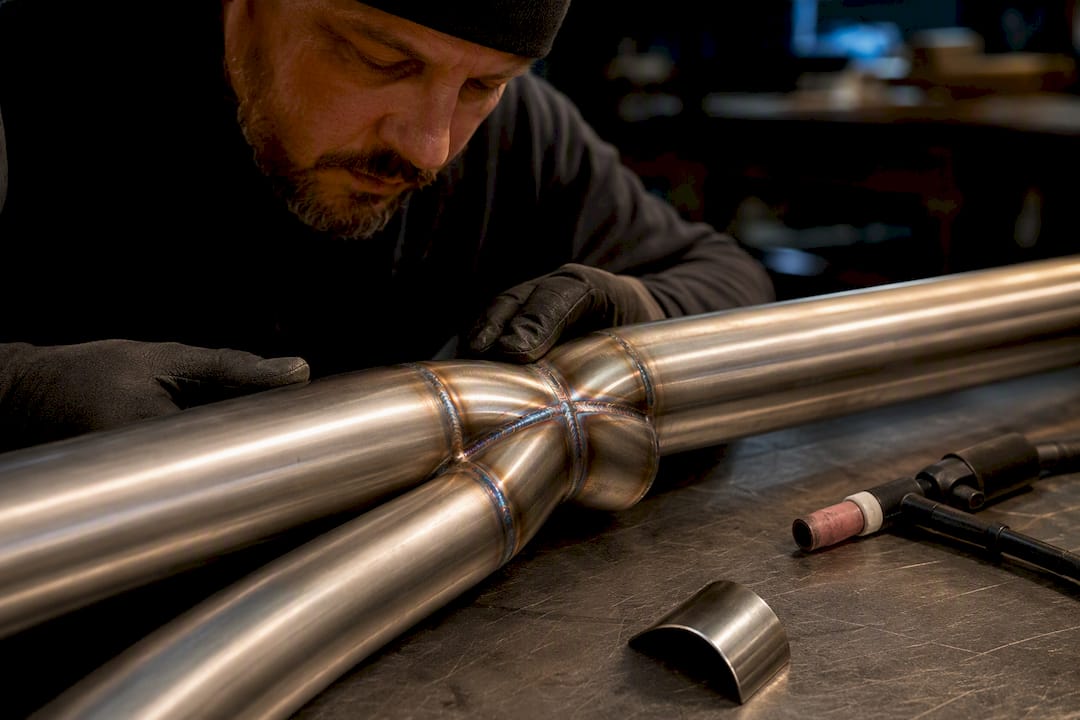
Wall thickness affects both sound and longevity. Thinner-wall tubing resonates more and can develop stress fractures sooner under high-rpm use. Thicker-wall tubing lasts longer but adds weight and can slightly restrict flow if not sized correctly for the engine’s exhaust volume.
For a Mustang that sees regular street use, stainless steel with clean TIG welds is worth the upcharge over mild steel. The pipe you’re not replacing again in three years is cheaper in the long run than the one that looked like a bargain at checkout.
How Do Crossovers Work With Other Exhaust Upgrades?
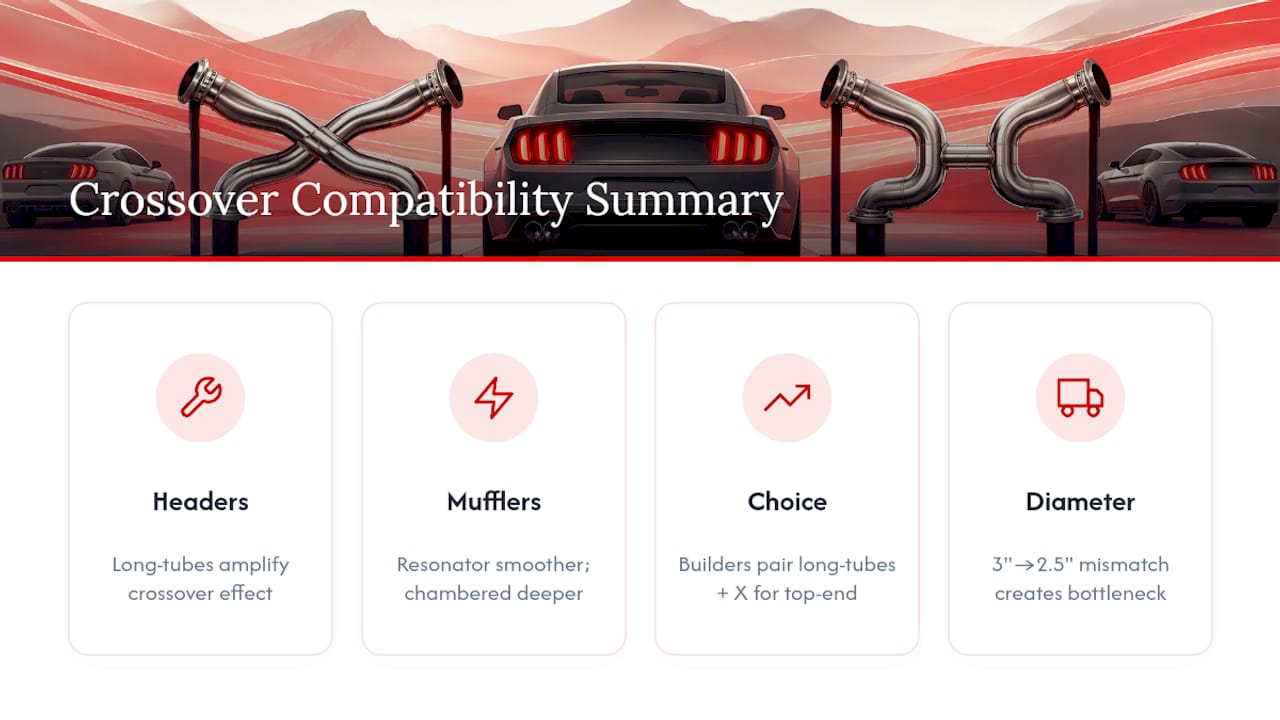
Crossover pipes rarely operate in isolation. Most Mustang builds pair them with long-tube or shorty headers, aftermarket mufflers, and sometimes axle-back or cat-back systems purchased separately from the midpipe.
Header selection changes how much a crossover pipe matters. Long-tube headers alter exhaust pulse timing more dramatically than stock manifolds, which amplifies whatever the X or H pipe is doing to those pulses. That’s part of why builders chasing top-end power often pair long-tubes with an X-pipe rather than an H-pipe.
Muffler compatibility is the other major variable. A resonator-style muffler tends to complement an X-pipe’s smoother tone without adding much drone. A chambered muffler paired with an H-pipe reinforces that deeper, choppier character many owners want. Mixing the wrong combination, like a loud straight-through muffler on an already-aggressive X-pipe, can push cabin noise into fatiguing territory on long drives.
Cat-back systems and midpipes need to match diameter for the whole setup to flow correctly. A 3 inch crossover feeding into a 2.5 inch cat-back creates a bottleneck that erases whatever gains the crossover was supposed to deliver. Confirm diameter compatibility before mixing components from different manufacturers.
Where Did the X-Pipe and H-Pipe Designs Come From?
The H-pipe design traces back to early American muscle-car exhaust engineering, when V8 dual-exhaust systems needed a way to balance pressure between the two banks without fully merging them. It was a straightforward solution: two tubes connecting the banks in an H shape, simple to manufacture and easy to retrofit onto existing dual-exhaust layouts.
The X-pipe emerged later as tuners and racers looked for more efficient exhaust scavenging, particularly as V8 performance builds pushed higher into the RPM range where H-pipe pulse equalization offered less benefit. The crossing-tube X design borrowed scavenging principles from racing exhaust theory, where merging collector geometry has long been used to pull spent gases out of the cylinder more effectively at high RPM.
Both designs matured alongside the muscle-car era and carried into the aftermarket performance scene that surrounds cars like the Mustang today, where the same fundamental trade-off from decades ago, tone versus top-end efficiency, still defines the decision.
The Verdict on Chasing Horsepower Over Sound
The horsepower argument around X-pipes and H-pipes gets more attention than it deserves. A 2 to 4 hp edge doesn’t change how a street-driven Mustang feels off the line, and most owners can’t detect that difference without a dyno sheet in front of them. What actually changes the driving experience is the sound character, and that’s the variable conventional advice tends to underemphasize.
The bigger mistake I see in forum threads and shop consultations alike is treating this as a binary choice made once and never revisited. Driving needs change. The commute you tolerate at 25 might not tolerate the drone you accepted at the track day. That’s the real argument for a valved system over locking into either pipe permanently: it doesn’t ask you to guess your future use case correctly on day one.
If you’re building toward high RPM, forced induction, or track use, the X-pipe’s scavenging edge is real, even if modest. If you want the sound that made you want a Mustang in the first place, the H-pipe still delivers it. Prioritize the driving experience you actually have, not the one you imagine having after the next dyno session.
— Info
Get the Sound You Want Without Committing to One Pipe
Valve Control Exhaust builds an alternative to the entire X versus H debate: a valved system that lets you switch between quiet cruise mode and full performance character on the same drive, without swapping midpipes or committing to one tone permanently.

That flexibility solves the exact problem this article walks through. A daily-driven Mustang doesn’t need to pick between a quiet commute and an aggressive weekend exhaust note if the valve actuator handles that switch electronically. Owners running valved systems get the deep tone when they want it and the low-key cruise setting when a residential noise ordinance or an early morning drive calls for it, all through the same hardware. The buyer’s guide to valved performance exhaust systems walks through fitment considerations across compatible platforms, and the benefits breakdown covers what changes day to day once the valves are installed. If your Mustang or European performance car is a candidate for a valved crossover setup, start with the buyer’s guide and request fitment details for your specific model.
Sources
The dyno and packaging claims here come primarily from MotorTrend’s and Hot Rod’s hands-on testing coverage, LS1Tech’s dyno-focused breakdown of torque curve changes, In The Garage Media’s shop-level placement guidance, and Yahoo Autos’ performance gain figures. Each source draws on direct dyno work or installer experience rather than manufacturer marketing claims.
- X-pipes and H-pipes Add Easy Horsepower, but Which is Best for Your Ride?
- X-pipes and H-pipes Add Easy Horsepower, but Which is Best for Your Ride?
- Exhaust Talk: Straight Pipe vs. Crossover, H-Pipe, or X-Pipe?
- The facts about X-pipe and H-pipe exhaust systems
- H-Pipe Vs X-Pipe: Which One Usually Delivers The Bigger Performance Gain?