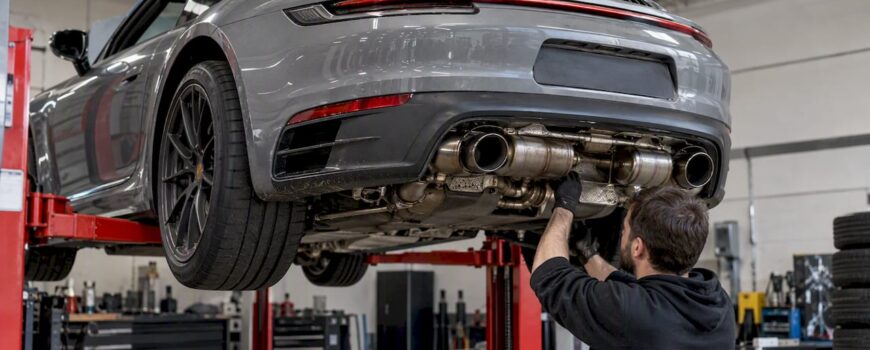
The best 911 exhaust upgrade for most owners is a valved cat-back or axle-back system. It gives you a quiet mode for the commute and a loud mode for the open road, and it leaves the emissions equipment alone. Power gains are real but modest, the sound change is dramatic, and the legal line sits at the catalytic converters. This guide covers what each part does on a 911, what to expect, and how to choose without regretting it six months later.
TL;DR
- A valved system is the safest way to get a louder 911 without living with constant drone, because you control the volume with a remote or app.
- Dyno gains of roughly 29 to 39 hp have been reported for a valved Carrera system, but only when paired with high-flow parts or software. Exhaust alone is a smaller number.
- Removing or replacing catalytic converters with non-certified parts is tampering under the Clean Air Act. Catless downpipes are for track or off-road use.
- Fitment depends on the generation (996, 997, 991.1, 991.2, 992) and the variant, so confirm by VIN before you order.
Table of Contents
- What an exhaust upgrade really changes on a 911
- Which parts you can upgrade, and what each one does
- Valved versus fixed: why we recommend valves
- How much power can you expect?
- Generation by generation: what to know before you buy
- Is a 911 exhaust upgrade street legal?
- How to choose the right setup
- Our perspective: control beats volume
- Where to find parts for your 911
- FAQ
- Sources
What an exhaust upgrade really changes on a 911
The 911 is an unusual exhaust platform. The engine sits behind the rear axle, so the tailpipes are close to your ears and the tone you hear from the cabin is shaped by a short, compact system. Small changes in muffler volume or pipe diameter are easy to hear.
Three things change when you upgrade:
- Sound. Less restriction and different muffler internals shift the note from muted to raw, often with more crackle and higher volume under load.
- Response. A freer-flowing system reduces back pressure, which can sharpen throttle feel, especially in the upper rev range.
- Weight and looks. Many aftermarket systems are lighter than the factory unit, and tips or diffusers change the rear view.
What does not change by itself is the fundamental power output. On a modern turbocharged 911 the engine control unit adjusts boost and fueling to hit its targets, so an exhaust alone leaves much of the potential on the table until the parts upstream or the software catch up.
Which parts you can upgrade, and what each one does
Think of the exhaust as a chain. You can change one link or several. Our exhaust system anatomy guide walks through every component, and here is the short version for a 911.
| Upgrade | What it does | Sound change | Power effect | Legal position in the US |
|---|---|---|---|---|
| Tips and diffuser | Look and slight tone change | Mild | None | Generally fine |
| Axle-back (valved) | Replaces the rear muffler section | Moderate to large, adjustable | Small | Generally fine on emissions, check local noise rules |
| Cat-back (valved) | Replaces everything behind the catalytic converters | Large, adjustable | Small to moderate | Generally fine on emissions, check local noise rules |
| Sport catalytic converters | Higher-flow cats that still filter exhaust | Moderate | Moderate with tuning | Must be certified for your market and state |
| Catless downpipe or X-pipe | Removes the cats on turbo cars | Very loud | Largest, with tuning | Not for street use |
The pattern matters more than any one row. The further forward you go, the more power you can find and the more legal risk you take on.
Axle-back: the easy first step
An axle-back swaps only the section from the rear axle to the tips. It is the cheapest and quickest job, and it makes most of the audible difference at idle and cruise. If your main goal is a better sound and you do not care about chasing horsepower, this is a sensible place to stop.
Cat-back: the best all-rounder
A cat-back replaces the mid-pipes and rear section behind the factory converters. You get more noticeable response gains, and since the converters stay, the car keeps its emissions equipment. Valved versions add electronic flaps so the system can be quiet or open on demand.

Downpipes and the turbo question
On turbocharged cars (the 991 and 992 Carrera, the Turbo and Turbo S, and the GT2 RS), the downpipes sit right behind the turbos, so they affect spool and flow the most. That is why they are the part tuners reach for first, and also why they are the most legally sensitive. Catless versions delete the converters. We cover that in the legal section below.
Valved versus fixed: why we recommend valves
A fixed performance exhaust has one volume, and that volume is a compromise. Make it loud enough to love on a back road and it will be tiring on a two-hour highway run. Make it civil and you lose the reason you bought it.
The usual complaint is drone, a steady resonance at cruising rpm that fills the cabin. Straight or bypass-style pipes tend to be the worst for it, which is why many owners who start with a fully open setup eventually move to a valved one.
A valved system solves this with electronically controlled flaps inside the pipes:
- Closed: exhaust gas is routed through the mufflers for a quiet, close-to-stock sound. Good for neighborhoods, early mornings and long drives.
- Open: gas takes the straight path for full volume and the freest flow.
- Controlled: a remote, phone app or drive-mode link lets you change it on the fly.
The practical benefit is that a neighbor never has to hear your 6 a.m. departure and you still get the full sound when you want it. For a car you drive daily and also enjoy, that flexibility is the whole point. Our write-up on the benefits of a valve control exhaust goes deeper on how the valves work and what to look for in a controller.
How much power can you expect?
Be skeptical of any listing that promises a big number from an exhaust alone. The honest range depends on the engine and what else you change.
One published example: an aftermarket valved exhaust for the 991 Carrera line lists dyno gains of 29 to 39 hp, and the manufacturer ties those figures to specific models and supporting modifications such as high-flow components or software optimization. Read that as a ceiling for a complete setup, not a promise for a bolt-on muffler.
A realistic way to think about it:
- Axle-back or tips only: expect a sound change and perhaps a slight feel improvement, not a measurable jump on a dyno.
- Cat-back: a small but real gain, more noticeable in the top half of the rev range.
- Cat-back plus sport cats or downpipes plus a tune: this is where the larger numbers come from, and this is where the legal and warranty questions get serious.
Dyno results also vary from shop to shop and day to day, so compare the same dyno, the same car and the same conditions before and after. If a seller shows only an “after” graph, ask for the baseline.
Generation by generation: what to know before you buy
Fitment is the number one reason upgrades go wrong. A 911 is not one car, and a part for one generation will not bolt onto the next.
- 996 and 997 (naturally aspirated Carreras): the sound is the headline. These cars respond well to freer-flowing mufflers and sport cats, and the flat-six note is the reward.
- 991.1 (naturally aspirated Carrera, turbocharged Turbo): the Carrera is still naturally aspirated, while the Turbo and Turbo S have a lot of untapped flow. For those, a valved exhaust with 250-cell sport cats keeps a catalytic converter in the system while opening up flow.
- 991.2 and 992 Carrera (turbocharged): the move to turbos made the exhaust note more muted from the factory, so owners often go looking for sound first. The Carrera S owner who wants the maximum flow should look at a track-oriented catless downpipe for the 992 Carrera S, keeping its intended use in mind.
- GT2 RS (991.2): a track-focused car, and the market for it is a track-focused one. An axle-back with catless downpipe for the 991.2 GT2 RS is built for that use.
- Newest cars: Porsche now builds the 911 Turbo S with a T-Hybrid powertrain, which changes what the exhaust can do, so expect fewer aftermarket options and check carefully before buying.
If you also own or are shopping for a Boxster or Cayman, the same fitment discipline applies. Our piece on VIN-checked 718 Cayman exhaust upgrades shows how particulate filter (GPF) versions change which parts fit, and the same logic applies to late-model 911s.
Is a 911 exhaust upgrade street legal?
This is the section most listings skip, and the one that costs owners the most.
The federal line: emissions equipment
The EPA treats removing or defeating emissions controls as tampering. Its enforcement initiative states that selling parts designed to defeat emissions systems is prohibited under the Clean Air Act, and the agency’s tampering policy covers replacing catalytic converters with non-certified pipes, commonly called test pipes or straight pipes. The practical consequences owners report include a permanent check engine light, a failed state inspection, and civil enforcement.
In plain terms:
- A cat-back or axle-back that leaves the converters in place does not touch the emissions hardware.
- Sport catalytic converters should be certified for your vehicle and state.
- Catless downpipes and test pipes are for vehicles used only on a closed course or track. We sell them on that basis, and you are responsible for how you use them.
When the converters are missing or the sensors read wrong, the car stores fault codes. If you want to understand what those emissions-related entries mean, this reference to OBD-II emissions fault codes lists the P04xx range tied to the exhaust and EGR side.
State and local rules
States differ. California and the other states that follow its emissions standards are the strictest about anything that touches the converters, and many states and cities also set noise limits or require a visual inspection of the exhaust. Check your state’s motor vehicle or environmental agency before you buy, and keep documentation for any certified part. A valved system you can close down is a real advantage here, since you can drive quietly through areas with enforcement and open it elsewhere.
Warranty
A modified exhaust can complicate a dealer warranty claim on related parts. If your 911 is still under Porsche warranty, talk to your service advisor before you modify anything upstream of the rear section.
How to choose the right setup
Use these questions in order.
- What do you want most: sound, response or lap times? Sound points to an axle-back or cat-back. Lap times point to sport cats or track downpipes plus a tune.
- Do you drive it on the street? If yes, keep the converters and pick a valved system.
- Do you tolerate drone? If not, choose a valved design and use the closed setting on the highway.
- Which exact car? Generation, engine, drivetrain (rear or all-wheel drive), and whether it has particulate filters. Match by VIN.
- Material and build. Stainless steel is the common choice, and high-end builds use lighter alloys. Check weld quality, hanger fit and the valve actuators.
- Control. Look for a remote, a phone app and a way to tie it to drive modes.
If you want to compare brand philosophies by type rather than by label, our buyer’s guide to performance exhaust lays out how the main approaches differ, and the comparison of high-end aftermarket systems goes into sound, build and control.
Our perspective: control beats volume
We sell exhaust parts for European performance cars every day, and the 911 questions we hear are remarkably consistent. Owners rarely regret getting more sound. They regret getting it with no way to turn it down.

That is why we steer 911 buyers toward valved systems and a controller they will actually use. The car you love on Sunday is the same car you drive on Monday. The technology we focus on is real-time control: adjust the sound and the flow to suit your mood and the road, with no compromise on either end.
The second thing we say is to be honest about legality. Our catalog includes catless downpipes, and we are clear that they are for track and off-road use. For a street 911, we would rather help you build a valved cat-back that you can enjoy without worrying about inspection day. We also only sell genuine products sourced from authorized manufacturers, because a poorly welded system that rattles or leaks costs more than the one that was right the first time.
— Info
Where to find parts for your 911
If you are ready to shop, start from the category that matches your plan:
- Exhaust parts for valved systems, mufflers, tips and controllers.
- Down pipes for track builds.
- Accessories for the remaining pieces, such as controller add-ons.
If you are not sure which part matches your car, send us the VIN and we will help you confirm fitment before you order.
FAQ
Does upgrading the exhaust improve performance?
Yes, but modestly on its own. A free-flowing system reduces restriction and can sharpen response, and larger gains appear when it is combined with high-flow parts or software. Treat any exhaust-only claim of a big horsepower jump with caution.
Will a 911 exhaust upgrade make my car too loud for daily driving?
Not if you choose a valved system. In the closed position it stays close to stock volume, and you open the valves only when you want the full sound. Fixed systems and straight pipes are the ones most likely to produce drone at highway rpm.
Is a catless downpipe legal on a street-driven 911?
No. The EPA considers removing or defeating catalytic converters on a road vehicle to be tampering under the Clean Air Act. Catless parts are intended for track or off-road use only. If you drive on public roads, keep your converters or use certified sport cats.
Can I install a 911 exhaust myself?
An axle-back or tips is a reasonable job for an experienced home mechanic with a lift and basic tools. Cat-backs and anything near the turbos or sensors are easier at a shop that works on Porsches, particularly because of the wiring for valve controllers and oxygen sensors.
Sources
- AWE Tuning exhaust for Porsche 911 Carrera 991, pcarwise listing
- US EPA: Stopping Aftermarket Defeat Devices
- US EPA: Enforcement Policy on Vehicle and Engine Tampering
- Porsche Newsroom: 2026 911 Turbo S press kit