
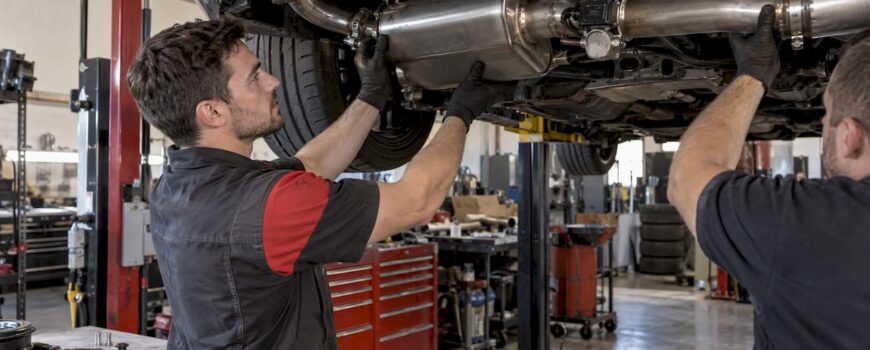
A bolt-on valved cat-back usually takes a shop 2 to 4 hours, and an axle-back valved muffler often takes 1 to 2. Add time if the job includes a downpipe, rusted hardware or a welded section. Add more if you do it yourself in a driveway. The valves bring their own extra steps: you mount an actuator, run a wire and pair a controller. Plan on 30 to 90 minutes for that part, which is our own working estimate and not a published figure.
This guide breaks the job down by system type, shows what stretches the clock, and gives you a way to check a shop’s quote before you hand over the keys.
TL;DR
- Published shop figures put axle-back installs at 1 to 2 hours and cat-back installs at 2 to 4 hours. A valved system sits at the upper end of those ranges because of the valve wiring.
- Complex jobs can run past 6 hours. Seized bolts, cut-and-weld work and a downpipe swap are the usual reasons.
- At the $160 to $200 hourly labor rate AAA cites, a 3-hour job is roughly $480 to $600 in labor, before parts.
- Ask for a written estimate with a completion date. Then confirm the parts are legal for street use in your state.
Table of Contents
- Install time by type of valved system
- What the valves add to the job
- A realistic timeline for a valved cat-back
- What turns 3 hours into 6
- DIY or shop: how the hours compare
- What the labor will cost
- How to save time before the car arrives
- Our perspective on install time
- Choosing a valved system you can install with confidence
- Check legality before you install
- FAQ
- Sources
Install time by type of valved system
Not every valved exhaust is the same job. The word “valved” tells you about the sound control. The hours depend on how much of the exhaust you are replacing.
| Job | Typical shop time | What drives the hours |
|---|---|---|
| Valved muffler or axle-back | 1 to 2 hours | Rear bumper or diffuser access, hanger rubbers, actuator wiring |
| Valved cat-back | 2 to 4 hours | Mid-pipe flanges, rusted fasteners, routing the control wire to the cabin |
| Valved cat-back plus downpipe | 4 to 6 hours or more | Heat shields, O2 sensor plugs, turbo or manifold access, tune requirements |
| Cut-and-weld valved muffler | Varies, often longer | Fabrication, fit checks, welding time |
The first two rows follow the shop ranges published by a Virginia Beach installer, who quotes 1 to 2 hours for axle-backs and 2 to 4 for cat-backs. The 4 to 6 hour row is our own estimate for combined jobs, not a published number. A general installation cost breakdown lists 1.5 to 4 hours for a standard install and says complex jobs may exceed 6.
Treat these as planning numbers. Your car, its mileage and where it has lived all change the answer.

What the valves add to the job
A fixed muffler bolts on and you are done. A valved system adds three tasks.
- Mount the valve actuator. Most valved mufflers carry an electric or vacuum-driven valve on the pipe or muffler body. It must be positioned so the hardware clears the underbody and the heat does not cook the wiring.
- Route the wiring. A harness runs from the actuator to the controller or module. On many cars that means reaching a power source and a cabin location for the receiver. This is where first-timers lose an hour.
- Pair and test the controller. You cycle the valves open and closed, confirm both positions, and check that the remote or app responds. Do this before the car comes off the lift, because it is much easier to fix a loose connector with the exhaust still hanging low.
If your system works through the vehicle’s own drive mode or a dedicated controller, the wiring part changes. The steps above still apply.
A realistic timeline for a valved cat-back
Here is how three hours tends to divide on a lift with a prepared installer. These are our working estimates, not a published breakdown.
- Lift, inspect and soak fasteners (15 to 20 minutes). Spray penetrating oil on every bolt and hanger you can see. Check the condition of the flange gaskets and rubber hangers.
- Remove the factory section (20 to 40 minutes). Support the weight, loosen the flanges, slide the hangers off. Rear bumper trim or a diffuser may come off first. The pieces come apart faster than they go back together.
- Test fit the new system loose (20 to 30 minutes). Hang it with the clamps and bolts loose. Check clearance to the subframe, axle and bumper. Check that the tips sit centered in the bumper cutouts.
- Align and tighten (20 to 30 minutes). Work front to back. Leave the tips for last so the system is not pulled to one side.
- Mount and wire the valves (30 to 60 minutes). Secure the actuator, route and tie off the harness away from heat and moving parts, connect the controller.
- Test (10 to 20 minutes). Cycle the valves, start the engine, listen and look for leaks at each joint, then do a short drive to check for rattles.
Add it up and 2.5 to 4 hours is a fair range. A first-time DIYer should double it.
What turns 3 hours into 6
The most common surprises are boring ones.
- Rust and seized hardware. Cars from the Northeast and Midwest, where road salt is routine, tend to fight back at the flanges. Cutting a bolt and replacing it takes minutes. Discovering it halfway through takes the afternoon.
- Heat shields and trim. Some luxury and performance models need undertrays, diffusers or bumper pieces removed. Budget extra time on cars that are tightly packaged.
- Downpipes and sensors. Swapping a downpipe means working near the turbos and oxygen sensors. It is a different order of job from a muffler swap.
- Parts that do not line up. Quality-fit parts save you time. A system that needs to be bent, trimmed or re-welded costs hours.
- Cut-and-weld designs. Some valved mufflers install by cutting the stock pipe and welding the new muffler in. That requires a welder and fit-up time. If you cannot weld, find a shop that does.
AAA’s Car Doctor has made a related point: labor estimates for parts that look simple, exhaust assemblies among them, often understate the time proper alignment and calibration take. Do not assume the book time is the real time.
DIY or shop: how the hours compare
In a driveway. You need a pair of rated jack stands or ramps, a torque wrench, penetrating oil and sockets, and a helper to hold the pipe while you tighten clamps. Reports from owners run from a couple of hours to a full weekend. Most of that spread comes from tools, patience and how rusty the car is. Do not work under a car supported by a jack alone.
At a shop. A lift, air tools and practice mean fewer hours and fewer scraped knuckles. The shop will also notice a worn hanger, a leaking flange or a cracked mount before it becomes a rattle.
Which one is faster in total depends on you. If you have never touched an exhaust, a shop is faster and usually safer. If you have done brake jobs and suspension work, a bolt-on valved muffler is a reasonable weekend project.

Picking a shop that knows your car
Hours also depend on who is holding the wrench. A general repair shop that has done 50 cat-backs will beat a specialist who has done two on your platform, but not always. A shop that works on European performance cars will already know where the trim clips are and which bolts like to snap. For more on how shop type shapes labor estimates, this walkthrough on upgrading a vehicle without a dealership visit is a useful read.
What the labor will cost
Labor is the clearest way to turn hours into dollars. AAA says professional labor typically runs $160 to $200 per hour, and that varies by region, vehicle and shop type. Using that range:
| Job length | Labor at $160/hr | Labor at $200/hr |
|---|---|---|
| 1.5 hours | $240 | $300 |
| 3 hours | $480 | $600 |
| 6 hours | $960 | $1,200 |
Those figures are simple multiplication of AAA’s range, not a quote from any shop. Rates in smaller markets may be lower. For a fuller picture including parts, see our U.S. exhaust installation cost guide.
Get the estimate in writing
Before a shop takes the car apart, ask for a written estimate with the expected completion date. Many states require this under their motor vehicle repair acts. In Colorado, for example, any change to the original completion date must be written on the invoice and communicated to you within 24 hours. Your state’s rules may differ, so check your attorney general or consumer affairs office.
Also ask:
- Does the quote include the valve wiring and controller setup, or only the muffler swap?
- What happens if a bolt snaps or a flange is rusted through?
- Will they test valve operation before you pick the car up?
- Is the hourly rate flat, or does it change if the job runs long?
How to save time before the car arrives
Most wasted hours happen before the first bolt.
- Confirm fitment by exact model, year and engine. A part for the right chassis with the wrong engine still wastes the day. Check our exhaust parts by vehicle and ask us if you are unsure.
- Lay out every piece. Check the box against the parts list before anything is removed. A missing clamp on a Saturday afternoon stops a job cold.
- Read the instructions. Install guides for valved systems, such as this valved exhaust guide for the BMW E9x 335i, show how a published procedure is laid out. Yours will differ by car.
- Spray the hardware the night before. Penetrating oil needs time to work.
- Buy the small stuff. New gaskets, hanger rubbers and clamps are cheap relative to a second trip to the shop.
- Schedule the sound test. Plan a short drive on the open road before you call the job done, so you can hear drone and rattles in real conditions.
Our perspective on install time
We sell valved systems and accessories for European and luxury performance cars, and the most common mistake we see in this topic is treating the muffler as the whole job. The muffler is the easy part. The time goes into fitment, access and wiring.
So we tell buyers to plan around three things. First, match the part to the exact car, so nothing needs bending or trimming. Second, decide up front who will do the wiring and controller pairing, because that is the step that surprises people. Third, leave room in the schedule. A system that goes on in 3 hours on a lift is a good day, and an afternoon that turns into a second day is normal when the underbody has years of road salt on it.
We also only sell genuine products from authorized manufacturers, which matters for install time more than most people expect: a real, correctly engineered part lines up with the mounting points the first time.
— Info
Choosing a valved system you can install with confidence
If you are shopping, start with the category that matches your job. Browse our exhaust parts for valved mufflers and systems, our down pipes if you are also upgrading the front of the system, and our accessories for controllers and tips. We carry parts for brands including Audi, BMW, Porsche, Ferrari, Lamborghini and Mercedes-AMG. Tell us your exact model and year and we will help you confirm compatibility before you order.
Check legality before you install
Install time is wasted if the part cannot stay on the car. The Clean Air Act prohibits tampering with emissions controls, and EPA’s enforcement policy targets aftermarket defeat devices that bypass or disable them. In practice, a valved muffler downstream of the catalytic converter is a different thing from a downpipe that removes or replaces a catalyst. Anything involving the catalyst needs a close look at emissions compliance for your state, and California and other CARB states have their own certification rules.
If you are unsure, check our guides on whether valved exhausts are legal, the EPA tampering checklist and passing an aftermarket exhaust inspection. State and local noise limits also apply, so a valve you can close for traffic stops and open on a track day is a practical advantage. Your state’s motor vehicle agency or an emissions inspection station can confirm what applies to your car.
FAQ
How long does it take to install a valved exhaust?
Most bolt-on valved axle-backs take 1 to 2 hours at a shop, and valved cat-backs take 2 to 4, based on one installer’s published ranges. The valve wiring and controller setup are the reason valved systems sit toward the top of those ranges. Downpipe work or welding can push the total well beyond that.
Can I install a valved exhaust myself?
If you are comfortable with tools, a bolt-on valved muffler is a realistic home project, and you should plan on more time than a shop would need. You need jack stands or ramps, a torque wrench and a helper. If the system requires cutting and welding, or you are not confident with automotive wiring, a shop is the better call.
How much does labor cost for a valved exhaust install?
AAA puts typical shop labor at $160 to $200 per hour. A 3-hour install therefore lands near $480 to $600 in labor, before parts. Your region and the type of shop will move that number.
Are valved exhausts legal in the U.S.?
That depends on the part and your state. Federal law prohibits tampering with or defeating emissions controls, and states set their own noise and inspection rules. Read our valved exhaust legality guide and check your state’s rules before you buy.
Sources
- Aftermarket Exhaust Installation in Virginia Beach
- Exhaust System Installation Cost, One and Done Prep
- How Much Does a Catalytic Converter Cost, AAA Automotive
- Q&A With AAA’s Car Doctor: June 2026
- Colorado Motor Vehicle Repair Act, AAA Colorado
- EPA Tampering Policy
- BMW E9x 335i Valved Exhaust System Installation Guide