
Audi’s exhaust sound system is defined by electronically controlled butterfly valves that physically reroute exhaust gases to change the noise profile in real time. This technology, commonly called active valve exhaust, sits at the intersection of engine management, drive mode selection, and acoustic engineering. The Audi Sport button and Dynamic drive mode trigger these valves to open, bypassing silencers and delivering a sharper, more aggressive note. Systems like the Milltek Active Valve Controller and the Milltek Active Valve Technology platform have made this level of control available to both OEM and aftermarket buyers. Understanding how these components interact is the foundation of any serious Audi sound system upgrade.
How do Audi exhaust sound systems work technically?
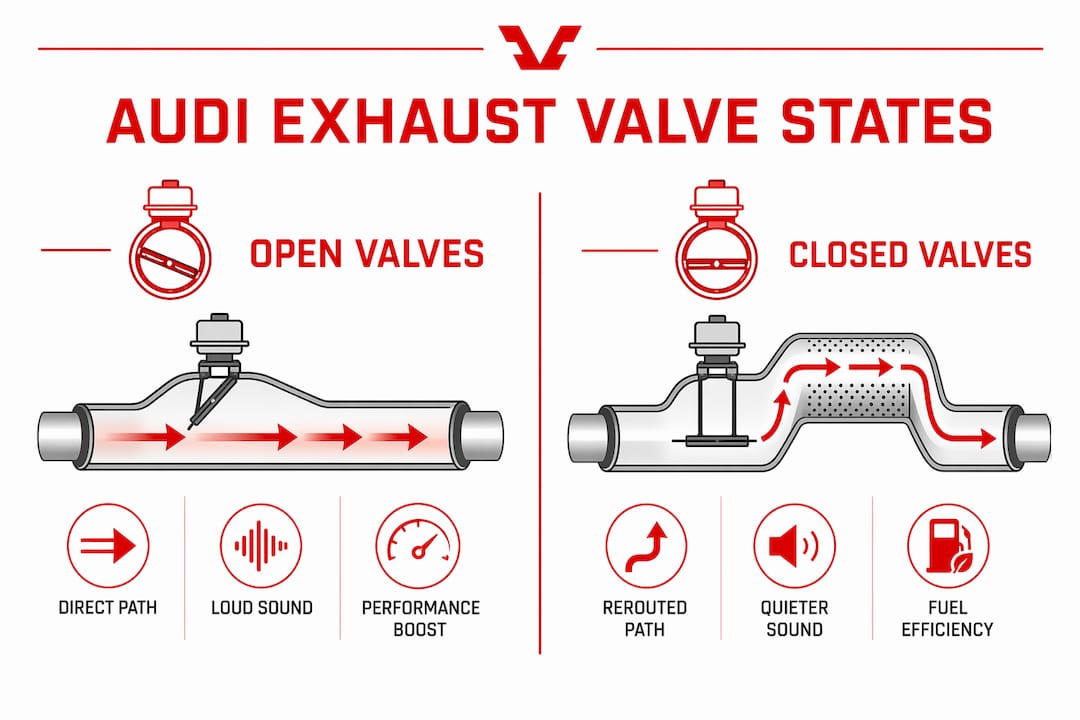
Audi exhaust sound control is managed via electronically controlled butterfly valves inside the exhaust pipes that change the exhaust path to alter noise levels. When the valves are open, exhaust gases take a shorter, more direct route through the system, bypassing the main silencer sections. The result is a louder, more resonant tone with sharper throttle response. When the valves close, gases are routed through the full silencer path, producing a quieter, more subdued note suited to urban driving or early morning starts.
The ECU plays a central role in this process. It reads inputs from oxygen sensors, throttle position, RPM, and the selected drive mode, then signals the valve actuators accordingly. This means the exhaust note is not a fixed characteristic but a dynamic output that changes with driving conditions. Under hard acceleration in Sport mode, valves open fully. During light cruising in Comfort mode, they stay closed.

| Valve state | Exhaust routing | Sound character | Performance effect |
|---|---|---|---|
| Open | Direct path, bypasses silencer | Loud, aggressive, sharp | Lower backpressure, improved flow |
| Closed | Full silencer path | Quiet, refined, subdued | Higher backpressure, smoother torque |
| Partial | Mixed routing | Moderate tone | Balanced backpressure |
Active exhaust valves do not simply amplify muffler sound uniformly. They change exhaust routing, making the biggest sound differences under load and at specific RPM ranges. This is why the sound difference between Comfort and Sport mode is most dramatic during hard acceleration rather than idle.
Audi also uses structure-borne sound actuators and, on some models, synthetic sound modules played through interior speakers to supplement the physical exhaust note. The RS3 and RS6 use this approach to reinforce the engine character inside the cabin without relying solely on the physical exhaust path.
Pro Tip: If you notice drone at highway speeds, the valves are likely staying open longer than intended. Check your drive mode settings first before assuming a hardware fault. Drone is almost always a valve timing or mode calibration issue, not a structural exhaust problem.
What are the customization options for Audi exhaust upgrades?
The aftermarket for Audi valved exhaust systems is mature and well-segmented. Valved aftermarket systems from brands like Milltek, FI Exhaust, Armytrix, Akrapovic, and Valvetronic offer customizable sound levels and performance gains, though compatibility with OEM sensors is critical to avoid check engine codes. Each brand takes a different approach to valve placement, actuator type, and control interface.
Key differences between popular aftermarket systems:
- Milltek Active Valve Controller: Plug-and-play CAN bus integration, smartphone app control, cold start noise suppression, and cylinder deactivation management. Works with OEM valves or Milltek’s own hardware.
- Armytrix: Bluetooth app control with preset sound profiles, available in titanium and stainless steel, strong fitment for Audi S and RS models.
- Akrapovic: Titanium construction, weight reduction focus, sound tuned for track use rather than daily street driving.
- FI Exhaust: Known for aggressive sound profiles and wide Audi model coverage, with remote control valve operation.
- Valvetronic: Motorized valve system with fine-grained control over valve position, not just open or closed.
The Milltek Active Valve Controller offers manual and app-based valve control, including cold start noise suppression, which is one of the most practical features for daily drivers who want performance sound without waking the neighborhood at 6 a.m.
Resonated versus non-resonated systems represent the most consequential choice in this category. Resonated systems include additional chambers that cancel specific sound frequencies, reducing rasp and drone at cruising speeds. Non-resonated systems deliver a rawer, louder note but can become fatiguing on long highway runs. For Audi owners who split time between track days and daily commutes, a resonated valved system gives the best of both worlds.
You can read more about how valve control exhausts shape the overall sound experience across different driving scenarios.
Pro Tip: Before purchasing any aftermarket valved exhaust, confirm whether it retains the OEM oxygen sensor bungs and catalytic converter positions. Systems that delete cats or relocate sensors will trigger fault codes on Euro 6 and later Audi models, and some will prevent the car from entering certain drive modes.
How do exhaust systems affect performance, fuel economy, and emissions?
Exhaust valve position directly influences backpressure, which in turn affects torque delivery across the RPM range. Open valves reduce backpressure and favor high-RPM power. Closed valves increase backpressure slightly, which can improve low-end torque on turbocharged engines by keeping exhaust velocity higher. This is why some Audi owners notice better throttle response in the mid-range when the system is not fully open.
Audi OEM exhaust systems include emission-control hardware like DPF, catalytic converter, and lambda probes that interface with engine management to optimize combustion and emissions. Diesel models add SCR systems with AdBlue injection and EGR valves for nitrogen oxide reduction. Any modification that disrupts this hardware chain creates measurable consequences for fuel economy and emissions compliance.
| Modification type | Performance impact | Fuel economy impact | Emissions compliance |
|---|---|---|---|
| OEM active valve system | Optimized across RPM range | Neutral | Full compliance |
| Resonated aftermarket (cat-back) | Moderate gain, better flow | Neutral to slight improvement | Compliant if sensors retained |
| Non-resonated aftermarket (cat-back) | Noticeable gain at high RPM | Neutral | Compliant if sensors retained |
| Decat or cat delete | High-RPM gain, low-end loss | Worse (rich fueling) | Non-compliant, fault codes |
Exhaust leaks before oxygen sensors affect sensor readings, causing the ECU to enrich the fuel mixture and reduce fuel economy. The sensor detects extra oxygen from the leak and interprets it as a lean condition, so the ECU adds fuel to compensate. Symptoms include a ticking sound from the engine bay, exhaust smell inside the cabin, and rough idle. Left unaddressed, this cycle degrades both fuel economy and catalytic converter life.
The interaction between the exhaust system and engine management is not passive. Improper modifications can disrupt sensor feedback, resulting in performance and emissions issues that compound over time. A cat-back system that retains all sensors and emission hardware is the safest path to sound improvement without ECU conflict.
Aftermarket exhaust upgrades should always be paired with a professional ECU read to confirm no fault codes are stored after installation. This takes 15 minutes and prevents weeks of diagnostic guesswork.
What Audi owners should know about exhaust maintenance and troubleshooting
Exhaust system longevity depends heavily on correct installation from the start. Exhaust installation must follow specific torque and alignment requirements to avoid leaks and noise, with flexible sections not bending more than 10 degrees to maintain system integrity. High-temperature grease on mounting nuts and correct bolt torque values are not optional details. They are the difference between a system that lasts a decade and one that develops leaks within a year.
Common troubleshooting steps for Audi exhaust sound issues:
- Check for fault codes first. Connect an OBD-II reader like the Ross-Tech VCDS or a generic Bluetooth scanner. Exhaust valve faults, oxygen sensor codes, and EGR errors all appear here before any physical symptoms become obvious.
- Inspect valve actuators. On OEM systems, actuator failure is the most common cause of a stuck-open or stuck-closed valve. The car will default to one sound profile and stop responding to drive mode changes.
- Listen for ticking at idle. A metallic tick that increases with RPM almost always indicates an exhaust manifold or downpipe leak. Address it before it migrates upstream and affects sensor readings.
- Check rubber hangers and mounting points. Worn hangers allow the exhaust to contact the underbody, creating rattles that are often misdiagnosed as valve problems.
- Verify valve response in each drive mode. Switch between Comfort, Auto, Dynamic, and Individual modes while stationary. You should hear a clear change in exhaust tone. If you do not, the valve actuator or its wiring is the likely fault.
Pro Tip: During cold starts in winter, keep the car in Comfort or Auto mode for the first two minutes. Cold valve actuators move more slowly, and forcing them open immediately adds mechanical stress. The Milltek Active Valve Controller’s cold start suppression feature handles this automatically, which is one reason it earns its price premium for daily drivers.
Valve hardware inspection should be part of any annual service on a modified Audi. Carbon buildup around valve seats can restrict movement over time, particularly on direct-injection engines like the EA888 found in the S3 and TT S.
Key takeaways
Audi’s active valve exhaust system delivers dynamic sound and performance control by physically rerouting exhaust gases through electronically managed butterfly valves integrated with the ECU and drive modes.
| Point | Details |
|---|---|
| Valve routing controls sound | Open valves bypass silencers for loud tone; closed valves use full silencer path for quiet operation. |
| Drive modes trigger valve changes | Sport and Dynamic modes open valves; Comfort mode keeps them closed for refined daily driving. |
| Aftermarket upgrades require sensor compatibility | Systems from Milltek, Armytrix, and Akrapovic must retain OEM sensor positions to avoid ECU fault codes. |
| Exhaust leaks degrade fuel economy | Leaks before oxygen sensors cause rich fueling, increasing fuel consumption and stressing the catalytic converter. |
| Correct installation prevents long-term failure | Specified torque values, alignment, and high-temperature grease on fittings are required for system durability. |
What I’ve learned from years with Audi exhaust systems
The most common mistake I see Audi owners make is treating the exhaust system as an isolated component. It is not. Every valve position, every sensor reading, and every drive mode selection feeds into a single engine management loop. When you modify one part without understanding the others, the system pushes back in ways that are expensive to diagnose.
My honest preference is for resonated cat-back systems with retained OEM sensors. The non-resonated setups sound spectacular on a dyno video, but after 90 minutes on a motorway, the rasp becomes genuinely unpleasant. The Milltek resonated range and similar offerings from Valvecontrolexhaust strike the right balance for owners who drive their cars rather than just photograph them.
I also think the synthetic sound augmentation that Audi uses on some RS models gets unfairly dismissed. Yes, it is not purely mechanical. But the result, a cabin experience that matches the visual drama of the car, is what most buyers actually want. Purists can disable it. Everyone else benefits from it.
The Sportback exhaust mode integration is one area where Audi’s OEM calibration genuinely outperforms most aftermarket controllers. The factory mapping knows exactly when to open valves for maximum effect without triggering drone. Aftermarket controllers give you more manual control, but that control requires you to know what you are doing. For most owners, the OEM logic is smarter than they give it credit for.
Avoid any system that requires you to delete the DPF or primary catalytic converter to achieve its claimed power numbers. The emissions conflict alone is not worth it, and the ECU behavior on a car running without its intended emission hardware is unpredictable in ways that affect more than just the exhaust note.
— Info
Upgrade your Audi’s exhaust sound with Valvecontrolexhaust
Valvecontrolexhaust specializes in valved exhaust solutions built specifically for high-performance Audi models, from the S3 and RS3 to the RS6 and R8. Their catalog covers systems from IPE, FI Exhaust, Armytrix, Akrapovic, Valvetronic, and Ryft, with detailed fitment guidance for each model.

If you are weighing the options between OEM sound enhancement and a full aftermarket upgrade, Valvecontrolexhaust’s exhaust system evaluations give you side-by-side comparisons grounded in real installation experience. For owners who want to understand why customizable exhaust systems appeal to serious enthusiasts, their guides cover the technical and experiential case in full detail.
FAQ
What is an active valve exhaust system on an Audi?
An active valve exhaust system uses electronically controlled butterfly valves inside the exhaust pipes to reroute gases between silenced and direct paths, changing the sound profile in real time based on drive mode and RPM.
Does the Audi Sport button actually change the exhaust sound?
Yes. Pressing the Sport button or selecting Dynamic drive mode signals the ECU to open the exhaust valves, bypassing silencers and producing a louder, sharper exhaust note compared to Comfort mode.
Will an aftermarket valved exhaust affect my Audi’s emissions compliance?
A cat-back aftermarket system that retains all OEM sensors and catalytic converters remains emissions compliant. Systems that delete cats or relocate oxygen sensors will trigger fault codes and fail emissions testing.
Why does my Audi exhaust sound the same in all drive modes?
If the exhaust note does not change between Comfort and Sport modes, the valve actuator is likely stuck or has failed. Connect an OBD-II scanner to check for exhaust valve fault codes before replacing any hardware.
What is the difference between resonated and non-resonated aftermarket exhausts?
Resonated systems include additional chambers that cancel specific sound frequencies, reducing drone and rasp at cruising speeds. Non-resonated systems deliver a louder, rawer note but can become fatiguing on long drives.