
Active exhaust valves are the primary mechanism controlling exhaust sound and flow in modern performance vehicles, operating downstream of the catalytic converter to manage noise output in real time. The role of exhaust valves in sound production goes far beyond simple noise reduction. These components determine whether your BMW M3 growls at idle, whispers through a residential street, or screams at full throttle on a track. Understanding how they work gives you real leverage over your driving experience, whether you own an Audi RS6, a Ferrari 488, or any performance car fitted with a valvetronic system.
How do exhaust valves control vehicle sound?
Active exhaust valves are positioned after the catalytic converter and manage sound by redirecting exhaust gases through different flow paths. This placement is critical to understand. These are not the same as the combustion chamber valves inside your engine block. They are external, system-level components designed exclusively for sound and flow management.

The core mechanism is straightforward. When the valve closes, exhaust gases travel through a longer, muffled route that absorbs sound energy and reduces noise. When the valve opens, gases take a direct path with less restriction, producing a louder, more aggressive exhaust note. The butterfly valve design uses a rotating disc between the catalytic converter and muffler to execute this switch, balancing backpressure and sound modes with precision.
Modern systems offer multiple driving modes that translate directly into distinct sound signatures:
- Quiet mode: Valves remain closed, gases route through full muffler baffling, and the car sounds nearly stock. Ideal for early morning departures or noise-restricted zones.
- Sport mode: Valves open fully, exhaust gases bypass muffler restrictions, and the engine note becomes raw and aggressive. This is the mode you want on an open road.
- Auto mode: The system keeps valves closed at low RPM for comfort and emissions compliance, then opens at around 3,500 RPM to deliver full performance sound when the engine demands it.
One of the most underappreciated benefits of valve-controlled exhaust systems is drone elimination. Fixed performance exhausts often produce an irritating resonance at highway cruising speeds, typically between 1,800 and 2,500 RPM. Valvetronic systems reduce exhaust drone significantly by keeping valves partially closed at those RPM ranges, which modulates backpressure and breaks the resonance frequency that causes drone.
Pro Tip: If your valvetronic system produces drone in auto mode, try switching to quiet mode during highway cruising. The closed valve position often eliminates the resonance entirely without sacrificing comfort.
Control interfaces have also matured considerably. Smartphone app control via Bluetooth lets drivers toggle sound modes on the fly, including in situations like drive-throughs where a sudden exhaust bark would be socially catastrophic. This level of real-time control is what separates a valvetronic system from any fixed exhaust setup.
What is the significance of exhaust valves for engine performance?
The significance of exhaust sound control extends directly into engine performance, and the relationship between the two is tighter than most enthusiasts realize. Exhaust valve operation affects backpressure, and backpressure affects how efficiently your engine breathes. Get this balance wrong, and you sacrifice either low-end torque or high-RPM power.
Here is how valve-controlled exhaust flow translates into measurable performance outcomes:
- Low-end torque preservation: Closed valves maintain higher backpressure at low RPM, which helps scavenge exhaust gases from cylinders more effectively and supports torque production in the 1,500 to 3,000 RPM range where most daily driving occurs.
- High-RPM power release: Open valves reduce backpressure at high RPM, allowing the engine to expel exhaust gases faster and draw in fresh air-fuel mixture more efficiently. This is where peak horsepower gains appear.
- Engine breathing optimization: The exhaust butterfly valve adjusts flow resistance dynamically, meaning the engine operates closer to its ideal breathing curve across a wider RPM range than any fixed system allows.
- Fuel efficiency at cruise: With valves closed during light-load driving, the engine maintains optimal combustion conditions without excessive pumping losses, contributing to better fuel economy on long highway runs.
- Thermal management: Exhaust valves operate at temperatures between 600 and 800°C, compared to intake valves at 200 to 300°C. This thermal differential means exhaust system components are engineered to handle sustained heat stress that would destroy lesser materials.
The practical implication is that a well-tuned valvetronic system on a Lamborghini Huracán or a BMW M5 does not force you to choose between a comfortable daily driver and a track-ready machine. You get both, calibrated by valve position. Explore how valve control exhausts enhance sound to understand the full performance picture.
Fixed exhaust vs. valvetronic systems: which one wins?
Traditional exhaust systems produce a fixed, unchanging sound profile determined entirely by pipe diameter, muffler design, and resonator placement. What you hear at idle is what you get at every RPM. Valvetronic systems replace that static character with a fully adjustable sound signature that responds to driver input and driving conditions.
| Feature | Fixed exhaust system | Valvetronic exhaust system |
|---|---|---|
| Sound profile | Single, unchanging tone | Adjustable from quiet to aggressive |
| Drone at highway speeds | Common, especially in performance setups | Eliminated via valve modulation |
| Driver control | None | Remote, app, or automatic mode |
| Performance tuning | Fixed backpressure curve | Dynamic backpressure adjustment |
| Cost | Lower upfront cost | Higher upfront, greater long-term value |
| Maintenance complexity | Minimal | Requires actuator and valve inspection |
| Daily usability | Compromised if tuned for performance | Fully usable in quiet mode |
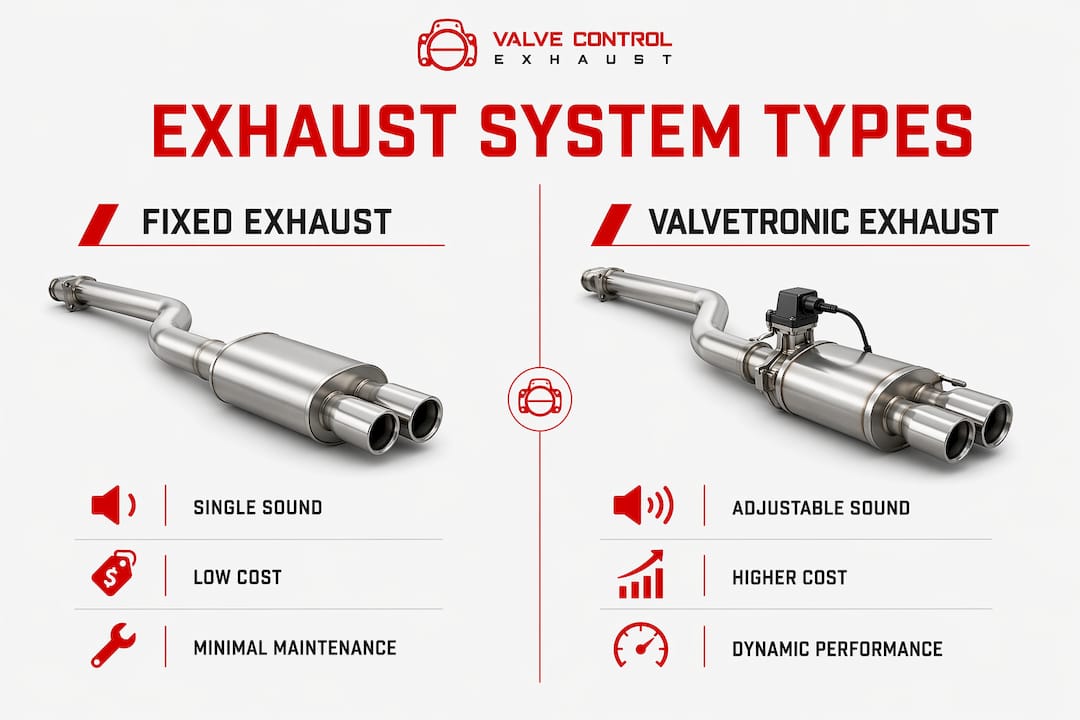
The trade-off is real. Valvetronic systems cost more and introduce additional components that require maintenance. For a driver who uses their Ferrari 488 exclusively on track days, a fixed race exhaust tuned for maximum flow might be the right call. For anyone who drives their performance car on public roads daily, the flexibility of a valve system is not a luxury. It is the only logical choice.
Brands like IPE, Armytrix, Akrapovic, and Valvetronic have each developed distinct approaches to valve actuation, materials, and sound tuning. A critical evaluation of these systems reveals meaningful differences in valve response time, sound character, and build quality that matter when you are spending four figures on an exhaust upgrade.
Common issues and maintenance tips for exhaust valve systems
Exhaust valve systems are durable, but they operate in one of the harshest environments on a vehicle. Heat cycling, road salt, moisture, and vibration all work against the actuators and valve mechanisms over time. Knowing what to watch for prevents a minor issue from becoming an expensive repair.
The most common problems you will encounter include:
- Sticking valves: Salt and moisture accumulation causes electric actuators to bind, particularly in northern climates where roads are salted in winter. The valve gets stuck in one position, eliminating your ability to switch modes.
- Rattling at idle: A loose valve disc or worn actuator linkage produces a metallic rattle that is most noticeable at cold start. This is often mistaken for a heat shield issue.
- Actuator failure: Electronic actuators have a finite service life. When they fail, the valve defaults to one position, usually open or closed, depending on the system design.
- Valve noise bleed-through: In quiet mode, a partially worn valve seat allows exhaust gases to bypass the muffler path, producing more noise than expected.
Preventing these problems requires a straightforward maintenance approach. Inspect valve mechanisms every 12 months or after any winter season in a salt-heavy climate. Apply high-temperature anti-seize lubricant to actuator linkage points during inspection. Flush the undercarriage regularly if you drive in salted conditions. Quality parts matter here. A budget actuator replacement will fail faster than an OEM or premium aftermarket unit.
Pro Tip: After washing your car in winter, run the exhaust through all valve modes two or three times while the system is warm. The heat and movement help clear moisture from actuator seals and prevent corrosion buildup.
Professional installation also reduces long-term maintenance headaches. Improper fitment stresses valve linkages and creates leak points that accelerate wear. If you are considering an upgrade, understanding how to choose the right system for your specific vehicle is the first step toward avoiding fitment issues entirely.
Key takeaways
Exhaust valves control both sound and engine performance by dynamically adjusting exhaust flow paths, making them the single most impactful upgrade for enthusiasts who want flexibility without compromise.
| Point | Details |
|---|---|
| Valve position drives sound | Closed valves route gases through muffled paths; open valves deliver aggressive, direct exhaust tones. |
| Auto mode balances everything | Valves stay closed for comfort below 3,500 RPM and open automatically for performance above that threshold. |
| Performance gains are real | Dynamic backpressure adjustment supports low-end torque and high-RPM power in a single system. |
| Valvetronic beats fixed for daily use | Fixed exhausts cannot eliminate drone or switch modes; valvetronic systems handle both without compromise. |
| Maintenance prevents failure | Annual actuator inspection and lubrication prevents sticking, rattling, and premature failure in all climates. |
Why exhaust valve technology changed how I think about performance cars
I spent years believing the best exhaust was the loudest one. Track-tuned, straight-piped, no apologies. That perspective lasted until I drove a Lamborghini Huracán fitted with a full valvetronic system back-to-back against the same car running a fixed race exhaust. The fixed setup was spectacular at 7,000 RPM and genuinely unpleasant at every other moment. The valvetronic car was quiet enough to hold a conversation at 60 mph and absolutely savage when you opened the throttle past 4,000 RPM.
What changed my thinking was not the sound itself. It was the control. The ability to decide, in real time, what your car sounds like based on where you are and what you are doing is a fundamentally different relationship with the vehicle. A Ferrari that sounds like a commuter car in your neighborhood and a race car on the highway is not a compromise. It is a more complete machine.
The resale angle is also worth considering. A car with a well-installed valvetronic system from a recognized brand like Akrapovic or Armytrix holds value better than one with an aggressive fixed exhaust that limits its appeal to a narrow buyer pool. Noise regulations are tightening in most major markets, and a system that can comply on demand is an asset, not a liability.
My advice for anyone weighing an exhaust upgrade: do not buy sound. Buy control. The benefits of a valve control exhaust system compound over time in ways a fixed system simply cannot match.
— Info
Upgrade your exhaust with Valvecontrolexhaust
Valvecontrolexhaust specializes in adjustable exhaust systems built specifically for Audi, BMW, Ferrari, and Lamborghini. Their systems give you real-time control over sound modes through smartphone apps, Bluetooth remotes, and automatic RPM-triggered valve opening, without sacrificing the performance characteristics your car was built to deliver.

If you are ready to move beyond a fixed exhaust and want a system that works as hard on Monday morning as it does on Saturday afternoon, start with the performance exhaust buyer’s guide covering IPE, FI Exhaust, Armytrix, Akrapovic, Valvetronic, and Ryft. Valvecontrolexhaust has the technical depth and model-specific compatibility to match you with the right system the first time.
FAQ
What is the role of exhaust valves in sound control?
Exhaust valves control sound by opening or closing to redirect exhaust gases through different flow paths, producing either a quiet, muffled tone or an aggressive, open exhaust note. They are positioned after the catalytic converter and operate independently of the engine’s internal combustion valves.
How do exhaust valves affect engine performance?
Exhaust valves adjust backpressure dynamically, supporting low-end torque when closed and releasing high-RPM power when open. This makes them more effective than fixed exhaust systems, which can only optimize for one point on the power curve.
What causes exhaust valve noise and rattling?
Rattling from exhaust valves is typically caused by a loose valve disc, worn actuator linkage, or moisture and salt accumulation that causes the actuator to bind. Regular inspection and lubrication of actuator components prevents most noise-related issues.
Can exhaust valves eliminate highway drone?
Yes. Valvetronic systems reduce exhaust drone by modulating valve position at highway cruising RPM, which adjusts backpressure and disrupts the resonance frequency that causes drone in fixed performance exhausts.
How are modern exhaust valves controlled?
Modern valvetronic systems are controlled via smartphone apps, Bluetooth remotes, or automatic RPM-based triggers. Auto mode keeps valves closed for quiet operation and opens them around 3,500 RPM to deliver full performance sound without driver input.