

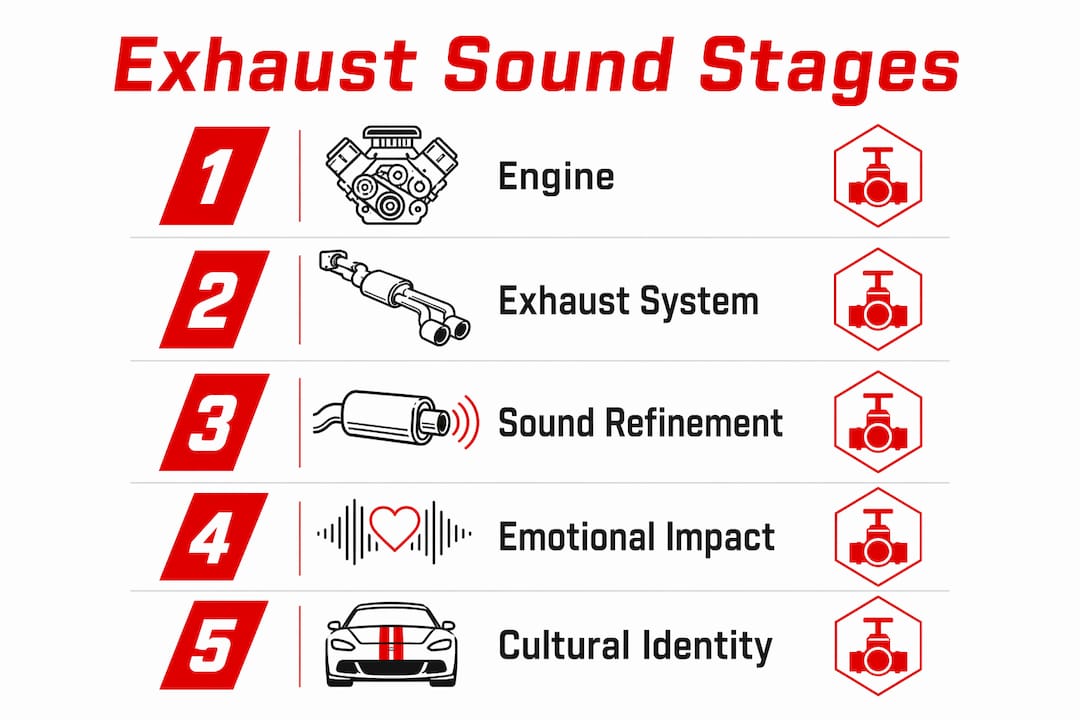
A car’s exhaust note is its acoustic fingerprint, the single most immediate signal of what a vehicle is and what it intends to do. Before you see a Ferrari pull onto the street, you hear it. That sound is not accidental. Manufacturers engineer sonic DNA into every vehicle from the earliest stages of development, setting acoustic benchmarks before a prototype ever turns a wheel. Why exhaust note defines car identity comes down to one truth: sound communicates character faster than any visual cue, badge, or spec sheet ever could.
Why exhaust note defines car identity at the engine level
The exhaust note does not originate in the exhaust system. It originates in the engine. This is the most common misconception among enthusiasts who bolt on a new muffler expecting a transformation. The exhaust system shapes and filters the sound, but the engine’s inherent sound signature comes entirely from its mechanical rhythm.
Engine configuration is the primary variable. A V8 fires in an overlapping, syncopated pattern that produces the deep, loping burble associated with American muscle. A flat-six fires in an evenly spaced sequence that creates the high-pitched, mechanical wail Porsche owners recognize instantly. A V10 produces a screaming, dense harmonic stack that sits in a frequency range no other configuration can replicate. Each layout creates a unique firing rhythm, and that rhythm is the raw material every exhaust engineer works with.

Firing order determines pulse timing and harmonic content. Two engines with identical displacement but different firing orders will sound fundamentally different, even through the same exhaust system. Intake and exhaust port geometry also shape the sound before gases ever reach the pipes. Port shape affects flow velocity, which affects the tonal character of each pulse. RPM range sets the pitch ceiling. A high-revving inline-four at 8,000 RPM produces a completely different tonal register than a torque-heavy V8 that peaks at 5,500 RPM.
Key engine factors that establish the base sound signature:
- Cylinder count and configuration: V8, V10, flat-six, rotary, and inline engines each produce structurally different pulse rhythms.
- Firing order: Determines the spacing between exhaust pulses and the resulting harmonic content.
- Port design: Intake and exhaust port geometry affect flow velocity and tonal character.
- RPM ceiling: Sets the upper pitch range and tonal register of the engine’s voice.
- Displacement: Larger displacement generally produces lower fundamental frequencies.
Pro Tip: Before spending money on an aftermarket exhaust, listen carefully to your engine at idle with the hood open. That raw, unfiltered sound tells you exactly what acoustic material you are working with.
How exhaust system design shapes and refines the sound
The exhaust system is the instrument body around the engine’s voice. A great exhaust system amplifies the best frequencies and suppresses the unpleasant ones. A poor exhaust design degrades an engine’s natural tone, introducing drone, harshness, or a flat, lifeless quality that no amount of money can fix after the fact.
The Lexus LFA is the clearest example of exhaust engineering taken to its logical extreme. Toyota’s engineers applied formant analysis to the LFA’s exhaust, borrowing a technique from vocal science to balance harmonic frequencies for an emotionally pleasing result. The titanium dual-stage silencers and triple tailpipes were tuned to frequencies that align with the human voice, producing a sound that feels almost biological. That is not a coincidence. It is the result of treating exhaust tuning as a form of acoustic composition.
Valve-controlled exhaust systems take this concept further by making the sound adjustable in real time. A driver can open or close exhaust valves to shift between a quiet, compliant mode for urban driving and a full-throated, aggressive mode for track use. This is the core technology behind what Valvecontrolexhaust builds for high-performance vehicles like Audi, BMW, Ferrari, and Lamborghini. The ability to customize exhaust sound on demand means a single car can carry two distinct acoustic personalities without sacrificing either.
| Design element | Effect on sound character |
|---|---|
| Equal-length headers | Balances pulse timing, producing a cleaner, more even harmonic stack |
| X-pipe crossover | Blends exhaust pulses from both cylinder banks, adding smoothness and high-frequency content |
| Resonator | Targets and eliminates specific drone frequencies without reducing overall volume |
| Valve-controlled muffler | Enables real-time switching between quiet and aggressive sound modes |
| Titanium construction | Reduces mass and shifts resonant frequencies upward for a sharper, more metallic tone |
Pro Tip: Equal-length headers make a measurable difference in sound quality, not just power. If your exhaust note sounds uneven or muddy at idle, unequal header lengths are often the cause.
Regulatory requirements add another layer of complexity. Engineers must balance the desired acoustic character against noise ordinances and homologation standards. Law enforcement agencies now use court-admissible exhaust testing to enforce loudness limits, which puts real pressure on aftermarket choices. A valve-controlled system that can drop to a legal decibel level on command is not just a luxury feature. It is a practical solution to a real regulatory problem.
Why exhaust notes create emotional and cultural connections
Psychoacoustic research explains why certain exhaust tones trigger a physical reaction. Frequencies between 40 and 400 Hz in exhaust notes closely resemble the rhythm of a human heartbeat. The body interprets these frequencies as a biological signal, triggering adrenaline release and heightened alertness. This is why a V8 at idle feels like something more than noise. It feels alive.
Sound functions as emotional storytelling in automotive culture. The V8 rumble carries decades of association with American muscle, drag strips, and raw mechanical power. The flat-six wail of a 911 carries a different story, one of precision, endurance, and European engineering discipline. Neither sound is objectively superior. Both are culturally loaded in ways that go far beyond decibels or frequency charts.
“Every sound component is designed to coexist for recognizable, coherent, and emotionally accurate acoustics.” The sonic DNA approach treats exhaust tuning as brand communication, not engineering afterthought.
The cultural weight of exhaust sound also builds community. Enthusiasts recognize each other’s cars by sound before sight. A Lamborghini V10 at full throttle identifies itself from three blocks away. That recognition creates a shared language among enthusiasts, a form of acoustic belonging that no visual modification can replicate. The importance of exhaust sound in car culture is not sentimental. It is structural. Sound is how the community identifies itself.
Key reasons exhaust notes carry emotional and cultural weight:
- Psychoacoustic resonance: Low frequencies mimic heartbeat rhythms, triggering a physical adrenaline response.
- Brand association: Specific tones carry decades of cultural meaning tied to racing heritage and manufacturer identity.
- Community recognition: Enthusiasts identify vehicles by sound, creating a shared acoustic vocabulary.
- Personal attachment: Drivers form emotional bonds with their car’s voice the same way they do with music.
- Motorsport heritage: Racing series like Formula 1 and Le Mans have made specific engine sounds iconic through decades of broadcast exposure.
How modern trends are changing exhaust sound and car identity
The shift toward hybrid and electric powertrains is the most significant challenge exhaust sound engineering has ever faced. Electric motors produce no combustion pulses. There is no firing order, no exhaust gas, and no natural acoustic signature to work with. Sound remains a primary driver-to-machine connection, and engineers are now tasked with creating that connection from scratch.
The approaches being used today fall into a clear progression:
- Synthetic sound generation: Electric and hybrid vehicles use speakers and digital processors to generate engine-like sounds, mapped to throttle input and speed.
- Acoustic amplification of existing noise: Some hybrids amplify the natural whine of electric motors and gear systems to create a futuristic but recognizable sound identity.
- Combustion engine retention in hybrids: Performance hybrids like those from Ferrari and McLaren retain combustion engines specifically to preserve acoustic character, using electric motors for performance augmentation rather than replacement.
- Dual acoustic personality design: Hybrid systems can switch between combustion and electric modes, giving drivers two distinct sound profiles within one vehicle.
- Regulatory-compliant sound design: Engineers must meet pedestrian safety regulations requiring minimum sound levels from electric vehicles at low speeds, adding a legal dimension to synthetic sound design.
The enthusiast community remains divided on synthetic sound. Many drivers accept it as a necessary adaptation. Others see it as a fundamental break from what defines car sound identity. The honest answer is that synthetic sound can be done well or done poorly, and the difference is immediately obvious to anyone who has spent time around real combustion engines. The emotional connection to sound does not disappear with electrification. It just becomes harder to engineer authentically.
Key Takeaways
The exhaust note defines car identity because it is the direct acoustic output of an engine’s mechanical character, shaped by engineering and loaded with cultural meaning that no other vehicle attribute can replicate.
| Point | Details |
|---|---|
| Engine creates the sound | Firing order, cylinder configuration, and port design establish the base acoustic signature before any exhaust modification. |
| Exhaust refines, not creates | Mufflers, valves, headers, and resonators shape and filter the engine’s raw sound into a polished acoustic identity. |
| Sound triggers physical response | Frequencies between 40 and 400 Hz mimic heartbeat rhythms, causing adrenaline release and visceral emotional reactions. |
| Valve control adds flexibility | Real-time valve adjustment lets drivers switch between quiet and aggressive sound modes without sacrificing either character. |
| Electrification challenges identity | Hybrid and electric powertrains require engineered synthetic sounds to maintain the emotional driver-to-machine connection. |
The exhaust note is the last honest signal a car gives you
Every other element of a car’s identity can be faked. A badge can be swapped. A body kit can be bolted on. Paint can be changed in a weekend. The exhaust note cannot be faked without the engineering to back it up. That is why it carries so much weight among people who actually know cars.
What I find most interesting is how manufacturers treat sound as functional telemetry, not just aesthetics. Experienced drivers use exhaust sound to monitor engine load, anticipate shift points, and detect mechanical problems before any warning light appears. The sound is data. It tells you things the gauges do not. Strip that away and you lose a layer of communication between driver and machine that took decades to develop.
The cultural dimension matters just as much. When a Lamborghini V10 opens up at full throttle, every person within earshot turns to look. That reaction is not about volume. It is about recognition. The sound carries meaning that has been built up through motorsport, film, and decades of enthusiast culture. A customizable exhaust system that preserves and enhances that character is not an indulgence. It is the most direct way to honor what makes a performance car worth owning.
The engineers who treat exhaust tuning as an afterthought are making a mistake. Sound is the first thing a car communicates and the last thing an enthusiast forgets. Get it right and the car has a voice. Get it wrong and it is just transportation.
— Info
What Valvecontrolexhaust offers for sound-conscious enthusiasts
Valvecontrolexhaust builds valve-controlled exhaust systems specifically for high-performance vehicles where acoustic character is non-negotiable. The systems are designed for Audi, BMW, Ferrari, and Lamborghini, giving drivers real-time control over sound output without compromising performance or legal compliance.

For enthusiasts who want to understand exactly how premium valved systems compare before making a decision, the performance exhaust buyer’s guide from Valvecontrolexhaust covers the full range of options with technical depth. The guide addresses sound quality, build materials, valve behavior, and compatibility across the major luxury and supercar platforms. If you are serious about your car’s acoustic identity, that is the right place to start.
FAQ
Why does exhaust note define a car’s identity?
The exhaust note is the direct acoustic output of an engine’s mechanical character, shaped by firing order, cylinder configuration, and exhaust design. It communicates a car’s personality and heritage faster than any visual cue.
Does the exhaust system create the sound or the engine?
The engine creates the base sound through its firing rhythm and mechanical design. The exhaust system refines, amplifies, and filters that sound but cannot generate a character that the engine does not already possess.
What frequencies make exhaust notes emotionally powerful?
Psychoacoustic studies show that exhaust frequencies between 40 and 400 Hz resemble human heartbeat rhythms, triggering adrenaline release and visceral emotional responses in listeners.
How do valve-controlled exhausts change a car’s sound identity?
Valve-controlled systems allow real-time switching between quiet and aggressive sound modes, giving a single vehicle two distinct acoustic personalities without permanent modification.
Can electric vehicles have a meaningful exhaust note?
Electric vehicles have no combustion exhaust, so engineers use synthetic sound generation mapped to throttle input. The results vary widely in authenticity, and the enthusiast community remains divided on whether synthetic sound can fully replace the emotional impact of a combustion engine’s voice.