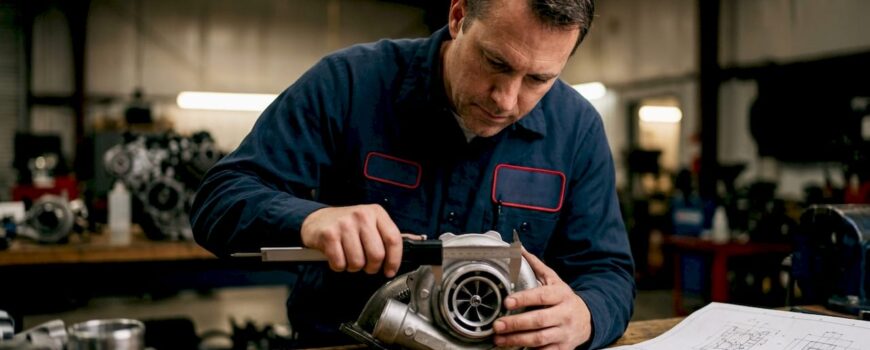
The exhaust system in a forced induction engine is defined as the primary mechanism controlling backpressure across the turbocharger turbine, directly determining how much power the engine produces. Get this wrong, and you lose horsepower before the engine even reaches peak boost. Get it right, and the turbo spools faster, the engine breathes freely, and power delivery feels immediate. Understanding the role of exhaust in forced induction is the difference between a car that performs and one that merely runs. Every enthusiast who owns a turbocharged Audi, BMW, Ferrari, or Lamborghini needs to know how exhaust flow shapes the entire forced induction equation.
How does exhaust backpressure affect turbocharger performance?
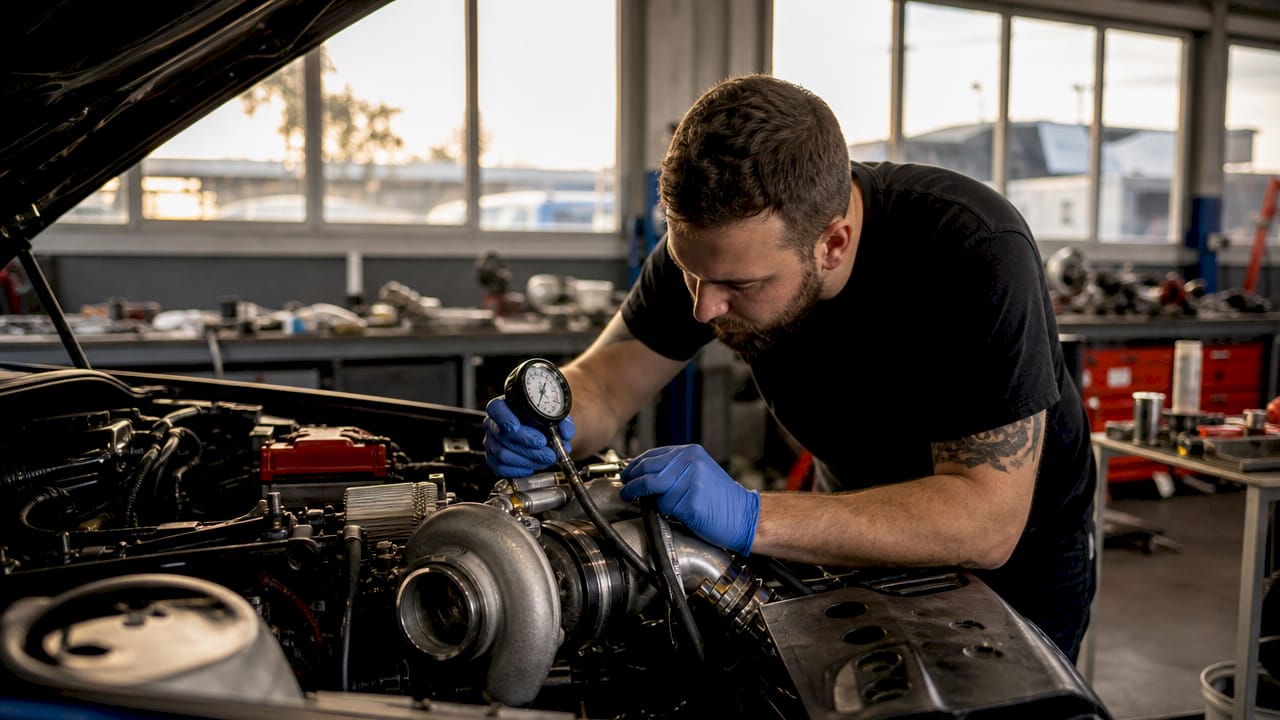
Exhaust backpressure is the resistance the exhaust gas meets as it exits the engine and passes through the turbine housing. Backpressure above 1.5–2 bar in a turbocharged engine disrupts turbine efficiency, spikes drive pressure, and commonly causes turbocharger failure. That threshold is not arbitrary. It marks the point where the turbine wheel slows down, boost pressure drops, and the engine starts fighting itself.
The power losses from excessive backpressure are real and measurable. Flow restrictions opposing boost typically cause power losses of 20–40 HP. That is a significant chunk of output gone before you even touch the throttle. The engine is working harder to push exhaust out while simultaneously trying to force more air in.
Here is the counterintuitive part: zero backpressure is not the goal. Controlled backpressure maintains gas velocity through the turbine, which accelerates the turbine wheel and reduces turbo lag. Think of it like water pressure in a hose. Remove all restriction and the flow loses velocity. The right amount of restriction keeps the gas moving fast enough to spin the turbine efficiently.
Pro Tip: If your turbocharged car feels sluggish at low RPMs despite a recent exhaust upgrade, the downpipe may be too large for your turbo size. Oversized pipes kill gas velocity at low load, making lag worse, not better.
The key variables that determine whether backpressure helps or hurts are:
- Turbine housing size: Smaller housings build backpressure faster, improving low-RPM spool but restricting top-end power.
- Downpipe diameter: Larger downpipes reduce restriction after the turbine, but only once exhaust gases have already done their work spinning the wheel.
- Exhaust temperature: Hotter gases expand faster and move through the system with more energy, reducing effective backpressure at high load.
- Engine displacement and boost level: Higher boost engines produce more exhaust mass flow, requiring larger downstream pipes to avoid restriction.
Understanding how exhaust affects turbo spool is the foundation for every smart exhaust decision you make on a forced induction build.
What are the critical design elements of forced induction exhaust systems?
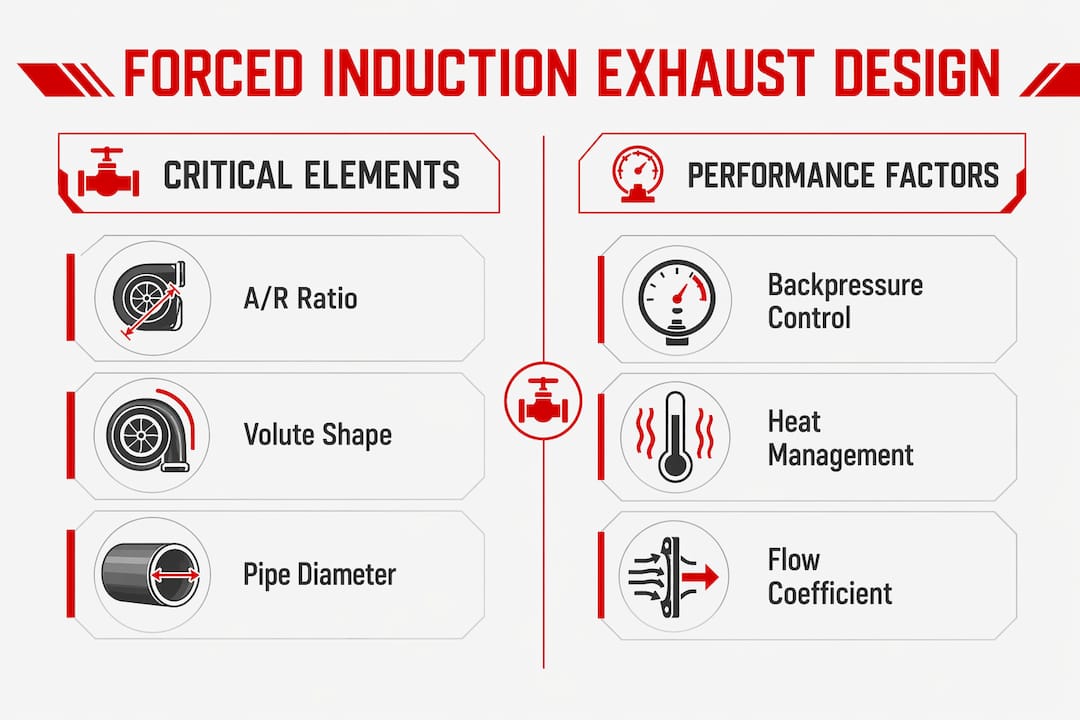
The exhaust housing on a turbocharger is not just a metal shell. The A/R ratio and volute shape determine how effectively exhaust gases convert thermal energy into turbine shaft work, directly impacting spool speed and peak power output. A lower A/R ratio builds boost earlier but chokes flow at high RPM. A higher A/R ratio allows more flow at the top end but takes longer to spool.
Variable Turbine Geometry (VTG) technology solves this trade-off by changing the effective A/R ratio across the RPM range. VTG adjusts the angle of the vanes inside the turbine housing, giving you fast spool at low RPM and unrestricted flow at high RPM. This technology is standard on many diesel turbos and increasingly common in high-performance gasoline applications.
Pipe diameter is the other major design variable, and forced induction engines demand more than naturally aspirated engines. A 2.5-inch exhaust supports approximately 660 HP in a forced induction application compared to 565 HP in a naturally aspirated engine at the same diameter. The difference comes from the higher exhaust flow coefficient: forced induction engines carry an exhaust flow coefficient of approximately 135 versus 115 for naturally aspirated engines. That gap means you need larger pipes sooner when boost is in the equation.
| Design element | Naturally aspirated | Forced induction |
|---|---|---|
| Exhaust flow coefficient | ~115 | ~135 |
| 2.5-inch pipe HP capacity | ~565 HP | ~660 HP |
| Typical downpipe diameter | 2.0–2.5 inches | 3.0–3.5 inches |
| Turbine housing priority | Scavenging | Pressure differential control |
Pro Tip: When sizing a downpipe, match the diameter to your power target, not your turbo size. A 3.0-inch downpipe suits most builds up to 500 HP. Step to 3.5 inches only when you are pushing beyond that threshold.
Primary pipes leading to the turbo inlet should stay sized for quick spool. Larger downpipes reduce backpressure after the turbine without hurting low-end response, because the turbine has already extracted energy from the gas by that point. The design logic is sequential: tight before the turbine, open after it.
Heat management is the third pillar of forced induction exhaust design. Turbocharged engines run hotter exhaust temperatures than naturally aspirated engines because the turbo itself adds thermal load. Proper heat shielding and high-temperature coatings on the exhaust manifold and turbine housing protect surrounding components and maintain consistent gas density through the system.
What impact do exhaust upgrades have on forced induction vehicles?
Performance exhaust upgrades improve horsepower and torque by reducing backpressure and improving combustion efficiency, but they require tuning to deliver those gains safely. Bolt on a free-flowing downpipe without a retune and you may actually lose power at certain RPM ranges because the ECU fuel and ignition maps were calibrated for the original exhaust restriction. The hardware change and the software change must happen together.
Sound is the variable most enthusiasts underestimate. A straight-pipe exhaust on a turbocharged BMW or Audi sounds nothing like the same setup on a naturally aspirated engine. The turbo acts as a natural silencer, absorbing a significant portion of the combustion noise. What comes out the other end is a different character: more whoosh, more flutter, less raw bark. Midpipe and resonator strategies often better balance sound control versus outright free flow, giving you a usable daily driver without sacrificing performance.
Valve-controlled exhaust systems solve the sound problem directly. Valvecontrolexhaust builds systems with adjustable valves that let you switch between a quiet mode for city driving and an open mode for track use. This approach is particularly effective on forced induction cars because the turbo already filters the harshest frequencies. The valve adds a second layer of control, letting you shape the sound character without touching the flow characteristics that matter for turbo efficiency.
The practical upgrade priorities for a forced induction exhaust build are:
- Downpipe first: The section between the turbo outlet and the catalytic converter is the single highest-restriction point in most factory exhaust systems. A high-flow or catless downpipe delivers the most immediate power gain.
- Cat-back second: Replacing the mid-pipe, resonator, and muffler improves flow downstream and shapes the sound profile.
- Tune third: A proper ECU remap after both hardware changes extracts the full power potential and protects the engine.
- Valve control last: Adding a valve-controlled system at the cat-back stage gives you long-term sound flexibility without compromising the flow gains from the downpipe.
Pro Tip: Always check emissions regulations in your state before removing or replacing catalytic converters. Many states enforce CARB standards, and a non-compliant downpipe can result in a failed inspection even on a track-focused build.
What are the common pitfalls in forced induction exhaust management?
The most destructive mistake in forced induction exhaust management is ignoring downstream restrictions. A clogged Diesel Particulate Filter (DPF) is one of the most common causes of repeated turbocharger failure. Owners replace the turbo, drive a few thousand miles, and the new unit fails again. The DPF was the real problem the entire time. Measuring DPF differential pressure before any turbo replacement is the diagnostic step that prevents this cycle.
- Skipping a pre-upgrade baseline. Before changing any exhaust component, log your boost pressure, exhaust gas temperature, and backpressure. Without a baseline, you cannot measure whether the upgrade actually worked.
- Choosing pipe diameter by feel rather than flow math. Bigger is not always better. Use an exhaust flow calculator to match pipe diameter to your actual power target and engine displacement.
- Ignoring heat after a downpipe upgrade. Aftermarket downpipes often sit closer to the firewall or floor pan than the factory unit. Without proper heat shielding, interior temperatures rise and wiring looms can be damaged.
- Tuning once and forgetting it. Exhaust systems age. Gaskets blow, joints corrode, and flow characteristics change. Re-check your tune after 20,000 miles or any additional modification.
Pro Tip: On diesel-powered forced induction vehicles, install a DPF differential pressure sensor if one is not already fitted. Real-time pressure data tells you exactly when the filter is approaching restriction levels, long before it damages the turbo.
Treating exhaust modifications as isolated changes is the root cause of most problems. Exhaust geometry and pipe sizing require tuning to match an engine’s specific forced induction characteristics. The exhaust, the turbo, the ECU, and the fueling system are one interconnected system. Change one element without accounting for the others and you introduce unpredictable behavior. The turbo exhaust efficiency guide from Valvecontrolexhaust covers this systems-level thinking in detail for enthusiasts planning a full build.
Key Takeaways
The exhaust system in a forced induction engine controls backpressure, turbine efficiency, and ultimately how much power reaches the wheels.
| Point | Details |
|---|---|
| Backpressure has a safe limit | Backpressure above 1.5–2 bar disrupts turbine efficiency and causes 20–40 HP losses. |
| Controlled backpressure beats zero backpressure | Maintaining gas velocity through the turbine reduces lag and improves spool speed. |
| Pipe sizing follows power targets | Forced induction engines need larger diameters; 3.0–3.5-inch downpipes suit most builds. |
| Tune after every hardware change | ECU remapping after exhaust upgrades is required to realize power gains safely. |
| DPF health prevents turbo failure | Measuring DPF differential pressure before turbo replacement stops repeated failures. |
Why bigger pipes alone will not save your turbo
The exhaust conversation in forced induction circles almost always drifts toward pipe diameter. Bigger downpipe, bigger cat-back, maximum flow. I understand the logic. Restriction is the enemy, so remove it. But this thinking misses the most important variable: where in the system the restriction lives and what it is doing there.
The turbine housing is a deliberate restriction. It is designed to build the pressure differential that spins the turbine wheel. Remove too much restriction downstream and you reduce the pressure ratio across the turbine. The turbo spools slower, not faster. I have seen enthusiasts fit 4-inch downpipes to relatively small turbos and then complain about lag that was not there before the upgrade. The pipe was too large for the turbo’s operating range.
What actually works is precision. Match the downpipe diameter to the turbo’s flow capacity. Use Variable Turbine Geometry or a valve-controlled exhaust to manage the system across the full RPM range. Then tune the ECU to match. The benefits of valve-controlled exhaust go beyond sound. On a forced induction car, the ability to modulate exhaust flow in real time is a genuine performance tool, not just a noise preference.
Real-world testing on the road and track will always tell you more than dyno numbers alone. Exhaust systems behave differently under sustained load, varying temperatures, and real driving conditions. Log your data, test in conditions that match how you actually drive, and adjust from there. That process is slower than bolting on the biggest pipe available. It is also the only process that reliably produces a faster, more reliable car.
— Info
Valvecontrolexhaust: exhaust systems built for forced induction
Forced induction vehicles demand exhaust systems that do more than flow freely. They need precise backpressure management, heat resistance, and sound control that works across every driving condition.

Valvecontrolexhaust designs valve-controlled exhaust systems specifically for high-performance turbocharged and supercharged vehicles including Audi, BMW, Ferrari, and Lamborghini. The adjustable valve technology lets you control sound and flow in real time, from quiet city driving to full open on track. Before you choose a system, the performance exhaust buyer’s guide covers the design features that matter most for forced induction applications. For a deeper comparison of valved systems, the critical analysis of leading valved exhausts gives you the detail needed to make a confident decision.
FAQ
What is the role of exhaust in forced induction?
The exhaust manages the pressure differential across the turbocharger turbine, controlling how fast the turbine spins and how much boost the engine produces. Balanced backpressure improves gas velocity and reduces turbo lag.
How much backpressure is too much for a turbo?
Backpressure above 1.5–2 bar in a turbocharged engine disrupts turbine efficiency and commonly leads to turbocharger failure, with typical power losses of 20–40 HP.
What downpipe size do I need for a forced induction build?
Most forced induction builds use downpipes in the 3.0–3.5-inch range. Match the diameter to your power target rather than your turbo size, and always retune the ECU after fitting a new downpipe.
Can a clogged DPF destroy a turbocharger?
Yes. A clogged DPF creates excessive downstream backpressure that overloads the turbo. Measuring DPF differential pressure before replacing a failed turbo prevents the new unit from failing for the same reason.
Do I need to retune after an exhaust upgrade?
A retune is required after any exhaust modification on a forced induction engine. The factory ECU maps are calibrated for the original exhaust restriction, and a new tune extracts the full power gain while protecting the engine.