
An exhaust controller module is an electronic device that lets you manually open or close your car’s exhaust valves to change sound and performance on demand. In the performance automotive world, this hardware is also called an active exhaust valve controller. The role of exhaust controller module technology goes far beyond a simple volume knob. It gives you real-time authority over your exhaust system, independent of whatever your factory ECU decides to do. For owners of vehicles like Audi, BMW, Ferrari, and Lamborghini, that independence is the entire point.
How does an exhaust controller module work?

An exhaust controller module connects directly to your factory valve motor harness without cutting a single wire. That plug-and-play connection is the foundation of the system’s appeal: you install it, and you own the valves. The module intercepts the signal between the ECU and the valve actuator, then substitutes your manual input for the factory logic.
Here is how the core functions break down:
- Manual valve control. You open or close the valves using a dedicated remote or your vehicle’s existing buttons. No app required, no drive mode dependency.
- Dual output support. Most quality modules control two valves simultaneously, which matters on V8 and V12 platforms where left and right banks each carry a valve.
- Programmable startup mode. You set whether the valves open or stay closed when the engine starts. This is the feature that solves the cold-start noise complaint in residential neighborhoods.
- “Last state” memory. High-end modules retain the valve position you chose before shutdown and restore it at the next startup. That means you never have to reprogram after every drive.
- CAN bus isolation. Quality controllers install without interfering with the vehicle’s CAN bus, so no error codes appear on your dashboard.
Pro Tip: Program your startup mode to “closed” if you park in a garage or a quiet street. You get the quiet cold start, then open the valves the moment you want the full sound.
What is the difference between hardware controllers and software exhaust module programming?
Hardware controllers and software calibrations solve the same problem from opposite directions. Understanding which one fits your situation prevents expensive mistakes.
A hardware exhaust controller is a physical device. It overrides the valve actuator signal manually, giving you 100% real-time control independent of any software update your dealer might push. The factory ECU never knows you changed anything, because the module sits between the ECU and the actuator.
Software calibrations work differently. They reprogram the factory ECU’s valve logic to change when and how the valves open automatically. A software update might make your BMW M3’s valves open earlier in Sport mode or add a startup rumble sequence. The behavior is automatic and tied to drive mode selection. You do not manually trigger it each time.
| Approach | Control type | Responds to ECU updates | Best for |
|---|---|---|---|
| Hardware controller | Manual, real-time | No | Drivers who want on-demand control |
| Software calibration | Automatic, mode-based | Yes | Drivers who want enhanced factory behavior |
| Combined setup | Both | Partial | Track and street dual-use vehicles |
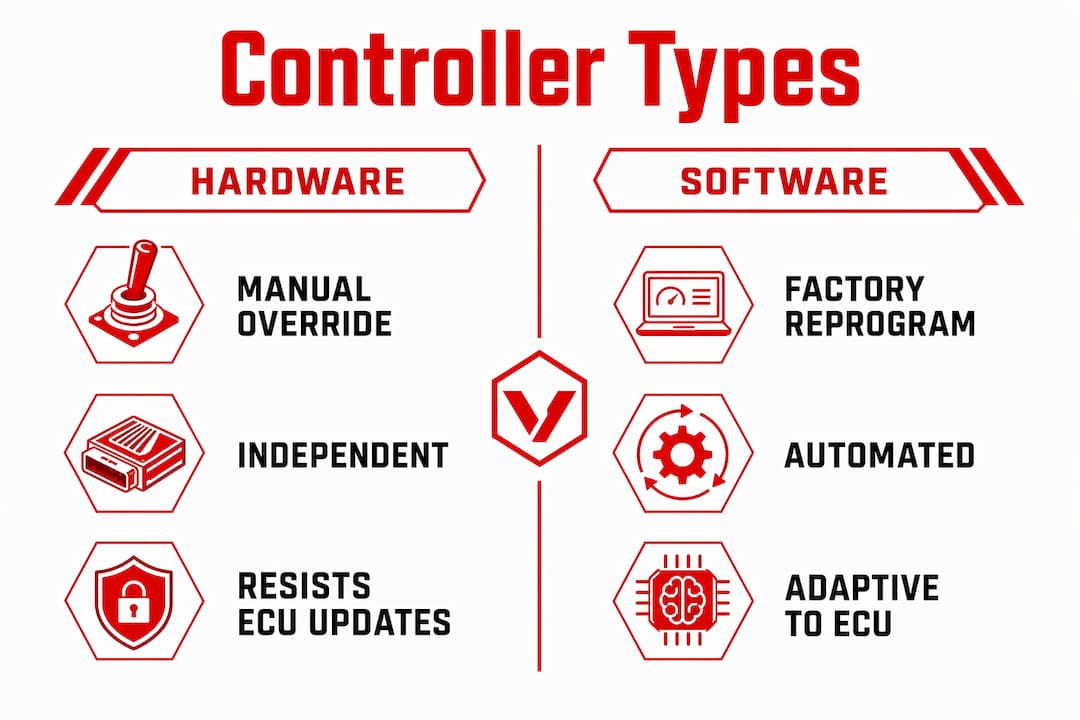
The practical tradeoff is clear. Software calibrations feel factory-smooth but surrender control to the ECU. Hardware controllers give you full authority but require you to actively manage valve position. Neither approach is wrong. They serve different driving styles.
Pro Tip: If your vehicle receives over-the-air software updates, a hardware controller protects your exhaust behavior from being reset. Software calibrations can be overwritten by a dealer service visit.
How do exhaust controllers differ from valve simulators and mechanical deletes?
This is where most enthusiasts get confused, and the confusion is costly. Industry professionals warn that mixing up simulators and controllers leads directly to permanent loud exhaust states that cannot be reversed without additional hardware.
Here is what each option actually does:
- Exhaust controller module. Actively opens and closes the valve on your command. You have full, real-time control over sound level at any moment during the drive.
- Valve simulator. A passive device that mimics the actuator’s electrical signal to prevent ECU fault codes after the physical valve has been removed. It does not move anything. The exhaust is permanently open, and the ECU simply does not know the valve is gone.
- Mechanical valve delete. A physical modification that removes the valve butterfly entirely. The pipe stays open all the time. Sound is always at maximum, and there is no going back without replacing hardware.
The consequence of choosing a simulator when you wanted a controller is a car that is always loud. That works on a dedicated track car. It does not work on a daily driver in a city with noise ordinances. Controllers give you the choice. Simulators and deletes remove it permanently.
A second risk applies specifically to software-based exhaust flap deletions. The actuator plug must be physically disconnected after a software delete is applied. Leaving it connected causes residual electrical activity that damages the actuator over time and triggers ECU errors. This detail gets overlooked constantly by enthusiasts who assume the software change is sufficient on its own.
What are the practical benefits, limitations, and installation considerations?
The benefits of an exhaust control module are concrete and well-documented among performance car owners. Here is what you actually get:
- Sound customization on demand. Open the valves for a full-throated note on the highway, close them for a civil tone in traffic. The same car, two completely different characters.
- Reversible installation. Because the module uses plug-and-play connectors, removal leaves no trace. This matters for lease returns and warranty situations.
- No CAN bus interference. The module does not write to the vehicle’s network. Other systems, including traction control, stability management, and infotainment, remain untouched.
- Independence from drive mode. The valves stay where you put them regardless of whether you switch between Comfort, Sport, and Race modes.
- Programmable startup behavior. You decide whether the car wakes up quiet or loud every single morning.
The limitations deserve equal attention. Active exhaust systems balance sound and emissions, and aggressive manual override can conflict with factory emissions cycles if the valves are held open during conditions where the ECU expects them closed. This is not a daily concern for most street drivers, but it matters on vehicles with strict emissions monitoring. Additionally, controller modules primarily improve sound and control. Performance tuner Charlotte Dawson notes that true horsepower gains require ECU tuning alongside exhaust hardware. The module alone does not add power.
Installation cost for quality plug-and-play units typically falls in the $269–$350 range, with IP68-rated waterproof systems at the higher end of that band. Most experienced enthusiasts complete the install in under two hours. Professional fitting adds labor cost but removes any risk of wiring errors.
Pro Tip: Route the controller’s wiring away from exhaust heat sources and secure it with heat-resistant loom. The module itself is rated for engine bay conditions, but the harness routing determines long-term reliability.
Key Takeaways
An exhaust controller module gives you real-time, manual authority over your exhaust valves, independent of factory ECU logic, software updates, and drive mode settings.
| Point | Details |
|---|---|
| Hardware vs. software | Controllers override the ECU manually; software calibrations modify automatic valve behavior tied to drive modes. |
| Controllers vs. simulators | Controllers actively move valves on demand; simulators only prevent fault codes after valve removal. |
| Reversible installation | Plug-and-play design leaves no trace and avoids CAN bus interference, protecting warranty and resale value. |
| Startup programming | Set valve position at startup to manage cold-start noise without sacrificing full sound when you want it. |
| Power gains require more | Sound and control improve immediately; real horsepower increases require ECU tuning alongside valve control. |
Why I think most enthusiasts underestimate what these modules actually do
Most people treat an exhaust controller as a sound switch. That framing undersells it significantly. What you are actually installing is a layer of acoustic and backpressure management that sits between you and the factory’s compromises.
Manufacturers tune exhaust valve behavior for regulatory compliance, noise ordinances, and the median customer. That median customer is not you. When you drive a Ferrari 488 or a BMW M5, you bought a car that was deliberately quieted for markets that would not accept the full sound. The controller module restores the decision to you.
The backpressure dimension gets ignored in most discussions. Exhaust controllers affect backpressure balance across the RPM range, not just decibel output. Holding valves open at low RPM changes how the engine breathes at that moment. It is a subtle effect on a street car, but it is real. Enthusiasts who understand this use valve position as a tuning variable, not just a volume dial.
The future direction I find genuinely interesting is integration with advanced engine management platforms. Systems like MoTeC already coordinate exhaust valve behavior with fuel mapping and timing. As aftermarket controllers develop CAN bus communication capabilities, the line between a simple override module and a full exhaust management node will blur. The enthusiasts who understand the hardware now will be positioned to use those systems well.
— Info
Valvecontrolexhaust: precision valve control for high-performance vehicles
Valvecontrolexhaust builds exhaust valve control systems specifically for vehicles like Audi, BMW, Ferrari, and Lamborghini. Every system is designed for plug-and-play installation with no CAN bus interference and full programmability for startup behavior and valve position memory.

If you are comparing options before committing, the premium aftermarket systems guide at Valvecontrolexhaust covers the full range of high-end valve control exhaust solutions side by side. For drivers who want to understand exactly what variable valve exhaust delivers over a fixed system, that resource answers the question in full technical detail. Valvecontrolexhaust also offers direct consultation for enthusiasts who want a recommendation matched to their specific vehicle and driving style.
FAQ
What does an exhaust controller module do?
An exhaust controller module lets you manually open or close your car’s exhaust valves in real time, independent of the factory ECU. It connects to the valve motor harness using plug-and-play connectors and requires no wire cutting.
Is a valve simulator the same as an exhaust controller?
No. A valve simulator passively mimics the actuator signal to prevent fault codes after a valve is removed, while a controller actively moves the valve on your command. Confusing the two results in a permanently open exhaust with no volume control.
Will an exhaust controller module trigger warning lights?
Quality plug-and-play controllers install without interfering with the CAN bus, so no error codes appear on the dashboard. The module intercepts the actuator signal before it reaches the ECU, keeping the factory system unaware of the override.
Does an exhaust controller add horsepower?
A controller module improves sound and valve control but does not add meaningful power on its own. Real horsepower gains require ECU tuning alongside exhaust hardware changes.
What is “last state” memory on an exhaust controller?
“Last state” memory is a feature that saves your valve position before engine shutdown and restores it automatically at the next startup. It eliminates the need to reprogram your preferred setting after every drive.