Race mode exhaust configuration is the active control of exhaust valves to maximize sound output and engine performance during spirited or track driving. Opening exhaust valves in race mode reduces backpressure, which directly increases horsepower and torque. The industry term for this technology is “active exhaust” or “valve-controlled exhaust,” and Valvecontrolexhaust has built its entire product line around it. Getting this setup right means understanding the hardware, the tuning process, and the tradeoffs between track aggression and daily comfort.
What is race mode exhaust configuration and how does it work?
Race mode exhaust configuration is the process of setting active exhaust valves to their fully open position, allowing maximum exhaust flow and producing the loudest, most aggressive sound profile the system can deliver. Butterfly valves control flow to outside outlets, and in race mode, those valves open completely. The result is a direct path for exhaust gases, which lowers backpressure and frees up power that a restricted system would otherwise absorb.
Valve-controlled exhausts combine aggressive race track sound with quieter daily driving modes, giving you a single system that works across every driving scenario. That dual capability is what separates active exhaust from a fixed aftermarket pipe. You get track-level noise and power on demand, and you can dial it back for a neighborhood cruise without swapping hardware.

Race mode often disables stability controls like ESC and Forward Collision Control alongside the exhaust valve change. That means activating race mode is not just an audio decision. It is a full vehicle dynamics shift, and you need to treat it that way.
What components and tools do you need for a race mode exhaust setup?
The right hardware is non-negotiable before you touch any software settings. A race mode setup requires active exhaust valves, a compatible ECU or valve controller, wideband oxygen sensors, exhaust gas temperature sensors, and quality heat shielding throughout the system. Skipping any of these creates gaps that show up as power loss, sensor faults, or premature hardware failure.
Core hardware components
- Active exhaust valves: Electrically or vacuum-actuated butterfly valves that open and close based on mode selection
- ECU tuning software: Required for remapping air-fuel ratios after any pipe diameter change
- Wideband oxygen sensors: Custom exhaust builds need wideband O2 sensors for accurate tuning and engine protection
- Exhaust gas temperature sensors: Monitor heat levels to prevent damage during sustained high-RPM driving
- Heat shielding: Protects wiring, sensors, and surrounding components from exhaust heat
Tool and role reference
| Tool | Role in setup |
|---|---|
| Active valve controller | Switches exhaust between quiet, sport, and race modes |
| Wideband O2 sensor | Reads air-fuel ratio in real time for safe tuning |
| ECU remap software | Adjusts fueling and ignition after hardware changes |
| Exhaust temp sensor | Prevents overheating during track sessions |
| Diagnostic scanner | Reads fault codes and confirms sensor function |
Pro Tip: Before buying any valve controller, confirm it supports your vehicle’s CAN bus protocol. Incompatible controllers cause communication errors that no amount of tuning will fix.
Compliance matters too. Check local noise ordinances and emissions regulations before locking in a race mode configuration for street use. Some jurisdictions treat open-valve exhaust systems as a noise violation even if the hardware is otherwise legal.
Step-by-step guide to configuring race mode exhaust for sound and performance
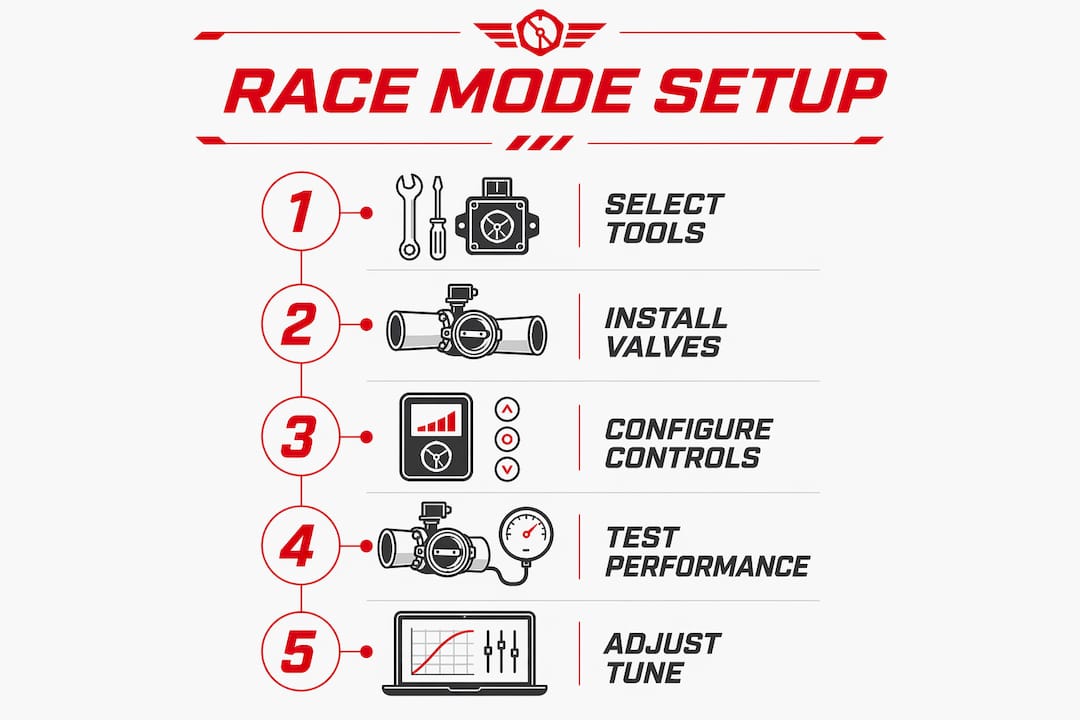
Follow this process in order. Skipping steps creates compounding problems that are harder to diagnose later.
-
Run baseline diagnostics. Connect a diagnostic scanner and clear any existing fault codes. Record baseline horsepower, torque, and air-fuel ratio data. You need a clean starting point to measure gains accurately.
-
Inspect all physical hardware. Check valve actuators, wiring harnesses, and sensor connections. Loose connectors and cracked heat shielding cause intermittent faults that mimic tuning errors.
-
Calibrate the valve controller. Set valve open and close positions using the controller’s calibration mode. Most systems require you to define the fully open angle for race mode and the partially closed angle for street or comfort modes.
-
Adjust exhaust flow settings. Activating race mode fully opens butterfly valves for maximum flow. Confirm the valves reach full open position under load, not just at idle.
-
Remap the ECU if pipe diameter changed. Wide-diameter piping alters air-fuel ratios and requires an ECU remap. Use wideband O2 sensor data to guide the tune. A lean condition at high RPM is an engine-damaging outcome you can avoid with proper mapping.
-
Set your sound profile. Most valve control systems let you define sound maps per mode. Start with a moderately aggressive race setting rather than maximum flow. You can always open the valves further, but drone at highway speeds is difficult to live with.
-
Verify with a test drive. Drive through the full RPM range in race mode. Listen for drone between 2,000–3,500 RPM, which signals excessive flow for your pipe diameter. Monitor sensor data live during the drive.
-
Log and review data. Pull post-drive logs from your ECU and O2 sensors. Confirm air-fuel ratios stayed within target range throughout the drive. Adjust fueling if readings drifted lean or rich under load.
Pro Tip: Run your first race mode test on a private road or track. Public road testing at full valve open exposes you to noise enforcement and makes it harder to focus on sensor data.
Common mistakes and how to troubleshoot race mode exhaust problems
Most race mode problems trace back to three root causes: misconfigured valve timing, uncorrected air-fuel ratios after hardware changes, and deferred maintenance on valve actuators.
- Drone at cruising speed: Caused by valves set too far open for street driving. Reduce the valve open angle in comfort and sport modes. Reserve full open for race mode only.
- Power loss after modification: Usually a sign of an uncorrected air-fuel ratio. Ignoring ECU mapping after exhaust changes causes lean or rich conditions that cut power and risk engine damage.
- Check engine light after valve install: Typically an O2 sensor fault. Confirm sensor placement matches the ECU’s expected location and that wideband sensors are properly calibrated.
- Inconsistent sound between drives: Points to a valve actuator binding or a loose electrical connection. Regular valve maintenance prevents binding and keeps operation consistent.
- No mode change response: Check the CAN bus connection between the valve controller and the vehicle’s ECU. A communication fault prevents mode switching entirely.
“Treat every exhaust hardware change as a tune-and-validation process. The hardware is only half the job. The tune is what makes it safe and fast.” — Valvecontrolexhaust technical guidance
When symptoms persist after basic checks, consult a specialist with a dyno and live ECU logging capability. Guessing at fueling corrections without data creates new problems faster than it solves existing ones. You can find a structured troubleshooting reference for valve control systems that covers the most common fault patterns in detail.
How do aftermarket exhaust options interact with race mode configurations?
Aftermarket exhaust options fall into three main categories, and each one changes how race mode performs. Cat-back, axle-back, and turbo-back systems each influence backpressure, volume, and compatibility with active valve setups differently. Choosing the wrong category for your tuning goals creates mismatches that no valve calibration will fully correct.
Exhaust category comparison
| Exhaust type | Flow impact | Race mode compatibility | ECU remap needed |
|---|---|---|---|
| Axle-back | Low to moderate | High, minimal tuning required | Rarely |
| Cat-back | Moderate to high | High, may need O2 sensor update | Sometimes |
| Turbo-back | High | Requires full ECU remap | Always |
Wider pipe diameters increase flow but reduce exhaust velocity at low RPM. That velocity drop hurts torque in the low-to-mid RPM range, which is exactly where street driving happens most. Wideband O2 sensors and custom tunes are non-negotiable when you move to larger diameter piping.
Emissions compliance is a real constraint. Removing catalytic converters for a turbo-back setup makes the vehicle non-compliant with EPA regulations in most U.S. states. California’s CARB standards are stricter still. Check compliance before purchasing any system that modifies or removes emissions equipment.
A balanced exhaust configuration that prioritizes drone control can outperform the loudest, highest-flow setup in real-world use. Consistent performance with less fatigue beats peak numbers that are uncomfortable to live with daily. When selecting aftermarket parts, match the pipe diameter and flow rate to your actual driving profile, not just your track ambitions.
Pro Tip: If you drive your performance car daily, an axle-back or cat-back system with active valves gives you the best balance. Save the turbo-back for dedicated track builds.
Key Takeaways
A properly configured race mode exhaust system delivers measurable power gains and a controlled sound profile only when hardware, valve calibration, and ECU tuning are treated as a single integrated process.
| Point | Details |
|---|---|
| Valve position drives everything | Race mode fully opens butterfly valves, reducing backpressure and increasing power output. |
| ECU remap is mandatory after pipe changes | Wide-diameter piping shifts air-fuel ratios and requires a proper tune to protect the engine. |
| Drone control beats maximum flow | A slightly less aggressive valve setting delivers consistent real-world performance with less fatigue. |
| Maintenance prevents inconsistency | Regular valve lubrication and inspection stop binding that causes unpredictable sound and mode failures. |
| Match exhaust type to driving profile | Axle-back and cat-back systems suit daily drivers; turbo-back setups belong on dedicated track cars. |
What I’ve learned from years of watching enthusiasts get this wrong
The most common mistake I see is treating race mode as a switch rather than a system. Enthusiasts install a valve controller, flip it to race mode, and call it done. Then they wonder why the car drones on the highway, throws an O2 sensor code, or feels flat above 4,000 RPM.
The tune-and-validate approach changes everything. Every hardware change shifts the engine’s operating parameters. Skipping the ECU remap after a cat-back install is like changing tire size without recalibrating the speedometer. The car runs, but nothing is accurate.
The tradeoff between track aggression and daily comfort is real, and I think most enthusiasts underestimate it until they’ve lived with a fully open valve setup for a week. Choosing slightly less aggressive flow achieves consistent performance with less driving fatigue. That is not a compromise. That is the smarter setup.
Maintenance is the part nobody talks about until something breaks. Valve actuators bind. Connections corrode. A system that sounded perfect at installation will drift over time without regular inspection and lubrication. Build a maintenance schedule into your ownership plan from day one, not after the first failure.
The enthusiasts who get the most out of race exhaust tuning are the ones who treat it as an ongoing process. They log data, adjust settings, and revisit the tune after every significant change. That iterative mindset is what separates a great setup from a frustrating one.
— Info
Valvecontrolexhaust systems for your race mode setup
Valvecontrolexhaust builds active valve exhaust systems specifically for high-performance vehicles including Audi, BMW, Ferrari, and Lamborghini. Each system gives you real-time control over exhaust sound and flow, switching between quiet street behavior and full race mode output without hardware changes.
If you are deciding which system fits your build, the customizable exhaust guide covers how active valve systems match different driving profiles and tuning goals. For model-specific fitment, the valve control compatibility guide lists confirmed applications across the most popular performance platforms. Valvecontrolexhaust also provides tuning support to help you get the valve calibration and sound profile dialed in correctly from the start.
FAQ
What does race mode do to exhaust valves?
Race mode fully opens the butterfly valves inside an active exhaust system, removing backpressure restrictions and producing maximum flow and sound output.
Do I need an ECU remap for race mode exhaust tuning?
An ECU remap is required any time you change pipe diameter or remove emissions equipment. Valve-only changes on stock piping typically do not require a remap.
What causes exhaust drone in race mode?
Drone occurs when exhaust valves are set too far open for the pipe diameter and driving speed, usually in the 2,000–3,500 RPM range. Reducing the valve open angle in street modes eliminates most drone.
How often should I service valve control exhaust components?
Regular lubrication and inspection of valve actuators prevents binding and maintains consistent sound and performance. Inspect the system at every oil change interval.
Are aftermarket exhaust options street legal in race mode?
Legality depends on your state and the specific hardware. Turbo-back systems that remove catalytic converters are not street legal in most U.S. states. Axle-back and cat-back systems with active valves are generally compliant when emissions equipment remains intact.