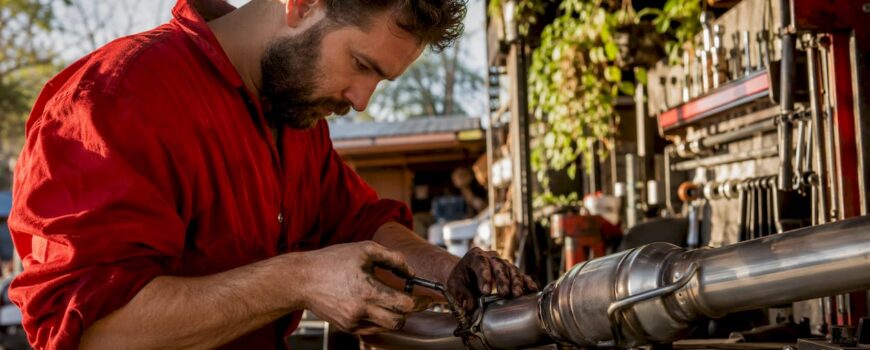
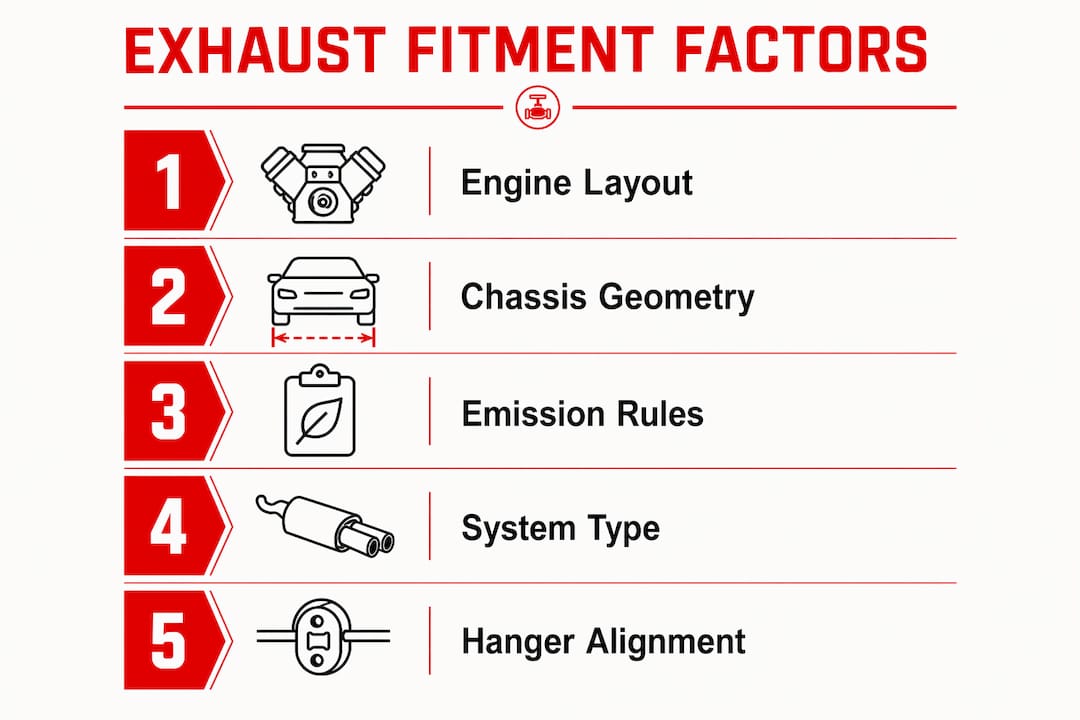
Exhaust fitment varies by model because the fit is dictated by engine architecture, chassis packaging, and emissions or drivetrain variants — not by a generic model name. Two cars wearing the same badge can require completely different systems if one runs a turbocharged inline-six and the other a naturally aspirated V8, or if one is AWD and the other is rear-drive.
Before you order anything, pull three pieces of information:
- VIN and exact engine code (not just “3.0T” — the full alphanumeric stamped on the block or listed in your service record)
- Drivetrain configuration (2WD, 4WD, or AWD changes crossmember routing and clearance)
- Emission package (federal vs. CARB-compliant, which affects catalytic substrate requirements under EPA and California Air Resources Board rules)
Valvecontrolexhaust builds every system around these three variables, not around a model year alone. That distinction is what separates a plug-and-play install from a three-hour rework.
Pro Tip: Check your door jamb sticker for the production month, not just the model year. Mid-year manufacturing changes can shift hanger positions or flange angles enough to break a fit.
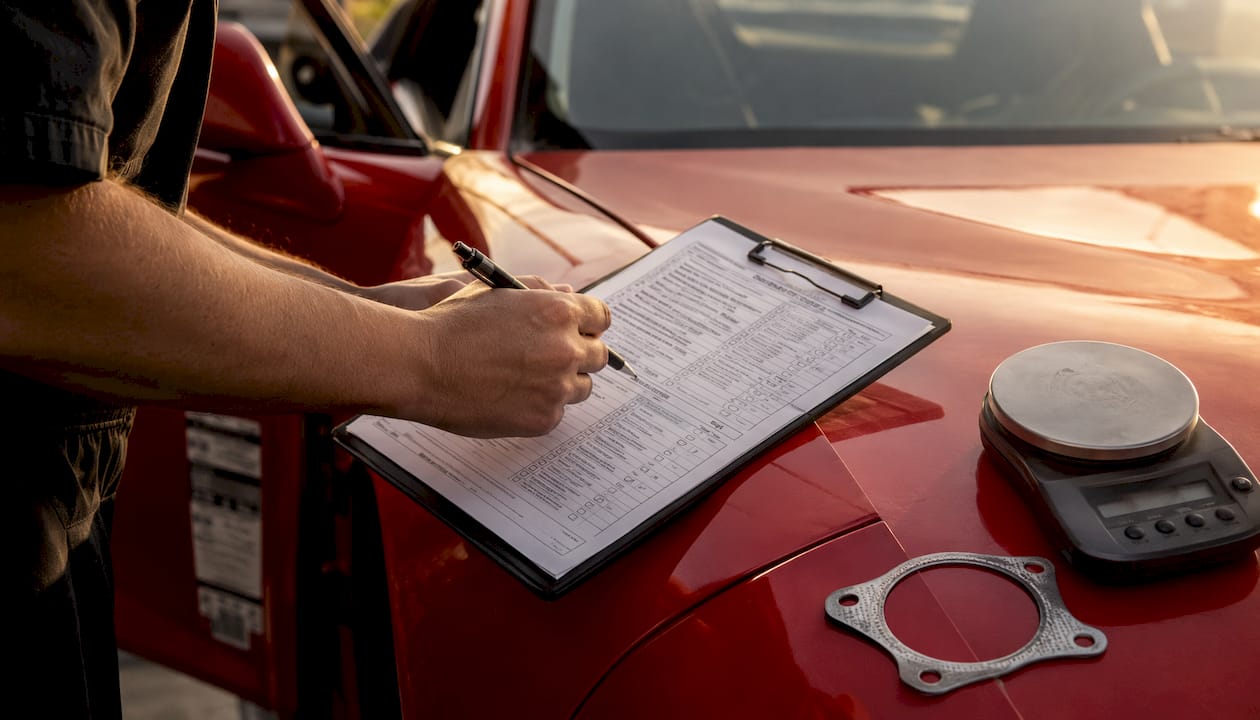
Table of Contents
- How engine layout and forced induction change what fits under your car
- Chassis and drivetrain variables that physically reroute your exhaust
- Why a truly universal exhaust cannot perform at a high level
- How fitment requirements differ across system types
- A fitment checklist to use before you buy or install
- U.S. emissions, OBD-II, and warranty implications
- What professional fitters check during installation
- Key Takeaways
- The fitment mistake most enthusiasts make once and never repeat
- Valvecontrolexhaust builds fitment into the system, not around it
- Useful sources
How engine layout and forced induction change what fits under your car
Engine configuration — cylinder count and bank arrangement — is the single biggest driver of exhaust layout. An inline-four routes its header collector straight back along the centerline. A flat-six on a Porsche 911 splits flow to both sides of the chassis. A V8 in a Ferrari 488 demands a Y-collector that has to clear the transaxle. Each geometry produces a different downpipe angle, a different flange position, and a different required pipe diameter.
Displacement and cylinder count also set the optimal pipe diameter for exhaust velocity and scavenging. Too large a diameter on a small-displacement engine kills low-end torque by dropping gas velocity below the threshold where the pressure wave can pull spent gases from the combustion chamber. Too small a pipe on a high-displacement engine creates backpressure that robs peak power.
Forced induction adds another layer. A turbocharged engine needs a downpipe that matches the turbo outlet flange precisely — bolt pattern, diameter, and sensor boss locations for the pre-cat O2 sensor. Naturally aspirated engines skip that flange entirely, so their headers and midpipes route differently from the start. Turbo outlet flanges on a BMW S58 and a Mercedes-AMG M177 are not interchangeable, even though both are twin-turbo inline-sixes of similar displacement. The underbody packaging around each engine dictates a unique bend pattern.
Pro Tip: Collect the turbo part number alongside the engine code. Turbo housing outlet diameter and flange style vary even within the same engine family across model years.
Chassis and drivetrain variables that physically reroute your exhaust
Wheelbase and body style change the pipe length between the catalytic converter and the rear axle. A coupe and a sedan on the same platform can differ in midpipe length, which shifts hanger location downstream. Trucks and SUVs add bed length and cab style as SKU-critical variables — mislabeling these causes high return rates because pipe length and hanger spacing are directly affected.
The drivetrain layout matters just as much. AWD systems run a front differential and transfer case that occupy underbody space a 2WD car leaves open. That hardware forces the exhaust to route around crossmembers and driveshafts that simply do not exist on the rear-drive version of the same model. Suspension travel on lowered or air-suspended luxury cars adds a clearance variable: a pipe that clears at ride height may contact a control arm at full droop.
Before ordering, physically inspect:
- Factory hanger locations and bracket style (welded vs. bolt-on)
- Spare-tire well or underfloor storage envelope that limits pipe diameter or routing
- Bumper cutout geometry and OEM tip exit angle, which must match aftermarket tip positioning
- Heat shield mounting points and any fuel or brake line proximity
Aftermarket hanger bushings can compensate for minor positional differences, but they cannot fix a pipe that is the wrong length.
Pro Tip: Photograph the underside of your car before ordering. A 30-second phone video of the factory hanger positions saves hours of rework if the new system arrives with different spacing.
Why a truly universal exhaust cannot perform at a high level
Universal exhausts are a practical myth for performance applications. Optimal scavenging, backpressure, and exhaust velocity require pipe diameter and length tuned to the engine’s displacement and power band — variables that differ by model. A universal pipe compromises all three.
Mandrel bending is where this becomes concrete. Mandrel-bent tubing preserves consistent inner diameter through every curve, so gas velocity stays constant. Crush-bent tubing collapses the cross-section at each bend, creating a restriction that costs power and changes the acoustic resonance of the system. Model-specific systems are mandrel-bent to the exact routing geometry of that chassis, which is why they perform and fit differently from a generic pipe. See real mandrel-bent examples to understand how routing geometry translates to measurable flow gains.
O2 and wideband AFR sensor placement is another reason fitment is model-specific. Pre-cat and post-cat sensor boss locations must align with the ECU’s expected signal timing. Move a sensor boss even a few inches from the OEM position and the ECU may read a false lean or rich condition, triggering a check-engine light or forcing an unwanted fuel trim adaptation.
- Scavenging: The pressure wave from one cylinder’s exhaust pulse helps pull gases from the next. Pipe length and diameter must be tuned to the engine’s RPM range for this to work.
- Backpressure: Too much restricts flow; too little on a small engine kills low-end torque.
- Velocity: Smaller diameter keeps velocity high at low RPM; larger diameter supports high-RPM flow.
- Sensor bosses: Must match OEM position within tight tolerances to avoid ECU faults.
Pro Tip: When a model-specific system is not available for a limited-production chassis, custom fabrication with a mandrel bender and a proper jig is the correct route — not a universal slip-fit with adapters.
How fitment requirements differ across system types
Each exhaust system type has its own set of fitment-critical points, and the complexity scales with how far forward the replacement starts.
| System type | Primary fitment points | Fitment sensitivity |
|---|---|---|
| Axle-back | Rear hanger spacing, tip diameter, tip exit angle | Low |
| Cat-back | Midpipe length, mid-hanger positions, tip alignment | Medium |
| Turbo-back / downpipe | Turbo outlet flange, sensor bosses, heat shielding, full routing | High |
| Valved system | All of the above, plus actuator mounts and control module wiring | High |
Cat-back systems retain the OEM catalytic converters, so fitment centers on midpipe length and hanger alignment. Axle-back systems are simpler but still require exact tip positioning — a 10mm offset on a Ferrari’s rear diffuser cutout is visible and wrong. Turbo-back swaps are the most demanding: the turbo outlet flange bolt pattern, the downpipe diameter, and every sensor boss location must match the specific turbocharger on that exact engine variant. Valved systems add actuator mounting brackets and a control module harness to that list, which is why Valvecontrolexhaust provides chassis-specific actuator mounting plans alongside each system.
A fitment checklist to use before you buy or install
Fitment errors most often happen when buyers order by model name rather than by the technical specs that actually determine fit. Use this checklist before placing any order:
- VIN, engine code, and production month — not just model year
- Drivetrain (2WD / AWD / 4WD) and transmission type
- Trim and option codes that affect exhaust routing (sport package, air suspension, tow package)
- Inlet/outlet diameter, flange bolt pattern, and pipe bend geometry matched against factory dimensions
- Hanger spacing measured from the axle centerline to each bracket
- Tip-to-bumper distance and bumper cutout dimensions
- Sensor types and locations (pre-cat O2, post-cat O2, wideband boss positions)
- Spare-tire or underfloor storage envelope that limits routing options
- Seller confirmation of wheelbase and cab/bed variant for trucks and SUVs
Exhaust fitment dimensions — inlet/outlet diameter, flange bolt pattern, bend geometry, and hanger locations — are the only reliable compatibility checks. Product photos and generic “model compatibility” lists are not.
Pro Tip: Ask the seller for sample fitment photos and factory OEM part numbers. If they cannot provide either, treat the listing as unverified.
U.S. emissions, OBD-II, and warranty implications
Retaining the OEM catalytic converters with a cat-back system is the most straightforward path to maintaining emissions legality and OBD-II compliance. The EPA and the California Air Resources Board (CARB) regulate catalytic converter replacement; a system without a CARB Executive Order (EO) number is not street-legal in California and several other states that follow CARB standards.
O2 sensor placement relative to the catalytic substrate is what the ECU uses to verify converter efficiency. A turbo-back or downpipe swap that relocates or deletes the post-cat sensor will trigger a P0420 or similar fault code on most OBD-II systems. On a luxury vehicle with a sophisticated engine management system — an AMG, a Lamborghini, or a BMW M car — that fault can cascade into limp mode or disable cylinder-specific fuel trims.
For warranty purposes, any exhaust modification that alters emissions hardware gives a dealer grounds to deny a powertrain claim under the Magnuson-Moss Warranty Act, though the burden of proof is on the dealer to show the modification caused the failure. Document every dealer communication in writing before and after installation.
- Request the CARB EO number for any catalytic converter replacement
- Confirm OBD-II compatibility for your specific ECU calibration before installing a turbo-back
- Review the sports car exhaust legal checklist for state-by-state guidance
- Keep all installation receipts and part numbers on file
Pro Tip: A valved cat-back system that retains OEM cats is the lowest-risk upgrade path for a daily-driven luxury car. You get sound control without touching emissions hardware.
What professional fitters check during installation
A professional installer does not just bolt the system on and call it done. The first check is hanger alignment at static ride height, then at full suspension droop. A pipe that clears the subframe at normal height can contact a control arm under compression on a lowered car. Flange seals get torqued in sequence to prevent warping, and every joint gets a visual check for concentricity before the car comes off the lift.
Thermal management is the step most DIY installs skip. Downpipe and turbo-outlet shielding must be repositioned or fabricated to keep heat away from fuel lines, brake hardlines, and chassis wiring. On a mid-engine car like a McLaren or Ferrari, the routing passes through tight engine bay packaging where a missing heat shield can damage adjacent components within a few hundred miles.
Post-install, a proper shop runs an AFR check to confirm O2 sensor readings are within expected range and that no fault codes are present. Drone suppression testing — listening for resonance at specific RPM bands — identifies pipe length or muffler placement issues before the car leaves the shop. Valvecontrolexhaust systems include actuator function verification as part of the installation protocol, confirming that valve open and close positions produce the expected sound profile. For a full post-install tuning sequence, the engine response checklist covers AFR validation and ECU adaptation steps.
Pro Tip: Use a sample-fit jig before cutting or modifying any factory hangers. A jig confirms pipe routing in 10 minutes and prevents irreversible chassis modifications.
Key Takeaways
Exhaust fitment is determined by engine code, chassis geometry, and emissions configuration — matching those three variables is the only reliable way to avoid returns, CEL events, and installation rework.
| Point | Details |
|---|---|
| Match specs, not model names | Engine code, flange pattern, and hanger spacing determine fit — not the model name alone. |
| Preserve OEM emissions hardware | Cat-back systems retain factory cats, keeping OBD-II compliance and CARB/EPA legality intact. |
| Measure before ordering | Document hanger spacing, tip-to-bumper distance, and sensor boss locations before placing any order. |
| Production month matters | Mid-year manufacturing changes can shift hanger positions or flange angles enough to prevent a plug-and-play install. |
| Valvecontrolexhaust verifies by VIN | Valvecontrolexhaust validates fitment by VIN and engine code, with chassis-specific actuator mounting plans for valved systems. |
The fitment mistake most enthusiasts make once and never repeat
The conventional wisdom is that buying by model year is good enough. It is not, and the reason is almost always a mid-year production change or a drivetrain variant that nobody flagged at the point of sale. A BMW M3 built in January and one built in August of the same year can have different hanger bracket positions. A Porsche 911 Carrera and a 911 Carrera S share a model name but run different exhaust outlet diameters from the factory.
The more interesting problem is what happens when enthusiasts try to adapt a system from a previous chassis generation to a refreshed model. Frame and underbody redesigns change pipe routing in ways that no adapter flange can fully correct. For a truly unique chassis — a limited-production supercar or a heavily modified platform — custom fabrication with a mandrel bender and a proper fit jig is the honest answer, not a universal slip-fit with reducers.
Where adjustable valve systems genuinely earn their place is in cases where fitment constraints force a smaller pipe diameter than ideal. A valved system can compensate for the acoustic trade-off: quiet at low RPM for daily driving, open at wide-open throttle for the sound and flow the engine deserves. That flexibility is why exhaust customization for luxury cars is not a cosmetic choice — it is an engineering one.
Valvecontrolexhaust builds fitment into the system, not around it
The real cost of a mismatched exhaust is not the return shipping. It is the installation labor, the potential CEL, and the performance you did not get because the pipe diameter was wrong for your engine. Valvecontrolexhaust addresses that by validating every system against VIN and engine code before it ships, with mandrel-bent sections sized to the specific chassis and actuator mounting plans drawn for each model’s underbody geometry.
For valved systems on Audi, BMW, Ferrari, Lamborghini, Mercedes-AMG, and Porsche, the remote electronic valve control lets you manage sound and backpressure in real time — without compromising the fitment precision that makes the system work in the first place. Every order includes compatibility verification, so you are not guessing at hanger spacing or sensor boss alignment. Check your vehicle’s fitment and explore the full system lineup to find the configuration built for your exact chassis.
Useful sources
- Do different car models require different types of downpipes? — Taimei Performance — engine configuration and fitment variables; supports sections on engine layout and buyer checklist
- Are Exhausts Universal? — Hrcounselblog — engineering rationale for model-specific design; supports the performance engineering section
- Types of exhaust systems — Italian Car Shop — cat-back, axle-back, and turbo-back fitment differences; supports system types and emissions sections
- Why your new exhaust doesn’t line up — TopTuningBoost — mid-year production changes and hanger variance; supports buyer checklist and installation sections
- Ford F-150 Cat-Back Exhaust Wholesale Fitment Guide — U-Ray — wheelbase, cab, and bed style as SKU variables; supports vehicle-level variables section
- How to choose the right exhaust pipe — CarParts — technical dimension matching as the only reliable fitment check; supports buyer checklist
- How to choose an aftermarket exhaust system — OnAllCylinders — mandrel bending and flow preservation; supports engineering rationale and installation sections
- Exhaust system anatomy — Valvecontrolexhaust — component-level terminology and product detail for buyers preparing to order
Recommended
- Why Exhaust Packaging Affects Your Tuner Choice
- Daily Driver Exhaust Customization: 2026 Guide
- Tuning the Exit: Practical Evaluation of IPE, FI, Armytrix, Akrapovic, Valvetronic and Ryft Exhausts – Valve Control Exhaust
- Valve Control Exhausts for Popular Car Models: What Fits Best? – Valve Control Exhaust