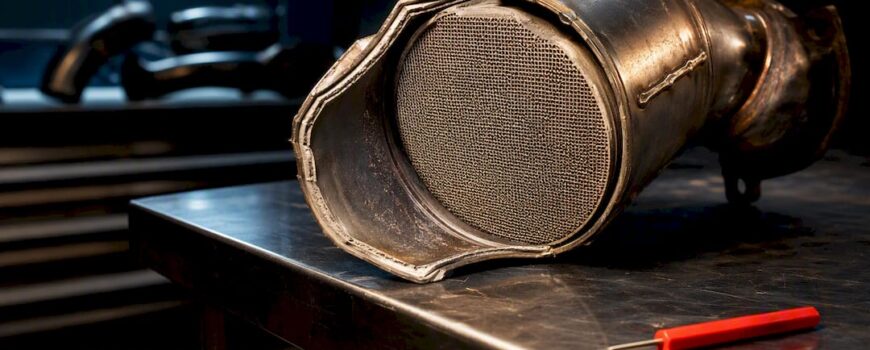
Most aftermarket high-flow catalytic converters last somewhere between 30,000 and 50,000 miles, compared to OEM units that are often engineered to run past 100,000. That’s a real gap, but it’s not fixed. Tune quality, driving style, and how well you control oil and coolant contamination swing that number more than the part itself does.
TL;DR:
- High-flow catalytic converters typically last between 30,000 and 50,000 miles, with lifespan heavily influenced by driving style, tune quality, and engine maintenance.
- Metallic substrates offer better thermal resistance than ceramic ones, which are cheaper but more brittle and prone to cracking under thermal shock.
- Failure modes include thermal shock, contamination, substrate breakage, fueling issues, and increased risk in boosted or track-driven cars, with early failure common under aggressive use.
- Proper tuning, avoiding lean conditions, allowing exhaust to cool gradually, and fixing oil or fuel issues can significantly extend high-flow cat longevity.
- Cost ranges from $200 to $700, with high-quality units offering better durability, especially for performance setups versus daily driven cars.
Table of Contents
- How Long Do High Flow Cats Last? What the Guides Report
- Why High Flow Cats Fail Early: The Real Failure Modes
- What Owners Actually Report: Real-World Mileage Variability
- Maintenance and Tuning Steps That Extend High-Flow Cat Life
- Signs Your High-Flow Cat Is Failing (and What to Check)
- What a High-Flow Cat Actually Costs (and What Warranty Coverage Looks Like)
- The Tuner’s Honest Take on Cat Longevity Trade-Offs
- Building an Exhaust System That Respects the Cat’s Limits
- Sources
- FAQ
How Long Do High Flow Cats Last? What the Guides Report
The 30,000 to 50,000 mile range gets cited a lot for a reason: it’s a fair midpoint across a wide field of aftermarket products, not a hard ceiling or floor. Some units die well before 30,000 miles. Others, paired with a clean-running engine and sane tuning, push past 70,000. The variance itself is the story, and it traces back to what’s actually inside the can.
OEM catalytic converters are designed to exceed 100,000 miles largely because manufacturers load them with more precious metal (platinum, palladium, rhodium) and build in more thermal mass to absorb heat cycling without cracking. Aftermarket high-flow units cut cost and increase flow by going the other direction: less dense substrate, often less catalyst loading, and sometimes thinner canning. That’s the trade you’re making when you bolt one on.
Substrate material matters just as much as loading. Metallic substrates resist thermal cracking better than ceramic honeycomb under the kind of rapid heat swings a track day or aggressive street tune produces. Ceramic substrates flow well and cost less, but they’re more brittle, and a hard enough thermal shock can fracture the core outright. That’s why two cats that look nearly identical on a spec sheet can have very different failure timelines.
Price tends to track quality here more honestly than in most car parts categories. There can be a wide price difference between catalytic converters, reflecting differences in build quality such as can thickness, catalyst loading, and substrate materials. The pricier one, especially from a brand that publishes flow and loading specs, is buying you margin against the exact failure modes covered below.
A few patterns show up consistently across technical write-ups and buyer guides:
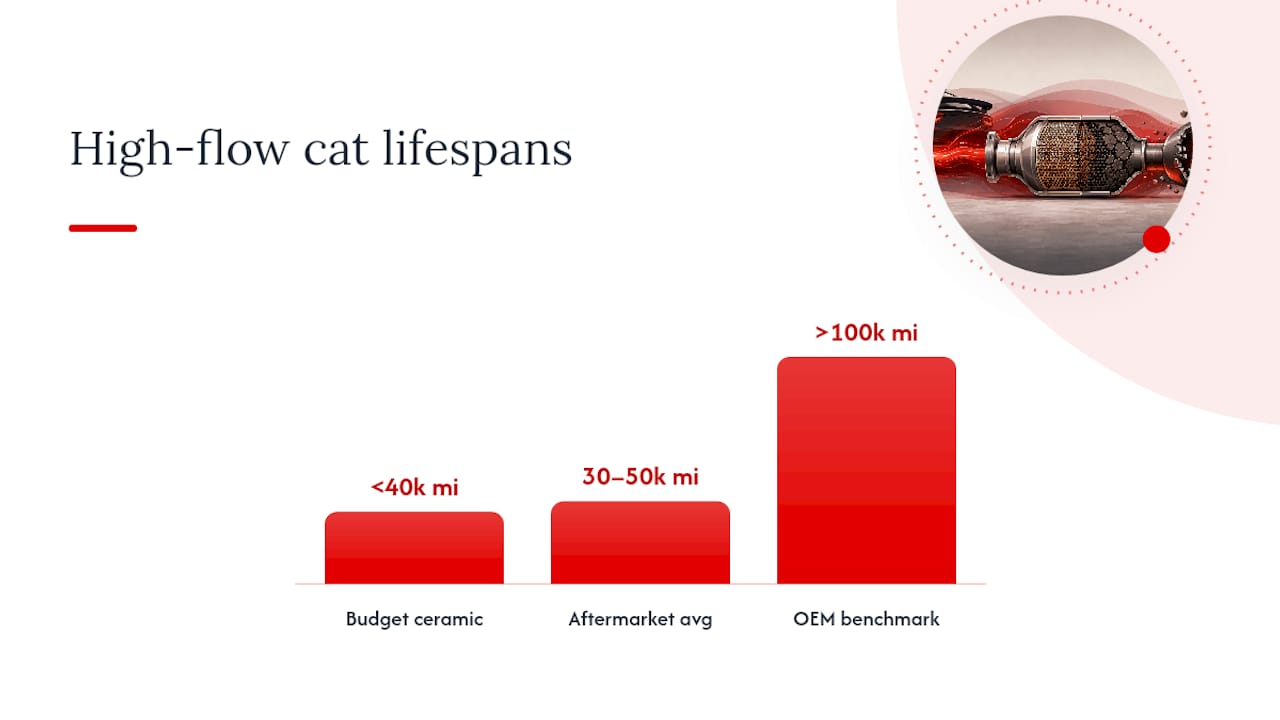
- Budget ceramic-substrate cats cluster at the low end of the lifespan range, often failing before 40,000 miles under hard use.
- Metallic-substrate units built for performance applications tend to hold up better under repeated heat cycling.
- High-flow cats gain their flow advantage from a less-dense honeycomb structure, which is the same design choice that reduces catalytic surface area and, in some cases, durability.
- Naturally aspirated applications typically see gains of roughly 5 to 15 horsepower from a high-flow cat swap, while turbocharged and supercharged setups tend to see larger gains, and correspondingly more thermal stress on the part.
The lifespan math in one line: aftermarket high-flow cats average 30,000 to 50,000 miles against an OEM benchmark north of 100,000, and the difference comes down to metal loading, substrate density, and how the car gets driven.
Why High Flow Cats Fail Early: The Real Failure Modes
Catalytic converters don’t usually die from one dramatic event. They die from repeated abuse that eventually adds up, and the paths to failure are pretty well understood by anyone who’s pulled a dead cat apart.
- Thermal shock. Running the engine hard, then shutting it down or cruising into cold air immediately after, stresses the substrate with rapid expansion and contraction. Do this enough times and a ceramic core can crack; a metallic one can fatigue and loosen inside its housing.
- Contamination and washcoat poisoning. Oil burning past worn rings or valve seals, coolant leaking through a failing head gasket, or even certain fuel additives can coat the catalyst’s active surface. Once the washcoat is poisoned, conversion efficiency drops permanently, no cleaning fixes it.
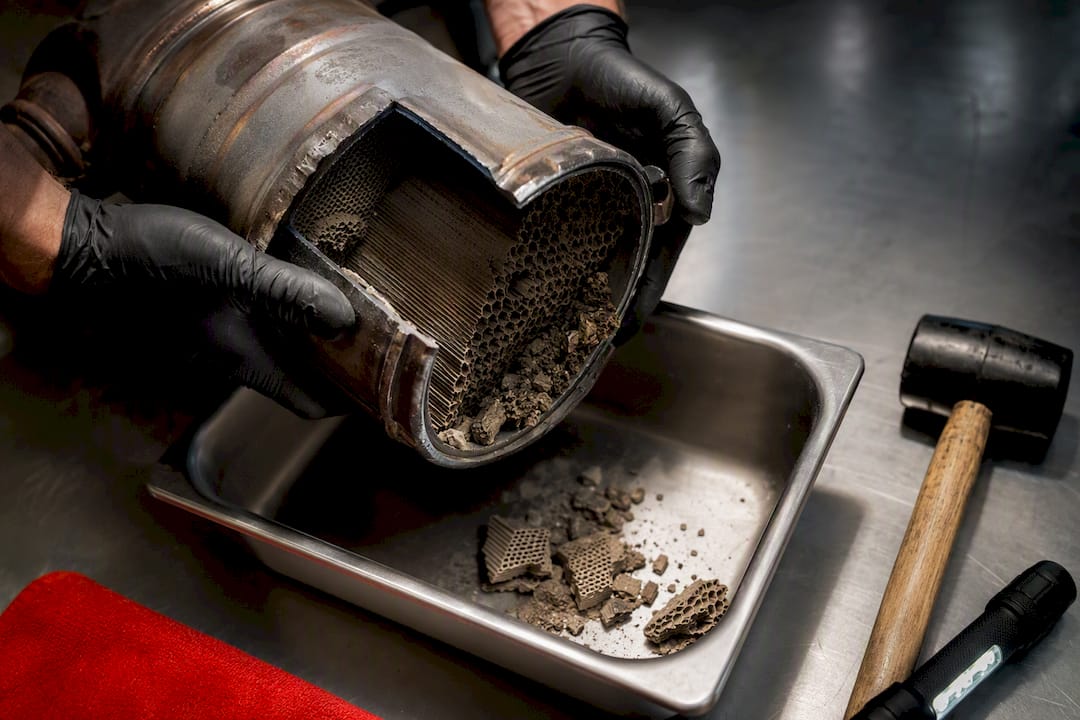
- Substrate breakage and mechanical failure. Vibration, impact from road debris, or a core that was never properly fixed inside its canister can cause the honeycomb to shift, crack, or partially collapse. This often shows up as a rattle long before the check engine light does.
- Fueling problems. A tune running lean under load pushes combustion temperatures up, which raises exhaust gas temperature and accelerates thermal aging of the cat. A tune running rich dumps unburned fuel into the exhaust stream, which can ignite inside the converter and cook the substrate from the inside.
- Boosted and track-driven cars carry more risk across the board. Higher exhaust gas temperatures, more frequent hard pulls, and more aggressive heat cycling all stack the odds against the converter compared to a mild naturally aspirated commuter.
Pro Tip: If you just picked up a used performance car with an aftermarket cat already installed, pull the freeze-frame data from the OBD port before you drive it hard. A history of rich or lean fuel trims tells you more about that cat’s remaining life than the mileage on the odometer ever will.
Fueling problems and thermal shock often show up together. A car that’s been chasing a lean condition under boost is also the car most likely to have seen repeated hard pulls followed by an abrupt cool down in the pit lane or the driveway. The two failure modes compound each other rather than acting independently.
What Owners Actually Report: Real-World Mileage Variability
Forum threads on catalytic converter life read like two entirely different conversations happening at once. Search Reddit, CorvetteForum, or Mustang6G threads on the topic and you’ll find owners reporting cat failure at 5,000 to 20,000 miles right alongside owners running the same part for 35,000 to 70,000 miles or more without issue. Both groups are telling the truth. They’re just describing different cars.
The pattern that emerges once you read enough threads:
- Boosted cars pushed hard on track days or regularly dyno tuned tend to cluster at the low end, often failing well under 20,000 miles.
- Track-focused builds with aggressive launch control or repeated hot laps see accelerated substrate fatigue from thermal cycling.
- Naturally aspirated cars with conservative, well-verified tunes routinely clear 40,000 to 60,000 miles on the same aftermarket cat that failed early on someone else’s boosted setup.
- Daily-driven cars with no major fueling issues and normal oil consumption sit comfortably in the higher end of the reported range.
Reading anecdotal mileage reports takes a little discipline. A single post saying “mine died at 8,000 miles” tells you almost nothing on its own, you need the context: was it boosted, was it tuned safely, was oil consumption an issue, was it tracked. A post with that context attached is genuinely useful. A post without it is just a data point with no denominator.
The honest takeaway for an individual reader: your car’s specific combination of power level, tune quality, and how you actually drive it matters more than any single mileage figure pulled from a forum thread. Two identical high-flow cats on two identical cars can have wildly different outcomes if one car spends its life on track and the other spends its life commuting.
Maintenance and Tuning Steps That Extend High-Flow Cat Life
Tune quality and engine health are the two biggest levers you actually control, and they matter more than which brand of cat you bought. A properly tuned engine running a mid-tier high-flow cat will often outlast a poorly tuned engine running a premium one.
- Keep air-fuel ratios in a safe range under load. Avoid sustained lean conditions, which spike exhaust gas temperatures and cook the substrate. Have a tuner verify wideband data rather than trusting a generic map.
- Watch your fuel trims and knock counts. Persistent negative long-term fuel trims or intermittent knock retard are early warning signs of a fueling or timing issue that will eventually stress the cat, catch them before they become a pattern.
- Let the exhaust cool gradually after hard runs. Giving the system a cool-down lap after a dyno pull or track session reduces the thermal shock that cracks ceramic substrates and loosens metallic ones.
- Fix oil consumption and misfires immediately. Worn valve seals, bad piston rings, or a misfiring cylinder dumping unburned fuel downstream will poison or overheat a cat faster than almost anything else on this list.
- Keep your O2 sensors healthy. A lazy or failing sensor feeds bad data to the ECU, which can push fueling out of range without throwing an obvious warning until the cat is already damaged.
- Choose your substrate material based on how you drive. If the car sees regular track time or aggressive tuning, a metallic-substrate high-flow cat is generally worth the extra cost over a ceramic one. If the car is a mild daily driver, a well-built ceramic unit or an OEM-style replacement may be the more sensible buy.
Pro Tip: Before you blame the cat for a check engine light, check your engine’s exhaust backpressure and overall exhaust health first. A restrictive or poorly matched exhaust system upstream can push heat and pressure into the converter in ways that have nothing to do with the cat’s own quality.
Signs Your High-Flow Cat Is Failing (and What to Check)
A rattling noise from underneath the car, especially on startup or over bumps, is one of the clearest early signs the substrate has come loose inside the canister. Don’t ignore it, a loose core tends to get worse fast, sometimes shedding pieces that clog the exhaust downstream.
A persistent check engine light tied to catalyst efficiency codes (commonly P0420 or P0430) means the O2 sensors are reporting the converter isn’t cleaning up exhaust gases the way the ECU expects. A sulfur or rotten-egg smell from the tailpipe often points to a rich condition overwhelming the catalyst’s capacity, which ties directly back to the fueling problems covered earlier. Noticeable loss of power or a car that feels like it’s breathing through a straw can mean the substrate has partially collapsed and is restricting flow rather than helping it.
Confirming any of this doesn’t require guesswork:
- Pull the actual diagnostic codes rather than assuming based on symptoms alone.
- Check O2 sensor data (upstream vs downstream readings) for evidence of reduced catalytic efficiency.
- Run an exhaust backpressure test if flow restriction is suspected.
- Physically inspect the converter for visible damage, loose mounting, or an audible rattle when tapped.
Roughly 30,000 to 50,000 miles is the honest window where a budget high-flow cat starts showing these symptoms. If you’re past that mark and hearing a rattle or seeing an efficiency code, replacement is almost always the right call. Cleaning or repair only makes sense for contamination-related efficiency loss caught early, not for mechanical substrate damage, which doesn’t reverse.
What a High-Flow Cat Actually Costs (and What Warranty Coverage Looks Like)
Aftermarket high-flow cats typically run $200 to $700, with most mid-market units landing around $500 to $700 before installation labor. Budget units under $250 usually mean thinner canning and lower catalyst loading, exactly the trade-offs that shorten lifespan.
Federal emissions warranty rules are worth understanding in general terms, but specifics vary by part and vehicle, so verify your own coverage rather than assuming a blanket standard applies. Aftermarket forums frequently reference a federal emissions warranty concept in the 5 year or 50,000 mile range when comparing coverage expectations, but treat that as a starting point for your own research, not a guarantee tied to any specific product you’re considering.
A few practical guardrails for the buying decision:
- If your car is a daily driver that needs to reliably pass emissions testing, a higher-quality unit or OEM-style replacement is usually the better long-term value even at a higher upfront cost.
- If the car is track-focused and you accept more frequent replacement as a cost of doing business, a budget high-flow unit paired with disciplined maintenance can make sense.
- Factor labor into the real cost. A cat swap on a car with a tight exhaust routing can add a meaningful chunk to the parts price.
The Tuner’s Honest Take on Cat Longevity Trade-Offs
A shorter-lived high-flow cat is worth it when the power gain actually matters to how you use the car: track days, boosted builds, cars built to be driven hard. It’s not worth it on a daily driver where reliability and inspection compliance matter more than a few extra horsepower. If you can’t commit to monitoring your tune and fuel trims, buy the more durable option. If you can, the trade-off is yours to make with open eyes.
— Info
Building an Exhaust System That Respects the Cat’s Limits
Flow versus emissions compliance isn’t a problem you solve by picking the cheapest cat and hoping. It’s solved by matching the right components to how you actually drive, which is exactly where a catted downpipe built for real-world compliance earns its keep. Some manufacturers build customizable valved exhaust systems and catted downpipes designed to balance flow gains against the thermal and fueling realities that determine how long a converter actually survives, rather than treating the cat as an afterthought bolted onto whatever pipe was cheapest.
An advantage over guessing your way through a generic aftermarket catalog is simple: components sold direct from authorized manufacturers, with compatibility data across Audi, BMW, Porsche, Ferrari, Lamborghini, Mercedes-AMG, and other performance platforms, so you’re not stacking mismatched parts and hoping the cat survives the combination. Browse the Down Pipe lineup for catted options built around flow and longevity, check the Exhaust Parts catalog for the rest of the system, and round out the install with Accessories like valve controllers. Talk to a tuner before you buy, confirm fitment for your exact model year, and place your order when you’re ready to build a setup that won’t sabotage the cat you just paid for.
Sources
For deeper technical detail beyond what’s covered here, the OEM vs. budget aftermarket catalytic converter breakdown and the high-flow catalytic converter performance guide both go further into substrate engineering. For part selection and fitment, the exhaust system anatomy guide and the common exhaust upgrade mistakes write-up cover ground this article didn’t.
- High Flow Catalytic Converter — Performance Guide 2026
- What Is A High Flow Catalytic Converter: Pros, Cons, Is It Worth It? – MotorVerso
FAQ
What Are the Drawbacks of High-Flow Cats?
They typically trade catalyst loading and substrate density for flow, which shortens expected lifespan to roughly 30,000 to 50,000 miles compared to over 100,000 for OEM units, and they can also draw scrutiny during emissions testing if they don’t meet local compliance standards.
How Much Horsepower Will a High-Flow Cat Add?
Naturally aspirated engines typically see gains of roughly 5 to 15 horsepower, while turbocharged and supercharged setups tend to see larger gains because reduced backpressure matters more under boost.
How Much Does a High-Flow Cat Cost?
Aftermarket high-flow cats generally run $200 to $700, with most mid-market units priced around $500 to $700 before installation labor. Current pricing for downpipes and exhaust components is listed directly on product pages.
Do High-Flow Cats Need a Tune?
Most performance applications benefit from a supporting tune to keep air-fuel ratios safe and avoid the sustained lean or rich conditions that accelerate cat failure. Skipping the tune doesn’t just risk power loss, it directly shortens the converter’s usable life.